 Maserati Biturbo
Specs, engines and history
Published Sources (1) Report an error
By Felix Hartmann, Automotive Technology & EV Contributor
- Built
- 1981–1994
- Top power
- 210 kW (286 PS)
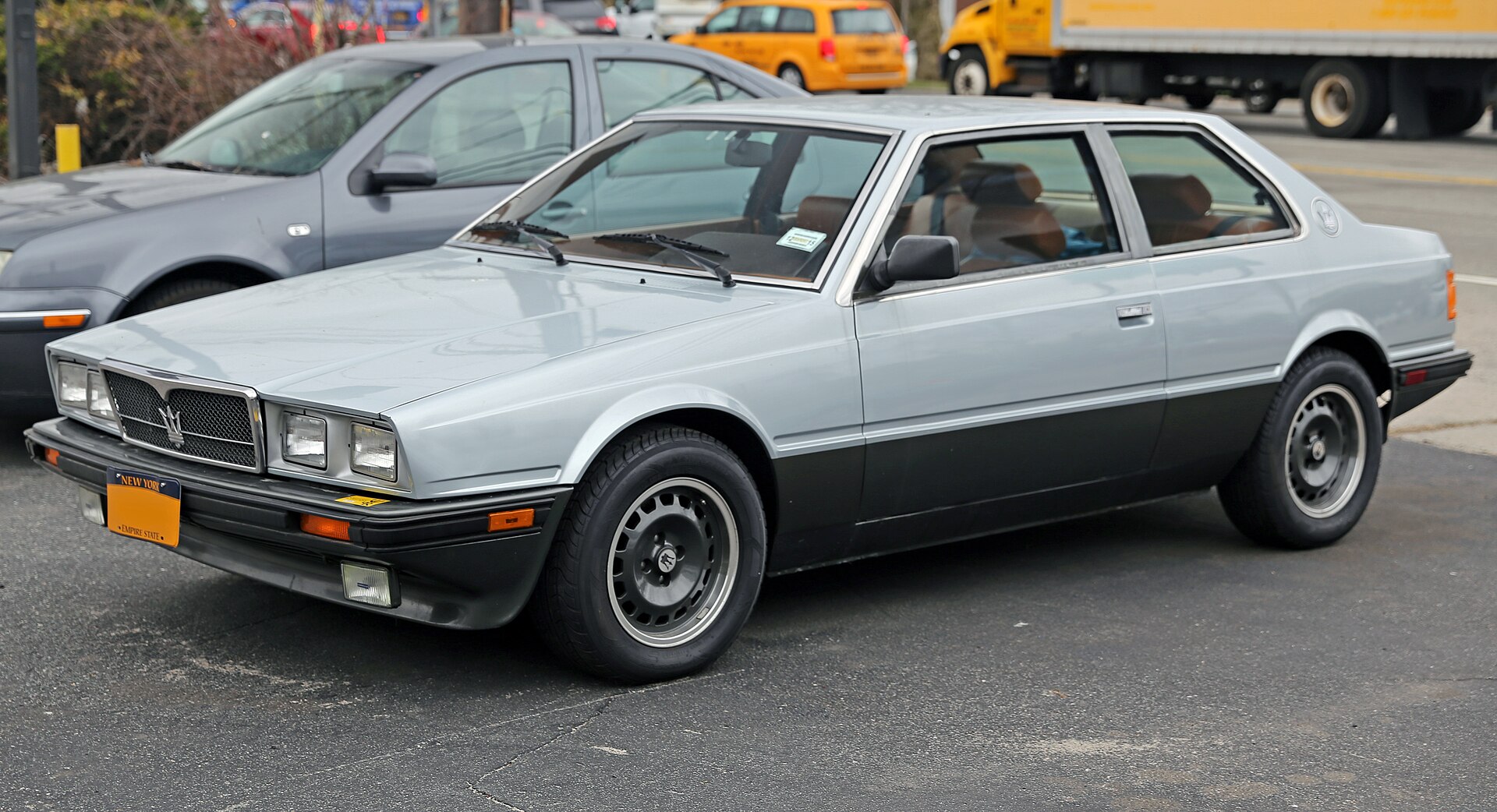
The Maserati Biturbo is a family of compact coupés, saloons and convertibles that Maserati built from 1981 to 1994. Introduced under the ownership of Alejandro de Tomaso, it was meant to bring the brand to new customers with a smaller, more affordable car. Its 90° V6 with two small turbochargers was described by Maserati as a world first for a production car. Sales were strong at first, but the car also gained a reputation for poor quality.
In short
- Original coupé introduced in December 1981; coupé, four-door saloon and Zagato Spyder versions built until 1994.
- Twin-turbo 90° V6 of 2.0, 2.5 or 2.8 litres, from 132 kW (180 PS) in the first coupé to 210 kW (285 PS) in the Racing of 1991.
- Wikipedia gives sales of about 40,000 at first; Maserati counts 11,919 cars of the 2.0-litre coupé alone.
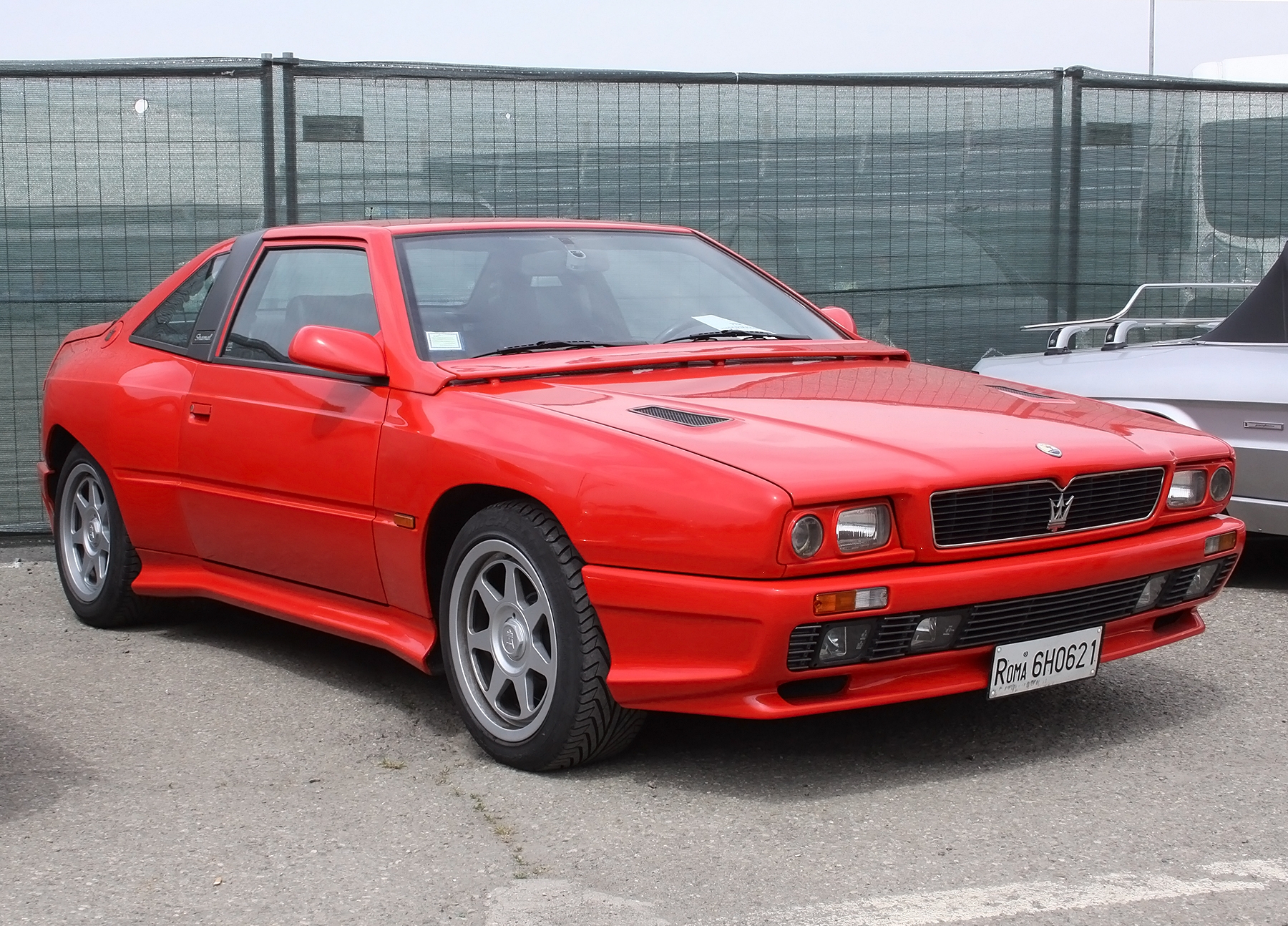
- The platform led to the Shamal, the Ghibli II, the Karif and the Quattroporte IV.
Maserati Biturbo at a glance
| Specification | Maserati Biturbo (coupé, Tipo AM331) |
|---|---|
| Production | 1981–1994 (whole family), Modena (Italy); Spyder bodies by Zagato |
| Body styles | two-door coupé, four-door saloon, 2+2 Spyder |
| Designers | Pierangelo Andreani (original); facelifts by Marcello Gandini; Spyder by Zagato |
| Engines | 90° V6 with two turbochargers: 1,996 cc, 2.5 and 2.8 litres |
| Power | 132 kW (180 PS) to 210 kW (285 PS) |
| Gearboxes | five-speed ZF manual; three- and four-speed automatics |
| Dry weight | 1,086 kg (2.0-litre coupé, Maserati) |
| Wheelbase | 2,514 mm (coupé); 2,400 mm (Spyder) |
| Top speed | 215–228 km/h for the 2.0-litre coupés (Maserati) |
| Successors | Ghibli II (coupé), Quattroporte IV (saloon) |
The Biturbo's descendants include the Maserati Ghibli name and the modern Maserati Quattroporte line. The full range is in the Maserati catalogue.
Development and launch
After buying Maserati in 1976, Alejandro de Tomaso wanted a model that was cheaper than the existing V8 cars but kept the prestige of the brand. The answer was the Biturbo, styled by Pierangelo Andreani, who led Maserati's design centre until 1981. Innocenti, another company in De Tomaso's group, produced body panels and handled final assembly.
Maserati presented the original two-door coupé in December 1981. It was a compact three-box car with four seats, a body type Maserati describes as a two-door, five-seat coupé. In the United States the Biturbo was sold from 1981 to 1990, with the last Spyders sold as 1991 models.

The twin-turbo V6
The engine is a 90° V6 with a small turbocharger for each bank. The first engines have three valves per cylinder, two for intake and one for exhaust, and a single overhead camshaft per bank. Later cylinder heads with four valves per cylinder followed.
Tax rules shaped the engine sizes. In Italy, cars with more than 2,000 cc paid a higher rate of VAT, so the home-market models used a 2.0-litre engine. Export versions received 2.5 litres and later 2.8 litres.
Fuel supply also changed over the years. The first cars used carburettors, a Weber DCNVH in 1984–85 and a Weber 34DAT in 1986. Weber-Marelli fuel injection appeared in 1986 and later became standard. Early intercoolers were water-to-air units from Spearco, and by late 1986 or early 1987 the factory moved them in front of the radiator.

Coupé versions from Biturbo to Racing
| Model | Years | Power |
|---|---|---|
| Biturbo | 1981–85 | 132 kW (180 PS) |
| Biturbo E / 2500 | 1983–85 | 136 kW (185 PS) |
| Biturbo S | 1983–86 | 151 kW (205 PS) |
| Biturbo i | 1986–90 | 138 kW (188 PS) |
| Biturbo Si | 1986–88 | 162 kW (220 PS) |
| 222 | 1988–90 | 162 kW (220 PS) |
| 222 E | 1988–90 | 184 kW (250 PS) |
| 2.24v | 1988–92 | 180 kW (245 PS) |
| 2.24v II | 1991–93 | 177 kW (240 PS) |
| 222 4v | 1991–94 | 205 kW (279 PS) |
| Racing | 1991–92 | 210 kW (285 PS) |
The years and outputs come from Wikipedia. The Biturbo S of 1983 added twin intercoolers fed by two NACA ducts on the bonnet, more boost, lower suspension and magnesium wheels. Maserati gives top speeds of 215 km/h for the original Biturbo, 221 km/h for the S, 220 km/h for the Biturbo i and 228 km/h for the Si.
In May 1988 the Biturbo name was dropped for the coupés, which became the 222. The 2.24v was the first model with wraparound bumpers. The Racing of 1991–92 was the most powerful two-door; according to Wikipedia, 230 were built, 173 of them for Italian customers.
Saloons: 425, 420 and 430
A four-door saloon used a wheelbase about 8.6 cm longer than the coupé and weighed about 100 kg more. The first was the 425 of 1983, with a 2.5-litre carburettor engine of 147 kW (200 PS). Two-litre 420 models served the Italian market. The flagship 430 of 1986 had the 2.8-litre engine and 165 kW (225 PS). Its 24-valve successor, the 430 4v, produced 206 kW (280 PS), and 291 were made. The 4.18v was the first Biturbo with standard ABS.
The 228 was a larger two-door coupé on the saloon's longer platform. Maserati lists 469 cars and a top speed of 235 km/h for the 2.8-litre version, which produced 184 kW (250 PS). Wikipedia gives a 0–100 km/h time of 5.6 seconds for European cars.

Spyder by Zagato and the Karif
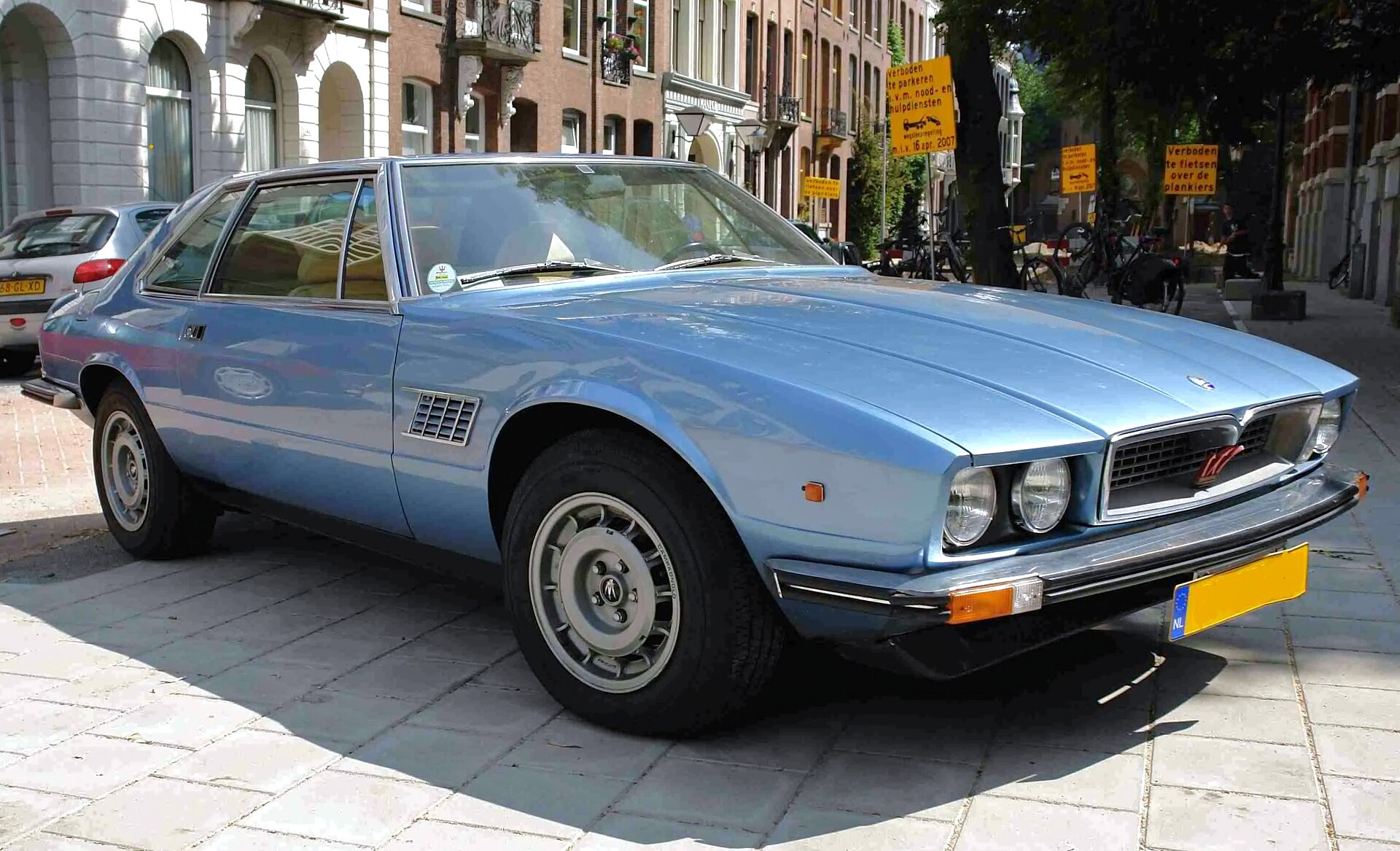
Zagato designed and built the body of the open Biturbo Spyder, which made its debut in Turin in 1984. Its wheelbase was shortened to 2,400 mm. The 24-valve 2.8-litre engine was never fitted to the Spyder, according to Maserati. Wikipedia counts 3,076 Spyders built over ten years, a record for open Maseratis. The Karif, a sporty closed car, was later built on the same short chassis.

Reliability and reputation
The Biturbo brought Maserati large sales at first, but its quality soon became a problem. Wikipedia describes the cars as known for poor quality and reliability, and sales fell as this reputation grew. The BBC series Crap Cars ranked it 28th, and in 2007 Time magazine included it in a list of the worst cars. De Tomaso later sold Maserati to Fiat, which grouped the brand with Ferrari.
In racing the Biturbo had little success. It entered the 1987 World Touring Car Championship and the 1988 European Touring Car Championship. The cars overheated until their carburettors were replaced with fuel injection.
Legacy
The Biturbo platform carried Maserati through the 1980s and into the 1990s. The two-door line ended with the Shamal and the Ghibli II, and the stretched saloon platform became the base of the Quattroporte IV with a 2.65 m wheelbase. Maserati's classic-car archive sums up the original aim: to attract new customers with a high-performance car at a competitive price.
Photo gallery


Maserati Biturbo in our rankings
- No. 278 of 912 · Longest-running car nameplates (13 years · top 32%)
- No. 457 of 859 · Most powerful cars (210 kW · top 54%)
- No. 84 of 127 · Most powerful Italian cars (210 kW · top 67%)
- No. 234 of 313 · Most powerful coupes (210 kW · top 75%)
In production longer than 68% of ranked nameplates in the 1CARS catalog (No. 278 of 912).
FAQ
What does "Biturbo" mean?
The name refers to the twin-turbocharged V6, with one small turbocharger for each cylinder bank. Maserati describes it as a world first for a production car.
Why did the Biturbo have a 2.0-litre engine in Italy?
Italy charged a higher rate of VAT on cars with engines over 2,000 cc, so home-market models used 2.0 litres and export models 2.5 or 2.8 litres.
How powerful is the Maserati Biturbo?
The first coupé of 1981 had 132 kW (180 PS). The most powerful two-door, the Racing of 1991, reached 210 kW (285 PS).
Which cars replaced the Biturbo?
The Ghibli II succeeded the coupés, and the Quattroporte IV, built on a stretched Biturbo saloon platform, succeeded the saloons.
Data sources
Data checked by an editor against the sources below.