 Marussia B1
Specs, engines and history
Published Sources (2) Report an error
By Oleksandr Hnatiuk, Automotive Editor & Used Car Specialist
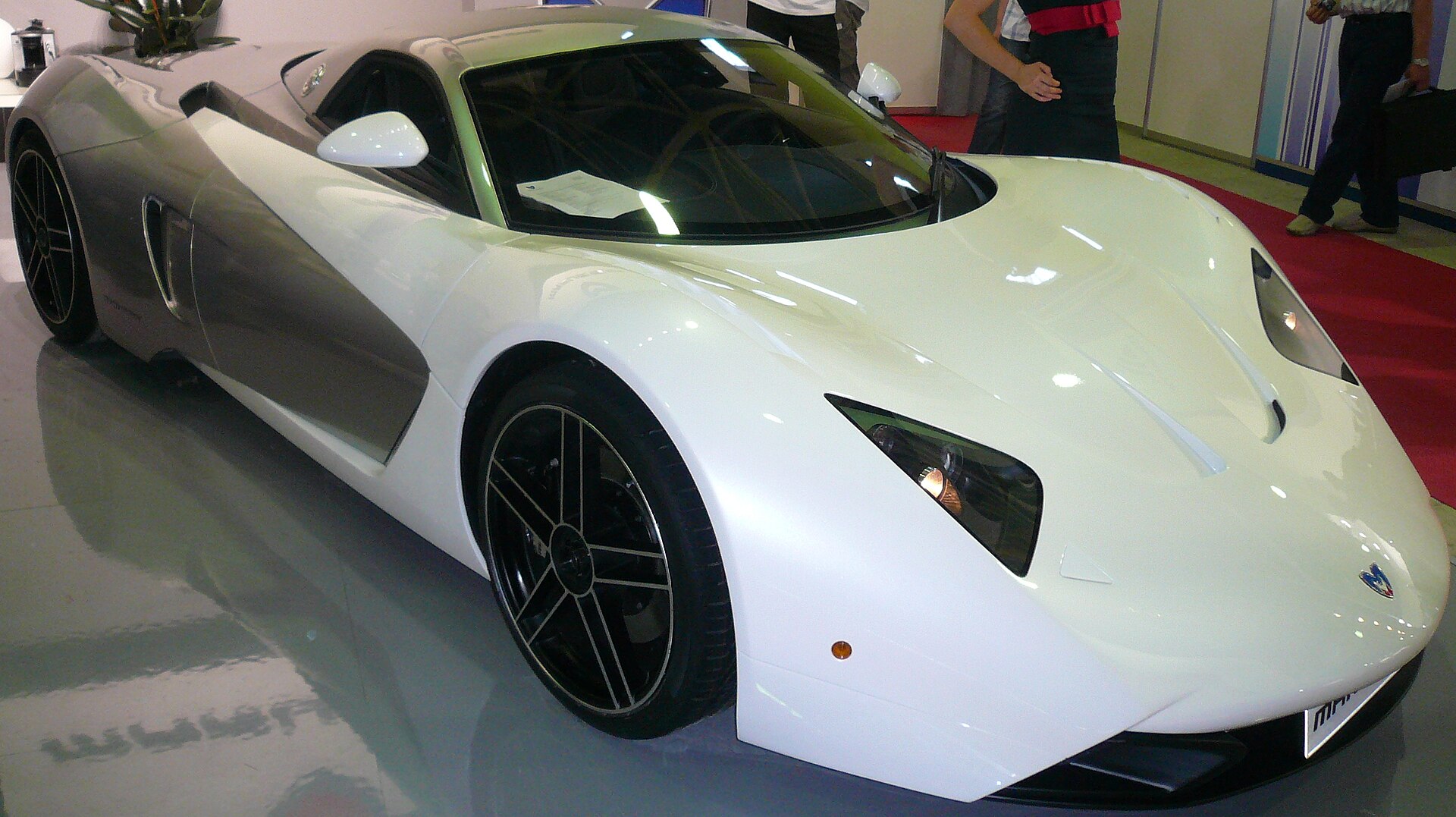
The Marussia B1 is a mid-engined two-seat coupé, the first car of the sports-car maker Marussia Motors. Presented in 2008, a year after the company was founded, it combined an aluminium chassis and a carbon-fibre body with V6 engines developed by the British engine specialist Cosworth. A more aggressively styled sister model, the B2, followed in 2009. The company had large plans, but only a small number of cars was built before it closed in 2014.
In short
- Presented in 2008; shown in London in February 2011 alongside the Formula One car of Marussia Virgin Racing.
- Cosworth V6 engines: 3.5-litre naturally aspirated with 224 kW (300 bhp), or 2.8-litre turbo with 268 kW (360 bhp) or 313 kW (420 bhp) (evo).
- Aluminium semi-monocoque with tubular spaceframes, carbon body panels, about 1,100 kg; six-speed automatic with paddles.
- Claimed 0–100 km/h in 3.2 s and 305 km/h (Wikipedia); Autoblog.it reports only about twenty B-Series cars built.
Marussia B1 at a glance
| Specification | Marussia B1 |
|---|---|
| Presented | 2008 |
| Company | Marussia Motors, founded 2007 by Nikolay Fomenko; closed 2014 |
| Body | two-door, two-seat coupé, carbon-fibre panels |
| Chassis | aluminium semi-monocoque with front and rear tubular spaceframes |
| Engines | Cosworth V6: 3.5 litres naturally aspirated; 2.8 litres turbocharged |
| Power | 224 kW (300 bhp); 268 kW (360 bhp); 313 kW (420 bhp) |
| Torque | about 409 Nm, 519 Nm and 599 Nm (evo) |
| Gearbox | six-speed automatic with paddle shifters, rear-wheel drive |
| Weight | about 1,100 kg |
| Performance | 0–100 km/h 3.2 s and 305 km/h (Wikipedia) |
| Sister model | Marussia B2 (2009) |
The company behind the car is described in our history of Marussia Motors, and the brand's models are listed in the Marussia catalogue.
A new sports-car maker
Marussia Motors was founded in 2007. evo names Nikolay Fomenko as its founder. The B1 was the first car of the young company and the first of what it called the B-Series. According to Autoblog.it, it was presented in 2008, one year after the company had been set up.
The project quickly became international. In 2010 Marussia bought a stake in the Virgin Racing Formula One team, which later raced as the Marussia F1 Team. In February 2011 the B1 was shown in London at the launch of the Marussia Virgin Racing F1 car at BBC Television Centre, and evo reported on it from there.
Design and body
The B1 is a low two-seat coupé with its engine behind the cabin. evo describes a clean body shaped with computational fluid dynamics and without wings or large spoilers. The panels are made of carbon composite, which helps to keep the weight down. AUTO BILD, which tested an early car, mentions electrically operated gullwing-style doors, slim centre-lock wheels and decent panel gaps for a pre-production car.
Wikipedia describes the B-Series as a full carbon-fibre body on an aluminium chassis. evo gives more detail: an aluminium semi-monocoque tub with tubular spaceframes at the front and the rear.


Cosworth engines and performance
All engines were supplied by Cosworth. evo lists three versions:
| Version | Engine | Power | Torque |
|---|---|---|---|
| B1 base | 3.5-litre V6, naturally aspirated | 224 kW (300 bhp) | about 409 Nm |
| B1 turbo | 2.8-litre V6 turbo | 268 kW (360 bhp) | about 519 Nm |
| B1 turbo | 2.8-litre V6 turbo | 313 kW (420 bhp) | about 599 Nm |
Wikipedia lists the B1 with 268 or 313 kW from a 2.8-litre engine, with torque of 410 Nm or 600 Nm at 4,000 rpm. A six-speed automatic gearbox with paddle shifters drives the rear wheels. AUTO BILD writes that the gearbox came from the Renault-Nissan parts range.
With about 1,100 kg and 313 kW, the strongest B1 has a power-to-weight ratio of about 285 kW per tonne. evo notes that this put it slightly ahead of the Ferrari 458 Italia of the time.
The performance claims differ. According to Wikipedia, the B1 needs 3.2 seconds to reach 100 km/h and can do 305 km/h. evo quoted a claimed 0–62 mph time of 3.8 seconds, which it called "extremely optimistic", and a top speed of 155 mph.

Cabin and technology
The interior was designed around screens. evo mentions an infotainment touchscreen powered by an Intel Core 2 Duo processor, and three cameras that help with low-speed manoeuvring and can record a journey. Headroom is tight for drivers taller than about 1.83 m. AUTO BILD describes a digital central display, a rear-view camera and seats that are sporty but comfortable. It praised the ergonomics and the space but criticised the feel of some materials.
A hydraulic suspension was being developed with the German specialist KW. It could raise the front of the car by a few centimetres when needed. ABS and ESP were fitted, so the B1 had the usual electronic safety aids of a modern road car.

First drive impressions
In May 2010 AUTO BILD drove a pre-production B1 in Monaco. The tester found that it handled well, with direct steering. The engine sounded aggressive, responded well to the throttle and had strong pull. Rattles revealed that the car was not yet finished, and the overall impression was still a little rough. The magazine concluded that the car needed fine-tuning but that the new maker was a serious contender. At the time, 15 test cars were in use and series production was planned for mid-2010.
The B2 sister model
Frankfurt saw the first B2 at its 2009 motor show. Technically it is almost identical to the B1, and Wikipedia calls the differences "only cosmetic". The B2 has a more aggressive design with a black grille and intakes and a front face shaped like the "M" of the Marussia logo, and its interior has a more futuristic look. In March 2012 the Finnish contract manufacturer Valmet Automotive agreed to build B2s at its plant in Uusikaupunki.

Production and the end of Marussia Motors
The plans were ambitious. Wikipedia says that Marussia intended to build 2,999 B1s, and Autoblog.it mentions plans for about 3,000 to 3,500 B-Series cars in total. The reality was very different: according to Autoblog.it, only about twenty B-Series cars were made. Marussia Motors officially ceased operations in 2014. The Formula One team raced for one more season.
The B1 and B2 also reached a wider audience through video games. They appear in Need for Speed: Most Wanted (2012), Need for Speed Rivals and Asphalt 8: Airborne, and a Marussia appeared on the cover art of Driveclub in 2014.
Marussia B1 in our rankings
In production longer than 31% of ranked nameplates in the 1CARS catalog (No. 569 of 912).
FAQ
What engine does the Marussia B1 have?
V6 engines developed by Cosworth: a 3.5-litre naturally aspirated unit with 224 kW (300 bhp), or a 2.8-litre turbo with 268 kW (360 bhp) or 313 kW (420 bhp).
How fast is the Marussia B1?
Wikipedia gives 0–100 km/h in 3.2 seconds and 305 km/h. evo quoted a claimed 155 mph and called the acceleration claim very optimistic.
What is the difference between the B1 and B2?
The two cars share their engines, chassis, suspension and brakes; the B2 has a more aggressive body and interior design.
How many Marussia B1s were built?
Marussia planned 2,999 B1s, but Autoblog.it reports that only about twenty cars of the whole B-Series were actually produced.
Data sources
Data checked by an editor against the sources below.
- Wikipedia - Marussia B1
- Wikipedia - Marussia Motors