Marussia: History of the Supercar Maker and Its Formula 1 Team
Marussia Motors was a small Russian sports-car maker, founded in 2007, that built the B1 and B2 coupés and lent its name to a Formula 1 team from 2011 to 2014. Only about 48 road cars are usually said to have been built. The car company wound down in 2014, the same year the racing team entered administration.

Key takeaways
- Founded in 2007; the first car, the B1, was shown in December 2008 and the B2 followed at the Frankfurt Motor Show in September 2009.
- Production stayed tiny: about 48 cars in total, roughly 20 B1 and the rest B2, against plans for thousands.
- The Formula 1 entry began as Virgin Racing in 2010 and raced under the Marussia name from 2011 to 2014, scoring its only points at Monaco in May 2014.
- The car company dismissed its staff in April 2014; the team ceased trading in November 2014 and returned in 2015 as Manor Marussia.

Marussia Motors at a glance
Marussia Motors was a low-volume supercar start-up rather than an established carmaker, and both of its businesses, road cars and Formula 1, had closed or changed hands by early 2015. The basic facts, as far as the available sources agree:
| Fact | Value |
|---|---|
| Founded | 2007 |
| Co-founders | Nikolay Fomenko and Andrey Cheglakov (other partners are named differently by different sources) |
| Country | Russia |
| Road cars | B1 (shown 2008), B2 (shown 2009); F2 off-roader (prototype only, 2010) |
| Engine partner | Cosworth |
| Cars built | About 48, usually quoted as roughly 20 B1 and the rest B2 |
| Staff | More than 300 (2010) |
| Formula 1 | Name partner and later owner of the former Virgin Racing team, 2011–2014 |
| Status, October 2026 | No longer active; no cars in production |
Founders and the plan for a home-grown supercar
Marussia was set up with one aim: to build a Russian-made supercar and sell it internationally. The company is usually dated to 2007. Nikolay Fomenko is the founder named by every source, and Andrey Cheglakov appears alongside him in both the English and German accounts. Beyond those two, the lists of co-founders differ, so this article does not repeat them.

The approach was typical of boutique sports-car start-ups: a small in-house team, a two-seat coupé with a light body structure, and engine work bought in from a specialist. Marussia turned to Cosworth, the British engine company better known for racing, for its powerplants. Showrooms abroad were planned for 2011.
The same template had been tried before by other small makers. Pagani in Italy and Spyker in the Netherlands also built low-volume supercars around engines from outside suppliers, with very different results.
From B1 to F2: the road-car years, 2007–2014
Marussia's road-car business lasted about seven years, from founding to the dismissal of its staff in April 2014. In that time it presented three models and put two of them into small-scale production.

2007–2008: founding and the B1
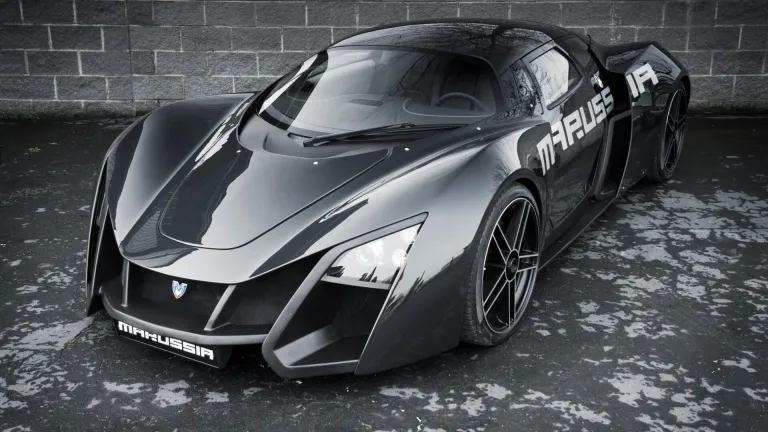
The first prototype, the B1, was unveiled in December 2008; the German-language record gives the date as 16 December. It was a two-seat sports coupé and set the template for the cars that followed. According to the company, the original plan was to build 2,999 examples of this first car.
2009–2010: the B2 at Frankfurt and the F2 prototype
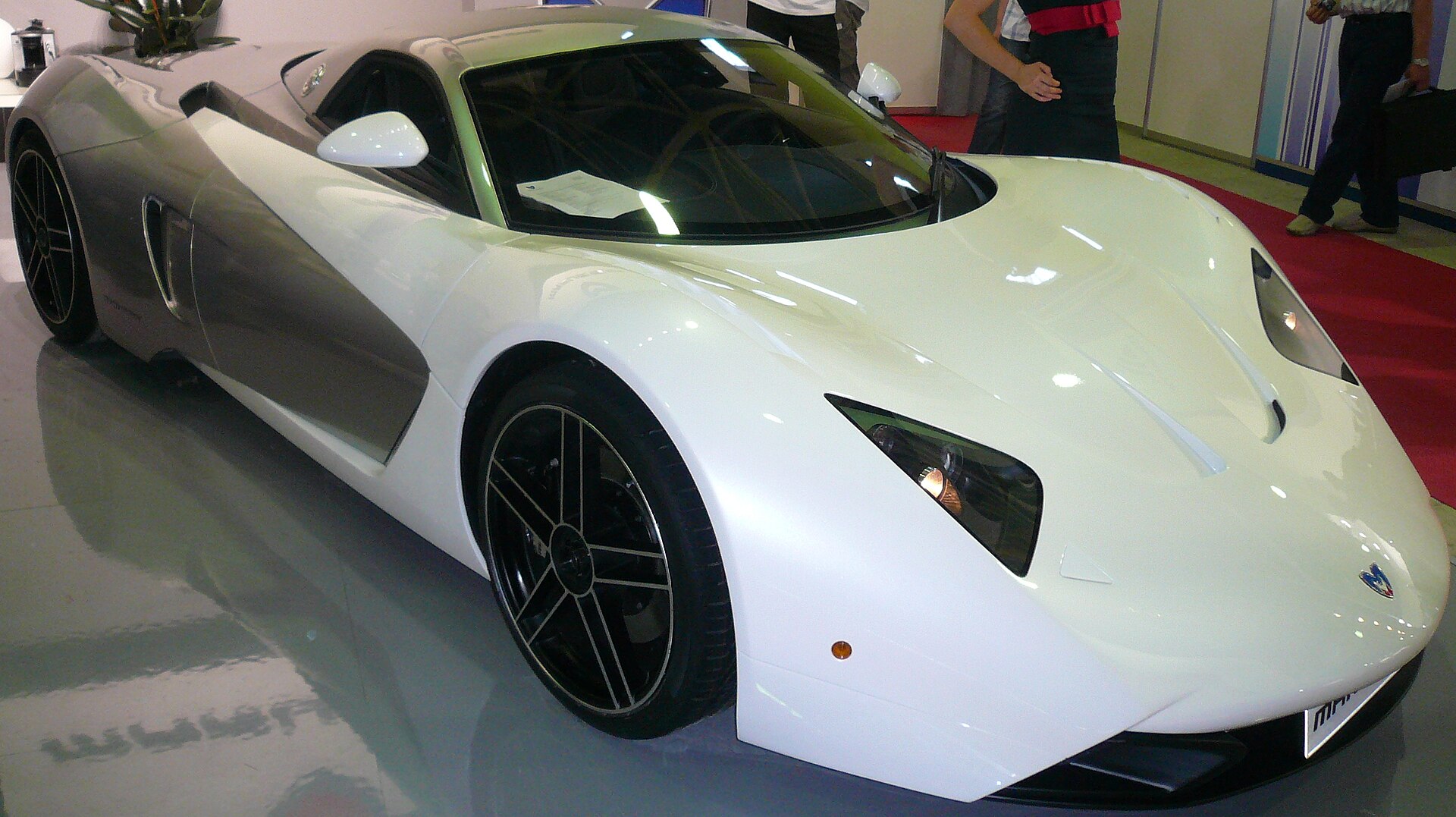
The B2 was first shown at the Frankfurt Motor Show in September 2009. It kept the two-seat coupé format of the B1 and became the model most people associate with the name. Its construction is described as carbon-fibre bodywork on an aluminium chassis. When it was announced, a starting price of around EUR 100,000 was reported, although figures of up to EUR 185,000 also appear in the sources, so the planned price is best treated as approximate.
In spring 2010 Marussia showed the F2, a large off-road vehicle that shared the brand's styling. Sources disagree on the exact date of its first showing (March or May 2010). Reports at the time spoke of a run of 300 units to be built by Valmet Automotive in Finland from 2012, but the F2 never reached production.
The company opened its first showroom in September 2010 and by then employed more than 300 people.
2011–2014: low-volume output and the wind-down
The road-car side never reached the scale its founders had planned. Plans quoted at different times ranged from 2,999 units of the first car to around 3,000 cars a year, but the total usually given for the whole seven years is about 48 cars, roughly 20 B1 and the remainder B2. A French-language reference goes further and describes the B1, B2 and F2 as prototypes that never reached series production. In April 2014 the company dismissed its staff and, according to the German-language account, filed for insolvency. One encyclopedia entry dates the formal end of the company to 2015.
B1, B2 and F2: the cars that carried the name
The three Marussia models were all built around the same idea: a light two-seat coupé (or, for the F2, an off-roader) with Cosworth engineering. The Marussia B2 has its own page with catalogue data.

| Model | Years | Why it matters |
|---|---|---|
| B1 | Shown December 2008; built in small numbers | The first Marussia; about 20 built |
| B2 | Shown September 2009 (Frankfurt); built in small numbers | The best-known Marussia and the bulk of the roughly 48 cars made |
| F2 | Prototype, 2010 | Off-road vehicle planned for 2012 production with Valmet Automotive; never built in series |
What the published figures say
Published technical data for the B-series do not agree, and none of the figures could be checked against an independent road test. The engines are described as Cosworth-tuned V6 units, but the details differ by source: one account lists a 2.8-litre turbocharged V6 rated at 268 or 313 kW (360 or 420 hp) and a 3.5-litre naturally aspirated V6 with 221 kW (300 hp); another gives a 3.5-litre V6 with 309 kW; a third says the B2 used an engine of Opel origin.
Performance claims vary in the same way. The 0–100 km/h (0–62 mph) time is given as anything from 3.2 to 3.8 seconds, and claimed top speeds range from 250 to 310 km/h (155 to 193 mph). The often-repeated kerb weight of 1,100 kg (2,425 lb) and dimensions of about 4,635 mm (182.5 in) long and 2,000 mm (78.7 in) wide are also manufacturer claims. With so few cars built, there is no large body of owner or test data to settle these questions.
From Virgin Racing to Marussia F1: five seasons on the grid
For most people outside the car world, Marussia is the name of a Formula 1 team rather than a car. The team began as Manor Grand Prix, a joint project of Manor Motorsport and Wirth Research that was granted a place on the 2010 grid in 2009. It raced its first season as Virgin Racing and finished 12th and last among the constructors.
In November 2010 Marussia Motors bought a major stake in the team. Sources describe the holding as either a controlling or a significant stake, and the German account dates a full takeover to 2012. The team raced as Marussia Virgin Racing in 2011, took the name Marussia F1 Team for 2012 and was based in Oxfordshire, England, from 2012 to 2014.
| Season | Entry name | Constructors' result | Notes |
|---|---|---|---|
| 2010 | Virgin Racing | 12th (last) | First season, before the Marussia stake |
| 2011 | Marussia Virgin Racing | Last | First season under the Marussia name |
| 2012 | Marussia F1 Team | 11th, 0 points | Timo Glock and Charles Pic; dropped from 10th after the Brazilian Grand Prix |
| 2013 | Marussia F1 Team | 10th, 0 points | Jules Bianchi and Max Chilton |
| 2014 | Marussia F1 Team | 9th, 2 points | Bianchi 9th at Monaco; missed the last races in administration |
| 2015 | Manor Marussia F1 Team | 10th, 0 points | Will Stevens and Roberto Merhi; renamed Manor Racing for 2016 |
Monaco 2014 and the Japanese Grand Prix
The team's best day came at the Monaco Grand Prix on 25 May 2014, when Jules Bianchi finished ninth. Those two points were the first and only ones scored under the Marussia name, and they were enough for ninth place in the constructors' championship.
Its worst came on 5 October 2014, when Bianchi crashed at the Japanese Grand Prix and was seriously injured. He died of his injuries in July 2015.
Stakes, administration and the Manor revival
The racing team outlived the car company by several months and then went through a formal insolvency process. A notice of intention to appoint administrators was filed on 7 October 2014. On 25 October the team said it would miss the United States Grand Prix, and it also missed the race in Brazil. Administrators issued their statement on 27 October, and the team ceased trading on 7 November 2014.
An auction of the team's assets was planned for mid-December 2014 but was cancelled on 19 January 2015 so that a buy-out could go ahead. On 19 February 2015 the team left administration as Manor Marussia F1 Team, now based in South Yorkshire. It finished the 2015 season tenth without points and was renamed Manor Racing in 2016, ending the use of the Marussia name in Formula 1.
The road-car business had no such rescue. After April 2014 there was no further production, and as of October 2026 nothing is built under the Marussia name. Few companies have managed to combine a road-car business with a Formula 1 team, and the best-known example, McLaren, raced for decades before it built road cars in series; Marussia tried to start both within a few years.
Marussia line-up: no current models
Marussia has no current line-up; all of its cars are historic. The table lists everything the company presented, and the Marussia catalogue page on 1cars collects the available data.
| Model | Segment | Body | Years |
|---|---|---|---|
| B1 | Sports car | Two-seat coupé | Shown 2008; low-volume production |
| B2 | Sports car | Two-seat coupé | Shown 2009; low-volume production |
| F2 | Off-road vehicle | SUV (prototype) | Shown 2010; not produced |
Marussia timeline
| Year | Event |
|---|---|
| 2007 | Marussia Motors founded |
| 2008 | B1 prototype unveiled (December) |
| 2009 | B2 shown at the Frankfurt Motor Show (September); Manor Grand Prix granted a 2010 Formula 1 entry |
| 2010 | F2 off-road prototype shown (spring); first showroom opens (September); Virgin Racing's first season; Marussia buys a major stake in the team (November) |
| 2011 | Team races as Marussia Virgin Racing; renaming to Marussia F1 Team announced on 31 December |
| 2012 | Marussia F1 Team finishes 11th; German account dates the full takeover to this year |
| 2013 | 10th in the constructors' championship |
| 2014 | Car company dismisses staff (April); Bianchi scores two points at Monaco (25 May); Bianchi's accident in Japan (5 October); team in administration (27 October), ceases trading (7 November) |
| 2015 | Auction cancelled (19 January); team leaves administration as Manor Marussia F1 Team (19 February); Bianchi dies (July) |
| 2016 | Team renamed Manor Racing |
Marussia in numbers
The numbers behind Marussia are small, which is part of its story:
- About 48 road cars built in seven years, roughly 20 B1 and the rest B2.
- 2,999 units planned for the first model alone.
- More than 300 employees in 2010.
- 3 models presented: B1, B2 and the F2 prototype.
- 4 Formula 1 seasons under the Marussia name (2011–2014), plus one as Manor Marussia in 2015.
- 2 championship points, scored at Monaco in 2014.
- 9th, the team's best constructors' result, in 2014.
Older cars from other makers, grouped by decade, are in the classics section of 1cars.
FAQ
Who founded Marussia?
Marussia Motors was co-founded in 2007 by Nikolay Fomenko and Andrey Cheglakov. Sources name further partners differently, so only these two are consistently recorded as founders.
How many Marussia cars were built?
About 48 cars are usually quoted for the company's seven-year life, roughly 20 B1 and the rest B2. The F2 off-roader remained a prototype, and plans for thousands of cars were never realised.
What engine did the Marussia B2 use?
The B2 used a V6 developed with Cosworth, but sources disagree on the details. Figures quoted range from a 3.5-litre naturally aspirated V6 with 221 kW (300 hp) to a 2.8-litre turbocharged V6 with up to 313 kW (420 hp).
Why did the Marussia F1 team close?
The team entered administration in October 2014, missed the last races of the season and ceased trading on 7 November 2014. A planned asset auction was cancelled in January 2015 when a buy-out was agreed.
Is Manor the same team as Marussia?
Yes. The team that raced as Virgin Racing and Marussia left administration on 19 February 2015 as Manor Marussia F1 Team and was renamed Manor Racing in 2016. Its roots go back to Manor Grand Prix, which won the 2010 entry.
When did Marussia Motors close?
The car company dismissed its staff in April 2014, months before the racing team's administration. One encyclopedia entry gives 2015 as the formal end date.