
 Marussia B2
Specs, engines and history
Updated Published Sources (3) Report an error
By Felix Hartmann, Automotive Technology & EV Contributor Reviewed by Oleksandr Hnatiuk

- Built
- 2009–2014
- Top power
- 309 kW (420 PS)
The Marussia B2 is a two-door, mid-engine, rear-wheel-drive coupé built in Russia by Marussia Motors, a company founded in 2007. It was unveiled at the Frankfurt Motor Show in September 2009 with V6 engines from 221 to 309 kW. A Finnish production deal followed in 2012, but series production is not reported to have started before the maker shut down in April 2014.
In short
- Mid-engine, rear-wheel-drive coupé with a six-speed automatic gearbox and paddle shifters.
- Engines: a 3.5-litre V6 with 221 kW (300 PS) or a Cosworth 2.8-litre twin-turbo V6 with 265 kW (360 PS) or 309 kW (420 PS).
- About 1,100 kg (2,425 lb), with an aluminium frame and composite body panels.
- Valmet Automotive agreed in March 2012 to build it in Finland; Marussia Motors closed in April 2014.

Specs by version
Engines
Dimensions and weight
Show all 2 versions
| Version | Width | Kerb weight |
|---|---|---|
| 3.5 221 kW (300 PS) Coupe | 1,400 mm55.1 in | 850 kg1,874 lb |
| 2.8 309 kW (420 PS) Coupe | 1,400 mm55.1 in | 850 kg1,874 lb |
Verified Manufacturer and type-approval data from our catalog · Sources and methodology
What the Marussia B2 is
The Marussia B2 is the second road car of Marussia Motors, a small-volume sports car maker led by its president, the racing driver Nikolai Fomenko, with co-founders Andrey Cheglakov and Libor Haluza. The company was set up in 2007 and launched its first model, the B1, in December 2008.
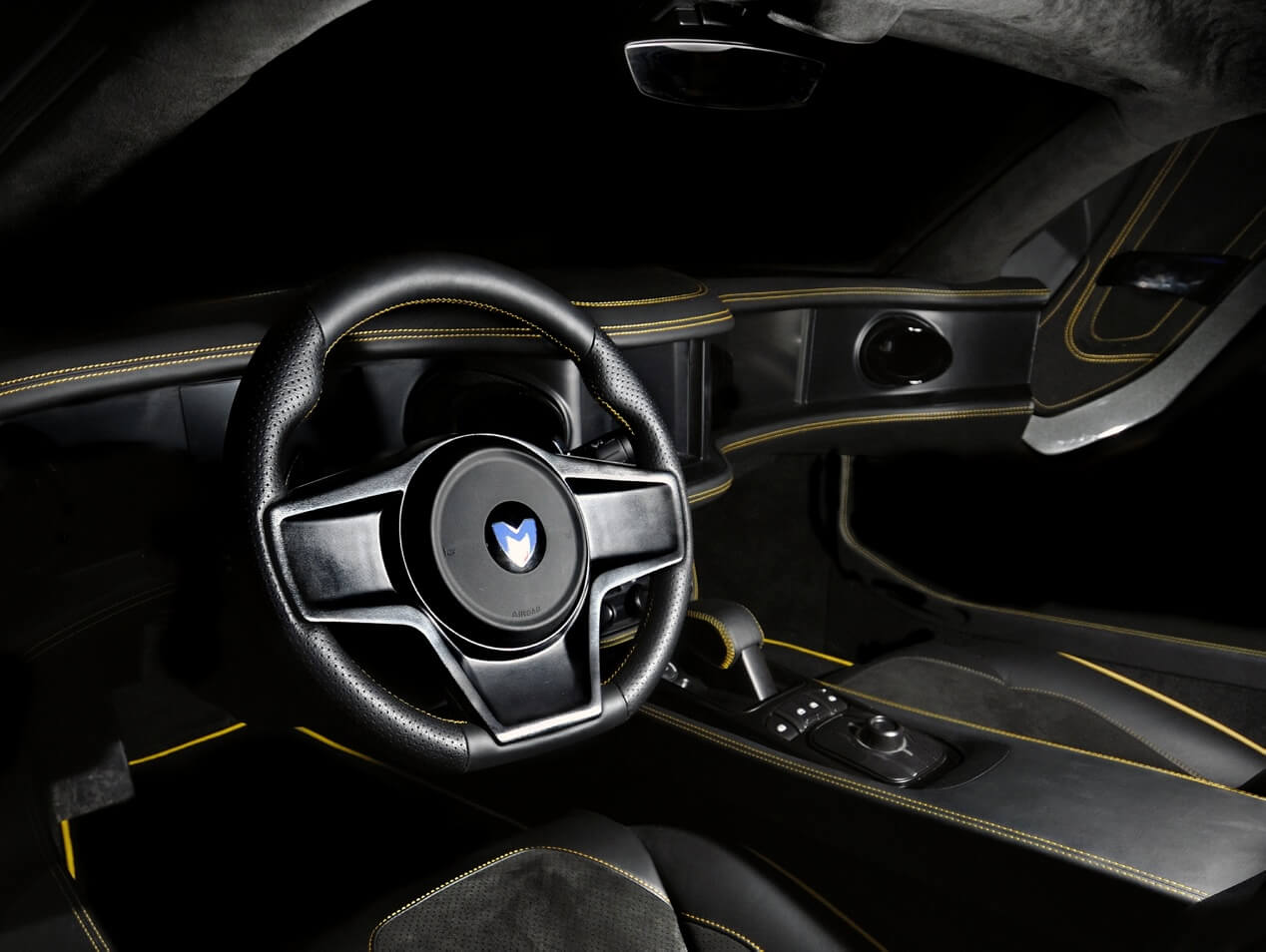
The B2 made its debut at the International Motor Show (IAA) in Frankfurt in September 2009. Marussia billed it as the first supercar from its home country, a claim repeated in English-language coverage, though it is a marketing label rather than a verified record. Auto Revue reports that two B2s appeared alongside two B1s at Top Marques Monaco in 2010, and that the brand opened a showroom in Monaco in May 2012.
For the wider background, see the history of Marussia Motors, which covers the company from its founding to the F1 years.
Marussia B1 and B2: what differs
The B1 and B2 are technically similar cars that differ mainly in design. They share the mid-engine layout, the chassis concept and the engine range. The B2 has a more aggressive, angular front end whose shapes echo the "M" of the Marussia logo, while the B1 is the softer-looking of the two. Both sit in the Marussia model range, which did not grow beyond these two coupés and an SUV prototype.
Engines, gearbox and performance
The B2 was offered with three V6 engines: one naturally aspirated 3.5-litre unit and a Cosworth 2.8-litre twin-turbo in two states of tune. All three sit behind the cabin and drive the rear wheels through a six-speed automatic with paddle shifters. A manual gearbox was reported to be in development but does not appear in any confirmed specification.

| Engine | Output | Torque |
|---|---|---|
| 3.5-litre (214 cu in) V6, naturally aspirated | 221 kW (300 PS) | 410 Nm (302 lb-ft) |
| Cosworth 2.8-litre (171 cu in) twin-turbo V6 | 265 kW (360 PS) | 520 Nm (384 lb-ft) |
| Cosworth 2.8-litre (171 cu in) twin-turbo V6 | 309 kW (420 PS) | 600 Nm (443 lb-ft) |
Cosworth, the British engine specialist, supplied the turbocharged V6. One English Wikipedia article says the engine came from Opel. The German article, GTspirit and the Czech magazine Auto Revue all name Cosworth, so the Opel line is best treated as an error.
The 309 kW (420 PS) car reaches 100 km/h from rest in 3.8 seconds, a figure given by both Auto Revue and Wikipedia. A quicker 3.2 seconds also circulates online, but it conflicts with these sources and is not used here. Top speed is less certain. Auto Revue says only "over 250 km/h" (155 mph), while other sources quote 305 to 310 km/h.
The engines run on 95-octane petrol, and the fuel tank is usually quoted at 80 L (21.1 US gal). No official fuel consumption figure from Marussia has surfaced in reputable sources.
Chassis, body and dimensions
The B2 is built around an aluminium space frame (sometimes described as a semi-monocoque) clad in composite, carbon-fibre body panels. That construction explains the low kerb weight of about 1,100 kg (2,425 lb). An 850 kg figure that circulates on older pages, including the previous version of this one, is not supported by any source we checked.
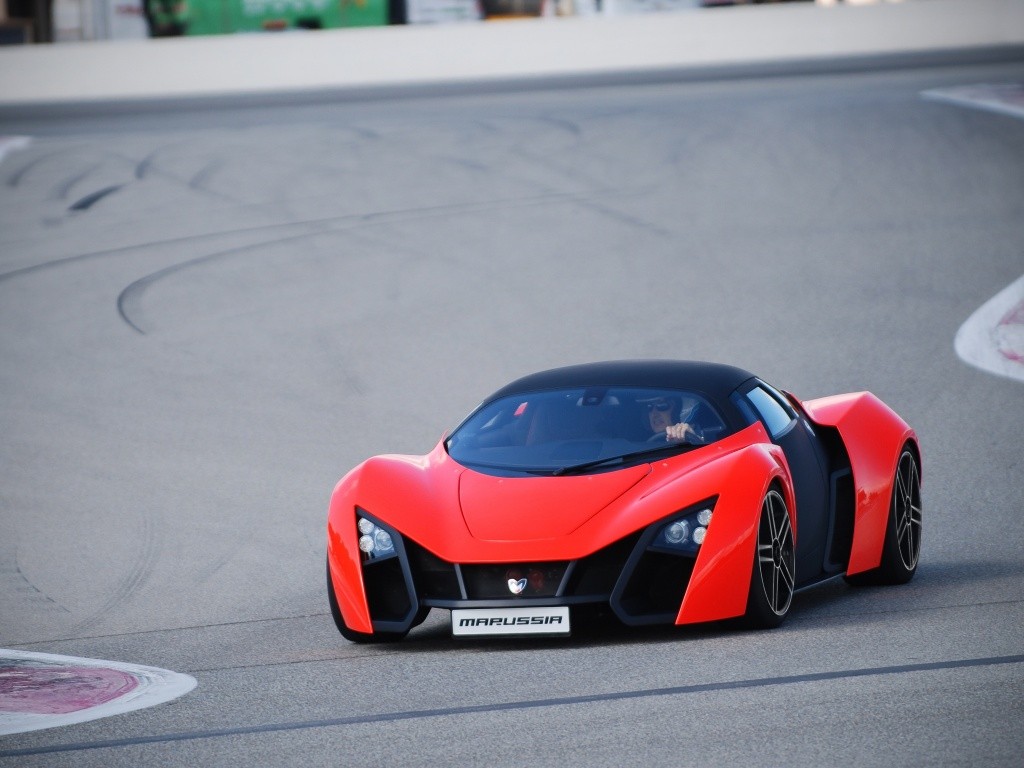
The car is wide and low. Its width is about 2.0 m (78.7 in), and the wheelbase is about 2,680 mm (105.5 in). Height is usually quoted at 1,100–1,130 mm (43.3–44.5 in). Overall length is a problem: Auto Revue gives 4,465 mm, while Wikipedia and other sources give 4,635 mm, and there is no factory data sheet to settle it.
Running gear details come mainly from Auto Revue. It describes 20-inch Pirelli tyres, 245/35 at the front and 285/35 at the rear, and 356 mm (14.0 in) ventilated discs with four-piston calipers. The pushrod suspension uses KW hardware with hydraulic ride-height adjustment, useful on a car this low. The same magazine reports that the B2 was tested on track at Paul Ricard in France.
Key specifications (Cosworth 309 kW version)
| Parameter | Metric | Imperial |
|---|---|---|
| Layout | Mid-engine, rear-wheel drive | - |
| Body | 2-door coupé | - |
| Engine | Cosworth 2.8 L twin-turbo V6 | 171 cu in |
| Maximum power | 309 kW (420 PS) | - |
| Maximum torque | 600 Nm | 443 lb-ft |
| Gearbox | 6-speed automatic, paddle shifters | - |
| 0–100 km/h | 3.8 s | - |
| Kerb weight | about 1,100 kg | 2,425 lb |
| Width | about 2,000 mm | 78.7 in |
| Wheelbase | about 2,680 mm | 105.5 in |
| Fuel tank (as usually quoted) | 80 L | 21.1 US gal |
| Chassis | Aluminium frame, composite body panels | - |
Production plans, price and the end of Marussia Motors
Marussia's production plans were ambitious. Reported targets were 2,999 units for the B1 and about 3,500 cars for the series as a whole, and a first run of 500 B2s was announced. Some reports at the time said the 500 cars had all been sold, but that claim was not verified.

The Valmet deal in Finland
At the Geneva Motor Show in March 2012, Marussia announced that Valmet Automotive would engineer and build the B2 at its plant in Uusikaupunki, Finland. The plan was for "several hundred units a year", starting at the end of 2012 or in 2013. The price at the time was about €100,000, as quoted in March 2012. Valmet was reportedly also to build the Marussia F2, an SUV prototype first shown on 2 May 2010, with 300 units planned for 2012.
Why the B2 did not reach series production
In February 2014, Auto Revue could still give no start date for production. Autoevolution states that the car never reached series production because homologation outside its home country was not completed. How many B2s were actually built is unknown: the totals quoted online disagree and none is backed by company records, so this page does not give one.
On 9 April 2014 it was reported that Marussia Motors had been shut down and its staff moved to a government-run technical institute. That ended the B2 project.
The Marussia F1 team is a separate story. Marussia Motors took a majority stake in Virgin Racing in late 2010, and the team raced as Marussia F1 from 2012 to 2014. By April 2014 it was controlled by Marussia Communications Ltd, independent of the car maker, and it ceased trading on 7 November 2014.
Legacy, video games and contemporaries
Many people know the B2 from video games. It appears in Need for Speed: Most Wanted (2012), Need for Speed Rivals (2013), Asphalt 8: Airborne (2013) and Driveclub (2014), where it was a cover car.

Among real cars, the B2 belongs with the small-volume supercars and sports cars launched by new or niche makers in the same period. The Artega GT from Germany, the Dutch Spyker C8 Aileron and the KTM X-Bow from Austria came from similarly small makers. The McLaren MP4-12C shows the other route of the same years: a new supercar backed by an established racing company.
What the B2 leaves behind is an unusual case. A start-up with a racing-driver founder commissioned Cosworth engines, signed a contract with an established Finnish manufacturer and even bought into Formula One, yet its road car stayed a show-and-prototype project.
Rivals
Compare with…
Compare Marussia B2 with
- Artega GT quick spec comparison
- Spyker C8 Aileron quick spec comparison
- KTM X-Bow quick spec comparison


Marussia B2 in our rankings
- No. 5 of 101 · Lightest coupes (850 kg)
- No. 17 of 438 · Lightest cars (850 kg · top 4%)
- No. 17 of 435 · Power-to-weight: cars (364 kW/t · top 4%)
- No. 16 of 100 · Power-to-weight: coupes (364 kW/t · top 16%)
- No. 53 of 207 · Most powerful cars of the 2000s (309 kW · top 26%)
- No. 321 of 1102 · Most powerful cars (309 kW · top 30%)
Lighter than 96% of ranked cars in the 1CARS catalog (No. 17 of 438).
Marussia B2 photos 14


Marussia B2 videos 2

Marussia B2 video 1

Marussia B2 video 2
FAQ
What engine does the Marussia B2 have?
The B2 was offered with a naturally aspirated 3.5-litre V6 rated at 221 kW (300 PS), or a Cosworth 2.8-litre twin-turbo V6 with 265 kW (360 PS) or 309 kW (420 PS). All versions are mid-mounted, drive the rear wheels and use a six-speed automatic.
What is the fuel consumption of the Marussia B2?
No official fuel consumption figure was published, and none appears in reputable sources. The known facts are that the B2 runs on 95-octane petrol and that its tank is usually quoted at 80 L (21.1 US gal).
Is the Marussia B2 available with all-wheel drive or as a hybrid?
No. Every B2 is a mid-engine, rear-wheel-drive petrol car with a six-speed automatic. There was no all-wheel-drive, hybrid or electric version, and a manual gearbox was only reported to be under development.
How fast is the Marussia B2?
The 309 kW (420 PS) version accelerates from 0 to 100 km/h in 3.8 seconds, according to two independent sources. Top speed claims differ; the most cautious figure, from Auto Revue, is over 250 km/h (155 mph).
Was the Marussia B2 ever put into series production?
Not as planned. Valmet Automotive agreed in March 2012 to build it in Finland, but no series start was reported, and Marussia Motors was shut down in April 2014. The number of cars actually built is unknown.
What are the main rivals of the Marussia B2?
The B2 was a rare, low-volume car, so its natural peers were other niche sports cars of the period, such as the Artega GT, Spyker C8 Aileron and KTM X-Bow, rather than mainstream supercars from established brands.
Data sources
Data checked by an editor against the sources below.
- The text of this article (1cars archive)
- Wikipedia - Marussia Motors
- Wikipedia - Marussia B2


