
 BelAZ 75710
Specs, engines and history
Published Sources (1) Report an error
By Oleksandr Hnatiuk, Automotive Editor & Used Car Specialist
- Built
- 2013–2022
- Top power
- 3,430 kW (4,664 PS)
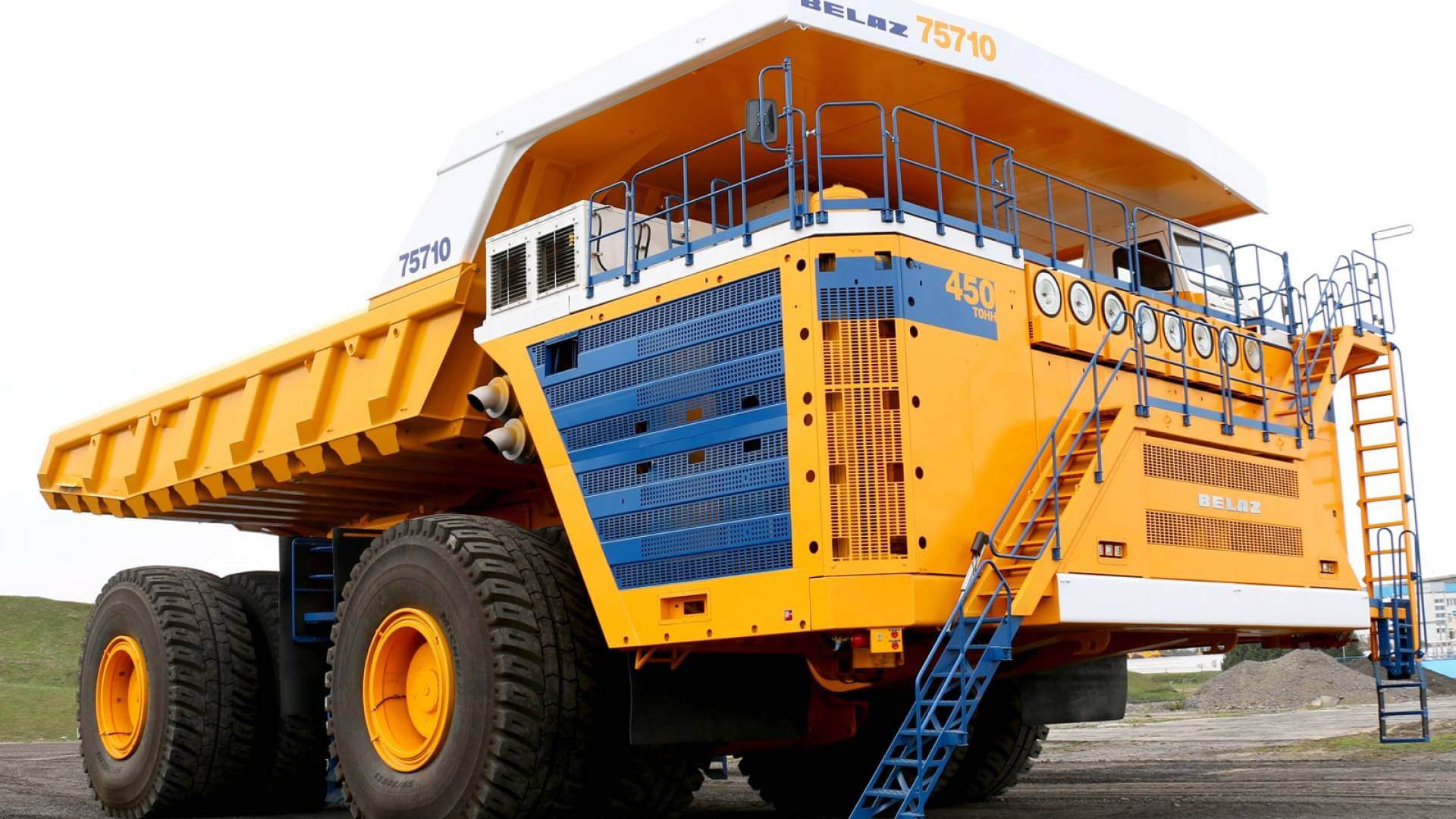
The BelAZ 75710 is an ultra-class mining dump truck built by BelAZ in Zhodzina, Belarus, and the largest dump truck in the world, with a rated payload of 450 tonnes. It was unveiled in autumn 2013. According to published figures, during tests in 2014 it carried a record load of 503.5 tonnes. It was designed for economic reasons rather than records: one 450-tonne truck costs considerably less to run than two or three smaller trucks, giving one of the lowest costs per tonne of material moved in the world.
In short
- Rated payload 450 tonnes; empty weight 360 tonnes; gross weight up to about 840 tonnes.
- Two MTU 16V4000 16-cylinder diesels, each producing 1,715 kW, driving generators for a Siemens diesel-electric drive.
- Four AC traction motors of 1,200 kW each; top speed 64 km/h.
- 20.6 m long, 9.87 m wide and 8.26 m high, on eight 59/80R63 tyres.
Specs by version
Engines
Performance
Show all 1 versions
| Version | Top speed |
|---|---|
| 2 × MTU 16V4000 diesel-electric (2 × 1,715 kW) | 64 km/h40 mph |
Dimensions and weight
Verified Manufacturer and type-approval data from our catalog · Sources and methodology
BelAZ at a glance
BelAZ, the Belarusian Autoworks, traces its history to a plant in Zhodzina that began building heavy mining trucks in 1958 and has produced dump trucks under the BelAZ brand since 1961. Its predecessors in the ultra class include the 280-tonne BelAZ 75501 and the 320-tonne BelAZ 75600, whose payload rose to 360 tonnes when Bridgestone supplied larger tyres in 2010. The 75710 uses the same tyre size; a single tyre weighs about 5.5 tonnes. Other heavy vehicles are listed in our car catalogue.
Design
Mining roads limit how wide a truck can be, so the engineers had to find an unusual steering solution for such a giant with dual front tyres. Conventional steered front wheels were impossible, and an articulated frame would have put enormous loads on the hinge, so they chose two steered axles. The design team nicknamed the arrangement an "upside-down excavator": in an excavator the chassis stays still and the body turns, whereas here the body is fixed and the axles swivel underneath. Front and rear axles are identical, and both are steered.
The frame is very different from an ordinary truck ladder frame. It uses box sections similar to shipbuilding practice, made from Swedish Weldox 800 high-strength steel supplied as ready-cut blanks, with two massive pivot joints using bearings 2.75 m in diameter.
Engines and drive
| Parameter | Value |
|---|---|
| Engines | 2 × MTU 16V4000 16-cylinder diesel |
| Power | 2 × 1,715 kW |
| Drive | Diesel-electric (Siemens) |
| Traction motors | 4 × 1,200 kW AC wheel motors |
| Top speed | 64 km/h |
| Fuel tanks | 2 × 2,800 l |
The two diesels, mounted transversely, have a combined displacement of about 65 litres. There is no conventional gearbox: the engines drive two generators that supply electricity to four traction motors, two per axle, built into the wheel hubs, and to the hydraulic systems. The truck carries 5,600 litres of fuel, 538 litres of engine oil and 1,800 litres of hydraulic fluid; loaded, it can burn up to about 470 litres of diesel per hour. Eight round elements on the platform of the two-flight staircase to the cab are air filters, not lights — the headlights are square units at the bottom of the cab structure. The body is heated by exhaust gases to stop material freezing to it.
Brakes, suspension and steering
Each wheel has hydraulically actuated twin-disc brakes, but with a loaded weight of over 800 tonnes this is not enough, so the truck also has electrodynamic braking: the wheel motors act as generators, and the large amount of heat produced is removed by forced air cooling. The suspension is a rigid-axle pneumo-hydraulic system with integrated hydraulic damping, without kingpins or ball joints. Steering is hydrostatic, with two cylinders per axle; the front axle turns first, followed by the rear. The turning radius is about 19.8 m — remarkably manoeuvrable for a truck more than 20 m long.
A combined hydraulic system with a common reservoir, powered by a Rexroth pump station, serves the brakes, tipping cylinders and steering. When the body is raised, steering is disabled so that all the oil can be used for tipping. Safety cables connect the body to the frame to prevent it from dropping suddenly if the hydraulics fail.
Safety and cab
The 75710 was the first mining dump truck fitted with an anti-roll bar to improve stability. It has a surround-view camera system and motion sensors and radars on all four sides that warn the driver if a person comes close to the truck. Electronic payload indicators on each side show the excavator operator how many tonnes have been loaded, and there is an emergency pneumatic back-up for the steering hydraulics. The cab, set high on the upper platform — known as the "deck" — resembles a ship's bridge and meets European comfort standards, with a fully adjustable seat, climate control and modern instruments.
Operation and service life
The truck works 23 hours a day, with the remaining hour used for refuelling and driver changes. According to published figures, a 75710 covers more than 500,000 km in five to six years of service; the manufacturer measures its life in engine hours rather than kilometres. The diesel-electric drive has few wearing parts, which helps longevity.
Key specifications
| Parameter | Value |
|---|---|
| Rated payload | 450 t |
| Empty weight | 360 t |
| Gross weight | about 840 t |
| Length / width / height | 20.6 m / 9.87 m / 8.26 m |
| Tyres | 59/80R63 |
| Engine power | 2 × 1,715 kW |
| Traction motors | 4 × 1,200 kW |
| Top speed | 64 km/h |
| Turning radius | about 19.8 m |
Rivals
The BelAZ 75710 has no direct rivals in payload. The closest competitors are the Liebherr T 282 B (built since 2004, 363 tonnes), the Caterpillar 797F (363 tonnes) and the Komatsu 980E-4.
BelAZ 75710 in our rankings
Longer than 94% of ranked trucks in the 1CARS catalog (No. 1 of 17).
FAQ
How much can the BelAZ 75710 carry?
Its rated payload is 450 tonnes; according to published figures, it carried 503.5 tonnes in a 2014 test.
What engines does the BelAZ 75710 have?
Two MTU 16V4000 16-cylinder diesels, each producing 1,715 kW, which drive generators for four 1,200 kW electric traction motors.
How fast is the BelAZ 75710?
Its top speed is 64 km/h.
How heavy is the BelAZ 75710?
It weighs 360 tonnes empty and about 840 tonnes fully loaded.
Data sources
Data checked by an editor against the sources below.


