 Pagani Utopia
Specs, engines and history
Published Sources (1) Report an error
By Oleksandr Hnatiuk, Automotive Editor & Used Car Specialist
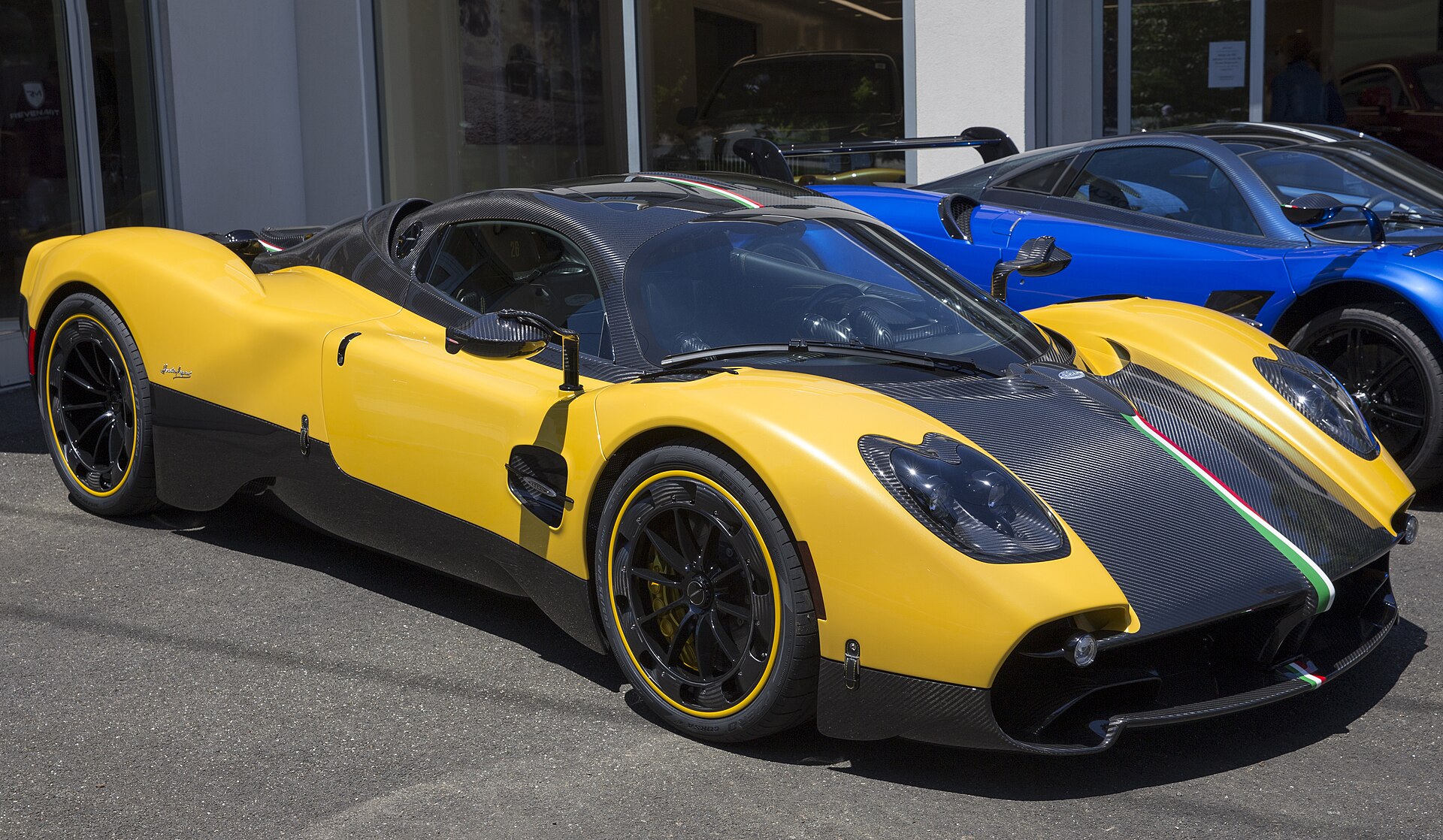
- Built
- 2022–present
- Top power
- 635 kW (863 PS)
The Pagani Utopia is the third model in the range of Pagani Automobili, following the Zonda and the Huayra. It was presented on 12 September 2022 at the Teatro Lirico in Milan and is built by hand in San Cesario sul Panaro, near Modena. Its formula is deliberately traditional for a modern hypercar: a twin-turbo V12 from Mercedes-AMG, no hybrid system, a carbon fibre body and - unusually for its class - the option of a fully manual seven-speed gearbox.
In short
- Presented 12 September 2022 in Milan; internal code C10; 99 coupés, all sold before the reveal; first delivery in October 2023.
- Mercedes-AMG M158 5,980 cc twin-turbo V12: 635 kW (864 PS) at 6,000 rpm and 1,100 Nm from 2,800 to 5,900 rpm.
- Seven-speed Xtrac transverse gearbox, available as a pure manual or an automated manual.
- Dry weight 1,280 kg; Utopia Roadster from July 2024, limited to 130 cars.
Pagani Utopia at a glance
| Specification | Pagani Utopia |
|---|---|
| Production | from 2022, San Cesario sul Panaro (Italy) |
| Cars planned | 99 coupés; 130 roadsters |
| Body | two-door berlinetta with butterfly doors; roadster from 2024 |
| Engine | Mercedes-AMG M158 5,980 cc V12, two turbochargers, mid-mounted |
| Power | 635 kW (864 PS) at 6,000 rpm |
| Torque | 1,100 Nm from 2,800 to 5,900 rpm |
| Gearbox | seven-speed Xtrac, manual or automated manual, rear-wheel drive |
| Dry weight | 1,280 kg |
| Dimensions | 4,597 mm long, 2,037 mm wide, 1,169 mm high, 2,794 mm wheelbase |
| Predecessor | Pagani Huayra |
The Utopia follows the Zonda (code C8) and the Huayra (C9) - see our articles on the Pagani Zonda R and the Pagani Huayra Imola. All models are listed in the Pagani catalogue.
Development
Horacio Pagani, the Argentine-born founder of the company, designed the Utopia himself. Development took more than six years. According to Wikipedia, Pagani built eight complete prototypes, three of which were used for about two years of engine testing, and twelve scale models: ten at 1:5 scale and two at full size.
At a time when most new hypercars were moving to hybrid or fully electric drive, Pagani kept a pure combustion engine and placed the emphasis on low weight, mechanical feel and craftsmanship. The car was shown to the public for the first time in Milan, in the Teatro Lirico, on 12 September 2022.
Internally the car is known as C10, continuing the sequence of the Zonda (C8) and the Huayra (C9). All 99 coupés had been assigned to customers before the presentation. The first customer car was delivered in October 2023.

Design and interior
The name comes from Thomas More's book Utopia of 1516, which describes an ideal society. According to Motor1's report on the launch, owners of earlier Paganis had asked the company for simplicity, lightness and driving pleasure, and the Utopia answers with a calmer, more minimalist shape than the Zonda and the Huayra. Active aerodynamic elements are built in discreetly so that they do not break the clean lines of the body. The doors open upwards in butterfly fashion.
Inside, Pagani avoided large screens. The speedometer and rev counter are analogue, with a single small display between them, and there is no central infotainment monitor. The centre stack carries a row of instruments, switches and climate controls, and the steering wheel and pedals are machined from solid metal.

Engine and gearbox
The V12 is designed and built for Pagani by Mercedes-AMG, the partner that has supplied all of the company's engines. The M158 twin-turbo V12 has a displacement of 5,980 cc and produces 635 kW (864 PS) at 6,000 rpm. Its maximum torque of 1,100 Nm is available over a wide band, from 2,800 to 5,900 rpm. The dry weight of the engine is 262 kg.
| Figure | Pagani Utopia |
|---|---|
| Engine | Mercedes-AMG M158, 5,980 cc twin-turbo V12 |
| Power | 635 kW (864 PS) at 6,000 rpm |
| Torque | 1,100 Nm (2,800–5,900 rpm) |
| Engine dry weight | 262 kg |
| Gearbox | seven-speed Xtrac, transverse |
| Differential | electro-mechanical |
| Car dry weight | 1,280 kg |
The gearbox was developed with the British specialist Xtrac and is mounted transversely behind the engine. Customers can choose a pure manual with a clutch pedal or an automated manual version, which Pagani describes as the quickest-shifting gearbox with helical gears. The V12 has a 60-degree angle between its cylinder banks, and Pagani says the car meets California's emissions standards. Both use a triple-plate clutch and an electro-mechanical differential. The manual option was one of the most discussed features of the car: very few hypercars of the 2020s offered a clutch pedal.
Chassis and suspension
The Utopia is a two-door berlinetta with butterfly doors that open upwards, and the engine sits behind the cabin driving the rear wheels. The suspension uses forged aluminium double wishbones at the front and rear, developed from experience with the track-only Huayra R. The monocoque is made of Pagani's carbon composites, Carbo-Titanium HP62 G2 and Carbo-Triax HP62, with front and rear subframes of chromoly steel. The body panels use a new type of carbon fibre that, according to Pagani, is 38 per cent stiffer at the same density. The quad titanium exhaust with a ceramic coating weighs just over 6 kg. The dampers are electronically controlled.
Brembo supplies carbon-ceramic brakes with six-piston calipers at the front and four-piston calipers at the rear. The wheels measure 21 inches at the front and 22 inches at the rear, with turbine-shaped carbon fibre inserts that pull hot air away from the brakes, and Pirelli made tyres especially for the car. With a weight of 1,280 kg, the Utopia is light for a car with a twin-turbo V12 and 1,100 Nm of torque.

Utopia Roadster
The open version was introduced on 30 July 2024. It has both a removable carbon fibre hard top and a removable soft top, and it keeps the powertrain and specification of the coupé. Like the coupé, it can be ordered with either the manual or the automated manual gearbox, and the removable roof panels let the owner choose between a fully open car, a soft top and a carbon hard top. Production is limited to 130 cars. Its price was reported at about €3.1 million in 2024.

Pagani's approach
Pagani builds only a small number of cars per year, and its models have stayed in production for many years with special editions and track versions: the Zonda was followed by the Huayra and its track-only Huayra R. For the Utopia, possible future track variants have already been mentioned. The background of the company founded in 1992 by Horacio Pagani is told in our Pagani history.
Photo gallery


Pagani Utopia in our rankings
- No. 8 of 127 · Most powerful Italian cars (635 kW)
- No. 37 of 859 · Most powerful cars (635 kW · top 5%)
- No. 31 of 313 · Most powerful coupes (635 kW · top 10%)
- No. 24 of 239 · Most powerful cars of the 2020s (635 kW · top 11%)
- No. 746 of 912 · Longest-running car nameplates (4 years · top 83%)
- No. 258 of 305 · Oldest car models still on sale (4 years · top 88%)
More powerful than 95% of ranked cars in the 1CARS catalog (No. 37 of 859).
FAQ
What engine does the Pagani Utopia have?
A 6.0-litre twin-turbo V12 built by Mercedes-AMG, producing 635 kW (864 PS) and 1,100 Nm.
Does the Pagani Utopia have a manual gearbox?
Yes. The seven-speed Xtrac gearbox is available as a pure manual with a clutch pedal or as an automated manual.
How many Pagani Utopias will be built?
99 coupés, all sold before the 2022 reveal, and 130 roadsters.
What came before the Utopia?
The Huayra, Pagani's second model, which itself followed the Zonda.
What is the Pagani Utopia made of?
The monocoque uses Pagani's Carbo-Titanium and Carbo-Triax composites with chromoly steel subframes, and the body is made of a new, stiffer type of carbon fibre. The car weighs 1,280 kg.
Data sources
Data checked by an editor against the sources below.