 Genesis G70
Specs, engines and history
Published Sources (1) Report an error
By Sarah Whitmore, Senior Automotive Writer
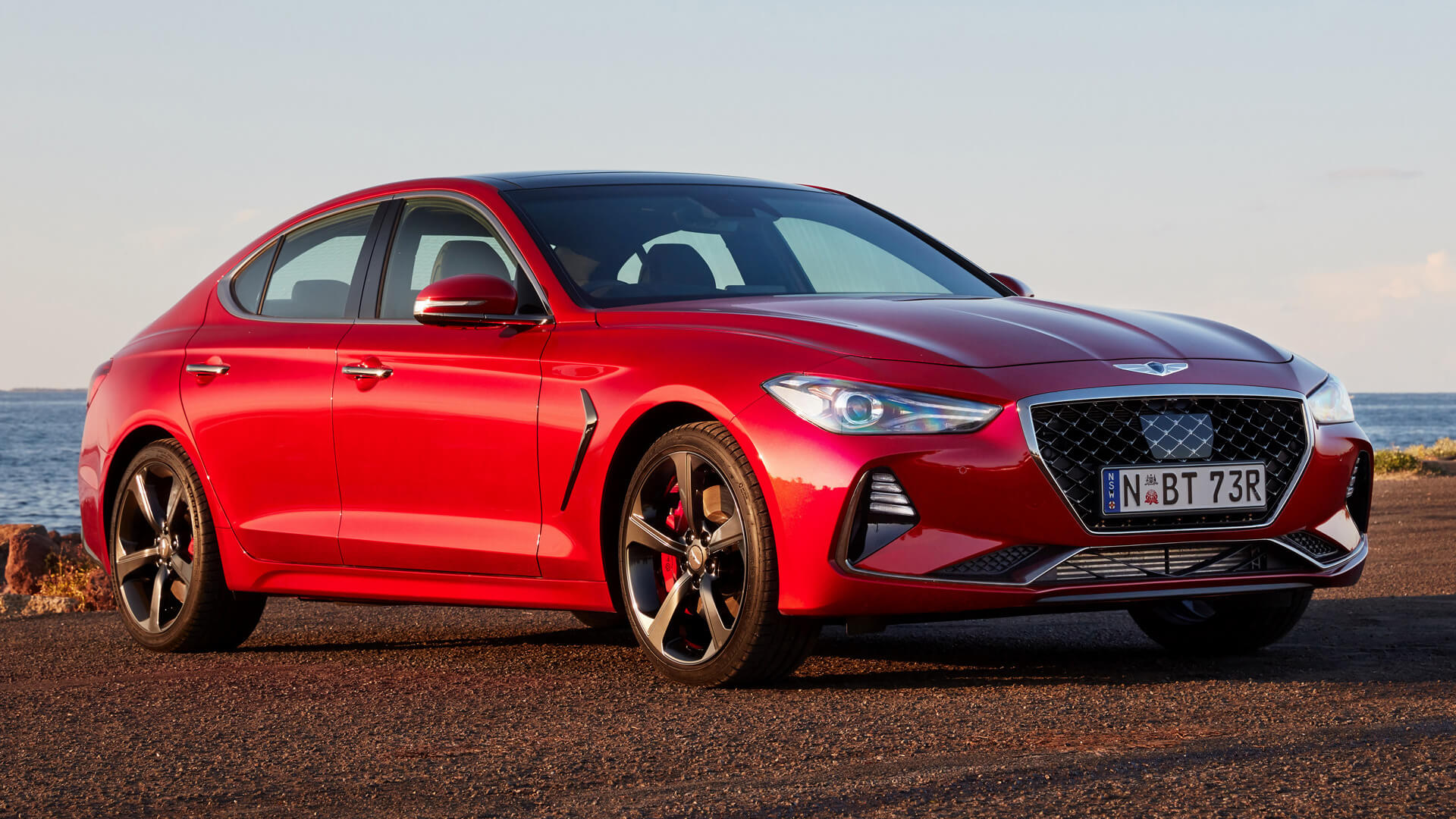
The Genesis G70 is a rear- or all-wheel-drive luxury sports sedan in the mid-size class - a D-segment car in European terms - created to take on established names such as the BMW 3 Series and Mercedes-Benz C-Class. It combines muscular styling, a premium cabin and strong turbocharged engines, and it completed the original line-up of Genesis, the luxury brand that Hyundai launched in 2015.
In short
- Previewed by the Genesis New York Concept in 2016 and launched in Seoul on 15 September 2017.
- Built on the rear-drive M2 platform shared with the Kia Stinger, with an eight-speed automatic and optional all-wheel drive.
- Engines range from a 145 kW (197 PS) 2.0 turbo to a 272 kW (370 PS) 3.3 twin-turbo V6 that reaches 100 km/h in 4.7 seconds.
- Facelifted in 2020; a Shooting Brake estate followed in 2021.
Genesis G70 at a glance
The G70 was first previewed as a concept at the New York International Auto Show in spring 2016. The production car was revealed on 15 September 2017 at a dedicated launch event in Seoul's Olympic Park, attended by around 15,000 guests. The young brand had recruited senior designers and engineers from established European premium makers, and its ambitions were clear: the G70 won the MotorTrend Car of the Year title for 2019 and was named North American Car of the Year in January 2019.
A facelift was announced on 8 September 2020, bringing the brand's newer split-light design, and in 2021 Genesis added the G70 Shooting Brake, a five-door estate aimed mainly at European buyers. More of the brand's range is in our Genesis catalogue; its large SUV is covered in the Genesis GV80 review.
Design
The original G70 was designed by a team led by Peter Schreyer; Luc Donckerwolke, the Belgian designer who had previously worked for the Volkswagen Group, oversaw the facelift. The car is instantly recognisable even in heavy traffic, although some details echo its rivals.
The front end follows the flagship G90, with narrow, slightly squinting headlights, a large trapezoidal grille and a muscular bumper with a distinctive air intake and simple fog lights. Base versions have halogen headlights, while higher trims use full LED units. In profile, the sedan has a long bonnet, sculpted flanks and a domed roofline that flows into a tight rear end. Pronounced wheel arches hold 17-inch wheels as standard, with 18- or 19-inch wheels optional, and functional air vents sit behind the front arches. Ground clearance is about 150 mm, and kerb weight ranges from about 1,595 to 1,840 kg depending on the version.
The rear has a sporty diffuser, distinctive tail lights and a high boot lid that gives the car a coupé-like stance. Base versions have a wide lower panel with a twin exhaust on one side - real pipes, not decoration - while higher trims use a different lower panel with two oval tailpipes at the corners.
Interior and practicality
The cabin follows a clean, minimalist style and uses high-quality materials throughout: soft-touch plastics, Nappa or synthetic leather and brushed-metal trim, in five standard colour schemes and two exclusive ones. The driver has a three-spoke multifunction steering wheel and an instrument panel that combines a colour trip-computer screen with two analogue dials. The centre console is angled slightly towards the driver and topped by an 8-inch infotainment screen, with the air vents, audio controls and three climate-control knobs below.
Five people can travel in the G70, but the rear centre passenger has to contend with a high transmission tunnel and a bench shaped for two, so it is really a four-seater. Rear passengers get their own air vents and a fold-down armrest with cupholders, and an unusual feature for the class lets them move the front passenger seat forward. Sound insulation is good.
The front seats are well shaped, with good lateral support, and can be had with ventilation, heating and even a massage function. The driver's seat can be fitted with the Smart Posture Control System, which uses the driver's body measurements to set the seat, steering column and mirrors automatically. On the other hand, rear space is tighter than in most rivals, and the sedan's boot is small, at about 330 litres; the rear seat backrest splits asymmetrically, and a space-saver spare wheel sits under the floor. The Shooting Brake offers 465 litres, or 1,535 litres with the seats folded.
Engines and transmissions
| Engine | Power (kW / PS) | Torque | 0–100 km/h | Top speed |
|---|---|---|---|---|
| 2.0T Theta II (inline-4 turbo) | 145 kW / 197 PS | 353 Nm | 8.8 s | 224 km/h |
| 2.0T Theta II (inline-4 turbo) | 180 kW / 245 PS | 353 Nm | 6.1 s | 240 km/h |
| 2.2 CRDi (inline-4 diesel) | 147–149 kW / 200–202 PS | 441 Nm | 7.4 s | 230 km/h |
| 3.3T Lambda II (V6 twin-turbo) | 272 kW / 370 PS | 510 Nm | 4.7 s | 270 km/h |
| 2.5T Smartstream (from 2023) | 224 kW / 304 PS | 422 Nm | - | - |
The 2.0-litre petrol engine is a turbocharged inline four with direct injection, variable valve timing and an aluminium block. The 2.2-litre diesel uses common-rail injection, a variable-geometry turbocharger, 16 valves and an intercooler. The top Sport versions have the 3.3-litre twin-turbo V6 from the Lambda II family, with direct injection, 24 valves and variable timing on both intake and exhaust camshafts. Times in the table are for rear-wheel-drive cars; all-wheel drive adds a few tenths.
An eight-speed automatic is standard across the range (a six-speed manual was offered on the 2.0T only in North America from 2019 to 2021). Power goes to the rear wheels by default, and the optional all-wheel-drive system uses a multi-plate clutch that can send up to 50% of the torque to the front axle. The G70 Sport also has a limited-slip differential.
Chassis
The G70 uses a rear-drive platform with a longitudinally mounted engine, shared with the Kia Stinger. More than half of the body is made of high-strength steel. The front suspension uses MacPherson struts and the rear a multi-link layout, with passive dampers and anti-roll bars on standard versions. Steering is rack-and-pinion with a rack-mounted electric motor, and all four brakes are ventilated discs. The Sport version adds electronically controlled dampers, variable-ratio steering, more powerful Brembo brakes and launch control. The suspension is genuinely comfortable.
Safety and equipment
Safety equipment includes front, side and curtain airbags and a driver's knee airbag, emergency stop signalling, tyre-pressure monitoring, ABS and stability control, hill-start assist and three-point belts with pretensioners. Driver assistance includes Highway Driving Assist, Forward Collision-Avoidance Assist, blind-spot monitoring, lane-keeping assist, smart cruise control, a reversing camera and parking assistance. The body has high torsional stiffness and an active bonnet that lifts automatically to protect pedestrians.
Depending on the market, base versions have seven airbags, synthetic leather, a rain sensor, dual-zone climate control, 18-inch alloys, cruise control, the 8-inch infotainment system, parking sensors all round, heated front seats and a reversing camera. The top Sport version adds adaptive cruise control, 19-inch wheels, automatic emergency braking, a surround-view camera, full LED lights, a head-up display, electrically adjustable and ventilated front seats, heated rear seats, a premium audio system and Nappa leather.
Strengths and weaknesses
Owners are generally pleased with the G70. They praise its looks, the quality cabin free of rattles and squeaks, the good brakes and the high level of safety; all-wheel-drive cars are sure-footed, and the low ground clearance rarely causes problems even in winter. Criticisms are the cramped rear seat with its large tunnel, the small boot and fuel consumption that is higher than in some German rivals. Competitors include the BMW 3 Series, Audi A4, Mercedes-Benz C-Class, Volvo S60, Jaguar XE and Lexus IS.
Genesis G70 in our rankings
- No. 431 of 912 · Longest-running car nameplates (9 years · top 49%)
- No. 170 of 305 · Oldest car models still on sale (9 years · top 60%)
In production longer than 51% of ranked nameplates in the 1CARS catalog (No. 431 of 912).
FAQ
When did the Genesis G70 come out?
It was revealed in Seoul on 15 September 2017, after a concept at the 2016 New York show. A facelift followed in 2020.
What is the most powerful Genesis G70?
The 3.3T with a twin-turbo V6: 272 kW (370 PS) and 510 Nm, 0–100 km/h in 4.7 seconds and up to 270 km/h.
Is the Genesis G70 rear-wheel drive?
Yes, it is rear-wheel drive as standard, with optional all-wheel drive that can send up to 50% of the torque to the front.
How big is the Genesis G70 boot?
The sedan has about 330 litres; the Shooting Brake estate offers 465 litres, or 1,535 litres with the seats folded.
Which car is the G70 related to?
It shares its rear-drive M2 platform with the Kia Stinger.
Data sources
Data checked by an editor against the sources below.