
Toyota Corolla vs VW Golf: hybrid or mild hybrid?
Updated Report an error By Sarah Whitmore

Toyota · 2018–present
Corolla E210
- Power
- 103 kW140 PS
- 0–100 km/h
- 9.2 s
- Top speed
- 180 km/h
- Kerb mass
- 1,430 kg

Volkswagen · 2019–present
Golf Mk8
- Power
- 110 kW150 PS
- 0–100 km/h
- 8.5 s
- Top speed
- 224 km/h
- Kerb mass
- 1,331 kg
At a glance
Who suits what, worked out from the catalog figures of the versions above.
Categories won: Corolla E210 3 Golf Mk8 2
- Family Golf Mk8 Boot: 381 l vs 361 l
- City Corolla E210 Consumption: 4.4 l/100 km vs 5.5 l/100 km
- Long trips Corolla E210 Range: 977 km vs 909 km (estimated)
- Performance Golf Mk8 Power per tonne: 83 kW/t vs 72 kW/t; 0–100 km/h: 8.5 s vs 9.2 s
- Running costs Corolla E210 Fuel per year: €1,160 vs €1,440 (estimated)
- Off-road Too close to call Drive and body: Front-wheel drive · Hatchback vs Front-wheel drive · Hatchback
Verdict Opinion
The Corolla is the low-stress choice for town and suburban driving. Its full hybrid runs on electricity at low speeds without a plug, the drivetrain is simple to live with, and the 2.0 hybrid gives decent pace.
The Golf is the more versatile car. It offers diesels for high mileage, plug-in hybrids for home chargers and the GTI and R for keen drivers.
— Sarah Whitmore
Two long-running bestsellers meet in the European compact class. The Toyota Corolla began in 1966, the Volkswagen Golf in 1974; Volkswagen counts more than 37 million Golfs sold.
In Europe the modern contest started in early 2019. Toyota had planned to call its new hatchback the Auris, but in January 2019, just after production began at Burnaston in Derbyshire, it brought back the Corolla name after a 12-year break. The eighth Golf was revealed in Wolfsburg on 24 October 2019. Their answers to rising fuel and emission costs are very different.
Toyota Corolla vs VW Golf: drivetrains, size, prices and safety
Full hybrid against mild hybrid
Since its update the E210 Corolla is sold in Europe only as a self-charging full hybrid. The 1.8 hybrid gave 90 kW (122 PS) at launch and 103 kW (140 PS) with the fifth-generation hybrid system after the update. The 2.0 hybrid was listed with 132 kW (180 PS) at its German launch and 144 kW (196 PS) after the update. A 1.2 turbo petrol with 85 kW (116 PS) was dropped early, and no diesel was offered. The Golf Mk8 relies on 48-volt mild-hybrid eTSI petrol engines, conventional TSI and TDI units and two plug-in hybrids: the eHybrid with 150 kW and the GTE with 180 kW.
Performance range
Volkswagen covers far more ground at the top. The Mk8 range runs from the 81 kW 1.0 TSI through the 147 kW GTD and the 180 kW GTI to the 235 kW Golf R with all-wheel drive. Toyota's fastest European Corolla is the 2.0 hybrid; the GR Corolla was built mainly for North America, and Europe received the GR Yaris instead.
Size and bodies
Wikipedia gives the international Corolla hatchback as 4,370 mm long and 1,790 mm wide. The Golf Mk8 is 4,284 mm long and 1,789 mm wide on a 2,636 mm wheelbase, so the Toyota is 86 mm longer. Both are also sold as estates, the Corolla Touring Sports and the Golf Variant, and Toyota built a saloon in Turkey for selected European countries.
German launch prices in 2019
At the German launch in February 2019 the Corolla hatchback started at €20,990 with the 1.2 petrol, the 1.8 Hybrid Comfort cost €27,290 and the 2.0 Hybrid €29,290; each Touring Sports cost €1,200 more. These figures help to judge the hybrid premium: €6,300 between the turbo petrol and the 1.8 Hybrid at launch, which our fuel cost comparison can set against your annual mileage.
Safety
Euro NCAP tested the Corolla hatchback with the 1.8 hybrid in 2019 and recorded 95 % for adult occupants, 84 % for children, 86 % for pedestrian protection and 77 % for safety assist. The earlier Golf Mk7 had scored 94 % for adult occupants in 2012.
Race Stats side by side
Each figure is a 0–100 score from the catalog numbers, the same as on the 1CARS Race cards. PI is the overall performance index (100–999) and its class D–S.
| Stat | Corolla E210 | Golf Mk8 |
|---|---|---|
| PI | C · 488 | B · 532 |
| Power | 40 | 44 |
| Grip | 38 | 40 |
| Handling | 70 | 71 |
| Top speed | 31 | 48 |
| Launch | 36 | 40 |
Grip and handling are estimates from drive type, weight, height and body (hover a figure to see where it comes from). 1CARS Race
Who wins a race?
Quarter-mile (402 m) drag from a standing start, dry road, no reaction time — the 1CARS Race physics on the catalog figures of these versions.
- 1 Golf Mk8Golf Mk8 · 1.5 TSI · petrol · 110 kW (150 PS) 16.12 sat 137 km/h
- 2 Corolla E210Corolla E210 · 1.8 Hybrid (2023 update) · 103 kW (140 PS) 16.66 sat 131 km/h · +0.54 s
Size and weight
Side view to scale, all cars from the front bumper.
| Corolla E210 | Golf Mk8 | |
|---|---|---|
| Length | 4,370 mm172.0 in | 4,284 mm168.7 in −86 mm −3.4 in −2.0% |
| Width | 1,790 mm70.5 in | 1,789 mm70.4 in −1 mm −0.04 in −0.1% |
| Height | 1,435 mm56.5 in † | 1,456 mm57.3 in +21 mm +0.8 in +1.5% |
| Wheelbase | 2,640 mm103.9 in † | 2,636 mm103.8 in −4 mm −0.2 in −0.2% |
| Kerb weight | 1,430 kg3,153 lb | 1,331 kg2,934 lb −99 kg −218 lb −6.9% |
| Boot | 361 l12.7 cu ft | 381 l13.5 cu ft +20 l +0.7 cu ft +5.5% |
| Fuel tank | 43 l11.4 gal US | 50 l13.2 gal US +7 l +1.8 gal US +16.3% |
| Fits a standard garage? | Yes | Yes |
Difference vs Corolla E210 (±). Garage check: a standard single garage takes a car up to about 5.0 m (16 ft 5 in) long and 1.9 m (6 ft 3 in) wide (width as listed in the catalog; some makers include the mirrors). Leave about 0.6 m (2 ft) to open the doors. † from another version of this generation.
Full specifications
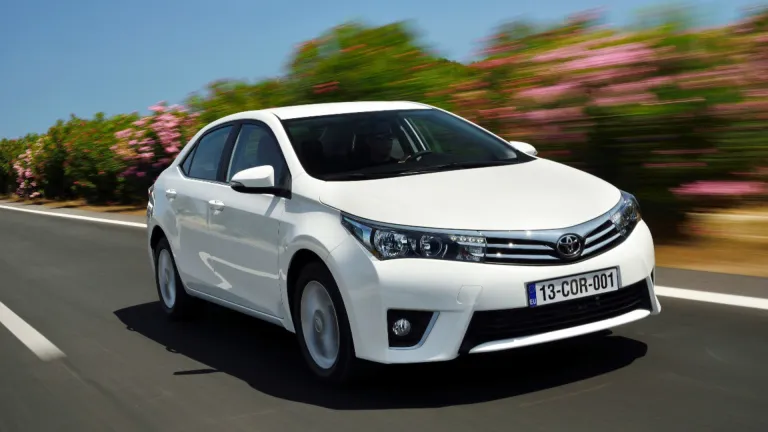
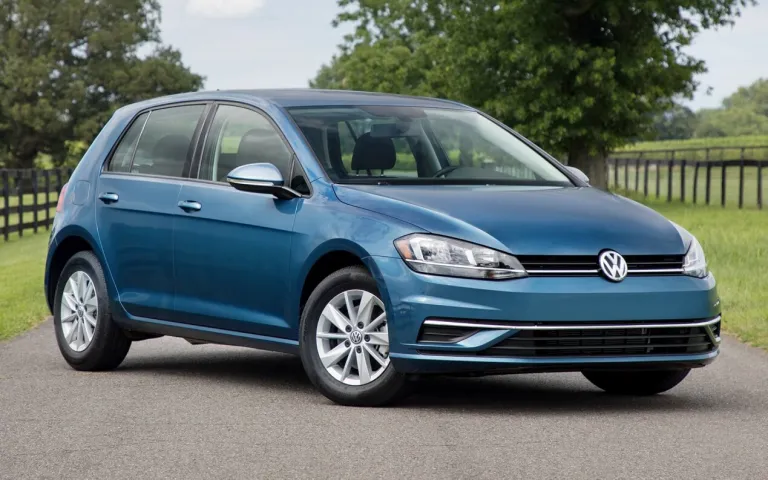
| Toyota Corolla | Volkswagen Golf | |
|---|---|---|
| General | ||
| Version | Corolla E210 · 1.8 Hybrid (2023 update) · 103 kW (140 PS) | Golf Mk8 · 1.5 TSI · petrol · 110 kW (150 PS) |
| Production years | 2018–present | 2019–present |
| Body | Hatchback | Hatchback |
| Country | Japan | Germany |
| Performance | ||
| Power Why it matters: More power means stronger acceleration and easier overtaking, especially with a full load. | 103 kW (140 PS) 138 hp | 110 kW (150 PS) 148 hp Better |
| Power, all versions | 73–144 kW (99–196 PS) 98–193 hp | 37–235 kW (50–320 PS) 50–315 hp |
| Torque Why it matters: Torque is the pulling force you feel when accelerating from low revs, towing or climbing hills. | No data | 250 Nm 184 lb-ft |
| 0–100 km/h Why it matters: A shorter 0–100 km/h time means quicker getaways and safer merging onto fast roads. | 9.2 s | 8.5 s Better |
| Top speed Why it matters: Top speed hints at how relaxed the car is at motorway speeds, even if you never reach it. | 180 km/h 112 mph | 224 km/h 139 mph Better |
| Power per tonne | 72 kW/t 88 hp/ton calculated | 83 kW/t 100 hp/ton calculated Better |
| Engine and transmission | ||
| Fuel | Hybrid | Petrol |
| Engine | No data | 1,500 cc 1.5 l |
| Engine code | 2ZR-FXE | No data |
| Gearbox | CVT | No data |
| Drive | Front-wheel drive | Front-wheel drive |
| Dimensions and weight | ||
| Length | 4,370 mm 172.0 in | 4,284 mm 168.7 in |
| Width | 1,790 mm 70.5 in | 1,789 mm 70.4 in |
| Height | 1,435 mm 56.5 in † | 1,456 mm 57.3 in |
| Wheelbase | 2,640 mm 103.9 in † | 2,636 mm 103.8 in |
| Kerb weight Why it matters: A lighter car is usually more agile and uses less energy. | 1,430 kg 3,153 lb | 1,331 kg 2,934 lb Better |
| Boot Why it matters: A bigger boot fits more luggage, shopping or a pram. | 361 l 12.7 cu ft | 381 l 13.5 cu ft Better |
| Fuel tank Why it matters: A larger tank means more distance between fuel stops. | 43 l 11.4 gal US | 50 l 13.2 gal US Better |
| Economy and running costs | ||
| Fuel consumption Why it matters: Lower consumption cuts running costs and CO₂ emissions on every trip. | 4.4 l/100 km 53.5 mpg US Better | 5.5 l/100 km 42.8 mpg US |
| CO₂ | 100 g/km Better | 125 g/km |
| Fuel cost per year | €1,160/year estimated Better | €1,440/year estimated |
| Range on a full tank | 977 km 607 mi estimated Better | 909 km 565 mi estimated |
| Safety | ||
| Euro NCAP | ★★★★★ (2019) | ★★★★★ (2025) |
These cars do not differ in the data we have.
Equal rows hidden (2): Body, Drive.
Better marks the stronger figure — only for measurable specs (power, torque, 0–100 km/h, consumption, boot, weight).
Estimated at 15,000 km a year with fuel at €1.75/l petrol. † from another version of this generation.
In plain words
Volkswagen Golf is quicker: 0–100 km/h in 8.5 s against 9.2 s for Toyota Corolla. Toyota Corolla is 86 mm longer than Volkswagen Golf (4,370 mm vs 4,284 mm). Volkswagen Golf is lighter by 99 kg (1,331 kg vs 1,430 kg). Volkswagen Golf has the bigger boot: 381 l against 361 l. At 15,000 km a year, fuel would cost about €1,160 (Toyota Corolla), €1,440 (Volkswagen Golf) (estimated). Toyota Corolla is the older design (from 1966); Volkswagen Golf arrived in 1974. On the catalog figures, the Volkswagen Golf is the pick for family and performance; the Toyota Corolla is the pick for city, long trips and running costs.
Which one to choose
Choose the Corolla if most of your driving is in town, you cannot charge at home and you value a proven hybrid system.
Choose the Golf if you drive long distances, want a diesel, can charge a plug-in hybrid at home or want a fast GTI or R.
For estates compare the Corolla Touring Sports with the Golf Variant directly; in Germany the Toyota estate cost €1,200 more than the hatchback in 2019.
Frequently asked questions
Is the Golf available as a full hybrid like the Corolla?
No. The Golf Mk8 uses 48-volt mild-hybrid eTSI engines and two plug-in hybrids, the eHybrid and the GTE. The Corolla's hybrids are self-charging full hybrids.
Is there a diesel Corolla?
Not in the E210 generation in Europe. The earlier E180 saloon had a 1.4 D-4D diesel.
Which is bigger?
The Corolla hatchback, at 4,370 mm, is 86 mm longer than the 4,284 mm Golf Mk8; both are about 1.79 m wide.
Why was the European Corolla almost called Auris?
Toyota sold its European hatchback as the Auris from 2006. In January 2019 it switched back to the Corolla name, shortly after production of the new car began.