
Honda Civic vs Toyota Corolla: two hybrid compacts
Updated Report an error By Sarah Whitmore
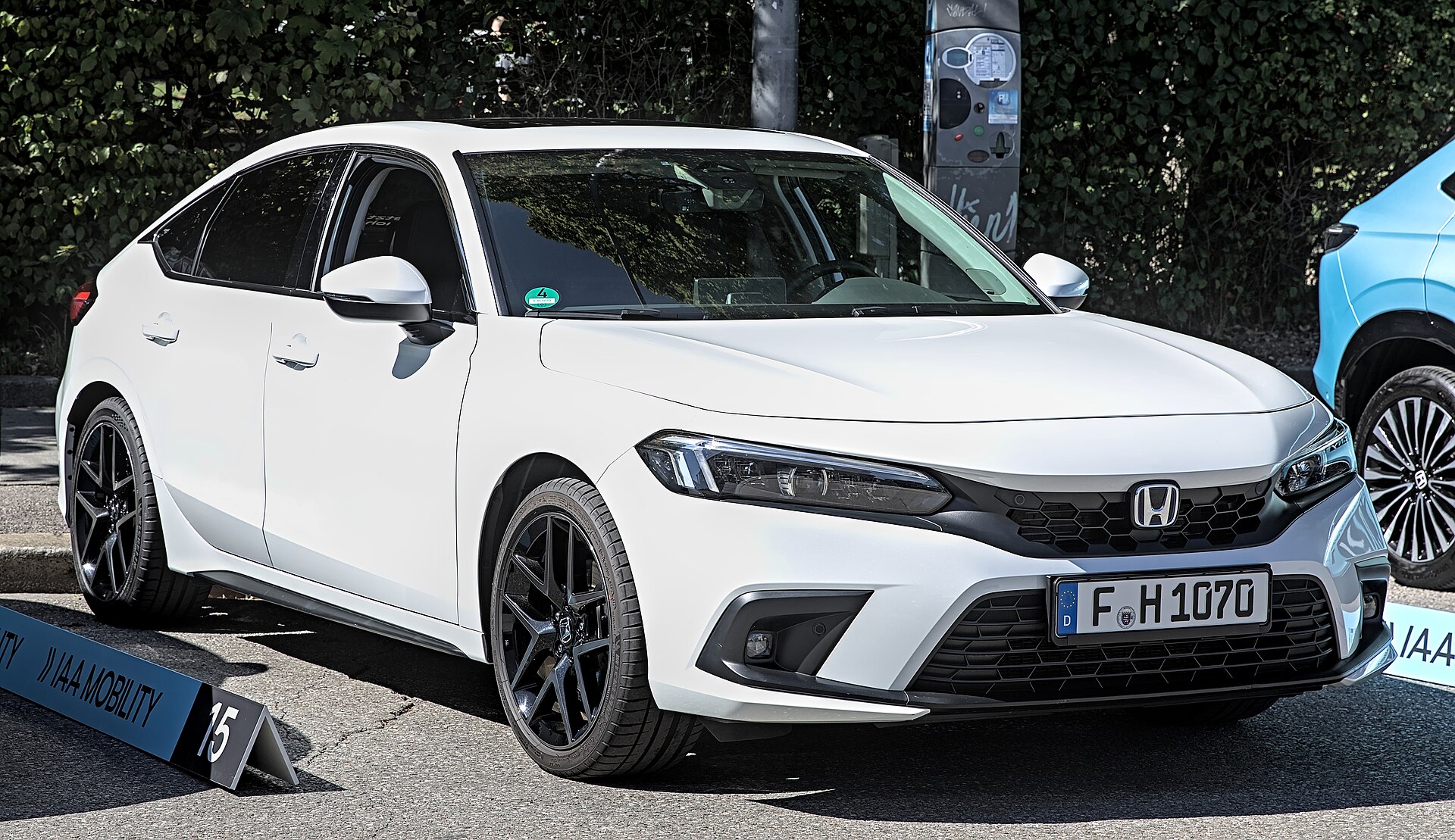
Honda · 2021–present
Civic XI
- Power
- 135 kW184 PS
- 0–100 km/h
- 7.8 s
- Top speed
- 180 km/h
- Kerb mass
- 1,517 kg

Toyota · 2018–present
Corolla E210
- Power
- 144 kW196 PS
- 0–100 km/h
- 7.5 s
- Top speed
- 180 km/h
- Kerb mass
- 1,460 kg
At a glance
Who suits what, worked out from the catalog figures of the versions above.
Categories won: Civic XI 1 Corolla E210 5
- Family Civic XI Boot: 410 l vs 313 l
- City Corolla E210 Length: 4,370 mm vs 4,549 mm; Consumption: 4.4 l/100 km vs 4.7 l/100 km
- Long trips Corolla E210 Range: 977 km vs 851 km (estimated)
- Performance Corolla E210 Power per tonne: 99 kW/t vs 89 kW/t; 0–100 km/h: 7.5 s vs 7.8 s
- Running costs Corolla E210 Fuel per year: €1,160 vs €1,230 (estimated)
- Off-road Corolla E210 Drive and body: Front-wheel drive · Hatchback vs Front-wheel drive · Liftback
Verdict Opinion
The Corolla is the broader, more conventional choice. Three body styles, two hybrid outputs, a high adult-protection score and the status of the world's best-selling passenger car in 2020 make it an easy recommendation for drivers who want low running costs.
The Civic is the more focused car. It is longer, has the stronger electric motor, and the e:HEV drive feels closer to an electric car because the engine rarely drives the wheels directly. The 243 kW Type R also gives the Civic range a dedicated performance flagship.
— Sarah Whitmore
The Civic and the Corolla have shared showrooms, and buyers, for half a century. In their current forms both are compact hybrids, but they are built around different ideas. The eleventh-generation Civic went into production in 2021; the liftback was unveiled on 23 June 2021, and in Europe it arrived in August 2022 with a single powertrain, the e:HEV hybrid. The twelfth-generation Corolla (E210) was first shown as a pre-production hatchback at the Geneva Motor Show in March 2018, sold at first as the Auris in Europe, and became a Corolla there in January 2019.
In short: the Toyota Corolla offers more body styles, two hybrid outputs and the higher Euro NCAP adult score. The Honda Civic is the larger, sharper car with a more powerful electric drive and the Type R at the top. Our catalogue pages for the Honda Civic and the Toyota Corolla list the versions behind the table below.
Honda Civic vs Toyota Corolla: how they differ
Two ways to build a hybrid
Honda's e:HEV uses a 2.0-litre petrol engine of 107 kW that mostly acts as a generator, while an electric motor with 135 kW (184 PS) and 315 Nm drives the front wheels. Our catalogue lists 7.8 seconds to 100 km/h and 180 km/h for the European car. Toyota uses its power-split system with two choices: a 1.8-litre hybrid that grew from 90 kW to 103 kW (140 PS) with the fifth-generation system in 2023, and a 2.0-litre hybrid that now delivers 144 kW (196 PS). On paper the 2.0 Hybrid has 9 kW more than the Civic, while the Civic's motor has the higher torque figure.
Size and body styles
Both stand on long wheelbases for the class: 2,736 mm for the Civic and 2,700 mm for the Corolla saloon and estate. The Civic liftback is 4,549 mm long, 179 mm more than the 4,370 mm Corolla hatchback; the saloons are closer, 4,674 mm against 4,630 mm. Toyota sells the Corolla as a hatchback, saloon and Touring Sports estate. Europe gets the Civic only as a five-door liftback; North America also has a saloon.
Petrol engines and gearboxes outside Europe
In the United States the Civic was offered with a 2.0-litre engine of 118 kW and a 1.5-litre turbo with 134 kW and 244 Nm. The hybrid arrived there for the 2025 model year and replaced the turbo. A six-speed manual remains on some liftbacks in Canada and Japan and is the only gearbox of the Civic Si. The American Corolla uses a 2.0-litre Dynamic Force engine with 126 kW and 205 Nm; its six-speed manual ended with the 2023 model year, so today every Corolla apart from the GR Corolla is an automatic. In Europe the Corolla dropped all non-hybrid engines with the 2022 update.
Performance models
The Civic Type R (FL5) has a 2.0-litre turbo with 243 kW (330 PS). Toyota's answer, the GR Corolla introduced in March 2022, uses a turbocharged 1.6-litre three-cylinder engine.
Euro NCAP
Euro NCAP gave the Civic e:HEV five stars in 2022, with 89% for adult occupants, 87% for children and 82% for pedestrians. The Corolla hatchback 1.8, tested in 2019, scored 95% for adults, 84% for children and 86% for vulnerable road users.
Race Stats side by side
Each figure is a 0–100 score from the catalog numbers, the same as on the 1CARS Race cards. PI is the overall performance index (100–999) and its class D–S.
| Stat | Civic XI | Corolla E210 |
|---|---|---|
| PI | B · 515 | B · 542 |
| Power | 46 | 50 |
| Grip | 37 | 46 |
| Handling | 69 | 69 |
| Top speed | 31 | 31 |
| Launch | 44 | 45 |
Grip and handling are estimates from drive type, weight, height and body (hover a figure to see where it comes from). 1CARS Race
Who wins a race?
Quarter-mile (402 m) drag from a standing start, dry road, no reaction time — the 1CARS Race physics on the catalog figures of these versions.
- 1 Corolla E210Corolla E210 · 2.0 Hybrid (2023 update) · 144 kW (196 PS) 15.59 sat 143 km/h
- 2 Civic XICivic XI · 2.0 e:HEV · hybrid · 135 kW (184 PS) 15.85 sat 143 km/h · +0.26 s
Size and weight
Side view to scale, all cars from the front bumper.
| Civic XI | Corolla E210 | |
|---|---|---|
| Length | 4,549 mm179.1 in | 4,370 mm172.0 in −179 mm −7.0 in −3.9% |
| Width | 1,801 mm70.9 in | 1,790 mm70.5 in −11 mm −0.4 in −0.6% |
| Height | 1,410 mm55.5 in | 1,435 mm56.5 in † +25 mm +1.0 in +1.8% |
| Wheelbase | 2,736 mm107.7 in | 2,640 mm103.9 in † −96 mm −3.8 in −3.5% |
| Kerb weight | 1,517 kg3,344 lb | 1,460 kg3,219 lb −57 kg −126 lb −3.8% |
| Boot | 410 l14.5 cu ft | 313 l11.1 cu ft −97 l −3.4 cu ft −23.7% |
| Fuel tank | 40 l10.6 gal US | 43 l11.4 gal US +3 l +0.8 gal US +7.5% |
| Fits a standard garage? | Yes | Yes |
Difference vs Civic XI (±). Garage check: a standard single garage takes a car up to about 5.0 m (16 ft 5 in) long and 1.9 m (6 ft 3 in) wide (width as listed in the catalog; some makers include the mirrors). Leave about 0.6 m (2 ft) to open the doors. † from another version of this generation.
Full specifications
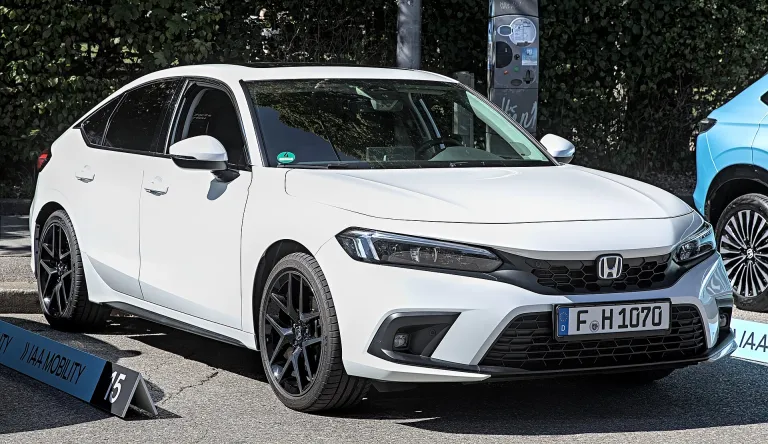
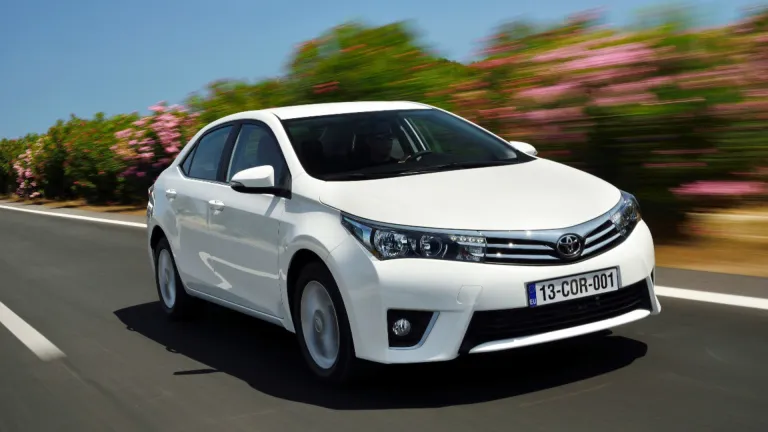
| Honda Civic | Toyota Corolla | |
|---|---|---|
| General | ||
| Version | Civic XI · 2.0 e:HEV · hybrid · 135 kW (184 PS) | Corolla E210 · 2.0 Hybrid (2023 update) · 144 kW (196 PS) |
| Production years | 2021–present | 2018–present |
| Body | Liftback | Hatchback |
| Country | Japan | Japan |
| Performance | ||
| Power Why it matters: More power means stronger acceleration and easier overtaking, especially with a full load. | 135 kW (184 PS) 181 hp | 144 kW (196 PS) 193 hp Better |
| Power, all versions | 57–135 kW (77–184 PS) 76–181 hp | 73–144 kW (99–196 PS) 98–193 hp |
| Torque Why it matters: Torque is the pulling force you feel when accelerating from low revs, towing or climbing hills. | 315 Nm 232 lb-ft | No data |
| 0–100 km/h Why it matters: A shorter 0–100 km/h time means quicker getaways and safer merging onto fast roads. | 7.8 s | 7.5 s Better |
| Top speed Why it matters: Top speed hints at how relaxed the car is at motorway speeds, even if you never reach it. | 180 km/h 112 mph | 180 km/h 112 mph |
| Power per tonne | 89 kW/t 108 hp/ton calculated | 99 kW/t 120 hp/ton calculated Better |
| Engine and transmission | ||
| Fuel | Hybrid | Hybrid |
| Engine | 4 cyl | No data |
| Engine code | No data | M20A-FXS |
| Gearbox | No data | CVT |
| Drive | Front-wheel drive | Front-wheel drive |
| Dimensions and weight | ||
| Length | 4,549 mm 179.1 in | 4,370 mm 172.0 in |
| Width | 1,801 mm 70.9 in | 1,790 mm 70.5 in |
| Height | 1,410 mm 55.5 in | 1,435 mm 56.5 in † |
| Wheelbase | 2,736 mm 107.7 in | 2,640 mm 103.9 in † |
| Kerb weight Why it matters: A lighter car is usually more agile and uses less energy. | 1,517 kg 3,344 lb | 1,460 kg 3,219 lb Better |
| Boot Why it matters: A bigger boot fits more luggage, shopping or a pram. | 410 l 14.5 cu ft Better | 313 l 11.1 cu ft |
| Fuel tank Why it matters: A larger tank means more distance between fuel stops. | 40 l 10.6 gal US | 43 l 11.4 gal US Better |
| Economy and running costs | ||
| Fuel consumption Why it matters: Lower consumption cuts running costs and CO₂ emissions on every trip. | 4.7 l/100 km 50.0 mpg US | 4.4 l/100 km 53.5 mpg US Better |
| CO₂ | 108 g/km | 100 g/km Better |
| Fuel cost per year | €1,230/year estimated | €1,160/year estimated Better |
| Range on a full tank | 851 km 529 mi estimated | 977 km 607 mi estimated Better |
| Safety | ||
| Euro NCAP | ★★★★★ (2022) | ★★★★★ (2019) |
These cars do not differ in the data we have.
Equal rows hidden (4): Country, Top speed, Fuel, Drive.
Better marks the stronger figure — only for measurable specs (power, torque, 0–100 km/h, consumption, boot, weight).
Estimated at 15,000 km a year with fuel at €1.75/l petrol. † from another version of this generation.
In plain words
Toyota Corolla is quicker: 0–100 km/h in 7.5 s against 7.8 s for Honda Civic. Honda Civic is 179 mm longer than Toyota Corolla (4,549 mm vs 4,370 mm). Toyota Corolla is lighter by 57 kg (1,460 kg vs 1,517 kg). Honda Civic has the bigger boot: 410 l against 313 l. At 15,000 km a year, fuel would cost about €1,230 (Honda Civic), €1,160 (Toyota Corolla) (estimated). Toyota Corolla is the older design (from 1966); Honda Civic arrived in 1972. On the catalog figures, the Honda Civic is the pick for family; the Toyota Corolla is the pick for city, long trips, performance, running costs and off-road.
Which one to choose
Choose the Honda Civic if you want a roomier liftback, a hybrid that drives mostly on electric power in town, or the Type R at the top of the range.
Choose the Toyota Corolla if you need an estate or a saloon, want to pick between a 103 kW and a 144 kW hybrid, or put the best adult-occupant result in Euro NCAP first.
Buyers also considering a European rival can read our Toyota Corolla vs Volkswagen Golf comparison; for the next size up there is Honda Accord vs Toyota Camry.
Frequently asked questions
Which is bigger, the Civic or the Corolla?
The Civic. Its liftback is 4,549 mm long against 4,370 mm for the Corolla hatchback, and its wheelbase is 2,736 mm against 2,700 mm for the Corolla saloon and estate.
Which hybrid is more powerful?
The Corolla 2.0 Hybrid has 144 kW (196 PS). The Civic e:HEV's drive motor has 135 kW (184 PS) but more torque, 315 Nm. The Corolla 1.8 Hybrid has 103 kW.
Is there a Civic or Corolla estate?
Only the Corolla: Toyota sells it as the Touring Sports estate. The current Civic is a liftback or, in North America, a saloon.
Which scored better in Euro NCAP?
It depends on the category. The Corolla leads for adult occupants (95% in 2019 against 89% for the Civic in 2022) and for pedestrians (86% against 82%); the Civic leads for child occupants, 87% against 84%.
Can you still buy either with a manual gearbox?
The Civic is still offered with a six-speed manual in some markets, and the Civic Si is manual-only. Apart from the GR Corolla, every current Corolla is automatic.