
Audi A3 vs Mercedes A-Class: premium compacts
Updated Report an error By Sarah Whitmore
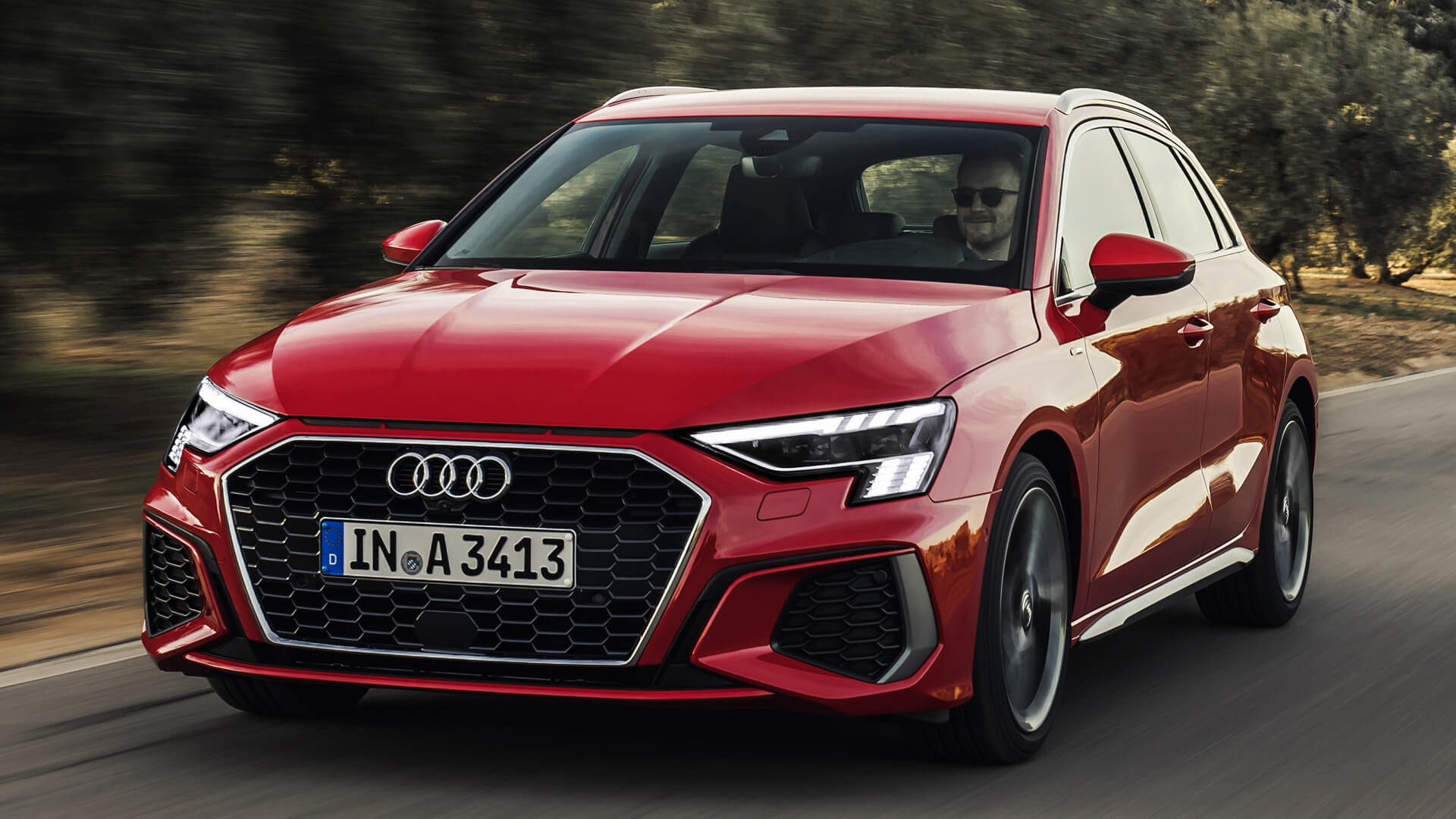
Audi · 2020–present
A3 8Y
- Power
- 110 kW150 PS
- 0–100 km/h
- 8.4 s
- Top speed
- 224 km/h
- Kerb mass
- 1,355 kg
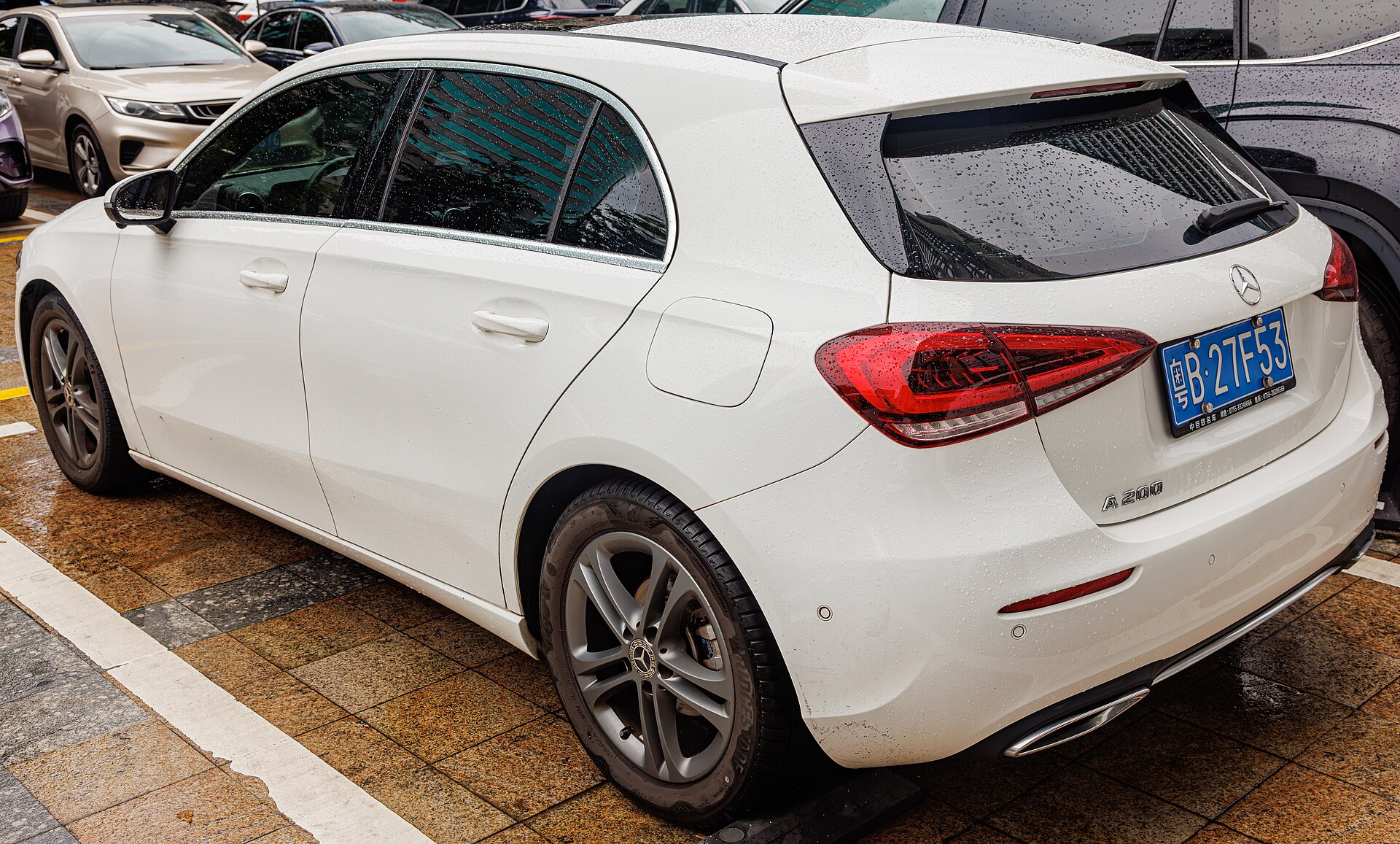
Mercedes-Benz · 2018–present
A-Class W177
- Power
- 120 kW163 PS
- 0–100 km/h
- 8.0 s
- Top speed
- 225 km/h
- Kerb mass
- 1,355 kg
At a glance
Who suits what, worked out from the catalog figures of the versions above.
Categories won: A3 8Y 4 A-Class W177 1
- Family A3 8Y Boot: 380 l vs 355 l
- City A3 8Y Consumption: 5.8 l/100 km vs 6.2 l/100 km
- Long trips A3 8Y Range: 862 km vs 694 km (estimated)
- Performance A-Class W177 Power per tonne: 89 kW/t vs 81 kW/t; 0–100 km/h: 8.0 s vs 8.4 s
- Running costs A3 8Y Fuel per year: €1,520 vs €1,630 (estimated)
- Off-road Too close to call Drive and body: Front-wheel drive · Hatchback vs Front-wheel drive · Hatchback
Verdict Opinion
The A3 offers a manual gearbox on base versions, front-wheel drive with quattro on stronger engines and, in the RS 3, the only five-cylinder engine of this pair.
The A-Class has the longer wheelbase, the MBUX infotainment system that it introduced in 2018, the higher Euro NCAP score and the most powerful engine in this pair, the 310 kW A 45 S. Buyers who want the badge and safety record of Mercedes at compact size will be well served by an A 200 or A 250.
- Sarah Whitmore
Audi entered the compact class in 1996 with the first A3 (8L); 880,000 of that generation were built. Mercedes-Benz entered a year later with a very different idea. The first A-Class of 1997 was a short, tall car with a "sandwich" floor, and three days after its launch a Swedish magazine's evasive-manoeuvre test tipped it onto its side. Mercedes stopped deliveries and made ESP stability control standard.
The two concepts converged in 2012, when the third A-Class became a conventional hatchback. Today's rivals are the fourth-generation Audi A3 (8Y), whose Sportback was revealed on 3 March 2020 and facelifted in March 2024, and the W177 A-Class, which went on sale in March 2018 and was updated for the 2023 model year. Both are offered as five-door hatchbacks and as saloons.
Audi A3 vs Mercedes-Benz A-Class: what separates them
Wheelbase, length and boot
The A-Class has the longer wheelbase, 2,729 mm against 2,636 mm for the A3, a difference of 93 mm. The W177 hatchback is 4,419 mm long and its saloon 4,549 mm; the A3 saloon measures 4,495 mm. The A3 Sportback's boot holds 380 litres, or 1,200 litres with the rear seats folded; quattro versions have 320 litres.
Everyday engines
At launch the A3 offered a 1.5 TFSI with 110 kW (150 PS) and 250 Nm and a 2.0 TDI with 85 or 110 kW. The A-Class range includes the A 180 with 100 kW (136 PS), the A 200 with 120 kW (163 PS) and the A 250 with 165 kW (224 PS), plus the A 180 d and A 200 d diesels with 85 and 110 kW. The 1.3-litre petrol engine of the smaller Mercedes was developed with the Renault-Nissan-Mitsubishi alliance.
Plug-in hybrids
Both have them. Audi sells the 40 TFSI e and 45 TFSI e; Wikipedia gives 7.4 and 6.3 seconds to 100 km/h. In the Mercedes A 250 e, an electric motor of 75 kW joins the 1.3-litre petrol unit; together they deliver 160 kW (218 PS), and the battery stores 15.6 kWh.
Performance models
Audi's RS 3 relies on a 2.5-litre five-cylinder: 294 kW (400 PS), 500 Nm. The Mercedes-AMG A 45 S has a 2.0-litre four with 310 kW (421 PS), 16 kW more, and reaches 100 km/h in 3.9 seconds. Below them sit the S3 with 231 kW (310 PS) and the A 35 with 225 kW (306 PS).
Euro NCAP: 96 against 89 percent
The W177 received five stars in 2018 with 96 percent for adult occupants, the best result of any A-Class. The A3 35 TFSI scored 89 percent for adults in 2020.
Gearboxes and prices
Mercedes dropped the manual gearbox with the 2023 update, while the A3 started with a six-speed manual on base versions. In Germany the A3 Sportback started at €28,900 when it went on sale in May 2020.
Race Stats side by side
Each figure is a 0–100 score from the catalog numbers, the same as on the 1CARS Race cards. PI is the overall performance index (100–999) and its class D–S.
| Stat | A3 8Y | A-Class W177 |
|---|---|---|
| PI | B · 530 | B · 539 |
| Power | 44 | 46 |
| Grip | 39 | 39 |
| Handling | 71 | 71 |
| Top speed | 48 | 48 |
| Launch | 40 | 42 |
Grip and handling are estimates from drive type, weight, height and body (hover a figure to see where it comes from). 1CARS Race
Who wins a race?
Quarter-mile (402 m) drag from a standing start, dry road, no reaction time - the 1CARS Race physics on the catalog figures of these versions.
- 1 A-Class W177A-Class W177 · A 200 · petrol · 120 kW (163 PS) 15.83 sat 142 km/h
- 2 A3 8YA3 8Y · Sportback 35 TFSI · petrol · 110 kW (150 PS) 16.09 sat 139 km/h · +0.26 s
Size and weight
Side view to scale, all cars from the front bumper.
| A3 8Y | A-Class W177 | |
|---|---|---|
| Length | 4,343 mm171.0 in † | 4,419 mm174.0 in † +76 mm +3.0 in +1.7% |
| Width | 1,816 mm71.5 in † | 1,796 mm70.7 in † −20 mm −0.8 in −1.1% |
| Height | 1,449 mm57.0 in † | 1,440 mm56.7 in † −9 mm −0.4 in −0.6% |
| Wheelbase | 2,636 mm103.8 in | 2,729 mm107.4 in † +93 mm +3.7 in +3.5% |
| Kerb weight | 1,355 kg2,987 lb | 1,355 kg2,987 lb |
| Boot | 380 l13.4 cu ft | 355 l12.5 cu ft −25 l −0.9 cu ft −6.6% |
| Fuel tank | 50 l13.2 gal US | 43 l11.4 gal US −7 l −1.8 gal US −14.0% |
| Fits a standard garage? | Yes | Yes |
Difference vs A3 8Y (±). Garage check: a standard single garage takes a car up to about 5.0 m (16 ft 5 in) long and 1.9 m (6 ft 3 in) wide (width as listed in the catalog; some makers include the mirrors). Leave about 0.6 m (2 ft) to open the doors. † from another version of this generation.
Full specifications
| Audi A3 | Mercedes-Benz A-Class | |
|---|---|---|
| General | ||
| Version | A3 8Y · Sportback 35 TFSI · petrol · 110 kW (150 PS) | A-Class W177 · A 200 · petrol · 120 kW (163 PS) |
| Production years | 2020–present | 2018–present |
| Body | Hatchback | Hatchback |
| Country | Germany | Germany |
| Performance | ||
| Power Why it matters: More power means stronger acceleration and easier overtaking, especially with a full load. | 110 kW (150 PS) 148 hp | 120 kW (163 PS) 161 hp Better |
| Power, all versions | 85–110 kW (116–150 PS) 114–148 hp | 44–310 kW (60–421 PS) 59–416 hp |
| Torque Why it matters: Torque is the pulling force you feel when accelerating from low revs, towing or climbing hills. | 250 Nm 184 lb-ft | 250 Nm 184 lb-ft |
| 0–100 km/h Why it matters: A shorter 0–100 km/h time means quicker getaways and safer merging onto fast roads. | 8.4 s | 8.0 s Better |
| Top speed Why it matters: Top speed hints at how relaxed the car is at motorway speeds, even if you never reach it. | 224 km/h 139 mph | 225 km/h 140 mph |
| Power per tonne | 81 kW/t 99 hp/ton calculated | 89 kW/t 108 hp/ton calculated Better |
| Engine and transmission | ||
| Fuel | Petrol | Petrol |
| Engine | No data | 1,332 cc · 4 cyl 1.3 l |
| Engine code | No data | M282 |
| Drive | Front-wheel drive | Front-wheel drive |
| Dimensions and weight | ||
| Length | 4,343 mm 171.0 in † | 4,419 mm 174.0 in † |
| Width | 1,816 mm 71.5 in † | 1,796 mm 70.7 in † |
| Height | 1,449 mm 57.0 in † | 1,440 mm 56.7 in † |
| Wheelbase | 2,636 mm 103.8 in | 2,729 mm 107.4 in † |
| Kerb weight Why it matters: A lighter car is usually more agile and uses less energy. | 1,355 kg 2,987 lb | 1,355 kg 2,987 lb |
| Boot Why it matters: A bigger boot fits more luggage, shopping or a pram. | 380 l 13.4 cu ft Better | 355 l 12.5 cu ft |
| Fuel tank Why it matters: A larger tank means more distance between fuel stops. | 50 l 13.2 gal US Better | 43 l 11.4 gal US |
| Economy and running costs | ||
| Fuel consumption Why it matters: Lower consumption cuts running costs and CO₂ emissions on every trip. | 5.8 l/100 km 40.6 mpg US Better | 6.2 l/100 km 37.9 mpg US |
| CO₂ | 132 g/km Better | 140 g/km |
| Fuel cost per year | €1,520/year estimated Better | €1,630/year estimated |
| Range on a full tank | 862 km 536 mi estimated Better | 694 km 431 mi estimated |
| Safety | ||
| Euro NCAP | ★★★★★ (2025) | ★★★★★ (2018) |
These cars do not differ in the data we have.
Equal rows hidden (6): Body, Country, Torque, Fuel, Drive, Kerb weight.
Better marks the stronger figure - only for measurable specs (power, torque, 0–100 km/h, consumption, boot, weight).
Estimated at 15,000 km a year with fuel at €1.75/l petrol. † from another version of this generation.
In plain words
Mercedes-Benz A-Class is quicker: 0–100 km/h in 8.0 s against 8.4 s for Audi A3. Mercedes-Benz A-Class is 76 mm longer than Audi A3 (4,419 mm vs 4,343 mm). Audi A3 has the bigger boot: 380 l against 355 l. At 15,000 km a year, fuel would cost about €1,520 (Audi A3), €1,630 (Mercedes-Benz A-Class) (estimated). Audi A3 is the older design (from 1996); Mercedes-Benz A-Class arrived in 1997. On the catalog figures, the Audi A3 is the pick for family, city, long trips and running costs; the Mercedes-Benz A-Class is the pick for performance.
Which one to choose
Choose the Audi A3 if you want a manual gearbox on a base model, the RS 3's five-cylinder engine, or a compact with quattro all-wheel drive.
Choose the Mercedes-Benz A-Class if you value the top Euro NCAP adult score, a longer wheelbase, MBUX voice control or the 310 kW A 45 S.
Both brands' ranges are in the Audi catalogue and the Mercedes-Benz catalogue; the class benchmark they are often measured against is the Volkswagen Golf.
Frequently asked questions
Which is bigger, the A3 or the A-Class?
The A-Class has a 93 mm longer wheelbase (2,729 mm against 2,636 mm), and its saloon is 54 mm longer than the A3 saloon (4,549 mm against 4,495 mm).
Which is faster, the RS 3 or the A 45 S?
The A 45 S has more power, 310 kW against 294 kW, and reaches 100 km/h in 3.9 seconds. The RS 3 has a 2.5-litre five-cylinder engine with 500 Nm.
Which of the two has the better crash-test result?
The A-Class: 96 percent for adult occupants in 2018, against 89 percent for the A3 in 2020.
Are both available as saloons?
Yes. Audi offers the A3 Sportback and saloon; Mercedes sells the A-Class hatchback and the V177 saloon, plus a long-wheelbase saloon for China.