
Hyundai Tucson vs Kia Sportage: same base, two cars
Updated Report an error By Sarah Whitmore

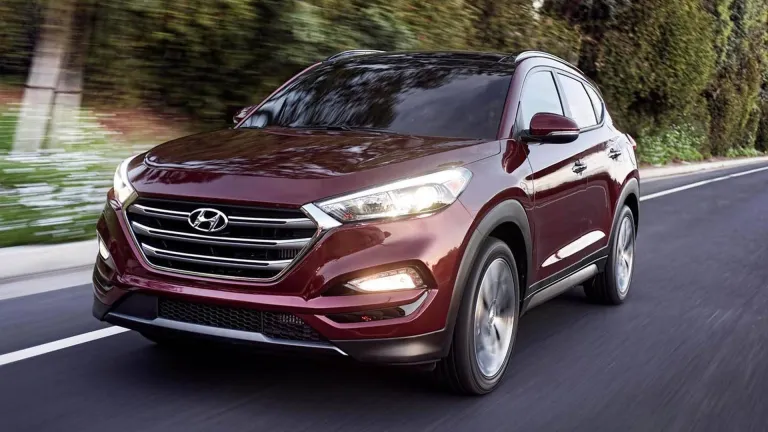
Hyundai · 2004–2009
Tucson JM
- Power
- 129 kW175 PS
- 0–100 km/h
- 10.5 s
- Top speed
- 180 km/h
- Kerb mass
- 1,668 kg

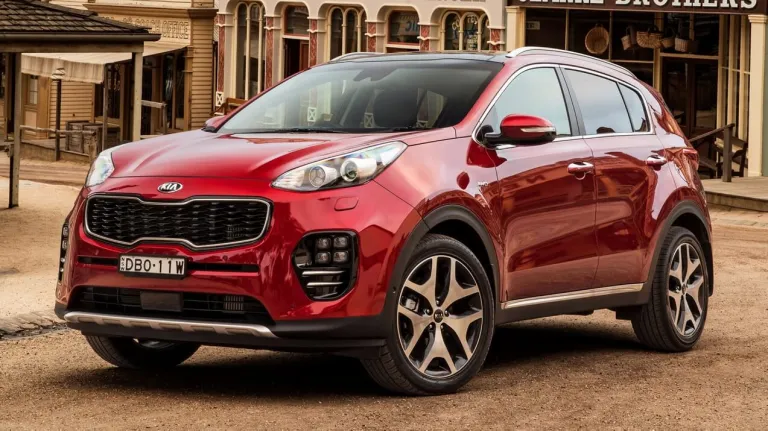
Kia · 2010–2015
Sportage SL
- Power
- 85 kW116 PS
- 0–100 km/h
- 12.3 s
- Top speed
- 173 km/h
- Kerb mass
- 1,490 kg
At a glance
Who suits what, worked out from the catalog figures of the versions above.
Categories won: Tucson JM 2 Sportage SL 2
- Family Too close to call Boot: 540 l vs 465 l
- City Tucson JM Length: 4,325 mm vs 4,440 mm; Width: 1,795 mm vs 1,855 mm
- Long trips Sportage SL Range: 1,094 km vs 650 km (estimated)
- Performance Tucson JM Power per tonne: 77 kW/t vs 57 kW/t; 0–100 km/h: 10.5 s vs 12.3 s
- Running costs Sportage SL Fuel per year: €1,310 vs €2,630 (estimated)
Verdict Opinion
Mechanically this is a draw: the same engines, the same hybrid and plug-in systems, the same platform and very similar dimensions in Europe. Neither car has an advantage you can measure on a spec sheet.
The Sportage edges ahead for buyers who keep a car for a long time but drive average distances, thanks to its seven-year warranty. It is also the one to pick if you still want a diesel. The Tucson suits high-mileage drivers better, since its five-year cover has no kilometre limit. After that, let styling, equipment and the local dealer offer decide.
— Sarah Whitmore
Search for one of these SUVs and the other appears in the next result. Hyundai owns a large stake in Kia, and the two brands share platforms and engines. In Europe both cars are built a short drive apart: the Tucson at Hyundai's plant in Nošovice, Czech Republic, and the Sportage at Kia's factory in Žilina, Slovakia.
The Sportage is the older name. Kia launched it in 1993, eleven years before the first Tucson of 2004, and the second-generation Sportage was already based on the Tucson's mechanicals. The current pair, the fourth-generation Tucson (revealed in September 2020) and the fifth-generation Sportage (revealed in June 2021), share the same third-generation architecture, known as N3. So the real question is not which one is better engineered, but which design, warranty and price suit you.
Hyundai Tucson vs Kia Sportage: what really differs
The same powertrains
In Europe the two cars use an almost identical engine list. The 1.6 T-GDi petrol with a 48-volt mild-hybrid system comes with 110 kW (150 PS) or 132 kW (180 PS). The full hybrid combines the same engine with an electric motor for 169 kW (230 PS), and the plug-in hybrid reaches 195 kW (265 PS) with a 13.8 kWh battery. Kia has also kept a 1.6 CRDi diesel with 85 or 100 kW (115 or 136 PS) in the Sportage range. Front-wheel drive is standard; the stronger versions add all-wheel drive.
European sizes
Both brands built a shorter version for Europe. The global Sportage is 4,660 mm long on a 2,755 mm wheelbase; the European car loses 135 mm in length and 75 mm between the axles. The European Tucson uses the same short 2,680 mm wheelbase, while long-wheelbase Tucsons for other markets measure 4,630–4,670 mm. In practice the two cars offer very similar cabin room, and the choice of hybrid or plug-in version affects the boot more than the badge does.
Design and cabin
The difference you notice first is styling. The Tucson has a grille with daytime running lights hidden in its pattern and sharp, angular flanks. The Sportage wears boomerang-shaped lights and a more conventional profile. Inside, both use large screens; the details of the dashboard and controls differ by model year, so try both before deciding.
Warranty and safety
Kia's seven-year, 150,000 km warranty is one of the longest in Europe; Hyundai answers with five years and no mileage limit. Both cars earned five Euro NCAP stars, the Tucson in 2021 and the Sportage in 2022.
Race Stats side by side
Each figure is a 0–100 score from the catalog numbers, the same as on the 1CARS Race cards. PI is the overall performance index (100–999) and its class D–S.
| Stat | Tucson JM | Sportage SL |
|---|---|---|
| PI | C · 463 | C · 407 |
| Power | 42 | 33 |
| Grip | 47 | 32 |
| Handling | 48 | 55 |
| Top speed | 31 | 28 |
| Launch | 30 | 22 |
Grip and handling are estimates from drive type, weight, height and body (hover a figure to see where it comes from). 1CARS Race
Who wins a race?
Quarter-mile (402 m) drag from a standing start, dry road, no reaction time — the 1CARS Race physics on the catalog figures of these versions.
- 1 Tucson JMTucson JM · 2.7 · petrol · 129 kW (175 PS) 17.23 sat 123 km/h
- 2 Sportage SLSportage SL · 1.7 · diesel · 85 kW (116 PS) 18.10 sat 121 km/h · +0.87 s
Size and weight
Side view to scale, all cars from the front bumper.
| Tucson JM | Sportage SL | |
|---|---|---|
| Length | 4,325 mm170.3 in † | 4,440 mm174.8 in +115 mm +4.5 in +2.7% |
| Width | 1,795 mm70.7 in † | 1,855 mm73.0 in +60 mm +2.4 in +3.3% |
| Height | 1,730 mm68.1 in † | 1,635 mm64.4 in −95 mm −3.7 in −5.5% |
| Wheelbase | 2,630 mm103.5 in † | 2,640 mm103.9 in +10 mm +0.4 in +0.4% |
| Kerb weight | 1,668 kg3,677 lb | 1,490 kg3,285 lb −178 kg −392 lb −10.7% |
| Boot | 540 l19.1 cu ft | 465 l16.4 cu ft −75 l −2.6 cu ft −13.9% |
| Fuel tank | 65 l17.2 gal US | 58 l15.3 gal US −7 l −1.8 gal US −10.8% |
| Fits a standard garage? | Yes | Tight |
Difference vs Tucson JM (±). Garage check: a standard single garage takes a car up to about 5.0 m (16 ft 5 in) long and 1.9 m (6 ft 3 in) wide (width as listed in the catalog; some makers include the mirrors). Leave about 0.6 m (2 ft) to open the doors. † from another version of this generation.
Full specifications
| Hyundai Tucson | Kia Sportage | |
|---|---|---|
| General | ||
| Version | Tucson JM · 2.7 · petrol · 129 kW (175 PS) | Sportage SL · 1.7 · diesel · 85 kW (116 PS) |
| Production years | 2004–2009 | 2010–2015 |
| Body | SUV | SUV, Convertible |
| Class | SUV / crossover | SUV / crossover |
| Country | South Korea | South Korea |
| Performance | ||
| Power Why it matters: More power means stronger acceleration and easier overtaking, especially with a full load. | 129 kW (175 PS) 173 hp Better | 85 kW (116 PS) 114 hp |
| Power, all versions | 100–136 kW (136–185 PS) 134–182 hp | 61–195 kW (83–265 PS) 82–261 hp |
| Torque Why it matters: Torque is the pulling force you feel when accelerating from low revs, towing or climbing hills. | No data | 260 Nm 192 lb-ft |
| 0–100 km/h Why it matters: A shorter 0–100 km/h time means quicker getaways and safer merging onto fast roads. | 10.5 s Better | 12.3 s |
| Top speed Why it matters: Top speed hints at how relaxed the car is at motorway speeds, even if you never reach it. | 180 km/h 112 mph Better | 173 km/h 107 mph |
| Power per tonne | 77 kW/t 94 hp/ton calculated Better | 57 kW/t 69 hp/ton calculated |
| Engine and transmission | ||
| Fuel | Petrol | Diesel |
| Engine | 2,700 cc · 6 cyl 2.7 l | 1,700 cc 1.7 l |
| Gearbox | No data | 6-speed manual |
| Drive | All-wheel drive | Front-wheel drive |
| Dimensions and weight | ||
| Length | 4,325 mm 170.3 in † | 4,440 mm 174.8 in |
| Width | 1,795 mm 70.7 in † | 1,855 mm 73.0 in |
| Height | 1,730 mm 68.1 in † | 1,635 mm 64.4 in |
| Wheelbase | 2,630 mm 103.5 in † | 2,640 mm 103.9 in |
| Kerb weight Why it matters: A lighter car is usually more agile and uses less energy. | 1,668 kg 3,677 lb | 1,490 kg 3,285 lb Better |
| Boot Why it matters: A bigger boot fits more luggage, shopping or a pram. | 540 l 19.1 cu ft Better | 465 l 16.4 cu ft |
| Fuel tank Why it matters: A larger tank means more distance between fuel stops. | 65 l 17.2 gal US Better | 58 l 15.3 gal US |
| Economy and running costs | ||
| Fuel consumption Why it matters: Lower consumption cuts running costs and CO₂ emissions on every trip. | 10.0 l/100 km 23.5 mpg US | 5.3 l/100 km 44.4 mpg US Better |
| CO₂ | 237 g/km | 139 g/km Better |
| Fuel cost per year | €2,630/year estimated | €1,310/year estimated Better |
| Range on a full tank | 650 km 404 mi estimated | 1,094 km 680 mi estimated Better |
| Safety | ||
| Euro NCAP | ★★★★☆ (2006) | ★★★★★ (2010) Better |
These cars do not differ in the data we have.
Equal rows hidden (2): Class, Country.
Better marks the stronger figure — only for measurable specs (power, torque, 0–100 km/h, consumption, boot, weight).
Estimated at 15,000 km a year with fuel at €1.75/l petrol, €1.65/l diesel. † from another version of this generation.
In plain words
Hyundai Tucson is quicker: 0–100 km/h in 10.5 s against 12.3 s for Kia Sportage. Kia Sportage is 115 mm longer than Hyundai Tucson (4,440 mm vs 4,325 mm). Kia Sportage is lighter by 178 kg (1,490 kg vs 1,668 kg). Hyundai Tucson has the bigger boot: 540 l against 465 l. At 15,000 km a year, fuel would cost about €2,630 (Hyundai Tucson), €1,310 (Kia Sportage) (estimated). Kia Sportage is the older design (from 1993); Hyundai Tucson arrived in 2004. On the catalog figures, the Hyundai Tucson is the pick for city and performance; the Kia Sportage is the pick for long trips and running costs.
Which one to choose
Choose the Hyundai Tucson if you like its bolder design, drive long distances every year and want a warranty without a mileage cap.
Choose the Kia Sportage if you want the longest warranty period, a diesel option, or simply prefer its looks and dashboard.
For a plug-in hybrid, the two are interchangeable on paper: compare the price, standard equipment and delivery time of the exact versions you are offered. If you are also considering a Japanese rival, see our Sportage vs Outlander comparison.
Frequently asked questions
Are the Tucson and the Sportage the same car?
Underneath, largely yes. The current generations share the N3 platform and the same 1.6 T-GDi engines, hybrid and plug-in systems. Body design, interior, tuning and warranty differ.
Which is built in Europe?
Both. The Tucson for Europe comes from Hyundai's plant in Nošovice, Czech Republic; the Sportage is built at Kia's factory in Žilina, Slovakia.
Which has the better warranty?
It depends on your mileage. Kia offers seven years or 150,000 km in Europe; Hyundai offers five years with no kilometre limit.
Do both have a plug-in hybrid?
Yes. Both use a 1.6 T-GDi engine with a 13.8 kWh battery and a system output of 195 kW (265 PS).
Is there a new Tucson?
Hyundai revealed a fifth-generation Tucson in August 2026. The fourth generation (NX4), revealed in 2020, is the one most buyers will find on the used market.