
 Mazda RX-3
Specs, engines and history
Published Sources (3) Report an error
By Sarah Whitmore, Senior Automotive Writer
- Built
- 1971–1978
- Top power
- 96 kW (131 PS)
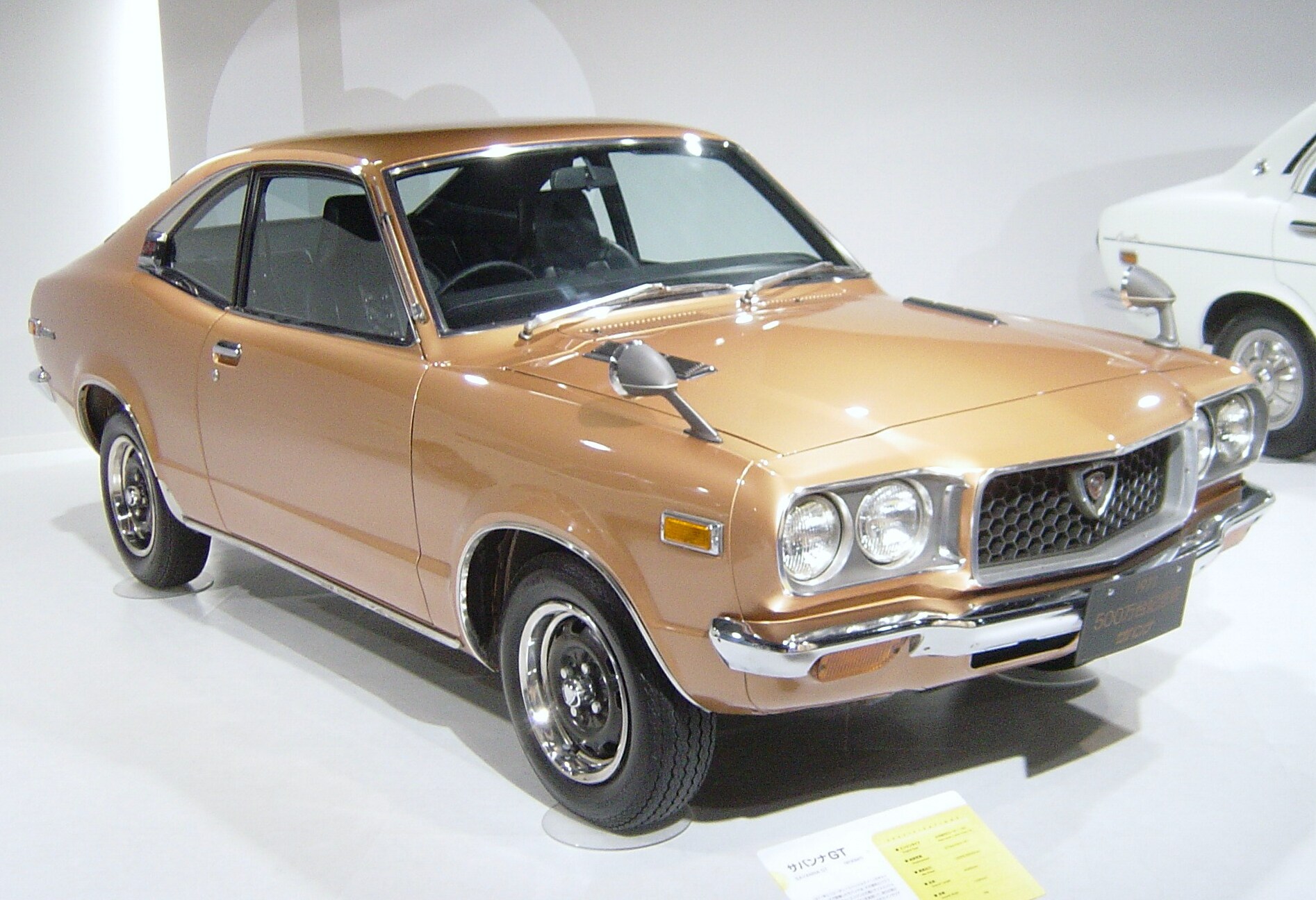
The Mazda RX-3 is the twin-rotor version of the Grand Familia compact, sold in Japan as the Savanna from 1971 to 1978. It used the 982 cc 10A Wankel engine and later the 1,146 cc 12A, with up to 96 kW (130 PS) in Japanese form. Around 286,000 were made, and in 1971-1972 it ended the Nissan Skyline GT-R's long winning run in Japanese touring-car racing.
In short
- Launched in September 1971 as the Savanna in Japan; the RX-3 name was used for export, and the piston-engined twin was sold as the 808 or 818.
- Coupé, four-door saloon and estate bodies; the Super Deluxe coupé weighed 884 kg.
- Classics World gives 286,757 built, with a peak of 105,819 in 1973.
- Japanese touring-car titles at Fuji in 1972, 1973 and 1975, a Bathurst class win in 1975 and the 100th domestic race win in 1976.
Specs by version
Engines
| Version | Engine | Power | Torque | Gearbox | Drive | Production years |
|---|---|---|---|---|---|---|
| RX-3 12A 90 hp (USA) | 1.1 l · Petrol 12A | 67 kW 91 PS90 hp | 127 Nm94 lb-ft | - | Rear-wheel drive | 1972–1978 |
| RX-3 12A 71 kW (Australia) | 1.1 l · Petrol 12A | 71 kW 97 PS95 hp | - | - | Rear-wheel drive | - |
| 10A coupé 105 PS | 1.0 l · Petrol 10A | 77 kW 105 PS103 hp | 135 Nm100 lb-ft | 4-sp Manual | Rear-wheel drive | 1971–1974 |
| Savanna GT 12A 125 PS | 1.1 l · Petrol 12A | 92 kW 125 PS123 hp | - | 5-sp Manual | Rear-wheel drive | 1972 |
Performance
Show all 2 versions
| Version | 0–100 km/h | Top speed |
|---|---|---|
| RX-3 12A 71 kW (Australia) | 10.5 s 0–62 mph | - |
| 10A coupé 105 PS | - | 177 km/h110 mph |
Dimensions and weight
Show all 1 versions
| Version | Kerb weight |
|---|---|
| 10A coupé 105 PS | 884 kg1,949 lb |
Verified Manufacturer and type-approval data from our catalog · Sources and methodology
Mazda RX-3 at a glance
| Specification | Mazda RX-3 |
|---|---|
| Years | September 1971 to 1978 (Japan and USA); exports to Australia and New Zealand ended by 1976 |
| Production | 286,757 (Classics World); other sources give 285,887 or more than 280,000 |
| Names | Savanna (Japan), RX-3 (export); piston versions Grand Familia, 808, 818, Mizer |
| Body styles | two-door coupé, four-door saloon, five-door estate |
| Layout | front engine, rear-wheel drive |
| Engines | 982 cc 10A twin-rotor (2 x 491 cc); 1,146 cc 12A twin-rotor (2 x 573 cc) |
| Power | 77 kW (105 PS) 10A; 92 kW (125 PS) Savanna GT; 96 kW (130 PS) later 12A; 67 kW (90 hp) US 12A |
| Gearboxes | four-speed manual, five-speed manual on the Savanna GT, three-speed automatic |
| Weight | 884 kg (Super Deluxe coupé) |
| Top speed | 177 km/h (110 mph), 10A coupé |
| 0-100 km/h | 10.5 s, Australian 12A (Retro Rides); 0-60 mph in 10.2 s for the UK 10A coupé (Motor, 1973) |
| Price new | GBP 1,633 for the UK coupé in 1972 |
Why Mazda built a rotary Grand Familia
By the end of 1970 Mazda had built 100,000 rotary engines, and the company wanted the Wankel in every size class it sold. The Cosmo Sport of 1967 came first, and the Capella RX-2 brought the rotary to the mid-size range. The RX-3 took it one step down, into the Grand Familia, a compact that otherwise ran on 1.3- to 1.6-litre four-cylinder engines.
The rotary and its piston twin shared the body shell. The Savanna had its own nose cone and triple-lens tail lights, and the sporting coupés had vents in the rear three-quarter panels. Mazda sold the piston car under several names: Grand Familia at home, 808 in the USA and Australia, and 818 in Europe because Peugeot claimed three-digit names with a zero in the middle. In the UK the RX-3 coupé cost GBP 1,633 in 1972, which was GBP 335 more than the 818 coupé with the same body.
The earlier rotary Mazda Cosmo explains where the engine came from. The RX-3 is the car that put it into volume production for buyers on an ordinary budget.
10A and 12A engines in the RX-3
Launch cars used the 10A, a twin-rotor unit with two 491 cc chambers, rated at 77 kW (105 PS) and 135 Nm. In 1972 the Japanese Savanna GT received the larger 12A with 1,146 cc and 92 kW (125 PS), together with a five-speed gearbox, while the regular car kept four speeds. A later single-distributor 12A was rated at 96 kW (130 PS) and 156 Nm. The 10A was dropped in 1974.
North American RX-3s always had the 12A. Emission rules pulled the federal version down to 67 kW (90 hp) and 127 Nm, and the US Sports Wagon estate was offered only for 1972 and 1973.
Motor tested a 10A coupé in 1973 and recorded 0-60 mph in 10.2 seconds and 24.9 mpg (11.3 L/100 km) over 1,220 miles, against 15.3 seconds for the 1.3-litre 818 saloon. The thirst became a sales problem after the 1973 oil crisis, and Australian buyers already saw the car as expensive to run.


Mazda RX-3 racing record against the Skyline GT-R
The Savanna arrived when the Nissan Skyline GT-R had been winning almost every Japanese touring-car race it entered. Mazda counts the 1971 Fuji Tourist Trophy, held in December, as its first overall victory, with the RX-3 beating the Skyline GT-R. At the Fuji Touring Car Grand Prix in May 1972 the rotary cars finished first, second and third. Wikipedia ties the end of the streak to the 1972 Japanese Grand Prix touring-car race, which kept the GT-R from a 50th consecutive win; Top Gear speaks of nearly 50 wins in a row.
| Year | Event | Result |
|---|---|---|
| 1971 | Fuji Tourist Trophy (December) | first overall win, ahead of the Skyline GT-R |
| 1972 | Fuji Touring Car Grand Prix (May) | first, second and third |
| 1972, 1973, 1975 | Fuji Grand Champion touring-car series | titles |
| 1974 | Bathurst 1000 | class win |
| 1975 | Bathurst 1000 | class win and fifth overall |
| 1975 | Daytona 24 Hours | 14th overall, third in class (private entry) |
| 1976 | JAF Touring Car Grand Prix | Mazda's 100th domestic race victory |
The car raced in the SCCA and IMSA series in North America and was entered at Le Mans by a private French team in 1975 after failing to qualify a year earlier. At Bathurst in 1975 the class-winning RX-3 was beaten overall only by four Holden Toranas with 5.0-litre V8 engines.
RX-3 production numbers and the RX-7 successor
Sales rose quickly. The RX-3 outsold the RX-2 from 1972 and reached 105,819 units in 1973, the year Mazda's total rotary output passed 500,000. In the UK the importer sold three times as many RX-3s as 818s that year, and an estate was added. From 1974 the larger RX-4 sold in greater numbers, and the oil crisis hurt every rotary model.
UK sales of the RX-3 ended in 1976, and Australian and New Zealand imports also stopped by then. Japan and the USA kept the car until 1978, when it made room for the two-seat Mazda RX-7. With 286,757 made, the RX-3 is the second-best-selling Mazda rotary after the RX-7 family.
Mazda RX-3 today: what to check when buying
Classics World's guide sends buyers along every seam. The front end with its separate nose, the sills, wheelarches, front and rear valances, the area around the rear light clusters and the rear three-quarter vents on sporting coupés are the usual rust spots. Rotary engines burn oil by design, so check the level at every fuel stop. A compression test every year and an oil change at least every 4,000 miles (6,400 km) are part of normal care.
Australian valuer Cliff Chambers (Retro Rides, May 2025) warns about 808s converted to look like RX-3s, so confirm that the car has its correct 12A rotary. Look for a "front cut", where the front of another car has been grafted on ahead of the windscreen pillars, and for exhausts without heat shields. Many cars received bigger engines, turbochargers and widened arches, and some owners now return them to standard. Mechanical parts shared with other Mazdas are easy to find, while the Savanna nose cone and triple-lens tail lights are scarce. Genuine four-door RX-3s are worth about 30% less than coupés in similar condition.
Retro Rides tracks the coupé at AUD 9,000 in 1995 and AUD 155,000 in 2024, about EUR 94,000 at 2024 exchange rates. North American collectors importing Japanese Savannas account for much of that rise. The Mazda catalogue lists the brand's other rotary and piston models. The RX-3 is one of ten cars in our list of the best Japanese classic cars.
Photo gallery

Mazda RX-3 in our rankings
- No. 8 of 110 · Lightest coupes (884 kg)
- No. 25 of 508 · Lightest cars (884 kg · top 5%)
- No. 665 of 1242 · Longest-running car nameplates (7 years · top 59%)
- No. 309 of 505 · Power-to-weight: cars (87 kW/t · top 62%)
- No. 19 of 30 · Quickest cars of the 1970s, 0–100 (10.5 s · top 64%)
- No. 35 of 50 · Fastest cars of the 1970s (177 km/h · top 70%)
Lighter than 95% of ranked cars in the 1CARS catalog (No. 25 of 508).
FAQ
What engine does the Mazda RX-3 have?
The RX-3 has a twin-rotor Wankel engine: the 982 cc 10A with 77 kW (105 PS) at launch, or the 1,146 cc 12A with 92-96 kW (125-130 PS) in Japan. US cars had the 12A only, rated at 67 kW (90 hp).
Is the Mazda Savanna the same car as the RX-3?
Yes. Savanna was the Japanese name and RX-3 the export name for the rotary model. The piston-engined car with the same body was called Grand Familia in Japan, 808 in the USA and Australia, and 818 in Europe.
How many Mazda RX-3s were built?
Classics World gives 286,757 built between 1971 and 1978, with 105,819 in the peak year of 1973. Its own buyer's guide quotes 285,887, and Top Gear says more than 280,000 were sold.
Did the RX-3 beat the Nissan Skyline GT-R?
Yes. Mazda says the RX-3 won the December 1971 Fuji Tourist Trophy ahead of the Skyline GT-R, and rotary cars took the top three places at the Fuji Touring Car Grand Prix in May 1972, ending the GT-R's run of wins.
Data sources
Data checked by an editor against the sources below.
- Wikipedia - Mazda Grand Familia
- Co - A Brief History Of The Mazda Rx 3
- Com - Top Tips For Buying A Used Mazda Rx 3 1973 77


