 Dodge Durango
All generations, specs and history
Published Sources (2) Report an error
By Felix Hartmann, Automotive Technology & EV Contributor
- Built
- 1997–present
- Generations
- 3 · DN to WD
- Top power
- 529 kW (719 PS)
Timeline
Durango generations
Click a generation for its own page
- Durango I DN 1997–2003 · SUV · 130–268 kW (177–364 PS)
- Durango II HB 2003–2009 · SUV · 157–290 kW (213–394 PS)
- Durango III WD Current 2010–now · SUV · 216–529 kW (294–719 PS)
Newest first · 3 generations since 1997
- 2010 WD In production 2010–now · SUV · 216–529 kW (294–719 PS)
- 2003 HB 2003–2009 · SUV · 157–290 kW (213–394 PS)
- 1997 DN 1997–2003 · SUV · 130–268 kW (177–364 PS)
All generations by year: Durango III WD (2010–now) · Durango II HB (2003–2009) · Durango I DN (1997–2003)
Which one is mine?
Pick the year of first registration to see which generation it is.
- WD 2010–present
- HB 2003–2009
- DN 1997–2003
Which Durango to buy
Our verdict · Felix Hartmann
- Everyday family use: the 3.6 V6 with all-wheel drive, the most economical version.
- For towing: a 5.7 Hemi V8, which combines more torque with lower costs than the SRT models.
- For performance: the SRT 392 or the 529 kW SRT Hellcat.
- For collectors: the rare 2009 Hybrid or the 1999-2000 R/T and Shelby S.P.360 with the supercharged 5.9 V8.
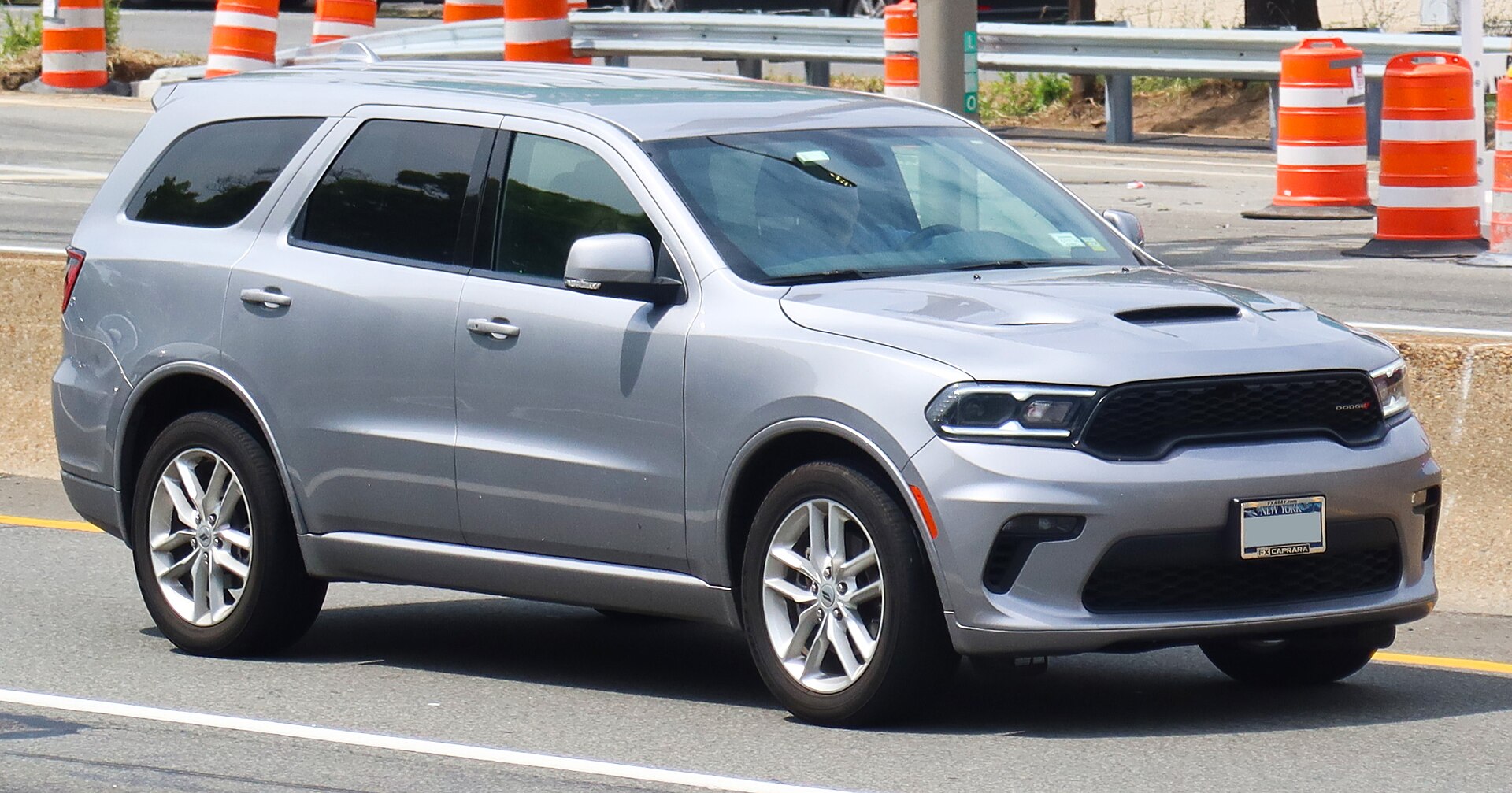
The Dodge Durango is a three-row, seven-seat SUV that Chrysler, and today Stellantis, has built for the North American market since the 1998 model year. The first two generations were body-on-frame trucks related to the Dodge Dakota and Ram pickups; the current third generation, built in Detroit since December 2010, shares its unibody platform with the Jeep Grand Cherokee. Engines range from a 3.6-litre V6 to the 529 kW (710 hp) supercharged V8 of the SRT Hellcat.
In short
- Three generations: 1998-2003 (DN), 2004-2009 (HB) and 2011-present (WD), each with seven seats or more.
- Current engines: 3.6 Pentastar V6, 5.7 Hemi V8, 6.4 Hemi V8 (SRT 392 and, from 2026, R/T 392) and 6.2 supercharged Hemi V8 (SRT Hellcat).
- More than two million Durangos have been sold; the sales table on Wikipedia adds up to 2,338,631, of which only 3,978 were registered in Europe.
- No Euro NCAP rating; in Europe the Durango remains a rare sight.
Size at a glance
| Dimensions | Dodge Durango III WD |
|---|---|
| Length | 5,101 mm200.8 in |
| Width | 1,924 mm75.7 in |
| Height | 1,851 mm72.9 in |
| Wheelbase | 3,042 mm119.8 in |
Running cost
Fuel · Durango WD 3.6 Pentastar V6
about 3,100 EUR fuel a year at 15,000 km
11.9 l/100 km · petrol at 1.75 EUR/l · change mileage, fuel price or version
Specs by version
Engines
| Version | Engine | Power | Torque | Gearbox | Drive | Production years |
|---|---|---|---|---|---|---|
| WD · 2010–present | ||||||
| WD · 3.6 Pentastar V6 | 3.6 l · 6 cyl · Petrol Pentastar | 220 kW 299 PS295 hp | 353 Nm260 lb-ft | 8-sp Automatic | All-wheel drive | 2025 |
| WD · 5.7 Hemi V8 | 5.7 l · 8 cyl · Petrol 5,654 cc | 268 kW 364 PS359 hp | 529 Nm390 lb-ft | 8-sp Automatic | All-wheel drive | 2011 |
| WD · SRT 392 6.4 Hemi V8 | 6.4 l · 8 cyl · Petrol 6,417 cc | 354 kW 481 PS475 hp | 637 Nm470 lb-ft | 8-sp Automatic | All-wheel drive | 2018–2024 |
| WD · SRT Hellcat 6.2 supercharged V8 | 6.2 l · 8 cyl · Petrol 6,166 cc | 529 kW 719 PS709 hp | 875 Nm645 lb-ft | 8-sp Automatic | All-wheel drive | 2021 |
Performance
Show all 1 versions
| Version | Fuel consumption |
|---|---|
| WD · 2010–present | |
| WD · 3.6 Pentastar V6 | 11.9 l/100 km19.8 mpg US · 23.7 mpg UK |
Dimensions and weight
Show all 1 versions
| Version | Length | Width | Height | Wheelbase | Kerb weight | Fuel tank |
|---|---|---|---|---|---|---|
| WD · 2010–present | ||||||
| WD · 3.6 Pentastar V6 | 5,101 mm200.8 in | 1,924 mm75.7 in | 1,851 mm72.9 in | 3,042 mm119.8 in | 2,261 kg4,985 lb | 93 l24.6 gal US |
Verified Manufacturer and type-approval data from our catalog · Sources and methodology
Dodge Durango at a glance
| Specification | Dodge Durango (current, WD) |
|---|---|
| Segment | Mid-size three-row SUV |
| Body | five-door SUV, seven seats |
| Built | Jefferson North Assembly Plant, Detroit, Michigan |
| Platform | unibody, shared with the Jeep Grand Cherokee (WK2) |
| Drive | rear-wheel drive or all-wheel drive |
| Engines | 3.6 V6, 5.7 V8, 6.4 V8, 6.2 supercharged V8 |
| Power range | 216-529 kW (290-710 hp) |
| Transmission | eight-speed automatic (since 2014) |
The Durango sits between car-based crossovers and full-size truck-based SUVs. Other models of the brand are on our Dodge brand page.
Generations and model history
| Generation | Code | Years | Body styles | Engines | Power (kW / hp) |
|---|---|---|---|---|---|
| Durango I | DN | 1998-2003 | 5-door SUV | 3.9 V6, 4.7 V8, 5.2 V8, 5.9 V8, 5.9 supercharged V8 | 130-268 kW (175-360 hp) |
| Durango II | HB | 2004-2009 | 5-door SUV | 3.7 V6, 4.7 V8, 5.7 Hemi V8, 5.7 hybrid | 157-290 kW (210-390 hp) |
| Durango III | WD | 2011-present | 5-door SUV | 3.6 V6, 5.7 V8, 6.4 V8, 6.2 supercharged V8 | 216-529 kW (290-710 hp) |
Years are model years. Generation codes are Chrysler's internal designations.
First generation (1998-2003)
The original Durango was built at the Newark Assembly Plant in Delaware and used the body-on-frame chassis of the Dodge Dakota pickup. Its predecessors were the Ramcharger and the Town Wagon. It seated seven passengers; the original eight-seat design with a rear-facing third row was changed to a forward-facing one before launch. Properly equipped, it could tow up to 3,400 kg (7,500 lb).
| Engine | Years | Power |
|---|---|---|
| 3.9 Magnum V6 | 1999 | 130 kW (175 hp) |
| 5.2 Magnum V8 | 1998-2000 | 172 kW (230 hp) |
| 4.7 PowerTech V8 | 2000-2003 | 175 kW (235 hp) |
| 5.9 Magnum V8 | 1998-2003 | 183-186 kW (245-250 hp) |
| 5.9 supercharged V8 (R/T, Shelby S.P.360) | 1999-2000 | 268 kW (360 hp) |
Gearboxes were four-speed automatics, joined by the five-speed 545RFE in 2003. Rear-wheel drive was standard and four-wheel drive was available.

Second generation (2004-2009)
The second Durango was again built in Newark, now on a fully boxed frame related to the Ram pickup. It was about 18 cm longer, 5 cm wider and 8 cm taller than its predecessor and could seat up to eight with a third-row bench. From 2007 Chrysler sold a more luxurious twin, the Chrysler Aspen.
Engines ranged from a 157 kW (210 hp) 3.7 V6 to the 5.7 Hemi V8 with 250 kW (335 hp), raised to 280 kW (376 hp) for 2009. The 2009 Durango Hybrid combined the Hemi with two 65 kW electric motors, for a combined 290 kW (390 hp), and was standard with four-wheel drive. It improved US fuel economy from 13/18 mpg to 19/20 mpg (city/highway), but Chrysler dropped it about two months after launch; only around 800 were built. Production in Newark ended on 19 December 2008.

Third generation (2011-present)
After a one-year gap, production of the third Durango started on 14 December 2010 at Jefferson North in Detroit, on the same assembly line as the Jeep Grand Cherokee (WK2). Unlike its predecessors it has a unibody structure. It went on sale in January 2011.
The 2014 update, shown at the New York International Auto Show in 2013, brought sportier styling, a revised interior and the eight-speed automatic. The SRT with a 6.4-litre Hemi arrived for 2018. The 2021 facelift changed the bumper and headlights, added a new instrument panel and the Uconnect 5 infotainment with 8.4- or 10.1-inch screens, and introduced the SRT Hellcat. The Hellcat was dropped for 2022 because of emissions rules and returned for 2023. For 2026 the 6.4-litre V8 came back in the R/T 392.
Engines and performance
| Engine (WD) | Power | Torque | Years |
|---|---|---|---|
| 3.6 Pentastar V6 | 216-220 kW (290-295 hp) | 353 Nm | 2011-present |
| 5.7 Hemi V8 | 268 kW (360 hp) | 529 Nm | 2011-present |
| 6.4 Hemi 392 V8 | 354 kW (475 hp) | 637 Nm | 2018-2024, 2026-present |
| 6.2 supercharged Hemi V8 (SRT Hellcat) | 529 kW (710 hp) | 875 Nm | 2021, 2023-present |
The V6 now has 220 kW (295 hp) in the 2025 GT. Trim names have included SXT, GT, R/T, Citadel, SRT 392 and SRT Hellcat; in 2023 the line-up was reorganised into base, Plus and Premium levels.


Dimensions, space and boot
| Parameter (2025 GT) | Metric | Imperial |
|---|---|---|
| Length | 5,101 mm | 201 in |
| Width | 1,924 mm | 76 in |
| Height | 1,851 mm | 73 in |
| Wheelbase | 3,042 mm | 120 in |
| Weight | 2,261 kg | 4,985 lb |
| Cargo volume | 487-2,410 l | 17.2-85.1 cu ft |
| Fuel tank | 93 l | 24.6 US gal |
| Towing capacity (V6 GT, with package) | 2,812 kg | 6,199 lb |
At just over 5.1 metres, the Durango needs a large parking space. Check it against your current car with our size comparison tool.
Fuel economy and running costs
Canadian official figures for the 2025 GT with the V6 and all-wheel drive are 13.5 l/100 km in the city, 10.0 l/100 km on the highway and 11.9 l/100 km combined. The V8 versions use considerably more. Our fuel cost calculator turns these figures into annual costs.
In Canada, the 2025 Durango GT was listed at CAD 59,995 (about EUR 39,000 in 2025) and the SRT Hellcat at CAD 152,135 (about EUR 99,000). There is no official European price.
Safety
We found no Euro NCAP rating for any Durango generation, and the model has no European type approval figures in our sources. North American crash ratings (NHTSA, IIHS) are the relevant reference for buyers.
Reliability and known issues
Documented problems in our sources concern the model line rather than individual faults: the 2009 hybrid was withdrawn after about two months, and the Hellcat had to be paused for the 2022 model year because of emissions requirements. The Pentastar V6 and the Hemi V8 are also used in other Chrysler, Dodge, Jeep and Ram models.
Sales
Sales are concentrated in North America. US deliveries were 69,196 in 2023, 59,357 in 2024 and 81,168 in 2025. In Europe the sales table counts 3,978 Durangos between 2000 and 2022, with a peak of 616 cars in 2019.
Rivals
| Model | Engines | Power (hp) | Boot (l) | Price from (EUR) |
|---|---|---|---|---|
| Dodge Durango | V6, V8 | 290-710 | 487 | no EU list price |
| Jeep Grand Cherokee | V6, V8, plug-in hybrid | - | - | - |
| Ford Explorer (US) | - | - | - | - |
| Chevrolet Tahoe | - | - | - | - |
Its closest relative is the Jeep Grand Cherokee, built on the same platform. Our comparison tool lists any two models side by side.
Photo gallery

Dodge Durango evolution in numbers
Did you know?
- The Dodge Durango has been around for 29 years: 3 generations in our catalog since 1997.
- The longest-running generation is the Durango III WD (2010–present): 16 years and counting.
- The biggest jump in power came with the Durango III WD: up to 529 kW (719 PS), 239 kW more than the Durango II HB.
Most powerful version, kW
Figures from the 1cars catalog: power is the strongest version of each generation; generations without the figure are left out.
Dodge Durango: first vs latest generation
| Spec | Durango I DN | Durango III WD | Change |
|---|---|---|---|
| Years | 1997–2003 | 2010–present | 13 years apart |
| Most powerful version | 268 kW (364 PS) | 529 kW (719 PS) | +261 kW (+97%) |
Oldest and newest generation in the 1cars catalog. Power is the strongest version of each; other rows are shown only when both generations have the figure.
Dodge Durango in our rankings
- No. 5 of 155 · Biggest engines: SUVs and crossovers (6,417 cc)
- No. 6 of 253 · Most powerful SUVs and crossovers (529 kW)
- No. 6 of 198 · Longest SUVs and crossovers (5,101 mm)
- No. 10 of 171 · Most torque: SUVs and crossovers (875 Nm)
- No. 31 of 531 · Longest cars (5,101 mm · top 6%)
- No. 84 of 1082 · Longest-running car nameplates (29 years · top 9%)
More powerful than 97% of ranked SUVs and crossovers in the 1CARS catalog (No. 6 of 253).
FAQ
How many generations of the Dodge Durango are there?
Three: 1998-2003, 2004-2009 and 2011 to the present (model years).
Is the Dodge Durango sold in Europe?
Only in small numbers: the Wikipedia sales table records 3,978 European sales between 2000 and 2022, and there is no German list price.
What is the most powerful Durango?
The SRT Hellcat with a 6.2-litre supercharged V8 producing 529 kW (710 hp) and 875 Nm.
Is the Durango related to the Jeep Grand Cherokee?
Yes. The third-generation Durango shares the WK2 platform, assembly line and many components with the 2011-2022 Grand Cherokee.
How many seats does the Durango have?
Seven in the current generation; the second generation could seat eight with a third-row bench.
Data sources
Data checked by an editor against the sources below.
- Wikipedia - Dodge Durango
- Guideautoweb