 Wuling Hongguang Mini EV
Specs, engines and history
Published Sources (1) Report an error
By Felix Hartmann, Automotive Technology & EV Contributor
- Built
- 2020–present
- Top power
- 30 kW (41 PS)
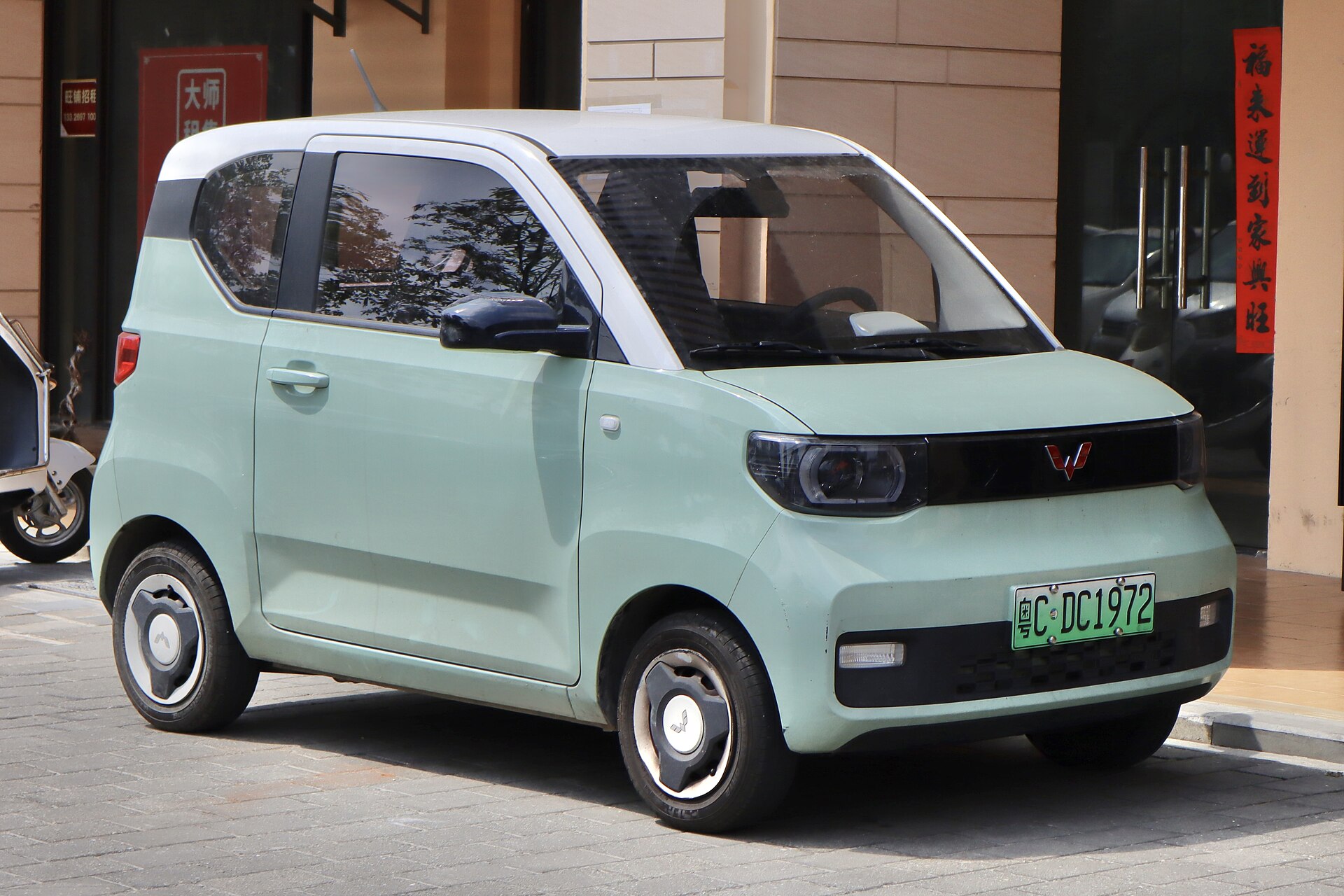
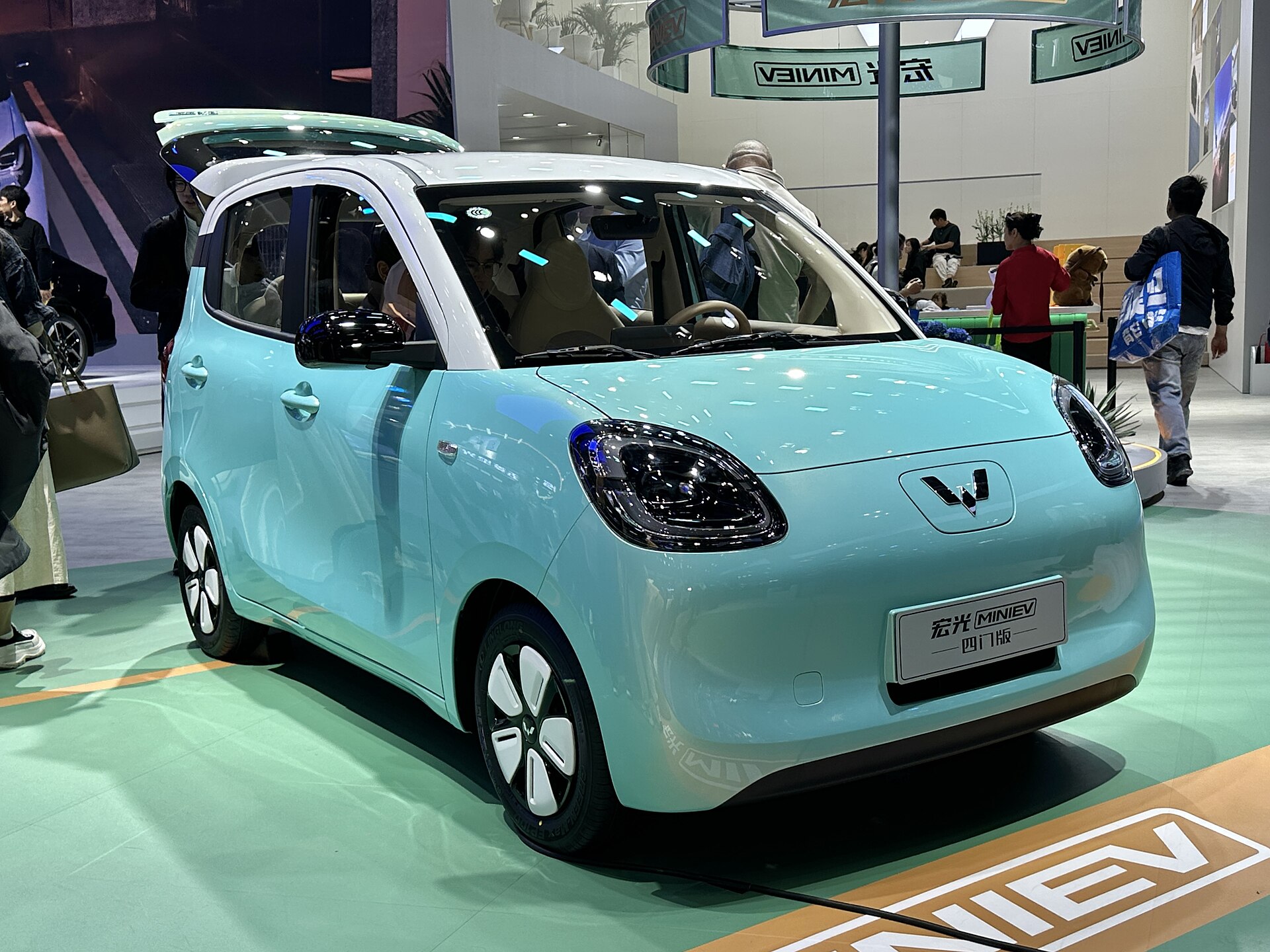
The Wuling Hongguang Mini EV is a four-seat electric city car built by SAIC-GM-Wuling in China since 2020. Retail deliveries began in July 2020, and within six months it was the second-best-selling plug-in car in the world after the Tesla Model 3. The first version is only 2,917 mm long, weighs 665–700 kg and has a 20 kW motor with a top speed of 100 km/h. More than 1.1 million had been sold by February 2023, and 424,983 found buyers in China in 2025 alone.
Wuling is the car brand of SAIC-GM-Wuling (SGMW), a joint venture in Liuzhou, Guangxi, founded on 18 November 2002. At the start SAIC Motor held 50.1 %, General Motors 34 % and the local Wuling Group, later Guangxi Automobile Group, 15.9 %; by 2011 GM had raised its share to 44 %.
Specs by version
Engines
Dimensions and weight
Show all 2 versions
| Version | Battery |
|---|---|
| 9.2 kWh | 9 kWh |
| 13.8 kWh | 14 kWh |
Verified Manufacturer and type-approval data from our catalog · Sources and methodology
Wuling made its name with microvans: the Wuling Sunshine sold more than 450,000 a year at its peak, according to SGMW. The joint venture as a whole sold 2,150,018 vehicles in 2017, its best year in the table, and 1,635,066 in 2025. SGMW also builds cars under its Baojun brand; the Baojun 510 was China's best-selling crossover in 2018, with nearly 800,000 sold by June 2019. Of the 1,635,066 vehicles of 2025, 899,727 were passenger cars. Exports began in 2009, first to Peru and often under the Chevrolet name, and a plant at Cikarang in Indonesia, built for 150,000 vehicles a year, has built cars since 11 July 2017.
In short
- Four-seat electric city car, 2,917 mm long, 665–700 kg; on sale in China since July 2020.
- 20 kW (27 hp) and 85 Nm rear motor, 30 kW and 110 Nm optional on later cars; top speed 100 km/h.
- Batteries 9.2 kWh (120 km NEDC) and 13.8 kWh (170 km NEDC); from 2022 also 26.5 kWh (280 km CLTC).
- Over 1.1 million sold by February 2023; often described as China's best-selling electric car.
Wuling Hongguang Mini EV at a glance
| Parameter | First version (2020) |
|---|---|
| Maker | SAIC-GM-Wuling, plants in Liuzhou (Guangxi) and Qingdao (Shandong) |
| Body | small hatchback with four seats; Cabrio and five-door versions later |
| Length / width / height | 2,917 / 1,493 / 1,621 mm |
| Wheelbase | 1,940 mm |
| Kerb weight | 665–700 kg |
| Motor | rear motor, rear-wheel drive, 20 kW (27 hp), 85 Nm |
| Batteries | 9.2 kWh or 13.8 kWh |
| Range (NEDC) | 120 km (9.2 kWh) or 170 km (13.8 kWh) |
| Consumption | 8.1 kWh/100 km (NEDC) |
| Top speed | 100 km/h |
A very small car for Chinese cities
The Mini EV was designed as cheap urban transport. Its length is under three metres, yet it has four seats. The motor sits at the back and drives the rear wheels. Its 20 kW are enough for town traffic, and the top speed of 100 km/h keeps it to city streets and ring roads rather than long motorway trips. When it came out in 2020 it was described as China's cheapest electric car.
The small battery is the key to the low price. With 9.2 kWh the car covers 120 km on the NEDC cycle, and with 13.8 kWh 170 km. Consumption is 8.1 kWh/100 km on the same cycle.


Sales: from zero to a million
| Year | Sales in China |
|---|---|
| 2020 | 127,651 |
| 2021 | 395,451 |
| 2022 | 404,823 |
| 2023 | 237,863 |
| 2024 | 261,141 |
| 2025 | 424,983 |
Success came very quickly. In about six months of 2020, 119,255 cars were sold, which made the Mini EV the second-best-selling plug-in car in China and in the world after the Tesla Model 3. In January 2021 it led all new-energy vehicles in China with 25,778 cars against 13,843 for the Model 3, according to China's passenger-car association CPCA. Global sales passed 1.1 million by February 2023.

Versions: Macaron, GameBoy and Cabrio
| Version | From | Changes |
|---|---|---|
| Macaron | April 2021 | driver airbag, reversing camera and radar, 20 kW |
| Cabrio | concept 2021, production September 2022 | two-door convertible with a folding soft top, 3,059 mm long, 925 kg |
| GameBoy | March 2022 | facelifted and larger, 3,061–3,089 mm, 772–832 kg; 9.2, 13.9 or 25.5 kWh |
| 2022 update | 2022 | 26.5 kWh battery, 280 km CLTC; 30 kW, 110 Nm motor optional |
| New Macaron | end of 2023 | 215 km CLTC; 30–80 % charge in 35 minutes |
| Five-door | 2024 | five-door body |
The Macaron of April 2021 added safety and convenience items that the first cars lacked, such as a driver airbag and a reversing camera. The GameBoy of 2022 was larger, with a wheelbase of 2,010 mm, and offered up to 25.5 or 26.5 kWh, depending on the source. The Cabrio turned the idea into a small open car; at 925 kg it is the heaviest member of the family, but still well under a tonne, and at 3,059 mm it is about as long as the GameBoy.

The second generation
A new generation was unveiled in December 2024 and launched on 22 February 2025, with batteries of 9.2, 13.8 or 26 kWh. A facelifted version was shown in February 2026, after China's ministry of industry, MIIT, had published photos in December 2025. Wikipedia EN counts these as the fourth and fifth versions of the model. In 2025, the first year of the new generation, Chinese sales rose to 424,983 cars.
Outside China
The Mini EV has been sold or assembled under other names in several markets. In Lithuania it was announced in 2021 as the FreZe Nikrob, assembled in Vilnius. In Turkey a version called Rainwoll RW10 was announced in 2023 with Basic, Comfort and Macaron trims, and in Vietnam the SGMW Mini EV is assembled by TMT Motors in Hưng Yên. The Philippines sell the Macaron and GameBoy under the Wuling name. The sources give no EUR prices and no Euro NCAP result for the car.
Who the Mini EV suits
The Hongguang Mini EV is a city car in the strictest sense: very short, light and economical, with four seats and a top speed of 100 km/h. It suits short daily trips and easy parking, not motorways. In Europe the closest ideas are the Citroën Ami, a two-seat electric quadricycle, and the small cars in the best small city cars list. The size comparison tool shows how its 2,917 mm compare with other cars, and more Wuling models are in the Wuling catalogue.
Photo gallery


Wuling Hongguang Mini EV in our rankings
- No. 624 of 912 · Longest-running car nameplates (6 years · top 69%)
- No. 227 of 305 · Oldest car models still on sale (6 years · top 75%)
- No. 850 of 859 · Most powerful cars (30 kW · top 99%)
- No. 239 of 239 · Most powerful cars of the 2020s (30 kW)
- No. 106 of 106 · Most powerful hatchbacks (20 kW)
- No. 97 of 97 · Most powerful electric cars (30 kW)
In production longer than 31% of ranked nameplates in the 1CARS catalog (No. 624 of 912).
FAQ
Who makes the Wuling Hongguang Mini EV?
SAIC-GM-Wuling, a joint venture of SAIC Motor, General Motors and Guangxi Automobile Group, based in Liuzhou, China.
How fast is the Wuling Mini EV?
The stated top speed is 100 km/h; the base motor has 20 kW, with 30 kW optional on later cars.
What is the range of the Wuling Mini EV?
120 km (9.2 kWh) or 170 km (13.8 kWh) on the NEDC cycle; the 26.5 kWh version of 2022 is rated at 280 km on China's CLTC cycle.
How many Wuling Mini EVs have been sold?
More than 1.1 million by February 2023, and 424,983 in China in 2025.
Where is the Wuling Mini EV built?
At SAIC-GM-Wuling's plants in Liuzhou, Guangxi, and Qingdao, Shandong; versions for Lithuania and Vietnam were assembled locally.
Data sources
Data checked by an editor against the sources below.