
 Isotta Fraschini Tipo 8
Specs, engines and history
Published Sources (1) Report an error
By Felix Hartmann, Automotive Technology & EV Contributor
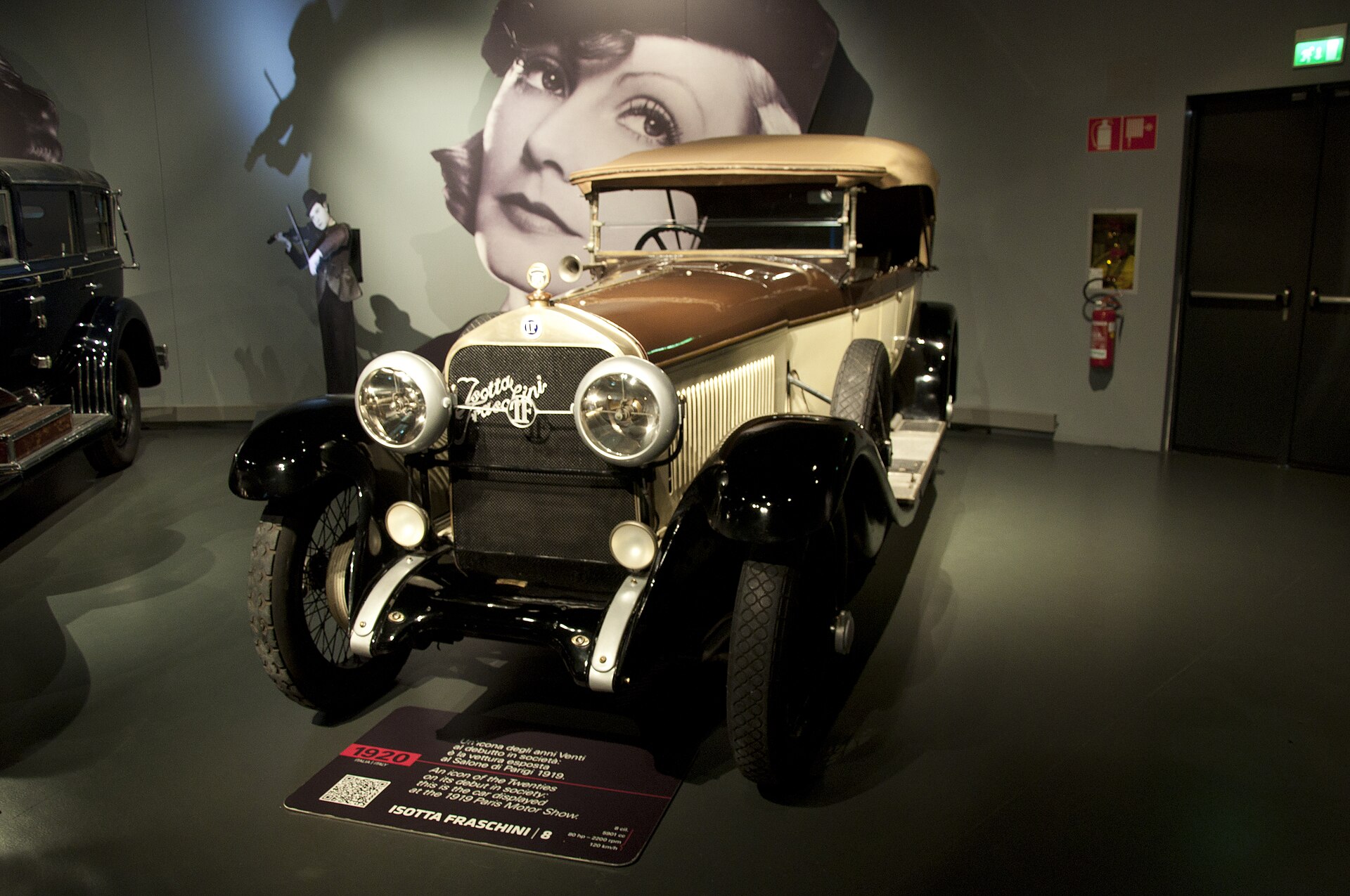
- Built
- 1919–1924
- Top power
- 67 kW (91 PS)
Isotta Fraschini was founded in Milan on 27 January 1900 by Cesare Isotta and the brothers Vincenzo, Antonio and Oreste Fraschini, as Società Milanese Automobili Isotta, Fraschini & C. Its stated purpose was to "import, sell, repair cars": from 1899 the founders had imported Mors and Renault cars, and before building their own cars in 1904 they assembled cars similar to Renaults. The company was among the earliest users of four-wheel brakes, the overhead camshaft and the straight-eight engine. Vincenzo Trucco won the 1908 Targa Florio in an Isotta Fraschini. In the 1930s the firm turned to aircraft and marine engines, and the original company went into liquidation in 1949; the name returned in 2022, and the Tipo 6 Le Mans Hypercar raced in the World Endurance Championship in 2024.
The Tipo 8 is the car that made the name famous. Shown at the Paris Motor Show in 1919 and delivered from 1920, it is described by English Wikipedia as the first series-produced car with a straight-eight engine. Its 5.9-litre engine gave 60 kW (80 bhp) at first and later 67 kW (90 bhp). Isotta Fraschini sold it as a bare chassis with engine, and coachbuilders such as Castagna and Cesare Sala built the bodies. Its main rival was Rolls-Royce, and its main market was the United States. 1,380 were built until 1924, when the larger Tipo 8A took over.
Specs by version
Verified Manufacturer and type-approval data from our catalog · Sources and methodology
In short
- Built in Milan from 1919 to 1924; 1,380 cars.
- 5,902 cc straight-eight with overhead valves: 60 kW (80 bhp), later 67 kW (90 bhp); top speed about 137–140 km/h.
- Sold as a chassis for coachbuilders; bodies mainly by Castagna and Cesare Sala.
- Followed by the Tipo 8A (1924–1931, 7.4 litres, 950 built) and the Tipo 8B.
Isotta Fraschini Tipo 8 at a glance: maker, production years (1919–1924), purpose
| Parameter | Value |
|---|---|
| Maker | Isotta Fraschini, Milan, Italy |
| Production | 1919 – 1924 (first deliveries 1920) |
| Built | 1,380 |
| Purpose | luxury car, sold as a rolling chassis |
| Body | by coachbuilders (Castagna, Cesare Sala and others) |
| Layout | front engine, rear-wheel drive |
| Engine | straight-eight, 5,902 cc, overhead valves |
| Power | 60 kW (80 bhp), later 67 kW (90 bhp) |
| Gearbox | three-speed manual; four-speed on late cars (Italian Wikipedia) |
| Brakes | mechanical brakes on all four wheels |
| Top speed | about 137–140 km/h |
| Rival | Rolls-Royce |
| Successor | Tipo 8A |
Development and production history
The First World War changed Isotta Fraschini. Afterwards the company adopted a policy of building a single series, and the Tipo 8 was that car. It was shown at the 1919 Paris Motor Show and delivered from 1920. English Wikipedia credits it as the first series-produced car with a straight-eight engine and the first in-line eight in a production car.
Production ran until 1924, with 1,380 cars. The car was aimed at the very top of the market, where Rolls-Royce was the main rival, and Italian Wikipedia names the United States as its main market. In the 1920s Isotta Fraschini sold its ultra-luxury cars in North America, and Clara Bow and Rudolph Valentino drove them. Italian Wikipedia gives a price of about 150,000 lire, without naming a year, so it is not used here as a dated price.
Design and engineering
Isotta Fraschini supplied the Tipo 8 as a bare chassis with the engine, and the buyer's chosen coachbuilder completed the car. Bodies typically came from Carrozzeria Castagna and Cesare Sala in Milan, with some European and American firms also supplying them. The cover photograph of this article shows a phaeton body by Sala.
The chassis is conventional for its time: rigid axles with semi-elliptic leaf springs, and Houdaille hydraulic dampers at the rear. Brakes act on all four wheels and are operated mechanically by pedal and lever, at a time when four-wheel brakes were still rare. Three levers on the steering wheel control ignition advance, mixture and throttle.
Engine and drivetrain: the first production straight-eight
The engine is an in-line eight of 5,902 cc, with an 85 mm bore and a 130 mm stroke, nine main bearings and overhead valves worked by pushrods and rockers. (English Wikipedia also calls it overhead-cam in one place.) Two carburettors are bolted directly to the block, without an external intake manifold.
English Wikipedia gives 60 kW (80 bhp) at first and 67 kW (90 bhp) later. Italian Wikipedia gives 75–80 CV at about 2,200 rpm for early cars and 90 CV later. Drive goes to the rear wheels through a three-speed manual gearbox with a multi-plate clutch; Italian Wikipedia adds that later cars had a four-speed gearbox. The power converter turns the bhp and CV figures into kW.
Isotta Fraschini Tipo 8 specifications
| Data | Value |
|---|---|
| Engine | in-line eight, 5,902 cc, 85 × 130 mm, nine main bearings |
| Valve gear | overhead valves, pushrods and rockers |
| Power | 60 kW (80 bhp), later 67 kW (90 bhp) |
| Carburettors | two, bolted directly to the block |
| Gearbox | three-speed manual; later four-speed |
| Suspension | rigid axles, semi-elliptic leaf springs; Houdaille dampers at the rear |
| Brakes | mechanical, all four wheels |
| Top speed | about 125 km/h early, about 140 km/h later (Italian Wikipedia); 137–140 km/h (English Wikipedia) |
Variants and derivatives: Tipo 8A and Tipo 8B
The Tipo 8 started a family of straight-eight luxury cars.
| Model | Years | Engine | Power | Built |
|---|---|---|---|---|
| Tipo 8 | 1919–1924 | 5.9 l straight-eight | 60–67 kW (80–90 bhp) | 1,380 |
| Tipo 8A | 1924–1931 | 7,370 cc straight-eight | 85–118 kW (115–160 PS) | 950 |
| Tipo 8B | after the 8A | straight-eight | — | — |
The Tipo 8A has a 3,683 mm wheelbase, or 3,404 mm in the S and SS versions, and Isotta Fraschini promised that every car could reach 150 km/h. English Wikipedia calls it the most powerful series-produced straight-eight of its time, and says it cost more than a Duesenberg Model J; about a third of production went to the United States. Its bodies came from Castagna, Sala, the Swiss Carrosserie Worblaufen, Floyd-Derham, Lancefield, LeBaron and Van Rijswijk. A 1929 Castagna-bodied 8A plays the car of Norma Desmond in the 1950 film Sunset Boulevard.


In service: the legacy of the straight-eight
The Tipo 8 and its successors made Isotta Fraschini a rival of Rolls-Royce and, in the 8A's case, a car more expensive than a Duesenberg Model J. The Great Depression and then the Second World War hurt the car business, and the company moved to industrial and aircraft engines in the 1930s. Its last car, the Tipo 8C Monterosa, was built in a reported three to six examples. The later engine business merged with Breda in 1955 and became part of Fincantieri in the 1980s as Isotta Fraschini Motori.
Preservation and collecting today
With 1,380 built and every car bodied by a coachbuilder to the buyer's order, the surviving Tipo 8s differ widely in body style. The Museo Nazionale dell'Automobile in Turin says it has displayed the Sunset Boulevard 8A since 1972, although the ownership of that car is disputed. No auction results in euros were found for the Tipo 8, so no market values are given.
Which Isotta Fraschini to look for:
- For the first straight-eight: an original Tipo 8 of 1919–1924.
- For more power: a Tipo 8A with the 7.4-litre engine.
- For sportier driving: an 8A S or SS on the shorter wheelbase.
More early cars are in the classic cars section; every model of the brand is in the Isotta Fraschini catalogue.
Photo gallery

Isotta Fraschini Tipo 8 in our rankings
- No. 96 of 557 · Biggest engines: cars (5,902 cc · top 18%)
- No. 625 of 912 · Longest-running car nameplates (5 years · top 77%)
- No. 803 of 859 · Most powerful cars (67 kW · top 94%)
- No. 121 of 127 · Most powerful Italian cars (67 kW · top 96%)
Bigger engine than 82% of ranked cars in the 1CARS catalog (No. 96 of 557).
FAQ
Was the Isotta Fraschini Tipo 8 the first straight-eight car?
English Wikipedia describes it as the first series-produced car with a straight-eight engine; it was shown at the 1919 Paris Motor Show.
How many Isotta Fraschini Tipo 8s were built?
1,380 between 1919 and 1924; the following Tipo 8A reached 950.
How powerful is the Tipo 8?
Its 5,902 cc straight-eight gave 60 kW (80 bhp) at first and 67 kW (90 bhp) later.
Who built the bodies of the Tipo 8?
Isotta Fraschini sold a bare chassis; bodies came mainly from Castagna and Cesare Sala, and also from other European and American coachbuilders.
Which Isotta Fraschini appears in Sunset Boulevard?
A 1929 Tipo 8A with Castagna coachwork, the car of Norma Desmond.
Data sources
Data checked by an editor against the sources below.


