 Checker Marathon
Specs, engines and history
Published Sources (1) Report an error
By Sarah Whitmore, Senior Automotive Writer
- Built
- 1960–1982
- Top power
- 224 kW (305 PS)
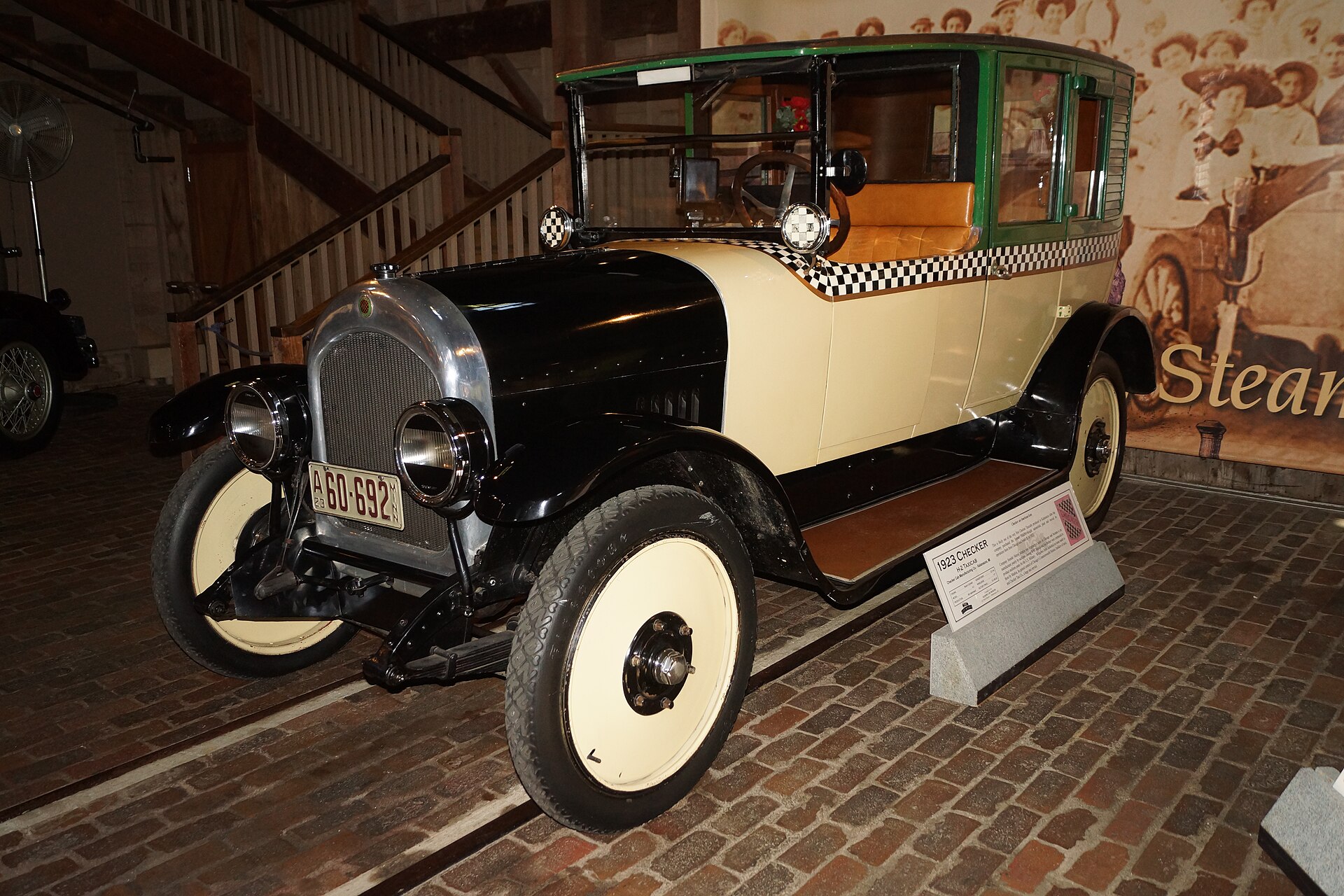
Checker Motors Corporation was the car maker from Kalamazoo, Michigan, whose taxicabs once filled the streets of New York and other American cities. Morris Markin formed the Checker Cab Manufacturing Company in Chicago in May 1922 by merging Commonwealth Motors with his Markin Automobile Body company. The business moved to a new Kalamazoo factory that opened on 23 June 1923. Checker built 8,019 taxicabs from 1922 to 1928 and 29,260 from 1929 to 1942, and in 1929 Markin also bought the Yellow Cab Company from John D. Hertz.
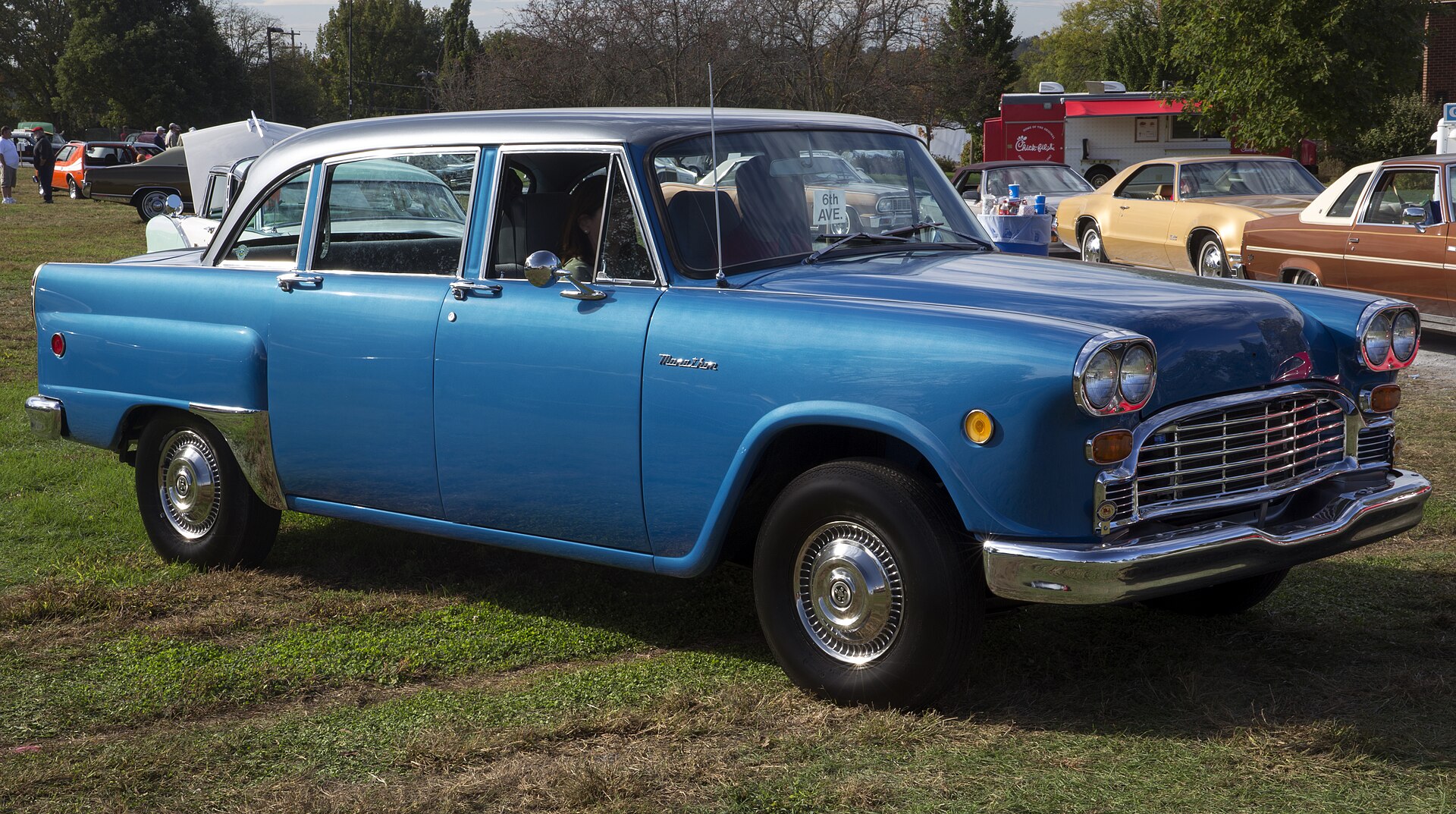
The Checker Marathon is the car most people picture when they hear the name. It went on sale in September 1960 as a 1961 model and stayed in production, with few visual changes, until July 1982. Checker sold it as a taxi and as a private car, and changed the engines and safety equipment many times under a body that hardly changed at all.
Specs by version
| Version | Engine | Power | Gearbox | Drive | Production years |
|---|---|---|---|---|---|
| 3.7 I6 | 3.7 l · 6 cyl · Petrol 3,707 cc | 60 kW 82 PS80 hp | — | Rear-wheel drive | 1961–1964 |
| 5.7 V8 (350) | 5.7 l · 8 cyl · Petrol 5,733 cc | 224 kW 305 PS300 hp | 3-sp Automatic | Rear-wheel drive | 1969 |
Verified Manufacturer and type-approval data from our catalog · Sources and methodology
In short
- Built in Kalamazoo from September 1960 (model year 1961) to 1982; the last car left the plant on 12 July 1982.
- Four-door sedan and station wagon on a 120 in (3,048 mm) wheelbase; the Town Custom limousine used 129 in (3,277 mm).
- Engines: a Continental 3.7-litre six at first, then Chevrolet sixes, a V6 and V8s; the 1969 Chevrolet L-48 350 V8 gave 224 kW (300 hp gross).
- Checker sold most cars to fleets; the last New York Checker cab retired in July 1999 after nearly one million miles.
Checker Marathon at a glance
| Parameter | Metric | Imperial |
|---|---|---|
| Maker | Checker Motors Corporation, Kalamazoo, Michigan | — |
| Production | September 1960 to July 1982 (model years 1961–1982) | — |
| Designer | Ray Dietrich | — |
| Chassis codes | A10, then A12 (private car); A9, then A11 (taxi) | — |
| Body styles | four-door sedan, station wagon, Town Custom limousine | — |
| Layout | front engine, rear-wheel drive | — |
| Wheelbase | 3,048 mm; limousine 3,277 mm | 120 in; 129 in |
| Length | 5,200 mm with the 1974 bumpers | about 205 in |
| Engines | Continental 3.7 l six; Chevrolet sixes, 3.8 l V6 and V8s of 4.4–5.7 l; Perkins and Oldsmobile diesels | 226 to 350 cu in |
| Top power | 224 kW (300 hp gross), Chevrolet L-48 350 V8, 1969 | — |
| Gearboxes | three-speed manual or three-speed TH400 automatic, both with column shift | — |
| Fuel tank | 81 l | about 21 US gal |
Morris Markin and the Kalamazoo cab works
Commonwealth Motors had introduced its Mogul Taxi in 1919 and went bankrupt in 1921, when Markin took over its assets. Through the 1920s he also bought up Checker Taxi, a Chicago cab operator. After buying Yellow Cab in 1929, he merged the two fleets into the Parmelee Transportation Company. Markin is credited with the checkerboard trim along the beltline that gave the cars their look. The company promoted its cabs as able to run 200,000 miles.
Checker named its models with letters and numbers. The A2 arrived on 15 December 1946. The A3 of August 1947 was the first Checker with a trunk and was also sold to the public. The boxy A8 of 1956–1958 gave the Marathon most of its chassis and body, as German Wikipedia notes. In 1960 the A10 Superba became Checker's first model aimed at private buyers.
Development and production history
The Marathon appeared in September 1960 next to the Superba Custom, which it gradually replaced, and it had a better-trimmed interior. It kept the Superba's A10 body code, while the taxi version carried A9. A wider grille and moved parking lamps told the two apart. A 1963 facelift brought new codes: A11 for taxis and A12 for private cars. That year Checker also added the Marathon Town Custom limousine, an eight-seater on a 129 in wheelbase, coded A19E and later A12E.
Checker had no nationwide dealer network, so most cars went to fleet buyers. In 1962 the company built more than 8,000 vehicles, most of them taxis. Sales to private buyers ran at about 1,000 a year from 1960 to 1968 and fell to 760 in 1969. In 1977 Ed Cole, a retired president of General Motors, and Victor Potamkin bought into Checker. Cole died in a plane crash in May 1977, and the plan for a Volkswagen-based taxi died with him.
| Year | Event |
|---|---|
| September 1960 | Marathon introduced as a 1961 model |
| 1963 | facelift; A11 taxi and A12 private car codes; Town Custom limousine |
| 1964 | Superba dropped; front lap belts standard |
| 1968 | roof raised by 2 in (51 mm) for a larger windscreen |
| 1969 | Medicar for wheelchair users; Perkins diesel for one year |
| 1974 | heavy 5 mph "girder" bumpers |
| 1976 | Chevrolet 350 V8, TH400 gearbox and Spicer 44 axle |
| 1980 | 3.8-litre V6 replaces the six |
| 12 July 1982 | last car leaves the Kalamazoo plant |

Design and engineering
The Marathon used a box-section frame with cross members. At the front it had independent unequal-length wishbones, coil springs and an anti-roll bar. A live axle on semi-elliptic leaf springs sat at the rear. The brakes were dual-circuit with servo assistance, discs at the front and self-adjusting drums at the rear. The steering was recirculating-ball, with optional power assistance. Reports say the front A-frames could be swapped with those of a 1956 Ford.
Two features suited cab work in particular. The rear quarter panels bolted on, so a damaged one could be replaced instead of repaired. The design also stayed almost unchanged for 21 years, which kept parts simple for fleets. Apart from the 5 mph bumpers of 1974, the changes went under the skin, and the car still met each new federal rule:
- 1964: front lap belts standard; 1966: rear lap belts standard;
- 1967: energy-absorbing steering column and wheel, padded dashboard, recessed knobs and a dual-circuit master cylinder;
- 1968: front shoulder belts for outboard seats; 1969: headrests and side reflectors;
- 1970: round side marker lamps and a locking steering column;
- 1975: catalytic converters, so the car needed unleaded fuel;
- 1978: parallel-action wipers and a Chevrolet-style steering wheel.
The Marathon was 5,200 mm long with the 1974 bumpers. The size comparison tool shows how that sets against a modern saloon.

Engines and drivetrain
The first Marathons used Continental six-cylinder engines of 226 cu in (3.7 litres), in side-valve and overhead-valve form. Chevrolet sixes and small-block V8s replaced them in the mid-1960s. English Wikipedia's text gives 1965 for the change, while its engine table puts the switch in the middle of 1964. Chevrolet's own story is in our history of Chevrolet.
| Period | Engine | Output | Notes |
|---|---|---|---|
| 1961–1964 | Continental 226 cu in (3.7 l) six | 105 kW (141 bhp) for the improved version from 1963 | side-valve and OHV versions |
| mid-1960s on | Chevrolet sixes; V8s of 307, 327 and 350 cu in | — | 350 = 5.7 l |
| 1969 | Chevrolet L-48 350 V8 | 224 kW (300 hp gross) | highest output of the run |
| 1969 | Perkins 4.236 diesel four, 3.9 l | 66 kW (88 bhp) | offered for one year |
| 1973 | Chevrolet 350 V8 | 108 kW (145 hp) | after the move to net ratings |
| 1980 | Chevrolet 229 cu in (3.8 l) V6 | 86 kW (115 bhp) at 4,000 rpm | 82 kW (110 bhp) in 1981 |
| 1980 | 4.4 l V8 standard; Oldsmobile LF9 5.7 l diesel V8 | — | German Wikipedia dates the diesel from 1977 |
From 1976 the car also took a radiator from the AMC Matador, the TH400 automatic and a Spicer 44 rear axle. Its steering used a rear drag link until 1980. Gearboxes were a three-speed manual or the three-speed TH400 automatic, both shifted from the column.
Aerobus, limousines and other variants
| Variant | Years | Body / purpose | Notes |
|---|---|---|---|
| A11 | 1963–1982 | taxi | the New York cab |
| A12 Marathon | 1963–1982 | private sedan and station wagon | A12E Marathon Deluxe from 1968 |
| Town Custom | from 1963 | eight-seat limousine, 129 in wheelbase | A19E, later A12E |
| Aerobus, six-door | 1962–1969 | stretched airport and hotel car | 12-seat version was the main one |
| Aerobus, eight-door | 1962–1974 | stretched station wagon | — |
| Aerobus 15 | 1976–1977 | 15-seat stretched car with sedan rear | Chevrolet 350 V8 standard |
| Medicar (A-12M) | from 1969 | wheelchair-accessible car | based on the A12E |
The station wagon faded out early: German Wikipedia records only 23 sold in model year 1974, and it was dropped that autumn. A few projects never reached production. The Ghia Centurion of 1968 was a limousine concept on the A12E chassis, shown in Paris and Turin. The Galva II of 1981 was a front-drive prototype on a stretched GM X platform.

In service: the New York cab and its last years
For decades the Checker was the dominant taxi in New York City. Its size, tough build, unchanging shape and bolt-on rear panels made it a fixture in Manhattan. Police departments used Marathons too, especially in Kalamazoo. In the late 1960s and early 1970s, A12 Marathons with Vatican plates carried the entourage of Pope Paul VI in motorcades. Film-makers still use them for scenes set in New York between the 1960s and the 1980s.
Production ended in 1982 because the Markin family chose to stop building cars instead of meeting labour demands. German Wikipedia adds that one last A12E was built in 1983 for David Markin. From 1983 Checker remanufactured cabs at its Kalamazoo Cab Services division, still doing so in 1997. It then made body stampings for General Motors, Ford and Chrysler for 27 more years. The company filed for bankruptcy in January 2009 and went out of business on 14 January 2010.
The last Checker cab in New York, nicknamed "Janie", retired in July 1999. Its driver, Earl Johnson, had run it since 1978. The car covered nearly one million miles, about 1.6 million km, and needed three new engines.

Preservation and collecting today
There is no single "correct" Marathon, because the car changed under the skin almost every year. For a buyer or restorer, the history above points to a few checks:
- Taxi or private car: the A11 cab and the A12 passenger car share the body, but trim and equipment differ.
- Engine: Continental sixes date from the early years, and later cars carry Chevrolet sixes, a V6, V8s or one of the rare diesels. Engine swaps were common in fleet service.
- Year group: cars from 1974 on have the heavy bumpers, and cars from 1975 on need unleaded fuel.
- Rare bodies: the station wagon, the Town Custom and the Aerobus were built in small numbers; only 23 wagons were sold in model year 1974.
More cars of the period are in the 1960s classics section, and other Checker models are in the Checker catalogue.
Photo gallery

Checker Marathon in our rankings
- No. 135 of 912 · Longest-running car nameplates (22 years · top 16%)
- No. 20 of 131 · Biggest engines: sedans (5,733 cc · top 17%)
- No. 104 of 557 · Biggest engines: cars (5,733 cc · top 20%)
- No. 54 of 149 · Most powerful sedans (224 kW · top 38%)
- No. 427 of 859 · Most powerful cars (224 kW · top 51%)
- No. 46 of 94 · Most powerful cars of the 1960s (224 kW · top 53%)
In production longer than 84% of ranked nameplates in the 1CARS catalog (No. 135 of 912).
FAQ
When was the Checker Marathon made, and where?
Checker built the Marathon in Kalamazoo, Michigan, from September 1960, as a 1961 model, until 12 July 1982, when the last car left the plant.
What engine does a Checker Marathon have?
Early cars have a Continental 3.7-litre six. Later cars use Chevrolet sixes and V8s up to the 5.7-litre 350, a 3.8-litre V6 from 1980, or a Perkins or Oldsmobile diesel.
What is the difference between the Checker A11 and A12?
From 1963 the A11 code was used for the taxi and the A12 code for the Marathon sold to private buyers; both share the same body.
Why did Checker stop making cars?
The Markin family decided in 1982 to end car production instead of meeting labour demands. Checker then remanufactured cabs and made body stampings for other carmakers until its bankruptcy in 2009.
When did the last Checker taxi retire in New York?
In July 1999. The cab, nicknamed "Janie", had been driven by Earl Johnson since 1978 and covered nearly one million miles with three engine replacements.
Data sources
Data checked by an editor against the sources below.