Auburn Speedster
Specs, engines and history
Published Sources (1) Report an error
By Sarah Whitmore, Senior Automotive Writer
- Built
- 1928–1936
- Top power
- 112 kW (152 PS)
Which Auburn Speedster to choose
Our verdict · Sarah Whitmore
- For the classic look: an 851 or 852 Speedster, the Buehrig design with the external exhaust pipes.
- For performance: the supercharged 851/852 SC, 112 kW and 160 km/h; only 143 were made.
- For rarity: the 1931 V12 Speedster 160, about 25 built, or the 1928–1929 Speedster 120, of which about 8 are thought to survive.
- Check the details: many replicas exist, and the 851 and 852 differ only in the grille badge.
More veteran and pre-war cars are in our classic cars section.
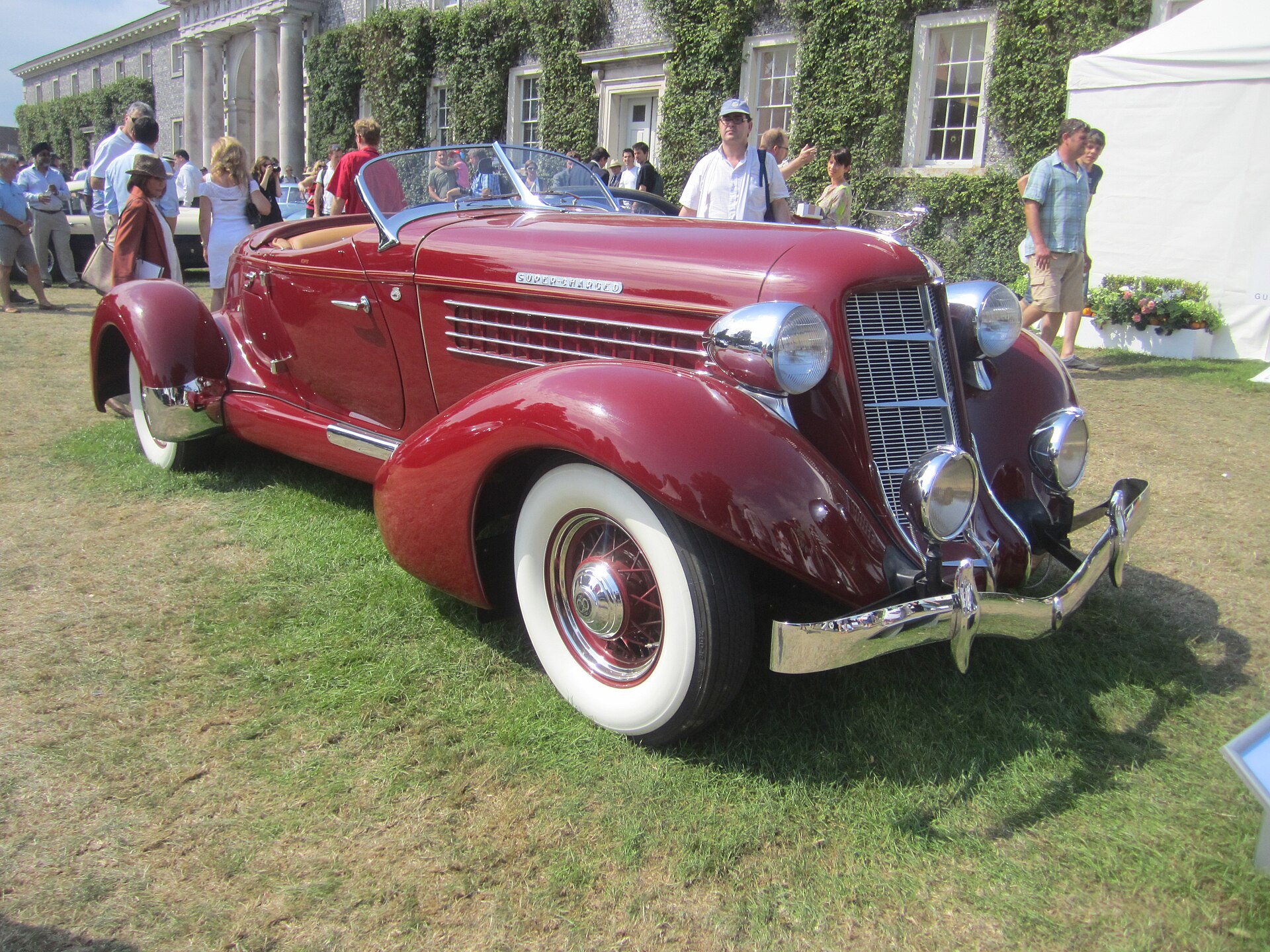
The Auburn Speedster is the boat-tailed two-seater that the Auburn Automobile Company of Auburn, Indiana, built in several series from 1928 to 1936. The best-known version is the supercharged 851 SC of 1935, styled by Gordon Buehrig and sold with a top speed of 100 mph (160 km/h); the 1936 852 differed only in its badge. English Wikipedia counts 887 Speedsters in all. Auburn stopped making cars in 1937, when E. L. Cord sold his holdings.
In short
- Lycoming straight-eights from 4.8 litres and 51 kW (68 hp) in 1926 up to the supercharged 4,585 cc engine of the 851 SC with 112 kW (150 bhp) at 4,000 rpm.
- A 6.4-litre V12 "Speedster 160" was offered from 1931; about 25 were built.
- A two-speed Columbia rear axle doubled the three-speed gearbox to six ratios.
- A 1935 car driven by Jenkins broke 70 American speed records, according to English Wikipedia.
Auburn Speedster at a glance
| Parameter | Metric | Imperial |
|---|---|---|
| Maker | Auburn Automobile Company, Auburn, Indiana | — |
| Production | 1928–1936 (English Wikipedia lead; its infobox gives 1925–1937) | — |
| Built | 887 Speedsters; 143 supercharged 851/852 SC | — |
| Designers | Alan Leamy (first two series), Count Alexis de Sakhnoffsky (early two-seater body), Gordon Buehrig (851) | — |
| Engine (851 SC) | Lycoming side-valve straight-eight, 4,585 cc, bore × stroke 77.78 × 120.6 mm, aluminium head | 280 cu in |
| Supercharger | Schwitzer-Cummins centrifugal, with one Stromberg downdraught carburettor | — |
| Power (851 SC) | 112 kW (150 bhp) at 4,000 rpm | — |
| Gearbox | three-speed manual, synchromesh on second and third, plus two-speed rear axle | — |
| Brakes | hydraulic Lockheed drums | — |
| Length × width | 4,930 × 1,800 mm | 194 × 71 in |
| Kerb weight | 1,700 kg | 3,700 lb |
| Top speed | 160 km/h | 100 mph |
From the Eight-In-Line to the first Speedster
The Auburn company grew out of the Eckhart Carriage Company, founded in Auburn, Indiana, in 1874 by Charles Eckhart. His sons Frank and Morris Eckhart began making cars around 1903. English Wikipedia describes a 1904 Auburn tourer with a flat single-cylinder engine of 7.5 kW (10 hp), a two-speed planetary transmission and a weight of 680 kg. The Eckharts absorbed two other local car makers, moved to a larger plant in 1909 and in 1919 sold the company to Chicago investors led by Ralph Austin Bard.
In 1924 the Chicago group offered E. L. Cord the job of running Auburn. He proposed a full takeover instead and completed the buyout before the end of 1925, after selling off the company's unsold stock with aggressive marketing. Under him Auburn moved to eight-cylinder engines from Lycoming, a company that later joined his group, and in 1926 he partnered with Duesenberg for the Model J of 1928–1937.
| Year | Model (English Wikipedia) | Engine |
|---|---|---|
| 1925 | Auburn Eight-In-Line, the first Auburn eight | Lycoming straight-eight |
| 1926 | 8-88 | 4.8-litre side-valve, 51 kW (68 hp) |
| 1927 | 115 | uprated to 86 kW (115 hp) |
| 1928–1929 | Speedster 120 | 268 cu in "big eight", 89 kW (120 hp); 100 built, about 8 thought to survive |
| 1930 | Speedster 125 | 93 kW (125 hp), advertised at over 100 mph |
| 1931 | Speedster 160 | 6.4-litre V12; about 25 built |
| 1934–1935 | 851 | supercharged or unsupercharged straight-eight |
| 1936 | 852 | as 851, with an "852" grille badge |
The source is not fully consistent about years and model names, so the table follows its timeline. The open two-seater body of the earlier Speedsters with its pointed boat tail is credited to Count Alexis de Sakhnoffsky, and Alan Leamy styled the first two series.

The V12 Speedster
In 1931 Auburn added a 6.4-litre V12 range. The engine was designed by George Kublin and built by Lycoming, and the Speedster version was called the "Speedster 160"; about 25 were made. English Wikipedia notes that the V12 design later became the basis of the LaFrance engine, used for decades in fire engines. The source gives no output for the V12, so it is not quoted here.

The 851 and 852 SC
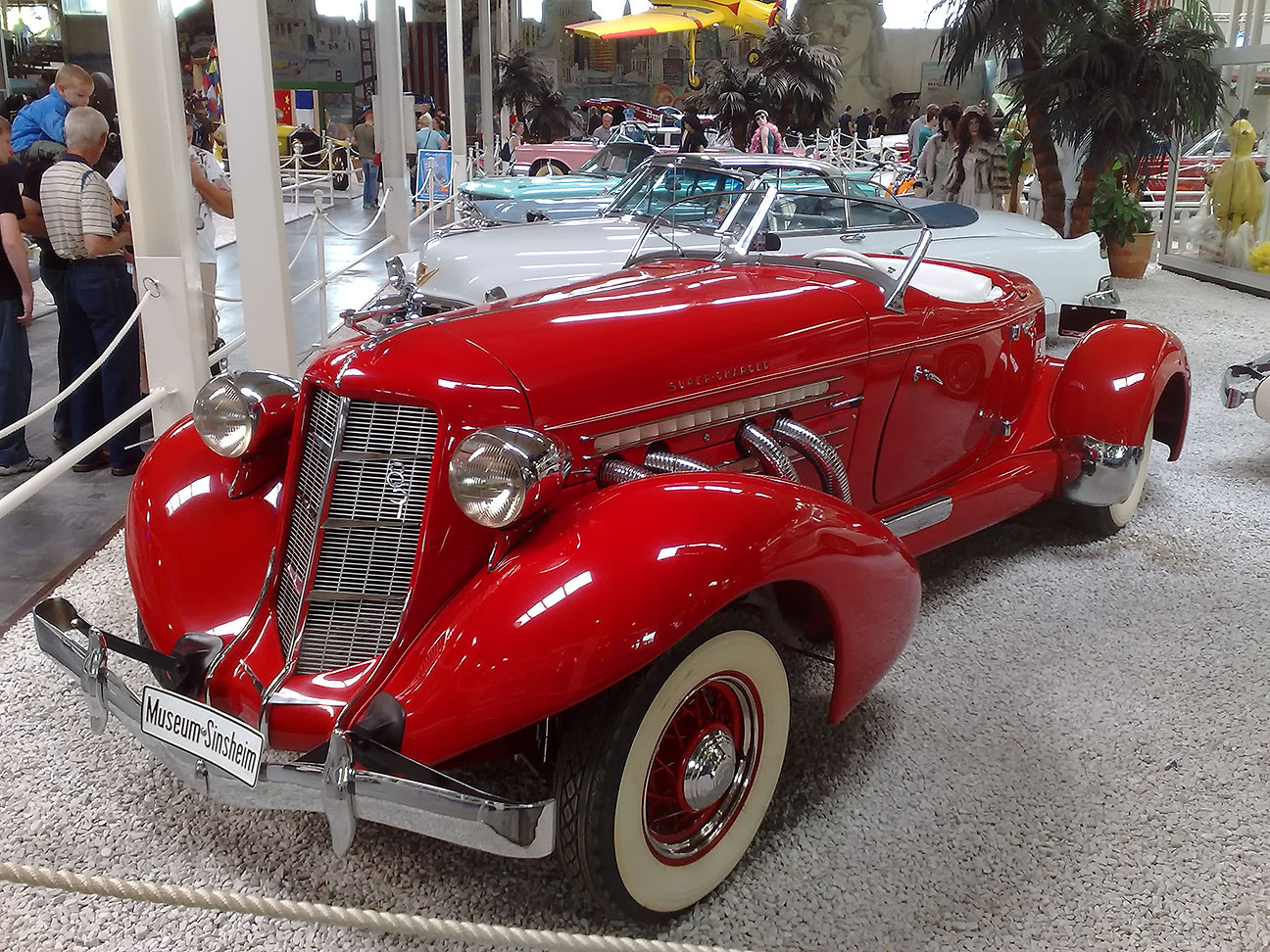
For 1935 Gordon Buehrig, who also styled the Cord 810, reworked the Speedster as the 851. Auburn marketed it as the "Hollywood car". It kept the boat tail and added sandwiched front and rear wings, a backswept radiator and external exhaust pipes on the side of the bonnet. The 852 of 1936 was the same car with a different grille badge.
The supercharged engine was a 4,585 cc side-valve straight-eight with an aluminium cylinder head. A Schwitzer-Cummins centrifugal supercharger and a single Stromberg downdraught carburettor gave 112 kW (150 bhp) at 4,000 rpm, enough for 160 km/h (100 mph). Only 143 supercharged 851/852 SC Speedsters were built. Between the 51 kW 8-88 of 1926 and the 112 kW 851 SC of 1935, Auburn's eight-cylinder output more than doubled, an increase of about 120% in nine years, while the supercharged engine produced about 24 kW per litre from its 4,585 cc. With 1,700 kg, that makes about 66 kW per tonne, or about 15 kg for every kW; our power-to-weight calculator compares that with modern cars.


Dual-ratio axle and chassis
The most unusual part of the 851 was its Columbia dual-ratio rear axle. An epicyclic gear train between the axle and the crown wheel offered a fast ratio of 3:1 and a slower 4.5:1, selected with a lever on the steering wheel and a dip of the clutch.
| Gear | Gearbox ratio | Note |
|---|---|---|
| 1st | 2.86:1 | — |
| 2nd | 1.68:1 | synchromesh |
| 3rd | 1.0:1 | synchromesh |
| Axle | 4.5:1 or 3:1 | Columbia two-speed |
Combined, the driver had six ratios. The chassis was a steel box-section frame with X-bracing. Semi-elliptic leaf springs and hydraulic dampers carried both axles, the rear a live axle. Steering was by worm and peg, brakes were hydraulic Lockheed drums, and the welded steel-spoke wheels measured 6.50 × 15 in.
Auburn after the Speedster
The Speedster's designers came from the same circle. Gordon Buehrig joined Cord's group in 1926, is credited with styling about half of the Duesenberg Model Js and moved to Auburn in 1934, while Alan Leamy was chief designer of the 1933 Speedster. Sales did not save the company: around 1935 Auburn began making kitchen cabinets and sinks to stay afloat. In August 1937 Cord sold his holdings while barred by an SEC injunction from further violations, and production of Auburn, Cord and Duesenberg cars ended that year.
The factories found other work. Former Auburn executives formed the Pak-Age-Car Corporation in 1938, and after a bankruptcy reorganisation in 1940 the company became Auburn Central Manufacturing, renamed American Central Manufacturing in 1942. It built body tubs for about 360,000 Willys MB Jeeps and about half of Ford's roughly 280,000 GPW Jeeps; by mid-1943 the Connersville plant had made its 150,000th Jeep body. The art deco Auburn headquarters now houses the Auburn Cord Duesenberg Automobile Museum and became a National Historic Landmark in 2005.
Records, films and legacy
A 1935 car driven by Jenkins broke 70 American speed records. The 851 appeared in many films: Swing Time (1936) used a 1935 851 Phaeton Sedan, Lonely Road (1936) an "Auburn Supercharger" Speedster and Headline Crasher (1936) an 851/2 Speedster driven by Frankie Darro; Marlene Dietrich drove a supercharged 851 SC in Desire (1936), Loretta Young an 851 Speedster in Love Is News (1937), and a 1936 Speedster appeared in the television series Remington Steele (1982–1987). The car in Indiana Jones and the Temple of Doom (1984) was a purpose-built replica. English Wikipedia also links the 851 with the Batmobile of early Batman comics.
The boat-tail idea returned on the 1963–1967 Chevrolet Corvette Sting Ray coupé, described in our Corvette C2 article, and on the 1971–1973 Buick Riviera. Auburn car production ended in 1937, together with the Cord brand.
Photo gallery


Auburn Speedster in our rankings
- No. 446 of 912 · Longest-running car nameplates (8 years · top 53%)
- No. 60 of 79 · Most powerful convertibles and roadsters (112 kW · top 78%)
- No. 667 of 859 · Most powerful cars (112 kW · top 79%)
- No. 137 of 154 · Most powerful American cars (112 kW · top 90%)
In production longer than 47% of ranked nameplates in the 1CARS catalog (No. 446 of 912).
FAQ
How many Auburn Speedsters were built?
English Wikipedia gives 887 from 1928 to 1936, including 143 supercharged 851/852 SC cars and about 25 V12 Speedsters.
What engine does the Auburn 851 Speedster have?
A 4,585 cc Lycoming side-valve straight-eight; with the Schwitzer-Cummins supercharger it produces 112 kW (150 bhp) at 4,000 rpm.
How fast is the Auburn 851 Speedster?
160 km/h (100 mph), according to English Wikipedia.
What is the difference between the Auburn 851 and 852?
Only the grille badge: the 1936 852 is identical to the 1935 851.
Who designed the Auburn Speedster?
Alan Leamy styled the first two series, Count Alexis de Sakhnoffsky the early two-seater body, and Gordon Buehrig the 1935 851.
Data sources
Data checked by an editor against the sources below.