Euro NCAP Ratings Explained: What the Stars Really Mean
A Euro NCAP star rating tells you how well a new car protects its occupants and other road users, and how good it is at avoiding a crash. The yardstick is the safety standard of the year it was tested. Five stars means excellent results in every area of the test; zero stars means the car meets the legal minimum for sale but lacks key modern safety technology. Since January 2026 the stars are based on four stages: Safe Driving, Crash Avoidance, Crash Protection and Post-Crash Safety. Because the tests get harder every few years, always read the stars together with the test year.
Key takeaways
- Stars run from 0 to 5. A car's weakest area decides the rating, so one poor result caps the stars.
- From 2026, a five-star car needs at least 80% in Crash Protection and Post-Crash Safety, and at least 60% (Safe Driving) and 70% (Crash Avoidance) during the 2026 transition year.
- A rating is valid for up to six years. A five-star car from 2019 and a five-star car from 2026 passed different tests.
- Some cars have two ratings: one for standard equipment and a higher one with an optional safety pack.
What each star level means
Euro NCAP describes the six levels like this:
| Stars | What Euro NCAP says it means |
|---|---|
| 5 | Excellent overall crash protection and well equipped with the latest crash avoidance technology |
| 4 | Good overall protection and prevention, but not the highest standard in every key area |
| 3 | Average safety performance, a medium standard |
| 2 | Nominal crash protection, below average in one or more key areas |
| 1 | Marginal crash protection and minimal crash avoidance technology beyond the legal requirements |
| 0 | Meets type-approval standards, so it can be sold, but lacks critical modern safety technology |
The last row is the one buyers misread most often. A zero-star car is legal. The rating says it is far behind what other new cars of the same year offer.
The 2026 system: four stages of safety
Euro NCAP announced the new system on 26 November 2025 and called it the largest revision since the overall rating was introduced in 2009. The protocol (version 10.0, June 2025) groups the tests by the stage of a crash. Each stage is scored out of 100 points and shown as a percentage.
| Stage | What it covers | Points inside the stage |
|---|---|---|
| Safe Driving | Driver monitoring and engagement, seatbelt use, speed assistance, ease of use of the main controls | Occupant monitoring 30, driver engagement 30, vehicle assistance 40 |
| Crash Avoidance | Automatic emergency braking (AEB), lane support, low-speed collisions such as pedal misapplication and cyclist dooring | Frontal collisions 60, lane departure 20, low speed 20 |
| Crash Protection | Frontal, side and rear impacts with a wider range of occupant sizes, plus pedestrian and cyclist impacts | Frontal 40, side 35, rear 5, vulnerable road users 20 |
| Post-Crash Safety | Rescue information, getting occupants out, automatic emergency calls, battery isolation in electric cars | Rescue information 40, extrication 35, post-crash intervention 25 |
Some details matter for everyday use. For top marks in Safe Driving a car needs continuous eye and head tracking of the driver. Controls are judged on placement, clarity and ease of use, including physical buttons for common functions. In Crash Avoidance, Euro NCAP now also scores how smooth and intuitive lane support feels in normal driving, after complaints about intrusive systems. After a crash, electrically powered door handles must still work so that rescuers can open the doors.
The thresholds behind the stars
The overall rating follows what the protocol calls the worst score principle: the car must reach the threshold for a star level in every stage. The weakest stage limits the result.
| Stars | Crash Protection | Post-Crash Safety | Safe Driving (2026 / 2027) | Crash Avoidance (2026 / 2027) |
|---|---|---|---|---|
| 5 | 80% | 80% | 60% / 70% | 70% / 80% |
| 4 | 70% | 70% | 50% / 60% | 60% / 70% |
| 3 | 60% | 60% | 40% / 50% | 50% / 60% |
| 2 | 50% | 50% | 30% / 40% | 40% / 50% |
| 1 | 40% | 40% | 20% / 30% | 30% / 40% |
Safe Driving and Crash Avoidance have a "soft landing": their thresholds rise each year until they match the other two stages at 80% for five stars. Two further rules apply. A surplus of up to 5 points in one of the first three stages can make up for a small shortfall in a neighbouring stage, although Safe Driving and Crash Protection cannot offset each other. And a car that meets every five-star threshold is still capped at four stars if any body region in the crash tests is rated red.
The protocol also gives each stage a weight: 20 for Safe Driving, 20 for Crash Avoidance, 50 for Crash Protection and 10 for Post-Crash Safety. These weights are used only for Euro NCAP's annual Best in Class ranking, not for the stars.
Worked example: why the test year matters
Take an imaginary car tested with these stage scores: Safe Driving 72%, Crash Avoidance 74%, Crash Protection 86% and Post-Crash Safety 85%. We calculated its rating from the published thresholds:
| Year of test | Safe Driving 72% | Crash Avoidance 74% | Crash Protection 86% | Post-Crash 85% | Result |
|---|---|---|---|---|---|
| 2026 | Five-star level (60%) | Five-star level (70%) | Five-star level (80%) | Five-star level (80%) | 5 stars |
| 2027 | Five-star level (70%) | Four-star level (needs 80% for five) | Five-star level | Five-star level | 4 stars |
In 2027 the same car loses a star because Crash Avoidance falls short of the higher bar: compared with 2026, the five-star threshold for that stage is 10 points higher. The Crash Protection surplus of 6 points cannot rescue it either: compensation is limited to 5 points, and 74 plus 5 is still below 80. Nothing about the car changed. The example shows why a rating only makes sense next to its test year.
How it worked before 2026
Cars tested up to 2025 were scored in four different boxes: Adult Occupant, Child Occupant, Vulnerable Road Users (pedestrians and cyclists) and Safety Assist. The worst-area rule applied there too: the overall stars were capped by the weakest box. Euro NCAP says the new system was built by regrouping these existing tests and recalculating their points, so the two systems measure related things but cannot be compared directly.
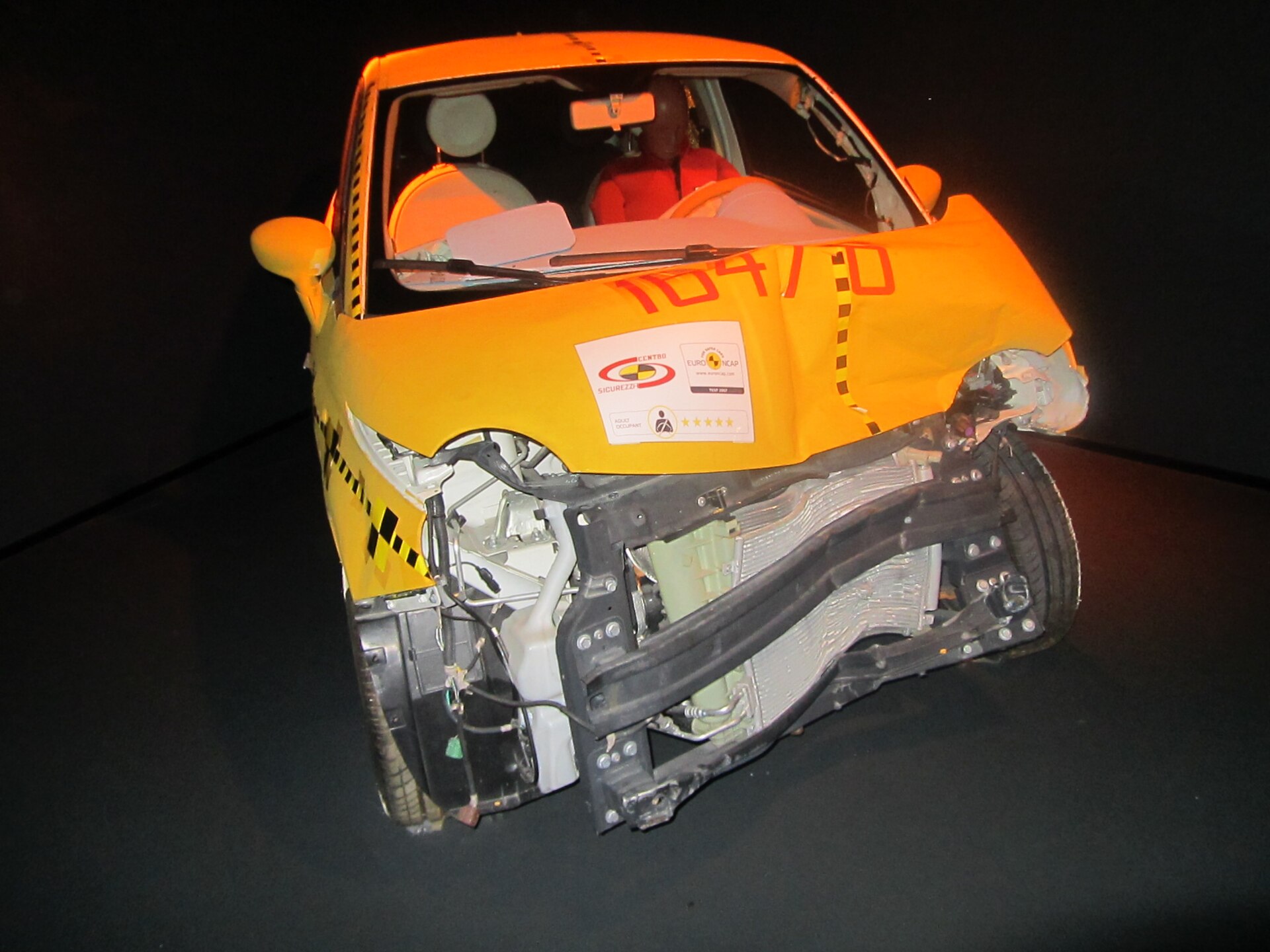
The physical crash tests themselves are demanding. According to Wikipedia's summary of the programme, the frontal test drives the car at 50 km/h into a 1,400 kg moving deformable barrier that also travels at 50 km/h, with 50% overlap. A full-width test drives the car into a rigid barrier at 50 km/h. In the side test a barrier hits the stationary car at 60 km/h, and in the pole test the car slides sideways into a rigid pole at 32 km/h.
Can you compare ratings from different years?
Only with care. Euro NCAP's own advice is that "the latest star rating is always the most relevant" and that ratings from different years are only comparable when the test changes in between were minor. The criteria are revised every three years, and a rating expires after six years because standards have moved on, not because the car has changed.
The best-known example is the Renault Zoe. As carwow notes, it scored five stars in 2013 and zero stars in 2021, after tougher tests and the removal of some safety features from the car. You can read more about the car in our article on the Renault Zoe.
Practical rules for comparing:
- Same year, same class: the most meaningful comparison. Look at the stage or box percentages, not only the stars.
- Different years: treat the older rating as weaker, even if the stars are the same.
- Expired rating: a car rated more than six years ago has no current rating. That says nothing bad about it, but it means you have no up-to-date benchmark.
- Facelifts: if a model is updated within the six years, Euro NCAP reviews whether the old rating still applies.
Dual ratings and safety packs
Since 2016 some cars carry two ratings. The first applies to the standard equipment fitted to every European version. The second, sometimes higher, applies when an optional safety pack is fitted. The manufacturer must sell the pack as a standalone option and meet minimum fitment rates. carwow gives the 2024 Hyundai Santa Fe as an example: four stars for the Premium trims, five stars with the SmartSense pack.
If you buy a car with a dual rating, check which rating your exact version has. A safety pack that is not fitted does nothing for you. Euro NCAP's 2026–2028 rating review notes that, because of longer lead times, it has decided not to actively extend the dual rating policy for now.
How to choose a safe car with Euro NCAP results
- Find the exact model and test year. Search the official Euro NCAP results, and check that the rating covers your body style and powertrain.
- Read the percentages. Two five-star cars can be far apart in Crash Protection or child protection. If you carry children, look at the child results in particular.
- Check the equipment. Make sure the tested systems, such as AEB and lane support, are standard on your trim or that you order the pack.
- Compare like with like. Use the rating to compare cars of the same size and test year. Our size comparison tool helps you put shortlisted cars side by side.
- Look up the model. Our car safety ratings page collects Euro NCAP results by model, and you can browse models in the car catalogue.
Who should care most: families, new drivers and anyone who drives a lot of urban kilometres, where the new Crash Avoidance tests for cyclists and pedestrians matter most. If two shortlisted cars are close on price and practicality, the one with the more recent five-star rating is the safer bet.
Try our calculator
Car size comparisonFAQ
What does a 5-star Euro NCAP rating mean?
It means excellent crash protection and up-to-date crash avoidance technology, measured against the tests of that year. Under the 2026 protocol the car must reach the five-star threshold in all four stages: Safe Driving, Crash Avoidance, Crash Protection and Post-Crash Safety.
Is a 4-star car unsafe?
No. Four stars means good overall performance, just not the top standard in every area. carwow also points out that a lower rating does not necessarily mean a car is unsafe. Check which stage or box held the car back.
How long is a Euro NCAP rating valid?
Up to six years from the date it was awarded. After that the rating expires because the tests have become tougher, not because the car got worse.
Why did some cars lose stars without changing?
Because the tests are revised every three years and thresholds rise. The Renault Zoe went from five stars in 2013 to zero in 2021 under newer, stricter tests.
Does Euro NCAP test every car sold in Europe?
No. It tests a selection of new models. Wikipedia's summary says it has tested more than 1,800 cars and published over 600 ratings since the first results in February 1997.
Sources
- Euro NCAP: How to read the stars (accessed 23 Oct 2026)
- Euro NCAP: Overall Assessment protocol, version 10.0 (June 2025, implementation January 2026) (accessed 23 Oct 2026)
- Euro NCAP: Euro NCAP announces 2026 protocol changes to tackle modern driving risks (26 November 2025) (accessed 23 Oct 2026)
- Euro NCAP: Rating Review 2026-2028 (accessed 23 Oct 2026)
- Wikipedia: Euro NCAP (accessed 23 Oct 2026)
- carwow: Euro NCAP ratings explained, how safe is your car? (2 September 2026) (accessed 23 Oct 2026)
Found a mistake? Report an error