Automatic Gearbox Types: Torque Converter vs Dual-Clutch (DSG) vs CVT
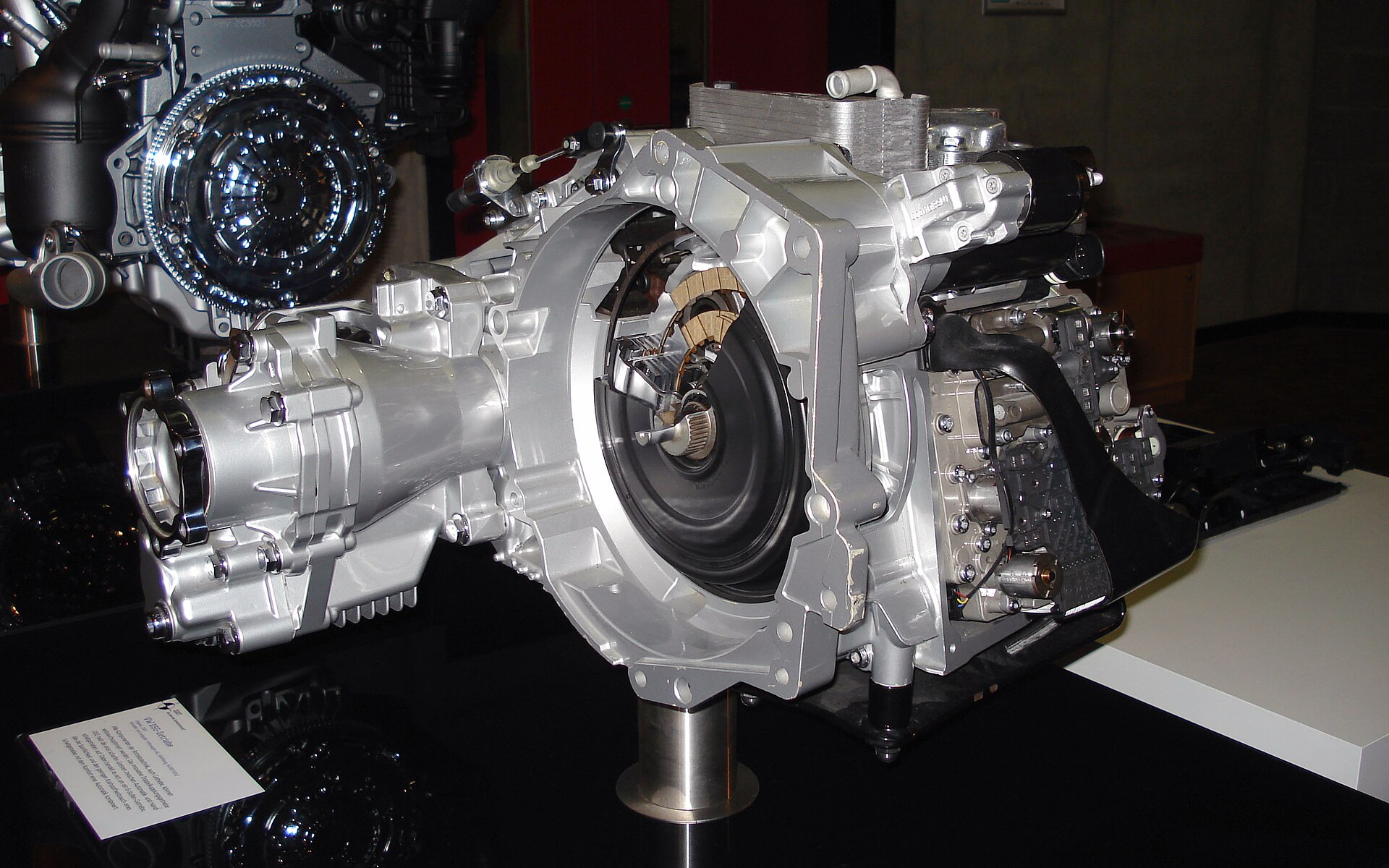
There are three main kinds of automatic gearbox in today's cars: the torque converter automatic, the dual-clutch gearbox (DCT, called DSG at Volkswagen) and the continuously variable transmission (CVT). Full hybrids add a fourth, the power-split "e-CVT", which has no belt at all. The torque converter is the smoothest in traffic and handles the most torque, the dual-clutch is the quickest and most efficient on the move, and the CVT is simple and frugal at moderate loads. No type is reliable or unreliable as a group: the specific gearbox design, its torque rating and its maintenance history matter more than the label.
Key takeaways
- Torque converter automatics date back to the 1948 Buick Dynaflow; modern ones have 8 to 10 speeds.
- Dual-clutch gearboxes preselect the next gear; the 2003 VW Golf R32 was the first mass-production car with one.
- Dry-clutch DCTs such as VW's DQ200 are rated for up to 250 Nm; wet-clutch units handle much more, up to 600 Nm for the DQ500.
- Belt CVTs have no fixed gears; the DAF 600 of 1958 was the first mass-production car to use one.
Automatic gearbox types at a glance
| Type | How it works | Strengths | Weak points | Typical use |
|---|---|---|---|---|
| Torque converter automatic | Fluid coupling plus planetary gear sets, 6 to 10 speeds | Smooth pull-away, high torque capacity, good for towing | Heavier; older units with few gears use more fuel | Premium cars, SUVs, large diesels |
| Dual-clutch (DCT/DSG) | Two clutches, one for odd and one for even gears | Very fast shifts, efficient | Low-speed judder on some units, dry clutches dislike heavy loads | Compact and sporty cars |
| CVT (belt or chain) | Two variable pulleys linked by a belt or chain | No shift steps, engine stays at its most efficient speed | Torque limits, engine noise under hard acceleration | Small cars, some Japanese models |
| Hybrid e-CVT (power-split) | Planetary gearset blends engine and electric motor | No clutch or belt to wear | Engine can drone under full throttle | Toyota and Lexus full hybrids |
| Automated manual (AMT) | Manual gearbox with robot-operated clutch | Cheap and light | Jerky shifts, torque interruption | Older city cars; largely replaced by DCTs |
You can see how gearbox types have spread across the catalogue in our gearbox types data page.
Torque converter automatic
A torque converter uses a fluid coupling to take the drive from the engine, so the car can creep and pull away smoothly without a clutch. The gears themselves are planetary sets switched by hydraulic or electronic control.
The history is long. GM's Hydra-Matic, introduced in 1939 for the 1940 model year, was the first mass-produced automatic, but it used a simple fluid coupling. The first automatic with a true torque converter was the Buick Dynaflow for 1948. From the 1980s, many four-speed automatics added a lock-up clutch in the converter to cut losses and improve fuel economy.
The number of gears then rose quickly:
| Gears | First production gearbox | Year |
|---|---|---|
| 6 | ZF 6HP26 (BMW 7 Series) | 2002 |
| 7 | Mercedes-Benz 7G-Tronic | 2003 |
| 8 | Toyota AA80E | 2007 |
| 9 | ZF 9HP | 2013 |
| 10 | Toyota Direct Shift-10A | 2017 |
More gears let the engine stay closer to its most efficient speed, which is why modern eight-speed automatics are no longer the thirsty option they once were. ZF, one of the main suppliers in Europe, is covered in our article on ZF gearboxes.
Dual-clutch gearbox (DCT or DSG)
A dual-clutch gearbox is two manual gearboxes in one housing. One clutch drives the odd gears, the other the even gears. While you drive in third, fourth is already selected; the shift just swaps clutches, so torque keeps flowing to the wheels.
The idea goes back to Adolphe Kégresse in 1939, and Porsche raced its PDK in the 962 C from 1985. The first mass-production passenger car with a DCT was the 2003 Volkswagen Golf R32. Volkswagen's family now covers several units:
| VW gearbox | Speeds | Clutches | Torque rating | Introduced |
|---|---|---|---|---|
| DQ250 | 6 | Wet | 350 Nm in text, 400 Nm in table (Wikipedia) | 2003 |
| DQ200 | 7 | Dry | 250 Nm | 2008 |
| DQ500 | 7 | Wet | 600 Nm | 2009 |
| DQ381 | 7 | Wet | 420 to 430 Nm | 2017 |
The difference between wet and dry clutches matters when buying. Wet clutches run in oil, which cools them, so they suit higher torque. Dry clutches are lighter and more efficient but are used behind smaller engines. Volkswagen claims the DQ200 is 6 % more economical than a six-speed manual and 20 % more than a traditional automatic.
The weak spots are known too. Some DCTs shudder or jolt at low speed, which is why Acura added a torque converter to the eight-speed DCT in the 2015 TLX. DSG units have also been recalled: in 2009 in the US for unplanned shifts to neutral and faulty temperature sensors, in China in March 2013 after a software fix had been offered for about 500,000 vehicles, and in Australia in October 2019 for a crack in the pressure accumulator that could cut power.
CVT: continuously variable transmission
A CVT has no fixed gears. Two pulleys, each made of two cones, are linked by a steel belt or chain. Moving the cones apart on one pulley and together on the other changes the ratio smoothly. The engine can stay at its most efficient speed while the car speeds up.
The DAF 600 introduced the Variomatic CVT in 1958, and in 1987 Subaru offered the first electronically controlled steel-belt CVT in the Justy. A belt-driven design is about 88 % efficient, according to Wikipedia's summary.
The trade-off is torque. Belt thickness limits how much torque the transmission can carry, which is why CVTs mostly sit behind small and medium engines, and higher-torque designs need a chain. Under hard acceleration the engine speed rises first and the car follows, a feeling many drivers dislike.
Hybrid e-CVT and automated manuals
Toyota's hybrid system, launched in the 1997 Prius, is often called a CVT but works differently. It has no belts or chains. A planetary gearset combines the engine and an electric motor, and changing the motor speed changes the effective ratio. With no clutches or belts, there are fewer parts to wear.
An automated manual is a conventional manual gearbox with an electronically operated clutch and shift. Systems such as Selespeed and Easytronic needed no driver input, but they have largely been replaced by dual-clutch gearboxes. On a used city car, expect noticeable pauses between gears.
Which automatic gearbox is most reliable?
There is no single answer by type, and sources that rank them usually generalise from a few problem gearboxes. A practical way to judge a specific car:
- Match the gearbox to the job. A dry-clutch DCT in a heavy car that tows or sits in traffic all day works near its limits; a wet-clutch DCT or a torque converter suits that use better.
- Check the torque rating. Look up the engine's torque on the car's specifications page and compare it with the gearbox; a unit near its limit has less margin.
- Ask about recalls and software updates. Several DSG problems were fixed by recalls or software, so ask a dealer whether they were done on the car's VIN.
- Look for fluid changes in the history. Wet-clutch DSGs hold about 7 litres of fluid, about 5.5 litres of it changed at a service; the handbook sets the interval.
Automatics are now mainstream in Europe. In 1997, only 10 to 12 % of cars in Europe had automatic gearboxes; since 2020 a majority of new cars sold in the UK have been automatic.
What to check on a test drive
| Check | Torque converter | DCT/DSG | CVT |
|---|---|---|---|
| Pull-away from rest | Should be smooth with gentle creep | Slight engagement is normal; shudder or jerks are not | Smooth; slipping or delay is a warning sign |
| Shifts under light throttle | Barely noticeable | Quick and clean | No shift steps, steady rise in speed |
| Hard acceleration | Prompt kick-down | Fast, no flare in revs | Revs rise then hold; whine is a warning sign |
| Reversing up a slope | Even, controllable | No judder or burning smell | No slipping |
| Warning lights | None | None, no gearbox messages | None |
Drive the car from cold if you can, and include stop-start traffic. Many faults show up only when the fluid is cold or the clutches are hot. You can then compare the running costs of manual and automatic versions of the same model with our cost of ownership calculator.
Try our calculator
Cost of ownership calculatorFAQ
Is DSG the same as a dual-clutch gearbox?
Yes. DSG (Direct-Shift Gearbox) is Volkswagen Group's name for its dual-clutch gearboxes. Porsche calls its version PDK, but the principle of two clutches for odd and even gears is the same.
Which is better, a CVT or a dual-clutch?
A dual-clutch gives faster, more direct shifts and suits sportier driving. A CVT is smoother in town and can be very economical with a small engine. For heavy loads or towing, a torque converter automatic is usually the better choice than either.
Are dry-clutch DSG gearboxes unreliable?
They are designed for lower torque, up to 250 Nm for the DQ200, and have been the subject of recalls. Many run without trouble, but check the recall and software history on the VIN and watch for low-speed judder on a test drive.
Is a hybrid e-CVT a real CVT?
Not in the mechanical sense. Toyota's system uses a planetary gearset and an electric motor to vary the ratio, with no belt or chain, so the usual CVT wear parts are not there.
Do automatic gearboxes need oil changes?
It depends on the gearbox, so follow the interval in the handbook; a wet-clutch DSG takes about 5.5 litres of fluid at a change. On a used car, a documented fluid change is a good sign.
Sources
- Wikipedia: Dual-clutch transmission (accessed 23 Oct 2026)
- Wikipedia: Direct-shift gearbox (accessed 23 Oct 2026)
- Wikipedia: Continuously variable transmission (accessed 23 Oct 2026)
- Wikipedia: Automatic transmission (accessed 23 Oct 2026)
Found a mistake? Report an error