Mazda 2 — Generations and the Third-Generation Hatchback
The Mazda 2 is a front-wheel-drive subcompact (B-segment) car from the Japanese manufacturer Mazda, offered as a five-door hatchback and, in some markets, a four-door saloon. In Japan it was called the Demio until 2019. It was the second model of Mazda's new-generation line-up after the Mazda 6, and today it is the brand's entry-level model outside Japan.
Key takeaways
- Three generations: DY (2002), built on the Ford B3 platform; DE (2007), World Car of the Year 2008; and DJ (2014), Japan Car of the Year 2014–2015.
- The DJ was updated in 2016, facelifted in 2019 and again in January 2023; a Toyota-based Mazda2 Hybrid joined in 2022.
- Skyactiv-G 1.5 petrol engines with 55–85 kW (75–115 PS) and a Skyactiv-D 1.5 diesel with 77 kW (105 PS).
- 280 litres of boot space, rising to 950 litres with the rear seats folded.
Mazda 2 at a glance
More Mazda models are listed in our Mazda catalogue, and the company's story is told in our history of Mazda.
| Generation | Code | Years | Notes |
|---|---|---|---|
| First | DY | 2002–2007 | Ford B3 platform shared with the Fiesta; built for Europe in Valencia, Spain |
| Second | DE | 2007–2014 | Debut at the Geneva motor show 2007; World Car of the Year 2008 |
| Third | DJ | 2014 onwards | Previewed by the Hazumi concept; facelifts 2019 and 2023 |
History
Mazda has built three generations so far. The first appeared in 2002 as the result of close cooperation with Ford, which controlled Mazda at the time. The second was introduced in 2007 and built until 2014. The third generation was unveiled in July 2014 as the production version of the Hazumi concept, which had debuted at the Geneva motor show in March 2014. In October 2016 Mazda gave the hatchback a light update that slightly changed the exterior and interior and introduced new features, including G-Vectoring Control. In July 2019 Mazda showed a more extensive facelift with a revised exterior, better equipment, a wider range of safety systems — including adaptive headlights — and G-Vectoring Control Plus. This article focuses on the third generation.
Exterior
The design of any Mazda is, to some extent, a work of art, and this plays a big role when buyers choose a car; it also makes the brand popular with younger drivers. The Mazda 2 shows the best of Mazda's design work, with signature details that give it a stylish and modern look.
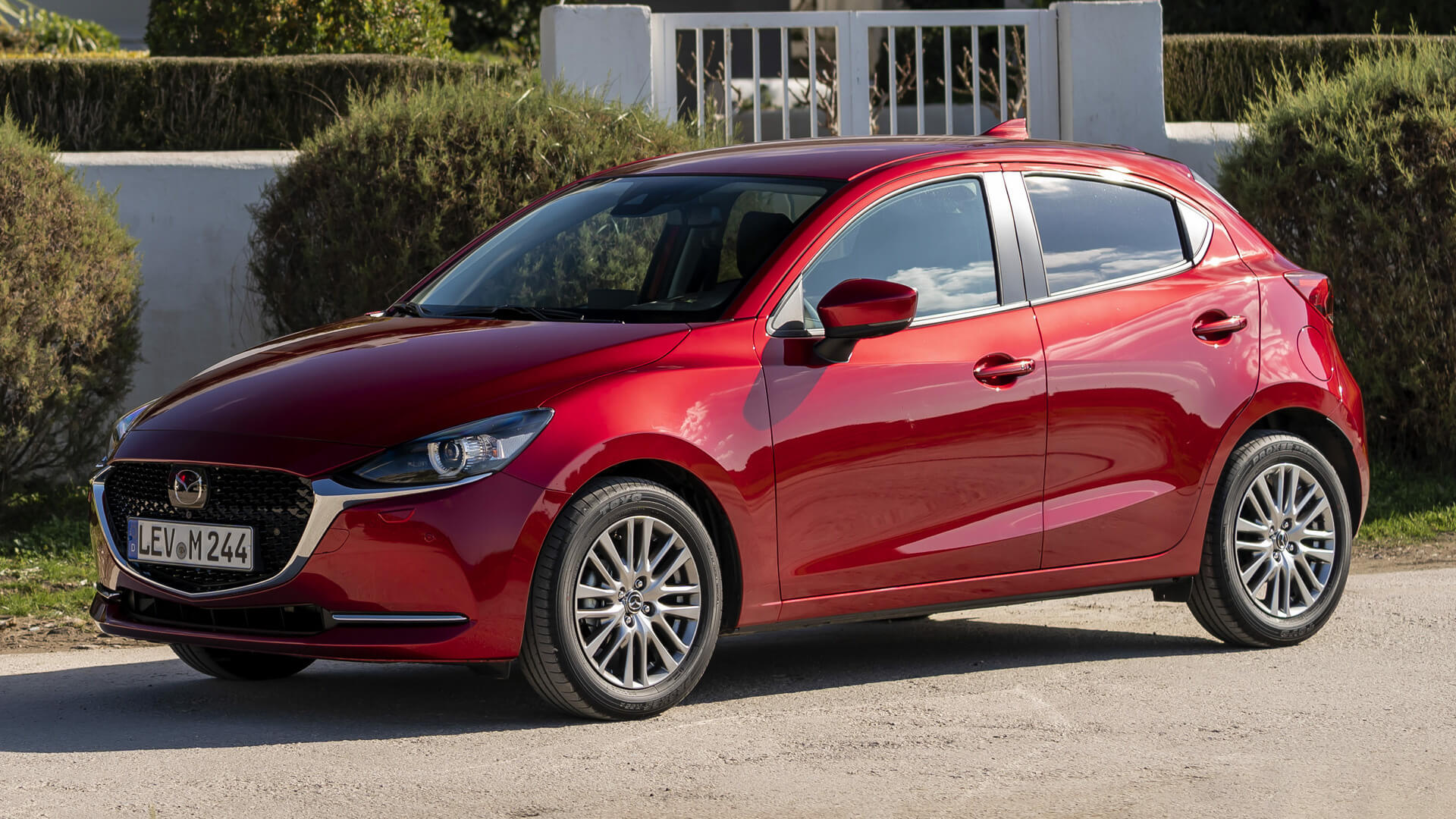
The front is particularly impressive. It is compact, with a gentle slope and a low stance that improves visibility and agility. The bonnet has a pronounced central section that bulges slightly outwards, with slightly recessed lines at the sides. Below them sit distinctive headlights made of thin, slanted horizontal strips; their equipment depends on the version, and after the facelift adaptive LED headlights with 20 individually controlled LEDs became available.
The signature grille in the centre of the bumper has a classic look and a stylish chrome surround, with the number-plate mount and the badge inside. The bumper is sculpted, with an auxiliary slot-shaped intake directly below the main grille and, at the sides, small recesses with two narrow chrome strips instead of fog lamps.
The side is distinctive without many decorative elements. Neat windows are separated by wide black strips, the compact oval mirrors carry indicators on some versions, and the doors are shaped with wave-like surfaces. Lower down there is stepped sculpting on the sills and slightly enlarged wheel arches. Ground clearance is an average 143 mm. The car rides on 15- or 16-inch alloy wheels with new designs.
At the rear, the tailgate is angled, with a spoiler incorporating the brake-light strip, a fairly large window for the class and large triangular tail lights. The rear bumper protrudes slightly and has a plastic diffuser, the number-plate mount, slim fog-lamp strips and an exhaust tip.
Interior
The cabin follows Mazda tradition. Materials include decent fabric, hard and soft plastics and leatherette. The infotainment system deserves praise: it is not overloaded but has everything needed. Sound insulation was improved, and the cabin combines space and ergonomics well. In 2015 the third-generation Mazda 2 received a Red Dot Design Award.
The driver has an elegant three-spoke steering wheel with buttons and switches. The instrument panel combines a central analogue rev counter with two digital trip-computer displays at its sides. The Mazda 2 seats five. Seats are trimmed in fabric or leatherette; options include electric adjustment and heated front seats, and all seats have head restraints. The front seats have an ergonomic shape with tall backrests and moderate side support.
The centre console is very clean. At the top is only a compact 7-inch MZD Connect touchscreen with Android Auto and Apple CarPlay, from which various vehicle settings can also be adjusted. Below it are a long horizontal air vent and round vents. The tunnel starts with three climate knobs, followed by a recess with sockets, the gear lever and the rotary controller, cupholders and a small but comfortable armrest with a storage box.
In theory three adults fit in the rear, but it is comfortable only for two. There are three full head restraints and a fold-down armrest with cupholders. The boot is not a record-breaker but is well shaped: 280 litres as standard and 950 litres with the rear seats folded, although the floor is not flat. A space-saver spare and a minimal tool kit sit under the floor.
Engines and transmissions
| Engine | Fuel | Power (kW / PS) | Torque |
|---|---|---|---|
| 1.5 Skyactiv-G | Petrol | 55 kW / 75 PS | 135 Nm |
| 1.5 Skyactiv-G | Petrol | 66 kW / 90 PS | 148 Nm |
| 1.5 Skyactiv-G | Petrol | 85 kW / 115 PS | 148 Nm |
| 1.5 Skyactiv-D | Diesel | 77 kW / 105 PS | 220 Nm |
The petrol engines are naturally aspirated four-cylinders with direct injection, 16 valves, double overhead camshafts and variable valve timing, using about 5 l/100 km. The turbodiesel has common-rail injection and 16 valves, uses about 3.4–3.6 l/100 km and has a top speed of 183 km/h. Power goes to the front wheels through a six-speed manual or a six-speed Skyactiv-Drive automatic, and the Mazda 2 reaches 100 km/h in about 9.8–12 seconds. Since 2022 Mazda has also offered a Mazda2 Hybrid in Europe, based on the Toyota Yaris Hybrid.
Chassis
The Mazda 2 uses a front-wheel-drive platform with a transverse engine and a monocoque body with a high share of high-strength steel. The front suspension is independent with MacPherson struts and the rear a semi-independent torsion beam, with anti-roll bars at both axles. Rack-and-pinion steering has electric assistance. The brakes are ventilated discs at the front and drums at the rear.
Safety and equipment
Despite its modest class, the Mazda 2 offers the most important comfort and safety systems: adaptive cruise control, G-Vectoring Control, lane departure warning, LED lighting, parking sensors, blind-spot monitoring, adaptive headlights, hill-start assist, rear cross-traffic alert, a 360-degree camera, traffic-sign recognition, ABS, ESP and front and side airbags, depending on the version.
A typical base version has front and side airbags, ABS and ESP, 15-inch steel wheels, electric windows, a multifunction steering wheel, keyless start, LED headlights and tail lights, the 7-inch infotainment system with six speakers, air conditioning, rear parking sensors, keyless entry, hill-start assist and blind-spot monitoring. Higher versions add adaptive headlights, a shark-fin antenna, climate control, a heated steering wheel and front seats, an electric driver's seat with memory, front parking sensors, a surround-view camera, traffic-sign recognition and cruise control.
What owners say
Owners of the third-generation Mazda 2 praise its compact size, reliability and economical engines. It is easy to drive, good-looking and lively, and its equipment and safety are good. On the downside, the low ground clearance can cause problems and the cabin is a little cramped: four people travel in reasonable comfort, five only with compromises. The boot is not the largest and noise insulation is not perfect, although the updated car improves on this.
Rivals
The third-generation Mazda 2 competed with the Volkswagen Polo, Renault Clio, Peugeot 208, Toyota Yaris, Suzuki Swift, Hyundai i20 and, until 2023, the Ford Fiesta.
Verdict
The Mazda 2 is a lively five-door supermini with a stylish, modern look that rarely leaves anyone indifferent and a functional cabin. Space and boot capacity are limited, but that is to be expected given its class, purpose and price — and the affordable price is not reflected in build quality, equipment or safety. Buyers can easily choose an economical engine that suits their needs.
FAQ
How many generations of the Mazda 2 are there?
Three: DY (2002), DE (2007) and DJ (2014), the last facelifted in 2019 and 2023.
What engines does the Mazda 2 have?
1.5 Skyactiv-G petrol engines with 55–85 kW (75–115 PS) and a 1.5 Skyactiv-D diesel with 77 kW (105 PS); a Toyota-based hybrid has been offered in Europe since 2022.
Was the Mazda 2 related to the Ford Fiesta?
The first generation was built on Ford's B3 platform shared with the Fiesta, and the second used a similar platform.
How big is the Mazda 2 boot?
280 litres, or 950 litres with the rear seats folded.