Mazda 5: Generations, Specs and History
The Mazda 5 is a compact MPV from the Japanese manufacturer Mazda. It grew out of the Mazda Premacy, a name that remained in use in Japan and some other Asian markets. Its most distinctive features are sliding rear doors, flexible seating for up to seven and a sporty driving character unusual for a people carrier.
Key takeaways
- The line began with the Premacy in 1999; from the 2005 generation the global model was called Mazda 5, and a new Mazda 5 followed in 2010.
- The 2010 generation was previewed at the Geneva motor show, entered production on 13 May 2010 and was the first Mazda styled in the Nagare "flow" design language.
- Engines included 1.6 diesel, 1.8 and 2.0 petrol units, and a 2.5 with 117 kW (157 hp) in North America.
- Mazda ended production in February 2018 and left the MPV market without a successor.
Mazda 5 at a glance
The story began in 1999, when the first Premacy was unveiled at the Geneva motor show. With the 2005 generation change, the global version took the name Mazda 5, while the Premacy name continued at home. The second Mazda 5 was unveiled in Geneva in 2010. It offered a clever interior layout, comfortable suspension settings, economical engines, sliding doors and balanced styling. Sales in the United States ended after the 2015 model year, and production for Japan ended on 23 February 2018 because of weak demand. The car was also sold under other names, including the Nissan Lafesta Highway Star in Japan and the Ford i-Max in Taiwan. More of the brand's range is in our Mazda catalogue.
Generations
| Generation | Years | Name | Notes |
|---|---|---|---|
| First | 1999–2005 | Premacy | Shown at Geneva in 1999; also sold as the Ford Ixion |
| Second | 2005–2010 | Mazda 5 (Premacy in Japan) | Sliding rear doors, Karakuri seating |
| Third | 2010–2018 | Mazda 5 (Premacy in Japan) | Nagare design; sold as Nissan Lafesta Highway Star |
Exterior of the 2010 Mazda 5
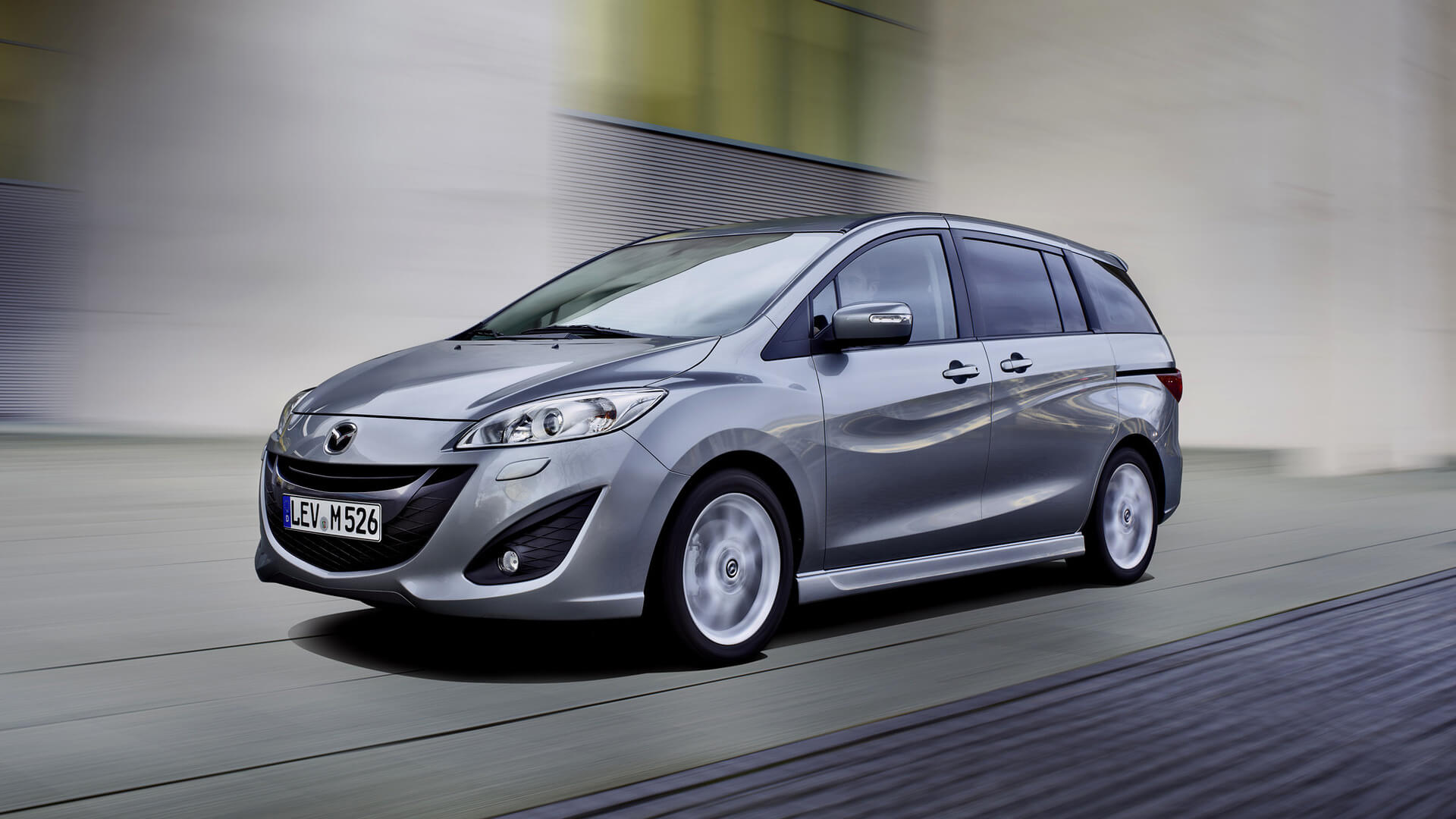
The 2010 Mazda 5 looks modern and attractive. At the front it has almond-shaped headlights and a large bumper with a "smiling" intake that combines the grille and an extra air slot. Contrasting black triangular inserts at the corners hold the fog lights, and small aerodynamic elements run along the lower edge. The front end closely resembles the smaller Mazda 3, sharing the design of the lights and intake, which is no surprise given how many car makers unify their models. The smooth, flowing shape reduces wind resistance and cabin noise.
Mazda's designers wanted to capture the flow of water in metal, as seen on their concept cars, and called the style Nagare ("flow"). Graceful flowing lines run around the whole body. The side view is especially distinctive, with ripples pressed into the panels: the first wave starts at the strong front wheel arch, descends across the front door and rises again towards the rear. A sloping bonnet, steeply raked windscreen, falling roofline, high waistline and a light, sporty rear complete the profile. From the 2013 update, the mirrors had integrated LED indicators. Sliding rear doors with a large opening set the car apart.
Ground clearance is a modest 130 mm, which is enough for town driving but not much more. Standard wheels are 16-inch alloys, with 17-inch wheels optional. Mazda used high-strength steel and galvanised metal on both sides of the panels, allowing it to offer a 12-year warranty against perforation corrosion.
The rear looks heavier because of the large light clusters and big tailgate, while the compact rear bumper looks almost as if it came from another car. The large rear window appears to merge with the side glass. The bumper carries parking sensors and reflectors at the corners, and a single round exhaust pipe completes the look.
Interior and practicality
The cabin is similar to the previous model's, with some new elements and details. The front seats have widely spaced side bolsters and heating, making long journeys comfortable. The driver has a three-spoke multifunction steering wheel adjustable for height and reach and a stylish instrument panel with two deep dials and a trip-computer display, all easy to read. The dashboard is made of hard plastic with a strict shape. A narrow display at the top of the centre console shows vehicle information, with a large audio unit below it (radio, CD, MP3, USB and AUX, six speakers) and the climate controls underneath. The gear lever sits high on the console. Some shiny hollow plastic trim looks cheap, but after the facelift the cabin gained gloss-black inserts, better seat fabric, a reversing camera, an auto-dimming mirror and a lit glovebox with a USB port.
Access to the second and third rows is easy thanks to the sliding doors, which open wide and can be electrically operated as an option. The middle-row seats are soft, wide and long, slide by 270 mm and recline, and there is room for three. The third row suits children or teenagers, as legroom and space generally are very limited. Mazda's Karakuri seating system lets the second and third rows slide and fold, turning the interior into a seven-, six-, five- or two-seater. One of the large middle-row seats hides a table and container, the other an extra folding centre seat, so two seats and the wide armrest can become a bench for three. Sound insulation and materials were improved compared with the predecessor.
With all seven seats in use, the boot holds 158 litres. Folding the third row raises this to 426 litres, folding all rear seats gives 780 litres, and loading up to the roof provides 1,485 litres on a flat floor.
Engines and transmissions
| Market | Engine | Power | Torque | Gearbox |
|---|---|---|---|---|
| Europe | 1.6 turbodiesel | - | - | 6-speed manual |
| Europe, Japan | 1.8 MZR petrol | - | - | 6-speed manual |
| Europe | 2.0 direct-injection petrol with i-stop | - | - | 6-speed manual or automatic |
| Some markets | 2.0 MZR petrol | 106 kW / 144 PS | 180 Nm | 5-speed automatic |
| North America | 2.5 MZR petrol | 117 kW / 157 hp | - | 6-speed manual or 5-speed automatic |
The 2.0-litre engine has four cylinders, 16 valves and variable valve timing. With a five-speed Activematic automatic with manual mode, it takes 13.1 seconds to reach 100 km/h, reaches 186 km/h and uses about 7 l/100 km on the combined cycle. Japanese versions were also offered with all-wheel drive and later with a 2.0 Skyactiv-G engine and a six-speed Skyactiv-Drive automatic. Other versions are front-wheel drive.
Chassis
The Mazda 5 has independent coil-spring suspension front and rear, giving a fairly soft but controlled ride. Steering is rack-and-pinion with electro-hydraulic assistance, and brakes are discs, ventilated at the front.
Safety and equipment
The Mazda 5 is well equipped for safety and comfort. Depending on the version, it has fog lights, headlight washers, climate control, heated front seats, electric windows all round, central locking, heated electric mirrors, a trip computer, ABS, EBD, emergency brake assist, DSC stability control and traction control, up to eight airbags, parking sensors, a rain and light sensor, tyre-pressure monitoring, xenon headlights and cruise control. Depending on the market, base versions have six airbags, ABS and ESP, climate control, electric windows, remote central locking and alloy wheels.
Strengths and weaknesses
Owners praise the attractive styling, good performance and handling, roomy cabin, suspension, reliability, reasonable running costs and safety, all important in a family car. Visibility is good, build quality is solid, and the three rows of seats with their flexibility and the sliding doors are very practical. On the downside, fuel consumption is higher than expected, the infotainment is basic, ground clearance is low, and some cars are prone to rust despite the warranty. Rivals include the Volkswagen Touran, Renault Scénic, Citroën C4 Picasso, Opel Zafira Tourer, Toyota Verso and Chevrolet Orlando.
FAQ
Is the Mazda 5 the same as the Mazda Premacy?
Yes. From 2005 the global model was called Mazda 5, while the Premacy name continued in Japan and some other markets.
How many seats does the Mazda 5 have?
Up to seven in three rows. The Karakuri system lets the cabin be set up for seven, six, five or two people.
When was the Mazda 5 discontinued?
Production for Japan ended on 23 February 2018; US sales had already ended after the 2015 model year.
Does the Mazda 5 have sliding doors?
Yes. The rear doors slide backwards and open wide, with optional electric operation.
How big is the Mazda 5 boot?
158 litres with seven seats, 426 litres with the third row folded and up to 1,485 litres loaded to the roof.