Mazda 3 — Generations, Specs and History
The Mazda 3 is a compact C-segment car built by Mazda Motor Corporation; in Japan it is sold as the Mazda Axela. It is the Hiroshima company's real breadwinner and its best-selling model ever. Four generations have been produced, and the latest was unveiled in Los Angeles in November 2018. Sedan and hatchback body styles have been offered throughout.
Key takeaways
- Four generations: BK (2003–2008), BL (2008–2013), BM (2013–2018) and BP (2018 onwards).
- Replaced the Mazda Familia (323, Protegé) and became Mazda's best-selling model; about two million first-generation cars were sold.
- Engines from 1.4 to 2.3 litres, including the 191 kW (260 PS) MPS hot hatch, Skyactiv-G petrol, Skyactiv-X and Skyactiv-D diesel engines.
- The fourth generation offers i-Activ AWD in some markets.
Mazda 3 at a glance
The Mazda 3 is a front-engined, front-wheel-drive compact with a transverse engine; the latest generation adds an all-wheel-drive option in some markets. It quickly became popular not only in Japan but also in the United States and Europe, thanks largely to its design and driving manners. More Mazda models are listed in our Mazda catalogue.
Mazda 3 generations
First generation: BK (2003–2008)
In 2003 the first Mazda 3, codenamed BK, replaced the ageing Familia (323). It had striking looks and sporty handling, and its dynamic appearance appealed especially to younger drivers. Attractive headlights, an unusual grille and fog lamps at the corners shaped the front; the side was harmonious and modern, with 15-inch alloys. The hatchback had a large tailgate with the Mazda badge and handle below the window. A 2006 facelift improved sound insulation and changed the bumpers and grille. Ground clearance is fairly low, which can be a nuisance in winter.
The interior is cosy and comfortable. The dashboard seems complicated at first but becomes familiar after ten minutes. The seats are ergonomically shaped with decent side support, and equipment was good, although sound insulation was weak and trim materials cheap. Higher versions had a pop-up display at the top of the centre console that could also show navigation.
Engines included a 1.6 with 77 kW (105 PS) and the most popular 2.0 with 110 kW (150 PS), with a five-speed manual; the 1.6 could have a four-speed automatic. The Mazda 3 MPS hot hatch used a 2.3-litre turbocharged four-cylinder with 191 kW (260 PS) and a six-speed manual only. Europe also had a 1.4 with 62 kW (84 PS), which was frankly underpowered, and 1.6, 2.0 and 2.2 turbodiesels with 80–136 kW (109–185 PS). The car used the global Ford C1 platform shared with the Ford Focus and Volvo S40, and was known for strong brakes, precise and predictable suspension, sharp handling and capable engines. The first generation lived on as a licensed copy, the Haima 3, in China.
Second generation: BL (2008–2013)
The second Mazda 3 (BL) was introduced in 2008 and substantially updated in 2011. It was less popular than the first — potential buyers were put off by its looks, although the styling was different rather than worse. Elongated diamond-shaped headlights remained; the grille moved lower into the bumper and, with the number plate, formed a "smile". Large side intakes with fog lamps channel air to the front brakes, and the new shape cut drag by 7%, helping fuel economy and high-speed driving. The hatchback has a beak-like nose, a smoothly falling roof, body-coloured mirrors, small rear doors, tail lights that wrap onto the sides and tailgate, 16-inch alloys, muscular arches, a two-part rear bumper and a large roof spoiler with a third brake light.
As promised, the interior looks more expensive and solid, with soft-touch plastic on the dashboard and revised ergonomics. The driver's seat is height-adjustable, and the three-spoke steering wheel adjusts for reach and height and now has many more buttons. Two dials frame a trip computer screen, and the infotainment and navigation display moved under its own hood above the centre console. Despite larger exterior dimensions, the cabin is no roomier: two adults are comfortable in the rear, three can fit. The hatchback's boot holds 340 litres (1,360 litres folded); the sedan's holds 430 litres.
Engines were 16-valve DOHC four-cylinders with variable valve timing and variable intake: a 1.6 with 77 kW (105 PS) and 145 Nm and a 2.0 with 110 kW (150 PS) and 187 Nm. The 2011 update brought a new 2.0 Skyactiv-G with 115 kW (157 PS) and 201 Nm, paired with Skyactiv-MT six-speed manual and Skyactiv-Drive automatic gearboxes in some markets; other versions kept five-speed manual and four- or five-speed automatic gearboxes. The suspension design changed little but was reworked to improve durability and eliminate weak points, and electro-hydraulic power steering became standard on all engines. Equipment ranged from ABS, EBD, front and side airbags and curtains, remote central locking, a trip computer and 15-inch steel wheels to dual-zone climate control, heated front seats, parking sensors, stability control, fog lamps, headlight washers and 16-inch alloys.
Third generation: BM (2013–2018)
The third Mazda 3 (BM) was revealed in summer 2013 and updated three years later, with attractive styling, a solid, almost German-quality cabin and modern engineering. It is styled in Mazda's "Kodo" language and launched with ten paint colours. LED headlights and more expressive fog lamps give a more aggressive look; a long bonnet, crisp lines, chrome highlights, rear-set mirrors, sculpted sills and 16-inch alloys shape the profile. Ground clearance is 155–160 mm. At the rear, a sculpted bumper houses the exhaust outlets, and intricate tail lights extend onto the tailgate, whose glass area shrank slightly without hurting visibility.
Mazda says the cabin was designed after analysing driver behaviour. The driver's seat has manual adjustment only but good side support. A large central rev counter is flanked by two displays, and a small head-up display above the instruments shows speed and cruise control information. The MZD Connect infotainment system uses a fixed 7-inch touchscreen, which works by touch only below 8 km/h; above that, steering-wheel buttons and a controller on the tunnel take over. The longer wheelbase was intended to add rear space, though the gain is small; two passengers sit comfortably in the rear. The hatchback boot holds 364 litres (1,263 litres folded) and the sedan's 408 litres, with a regular shape, good trim and a sensible loading height.
Petrol engines included a 1.6 with 76 kW (104 PS) and 144 Nm (0–100 km/h in 13.5 seconds, 177 km/h, 6.3 l/100 km) and a 1.5 Skyactiv-G with direct injection, dual variable valve timing and a 4-2-1 exhaust manifold, producing 88 kW (120 PS) and 150 Nm (11.6 seconds, 191 km/h, 5.8 l/100 km), both with a six-speed automatic. The Skyactiv body uses 60% high- and ultra-high-strength steel; suspension is MacPherson at the front and multi-link at the rear, with anti-roll bars on both axles. Steering has adaptive electric assistance with the motor on the column, and the brakes are discs all round with ABS, EBD and brake assist. G-Vectoring Control adjusts engine torque according to speed, steering input and acceleration to make the car's responses smoother and more predictable. Equipment includes six airbags, the 7-inch infotainment system, dual-zone climate control, ESP, heated front seats and power-folding heated mirrors; higher trims add adaptive LED headlights, a colour head-up display, an electric parking brake, automatic braking and traffic-sign recognition.
Fourth generation: BP (2018 onwards)
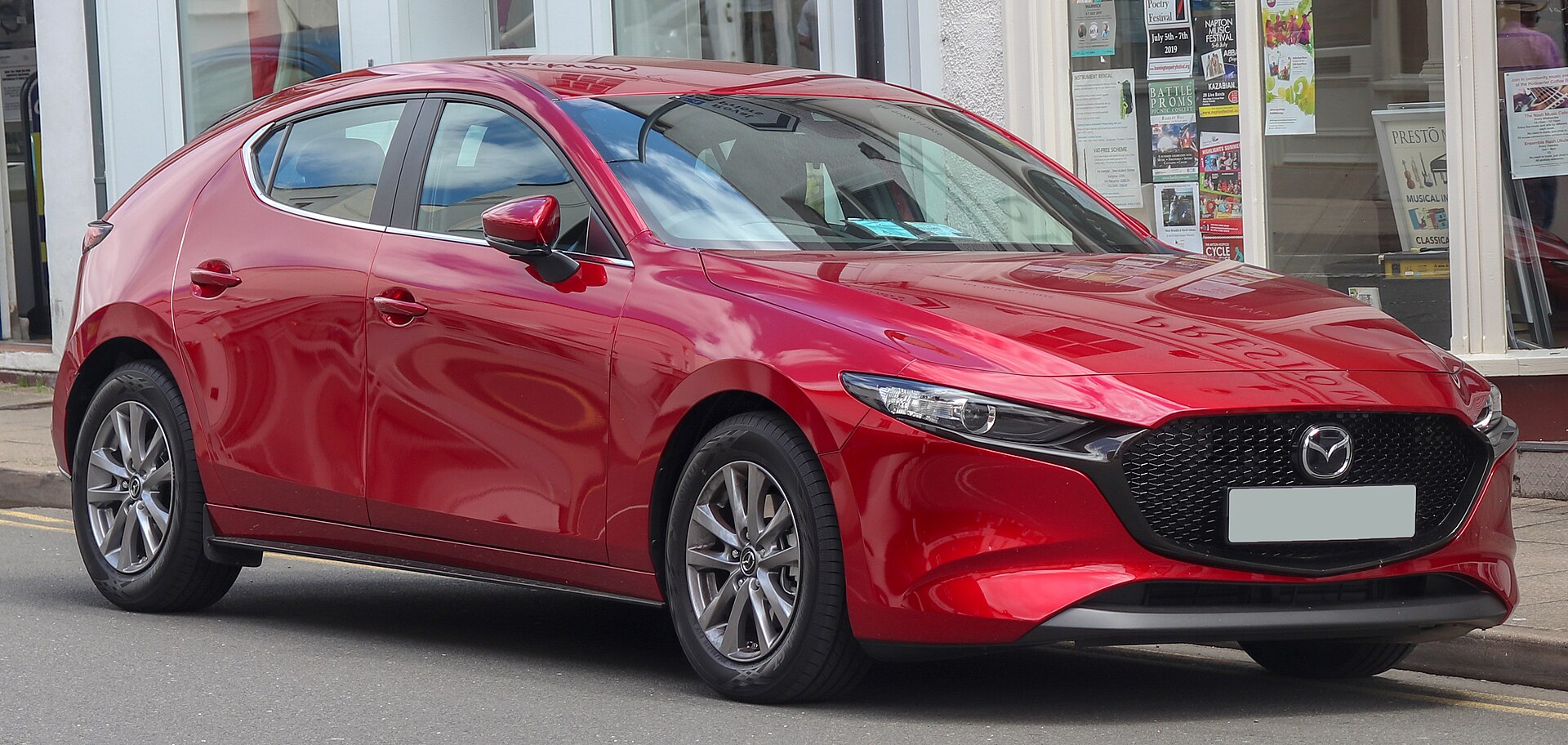
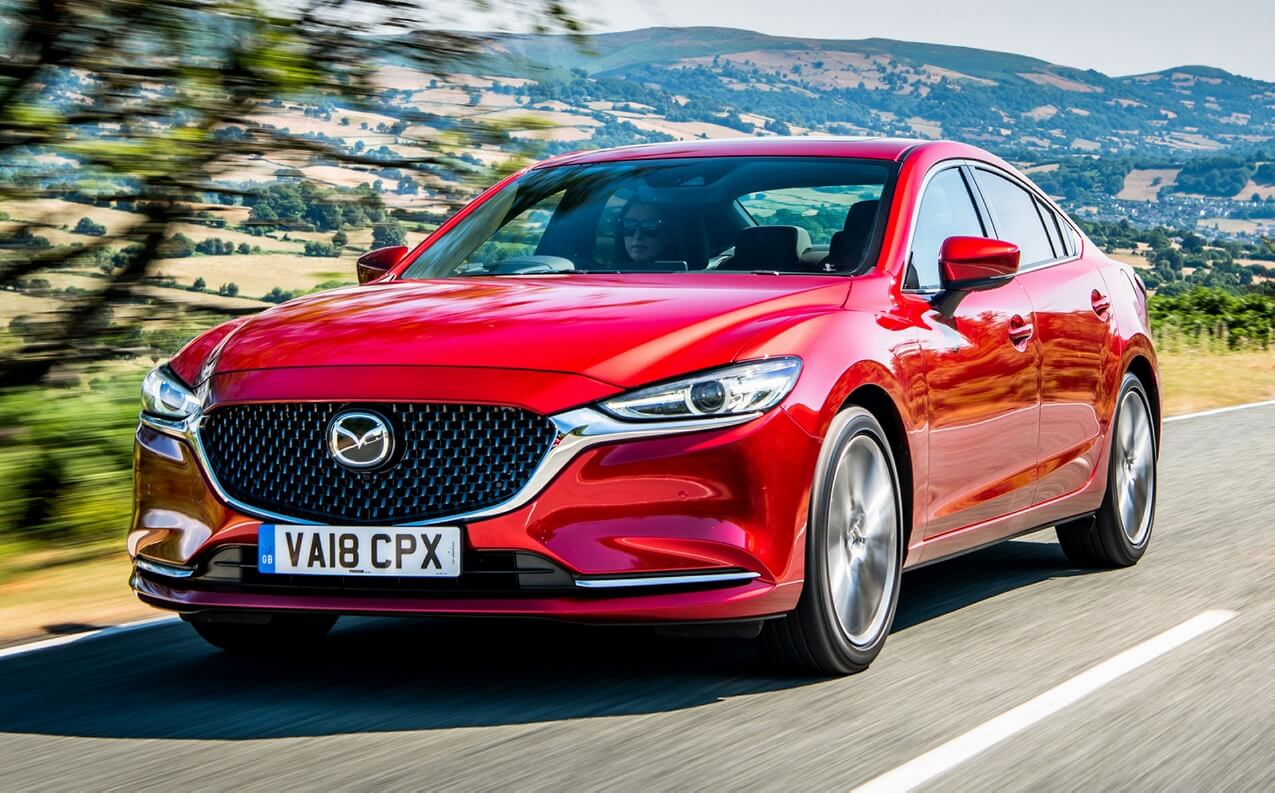
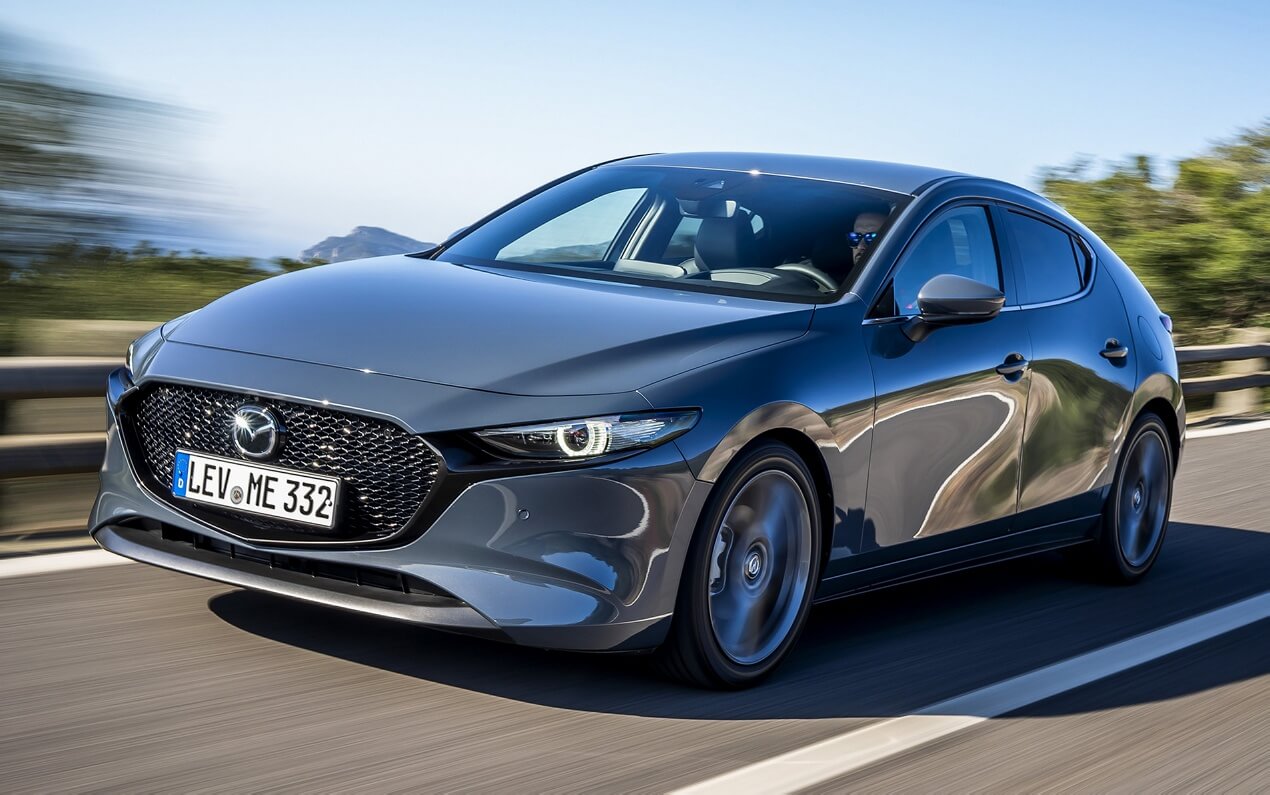
The fourth-generation sedan (BP) was unveiled alongside the hatchback at the Los Angeles motor show in November 2018. The two differ only at the rear. At the front, a larger mesh grille with a chrome strip along its lower edge running into the headlights is the most noticeable change. The narrower headlights have LED main beams on every version, with LED or halogen running-light rings, and fog lamps are built in. The bonnet is less domed, the windscreen narrower at the top and the sides are smooth, without sharp creases. Mirrors are smaller, with LED indicators, power adjustment and heating as standard. Ground clearance fell to 135 mm, and wheels are 16 inches as standard or 18 inches optionally. The sedan has a spoiler-like lip on the boot lid and long LED rear fog lamps; the hatchback adds a roof spoiler.
The minimalist interior uses soft leather, aluminium-look trim, chrome and metal, and build quality is excellent. The digital instruments are clear in any light, though their layout cannot be changed. A wide 8.8-inch display shows navigation and the rear camera and supports Apple CarPlay, Android Auto and voice control. The centre vents are split to each side, the climate controls look modern, and the electric parking brake and safety-system switches sit by the gear lever. Front bucket seats give good support; heating is widely fitted, and higher trims add electric adjustment with memory. Three adults fit in the rear. The sedan's boot holds 444 litres (1,138 litres folded) and the hatchback's 358 litres (1,026 litres folded), with a wide opening but a high sill.
Engines and transmissions (fourth generation)
| Engine | Power (kW / PS) | Torque | Notes |
|---|---|---|---|
| 1.5 Skyactiv-G | 88 kW / 120 PS | 153 Nm | Naturally aspirated, direct injection |
| 2.0 Skyactiv-G | 110 kW / 150 PS | 213 Nm | Naturally aspirated, direct injection |
| 2.0 Skyactiv-X | 132–137 kW / 180–186 PS | 224–240 Nm | Spark-controlled compression ignition, mild hybrid; some markets |
| 1.8 Skyactiv-D | 85 kW / 116 PS | 270 Nm | Turbodiesel, offered in some markets |
The petrol engines are in-line four-cylinders with 16 valves (DOHC) and electrically controlled variable timing on both camshafts, using 6.0–6.9 l/100 km. A six-speed manual is standard, with a six-speed automatic available, and i-Activ AWD is offered in some markets. The hatchback reaches 100 km/h in 9.3–12.4 seconds and 193–213 km/h. The BP uses the evolved Skyactiv-Vehicle architecture with a high proportion of high-strength steel, MacPherson struts at the front and a torsion-beam rear, passive dampers and anti-roll bars, electric power steering and disc brakes all round (ventilated at the front).
Safety and equipment
The fourth generation offers ABS, EBD, stability control, tyre-pressure monitoring, front and side airbags, curtain airbags, a driver's knee airbag, steering-wheel paddles, climate control, heated front seats, rain and light sensors, front and rear parking sensors, a rear camera, an electric parking brake, heated wiper area, mirror memory and navigation. Even the base version has seven airbags, LED headlights, the 8.8-inch infotainment screen, G-Vectoring Control, a head-up display and an eight-speaker audio system; the top-spec version adds 18-inch wheels, electric front seats, a heated steering wheel, keyless entry and front and rear parking sensors.
Key specifications by generation
| Parameter | BK | BL | BM | BP |
|---|---|---|---|---|
| Years | 2003–2008 | 2008–2013 | 2013–2018 | 2018 onwards |
| Petrol power (kW / PS) | 62–191 kW / 84–260 PS | 77–115 kW / 105–157 PS | 76–88 kW / 104–120 PS | 88–110 kW / 120–150 PS |
| Ground clearance | — | — | 155–160 mm | 135 mm |
| Boot, hatchback | — | 340 / 1,360 l | 364 / 1,263 l | 358 / 1,026 l |
| Boot, sedan | — | 430 l | 408 l | 444 / 1,138 l |
Strengths and weaknesses
Owners of the latest Mazda 3 report lively performance in town despite modest figures on paper, a comfortable cabin with an adjustable seat cushion, a steering column with a wide range of adjustment, a fast infotainment system that connects phones easily and a useful rear camera. It corners confidently at speed, and the trim, seats and ergonomics are excellent. The 135 mm ground clearance can be a concern. Rivals include the Kia Cerato, Hyundai Elantra, Toyota Corolla, Honda Civic, Citroën C4, Ford Focus, Audi A3, Volkswagen Jetta and BMW 1 Series.
FAQ
What is the Mazda 3 called in Japan?
Mazda Axela.
How many generations of the Mazda 3 are there?
Four: BK (2003), BL (2008), BM (2013) and BP (2018).
Which car did the Mazda 3 replace?
The Mazda Familia, also known as the 323 and Protegé.
What platform did the first Mazda 3 use?
The global Ford C1 platform, shared with the Ford Focus and Volvo S40.
How big is the Mazda 3 boot?
In the fourth generation, 444 litres for the sedan and 358 litres for the hatchback.