 Chevrolet Captiva
All generations, specs and history
Published Sources (2) Report an error
By Sarah Whitmore, Senior Automotive Writer
- Built
- 2006–present
- Generations
- 2
Timeline
Captiva generations
Click a generation for its own page


- Captiva C100/C140 2006–2018 · SUV
- Captiva II Current 2018–now · SUV
Newest first · 2 generations since 2006
All generations by year: Captiva II (2018–now) · Captiva C100/C140 (2006–2018)
Which one is mine?
Pick the year of first registration to see which generation it is.
- Captiva II 2018–present
- C100 2006–2018
The Chevrolet Captiva is a compact five-door crossover with five or seven seats, developed by GM's South Korean division. It never led its class in sales, but it earned a reputation for offering a lot of car for a reasonable price. Derived from the Chevrolet S3X concept shown at the Paris motor show in 2004, the Captiva went on sale in 2006. The first generation was facelifted in 2011 and again for 2016 and was phased out in 2018, when the Chevrolet Equinox replaced it in most markets; a second-generation Captiva, based on a Chinese Wuling model, followed from late 2018 in Latin America, Asia and the Middle East.
In short
- First generation (2006–2018) on GM's Theta platform, sold as the Daewoo Winstorm in Korea until 2011 and the Holden Captiva in Australia.
- Petrol 2.4 four with up to 123 kW (167 PS), 3.2 and 3.0 V6s with up to 190 kW (258 PS), and 2.0 and 2.2 VCDi diesels with up to 135 kW (184 PS).
- Front-wheel drive or on-demand all-wheel drive; five or seven seats.
- Second generation (from 2018): a rebadged Baojun 530 built by SAIC-GM-Wuling.
Chevrolet Captiva at a glance
The Captiva is a monocoque crossover with a transverse front engine. The first generation shares its underpinnings and many powertrain components with the Opel/Vauxhall Antara and the Saturn Vue. More Chevrolet models are listed in our Chevrolet catalogue, and its Opel sister is covered under the Opel Antara tag.
Chevrolet Captiva generations
| Generation | Years | Basis | Notes |
|---|---|---|---|
| First (C100) | 2006–2018 | GM Theta | Facelifts in 2011 and 2015/16; built in Korea, Thailand, Vietnam, China and Uzbekistan |
| Second | 2018 onwards | Baojun 530 (SAIC-GM-Wuling) | Sold in Latin America, Thailand and the Middle East |
First generation (2006–2018)
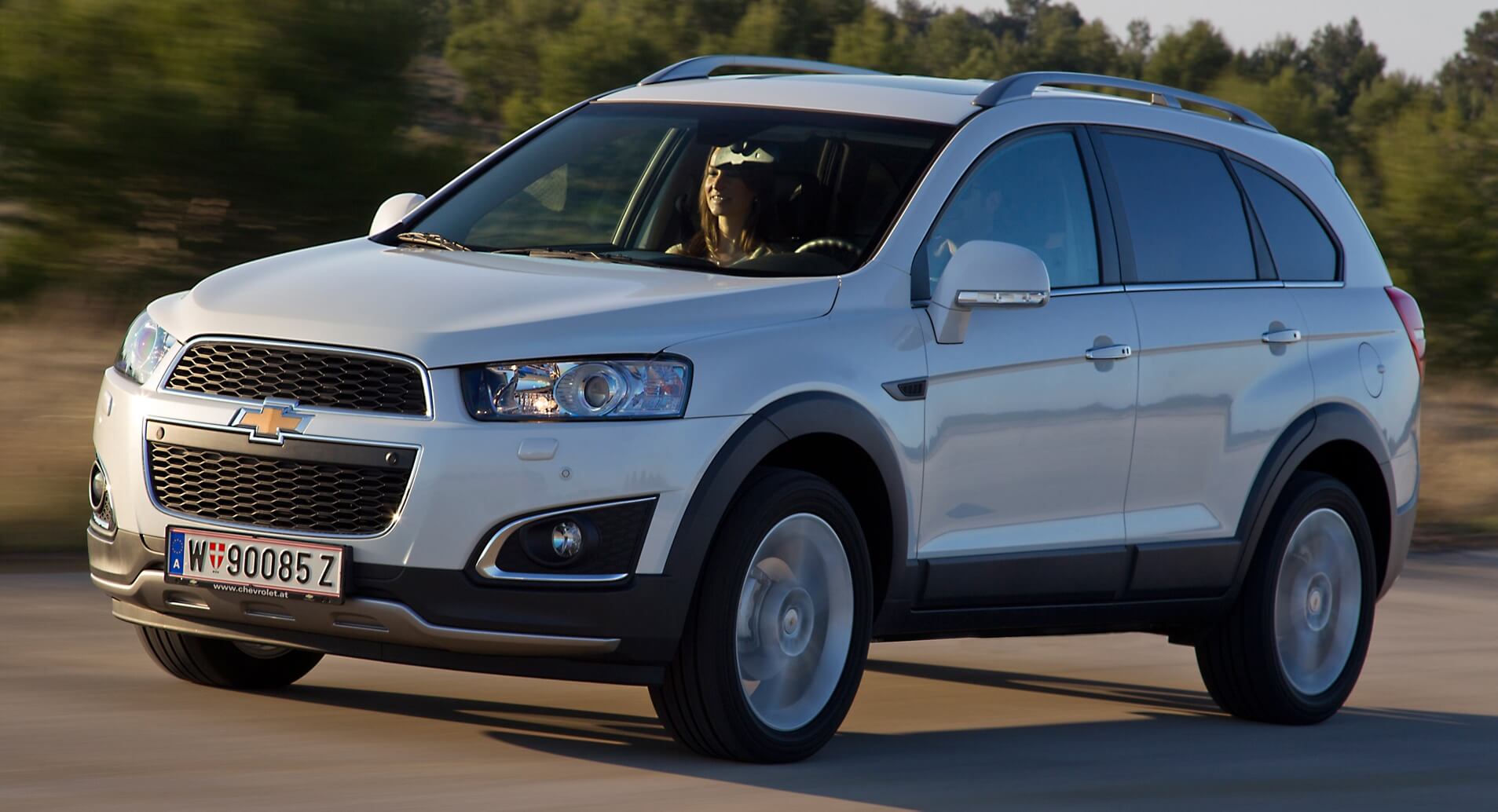
The first Captiva grew out of the S3X concept, followed by a shorter T2X concept at the 2005 Seoul show. It launched in 2006 with five or seven seats. The 2011 facelift brought a new front end similar to that of the Aveo, LED indicators in the mirrors, new alloy wheels and new engines. A further update, revealed at the 2015 Dubai motor show, added new LED lights, a new grille, bumper and dashboard.
Exterior
At first glance it is hard to spot what changed with the updates, but the details are there. The Korean designers refined the grille mesh, placed the fog lights in recesses with chrome surrounds and fitted headlight washers — a useful feature. The bumper has slightly revised proportions and a new lower lip, and the Chevrolet bowtie sits on the bar that divides the grille in two. The side shows sculpted wheel arches, strong creases and stylish mirrors on stalks with indicator repeaters, and generous plastic cladding protects the lower body.
That cladding hints at rough-road ability, but in practice the low front overhang is easy to damage even in town, so leaving the asphalt is not always appealing. Ground clearance is quoted at about 200 mm, although the front bumper sits lower. Alloy wheels measure 17 to 19 inches. At the rear, new LED tail lights look good and light up faster when the driver brakes, the bumper has a new shape with fresher reflector lines, and the exhaust tips are trapezoidal. The tailgate glass can be opened separately to load small items.
Interior
The cabin is pleasant, with an emphasis on comfort, and buyers could choose five seats in two rows or seven in three. Chevrolet said that both material quality and sound insulation had improved considerably. The driver faces a four-spoke multifunction steering wheel and a new instrument cluster with two large chrome-ringed dials and a colour trip-computer display between them. More expensive versions offer ambient lighting, heated second-row seats, keyless entry and push-button start, dual-zone climate control and a rear camera. The front seats are comfortable for relaxed driving but have flat cushions and little lateral support, so occupants are not held well in corners. There is plenty of space everywhere.
A 7-inch touchscreen sits in the centre console between vertical air vents, while simpler versions have a small monochrome display. The lower console is crowded with buttons for the audio and climate systems, which takes some getting used to. The second row offers plenty of width and headroom even for people over 190 cm, with a flat floor. To reach the third row, the right-hand middle seat folds and tips up; the two rearmost seats are less comfortable but usable.
Luggage space depends on the layout. With all seven seats in use there are 97 litres; with the third row folded, 477 litres; with the second row folded as well, 942 litres and a flat floor; and with the front passenger seat folded too, 1,577 litres. The five-seat version offers 477 or 942 litres. The spare wheel is mounted under the body.
Engines and transmissions
| Years | Engine | Power (kW / PS) | Torque | Gearbox |
|---|---|---|---|---|
| 2006–2011 | 2.4 petrol | 103 kW / 140 PS | 220 Nm | 5-speed manual |
| 2006–2011 | 3.2 V6 petrol | 169 kW / 230 PS | 297 Nm | 5-speed automatic |
| 2006–2011 | 2.0 VCDi diesel | 110 kW / 150 PS | 320 Nm | 5-speed manual or automatic |
| 2011 onwards | 2.4 Ecotec petrol | 123 kW / 167 PS | 230 Nm | 6-speed manual or automatic |
| 2011 onwards | 3.0 V6 direct injection | 190 kW / 258 PS | 288 Nm | 6-speed automatic |
| 2011–2015 | 2.2 VCDi diesel | 120–135 kW / 163–184 PS | 350–400 Nm | 6-speed manual or automatic |
| 2016–2018 | 2.0 diesel | 126 kW / 171 PS | 400 Nm | 6-speed automatic |
The post-2011 2.4 has multi-point injection and variable valve timing, the aluminium 3.0 V6 has direct injection, and the 2.2 diesel has variable valve timing and a variable-geometry turbocharger. According to published figures, 0–100 km/h takes 9 to 11.1 seconds and top speed is 175–198 km/h, with combined consumption of 9.3–10.7 l/100 km for the petrols and 6.4–7.9 l/100 km for the diesel. The V6 is available only with the automatic. All-wheel drive uses an electronically controlled clutch: normally all torque goes to the front wheels, and up to 50% can be sent to the rear when needed.
Chassis and safety
The Theta platform has MacPherson struts at the front and a multi-link rear suspension, with self-levelling rear suspension on some versions. Rack-and-pinion steering has hydraulic assistance, and all four brakes are ventilated discs with four-channel ABS. The body has designed crumple zones, and even base versions have front and side airbags, three-point belts with pretensioners and child-seat anchors; richer versions add curtain airbags for the rear. Electronic aids include EBD, brake assist, stability and traction control and hill descent control. Typical equipment ranges from parking sensors, six airbags, 17-inch wheels and an audio system with USB in basic cars to 19-inch wheels, tinted glass, power-adjustable mirrors, steering column and seats, a sunroof or panoramic roof, leather, seat memory and keyless entry and start in higher trims.
Second generation (2018 onwards)
The second Captiva is a rebadged Baojun 530 developed and built by SAIC-GM-Wuling in China. It went on sale in Colombia in November 2018, in Thailand in 2019, elsewhere in South America from April 2019, in the Middle East from 2020 and in Mexico from 2021, positioned between the Trax/Tracker and the Equinox. In 2025 Chevrolet announced electric and plug-in hybrid Captiva models based on the Wuling Starlight S for Latin America and the Middle East.
Strengths and weaknesses
Owners praise the Captiva's handsome styling, reliability, solid build quality, spacious cabin, all-wheel drive and large boot. Complaints include a sometimes hesitant automatic gearbox, modest performance, fuel consumption and parts that can be hard to find; the low front overhang and on-demand all-wheel drive make it better suited to family use than real off-roading. Rivals include the Mazda CX-5, Honda CR-V, Kia Sorento, Ford Kuga, Toyota RAV4, Mitsubishi Outlander, Hyundai Santa Fe, Nissan X-Trail and Renault Koleos.
Image credits · Photos from Wikimedia Commons under free licences
- Chevrolet Captiva C100/C140 · Photo: M 93 / Wikimedia Commons, CC BY-SA 3.0 de
- Chevrolet Captiva II · Photo: Chanokchon / Wikimedia Commons, CC BY-SA 4.0
Chevrolet Captiva in our rankings
- No. 165 of 912 · Longest-running car nameplates (20 years · top 19%)
- No. 101 of 305 · Oldest car models still on sale (20 years · top 35%)
- No. 278 of 345 · Cars with the most generations (2 generations)
In production longer than 81% of ranked nameplates in the 1CARS catalog (No. 165 of 912).
FAQ
How many seats does the Chevrolet Captiva have?
Five or seven; the seven-seat version has a third row.
Is the Chevrolet Captiva the same as the Opel Antara?
The first-generation Captiva shares its platform and many components with the Opel/Vauxhall Antara, but the bodies differ.
What engines does the Chevrolet Captiva have?
The first generation offered 2.4 petrol, 3.2 and 3.0 V6 and 2.0 and 2.2 diesel engines with up to 190 kW (258 PS).
What replaced the Chevrolet Captiva?
In most markets the Chevrolet Equinox; a new Wuling-based Captiva is sold in Latin America, Asia and the Middle East.
Data sources
Data checked by an editor against the sources below.
- Wikipedia — Chevrolet Captiva
- Euro NCAP — Euro Ncap Announces The Results For Twelve New Vehicles Including 5 Stars For A Pick Up