Ford GT40 — the Car Built to Beat Ferrari at Le Mans
The Ford GT40 is an endurance racing car that won the Le Mans 24 Hours four times in a row, from 1966 to 1969. It was designed for one purpose: to beat Ferrari in long-distance races. The Italians had won Le Mans six times in a row, from 1960 to 1965, and Ford wanted to end that run.
Key takeaways
- Built from 1964 to 1969; about 105 cars were made, including road-going versions.
- Based on the Lola Mk6 and developed in England by Ford Advanced Vehicles, then raced and refined by Shelby American.
- Mid-mounted Ford V8 engines: 4.7 litres in the Mk I and 7.0 litres in the Mk II and Mk IV.
- Le Mans wins in 1966 (a 1-2-3 finish), 1967, 1968 and 1969.
Ford GT40 at a glance
More Ford models are listed in our Ford catalogue.
| Version | Engine | Approximate power | Notes |
|---|---|---|---|
| Mk I | 4.7 V8 (289 cu in); early prototypes 4.2 | About 283 kW (380 hp) in race trim | ZF five-speed gearbox; Le Mans winner 1968 and 1969 |
| Mk II | 7.0 V8 (427 cu in) | About 362 kW (485 hp) | Kar Kraft four-speed; 1-2-3 at Le Mans 1966 |
| Mk III | 4.7 V8, detuned | 228 kW (306 hp) | Street-legal road car |
| Mk IV | 7.0 V8 | About 362 kW (485 hp) | Built on the J-car chassis in the USA; Le Mans winner 1967 |
| Gulf-Wyer Mk I (1968–1969) | 4.9 V8 | About 317 kW (425 hp) | Run by John Wyer's team |
History
The car was born from a fierce rivalry between Henry Ford II and Enzo Ferrari. In 1963 Ford's talks to buy Ferrari collapsed, and Henry Ford II decided to beat the Italian company on the track instead. Ford had no experience with sports-racing cars, so it based the project on the Lola Mk6 designed by Eric Broadley, who contributed personally. John Wyer and Roy Lunn joined the team, which worked in Slough, England, where Ford Advanced Vehicles was set up to run the programme. The first results were disappointing, and after the 1964 Nassau race the racing programme passed to Carroll Shelby's company, Shelby American. In 1965 the GT40 won the Daytona 2000 km with Ken Miles and Lloyd Ruby, and from then on it increasingly appeared on the podium.
The name combines GT, for grand touring, with 40 — the car's height in inches at the top of the windscreen, about 1.02 metres.
Le Mans victories
- 1966: Mk II cars finished first, second and third. Bruce McLaren and Chris Amon were declared the winners after a controversial staged finish that denied Ken Miles and Denny Hulme the victory.
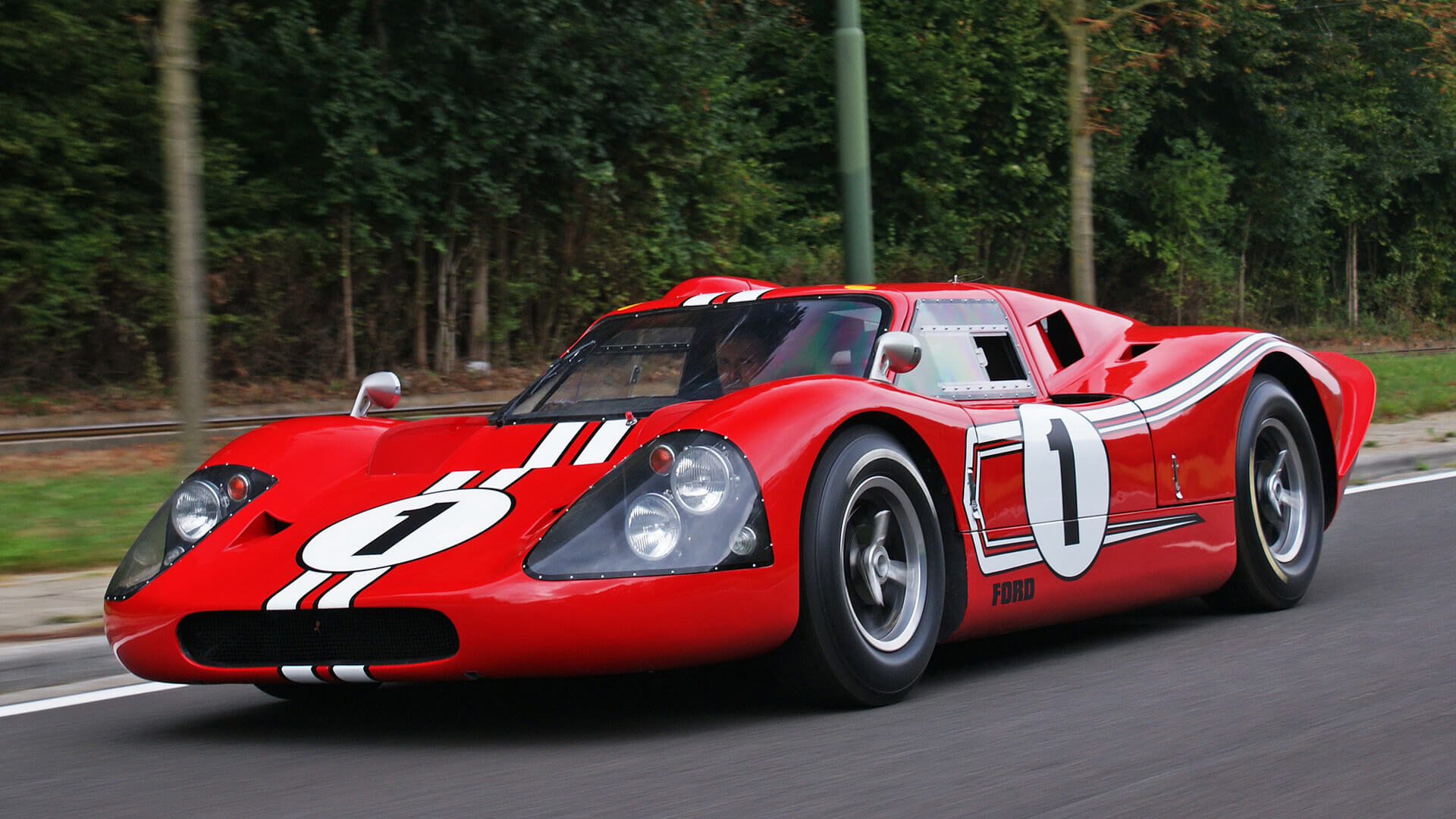
- 1967: Dan Gurney and A.J. Foyt won in a Mk IV, the only GT40 built entirely in the United States; on the Mulsanne Straight a Mk IV reached about 343 km/h (213 mph).
- 1968: Pedro Rodríguez and Lucien Bianchi won in a Mk I entered by John Wyer's team.
- 1969: Jacky Ickx and Jackie Oliver won in the same Mk I chassis.
Shelby and Ken Miles were central to the car's development, improving its aerodynamics and handling and raising its top speed. Miles died in August 1966 while testing the J-car, the successor project that led to the Mk IV.
Exterior
The designers wanted a racing car that would be remembered for a long time. Since the GT40 was built first and foremost for the track, styling played a secondary role, yet the shape is unforgettable: very low, with rectangular headlights rounded at the edges and set into the body, and a smooth, streamlined form. Openings in the lower body cool the engine and brakes, and intakes in the sides serve the same purpose.
Aerodynamic work transformed the car. An early version that became unstable at around 290 km/h (180 mph) was refined in the wind tunnel, and the developed car reached about 320 km/h (200 mph). The GT40 rides on 15-inch Halibrand magnesium wheels. The doors are small and cut deep into the roof, which makes getting in a challenge. At the rear there are round tail lights at the corners and two exhaust pipes in the middle.
Interior
The cabin is focused entirely on racing; the GT40 can hardly be called comfortable. The driver faces a three-spoke steering wheel and an instrument panel that stretches horizontally across almost the entire dashboard, with many switches and gauges angled towards the driver for easier reading. Between the two seats are a divider and the handbrake lever, and the seats offer moderate side support.
Engines
The GT40 used naturally aspirated Ford V8 petrol engines mounted behind the driver. Early prototypes had a 4.2-litre unit, and production Mk I cars used the 4.7-litre (289 cubic inch) V8, which in race trim produced around 283 kW (380 hp). According to published figures, the Mk I reached 100 km/h in about 7.4 seconds and had a top speed of about 310 km/h. The Mk II and Mk IV used the 7.0-litre (427 cubic inch) V8 with about 362 kW (485 hp) and 644 Nm, cutting the 0–100 km/h time to about 5.2 seconds; published figures give a top speed of about 346 km/h. For the 1968–1969 seasons, John Wyer's Gulf-liveried Mk I cars used an enlarged 4.9-litre engine with about 317 kW (425 hp). The big engines had one undeniable drawback: high fuel consumption, which meant more frequent pit stops.
Transmission
Early cars used an Italian Colotti gearbox, which struggled with the high torque and was replaced by a ZF five-speed manual. The 7.0-litre Mk II and Mk IV used a stronger Kar Kraft four-speed. All versions are rear-wheel drive.
Chassis
The GT40's chassis derives from the Lola Mk6. Mk I chassis were built by Abbey Panels in Coventry, with a fibreglass body; the later J-car used an aluminium honeycomb tub, and the Mk IV added a steel-tube roll cage. The suspension uses wishbones at the front and a multi-link arrangement at the rear, with rack-and-pinion steering. The brakes were later upgraded from Girling to more effective ventilated Kelsey-Hayes discs.
Rivals
The GT40 was built to beat the fastest racing cars of its time, above all the Ferrari 365 P2 and the later Ferrari 330 P3. The Fords were faster on the straights, while the lighter Ferraris relied on agility and cornering speed.
Legacy
Only about 105 GT40s were built between 1964 and 1969, so they are rarely seen on the road, and they are extremely valuable: in 2018 a 1966 Mk II that finished third at Le Mans sold at auction for a record price for the model at the time. Ford later paid tribute to the GT40 with the Ford GT road car, delivered from 2004, and with a second-generation Ford GT, sold from 2017 with a 3.5-litre twin-turbo V6.
Verdict
Was it worth the effort and money for Henry Ford II to knock Ferrari off its pedestal after Enzo Ferrari refused to sell his company? Absolutely. The road to success was long, but Ford got there — finishing first, second and third at Le Mans in 1966 and winning the next three years too. Thanks to Carroll Shelby, Ken Miles and the engineers in England and the United States, the GT40 will always have a place in the history of Le Mans and motorsport as a whole.
FAQ
Why is it called the GT40?
GT stands for grand touring, and 40 is the car's height in inches at the top of the windscreen — about 1.02 metres.
How many times did the Ford GT40 win Le Mans?
Four times in a row, from 1966 to 1969.
What engine does the Ford GT40 have?
A mid-mounted Ford V8: 4.7 litres in the Mk I and 7.0 litres in the Mk II and Mk IV.
How many Ford GT40s were built?
About 105 cars between 1964 and 1969.