Infiniti QX70 — Specs, Engines and History
The Infiniti QX70 is a luxury crossover built by Nissan under its Infiniti brand. Its roots go back to 2002, when the model was launched as the Infiniti FX; following the seven-seat Infiniti QX60, the FX (previously sold as the FX35 and FX50, among others) was renamed QX70 in 2014. Production ended in 2017.
Key takeaways
- Known as the Infiniti FX until 2014 and as the QX70 until production ended in 2017.
- Engines: 3.0 V6 turbodiesel with 175 kW (238 PS), 3.7 V6 petrol with 245 kW (333 PS) and 5.0 V8 petrol with 294 kW (400 PS).
- Seven-speed automatic with manual mode and paddles; rear- or all-wheel drive, with active rear steering.
- 184 mm of ground clearance, 20- or 21-inch wheels and a 376-litre boot.
Infiniti QX70 at a glance
The QX70 is a large, sporty crossover with a longitudinal front engine, fully independent suspension and rear- or all-wheel drive. More Infiniti models are listed in our Infiniti catalogue.
Exterior
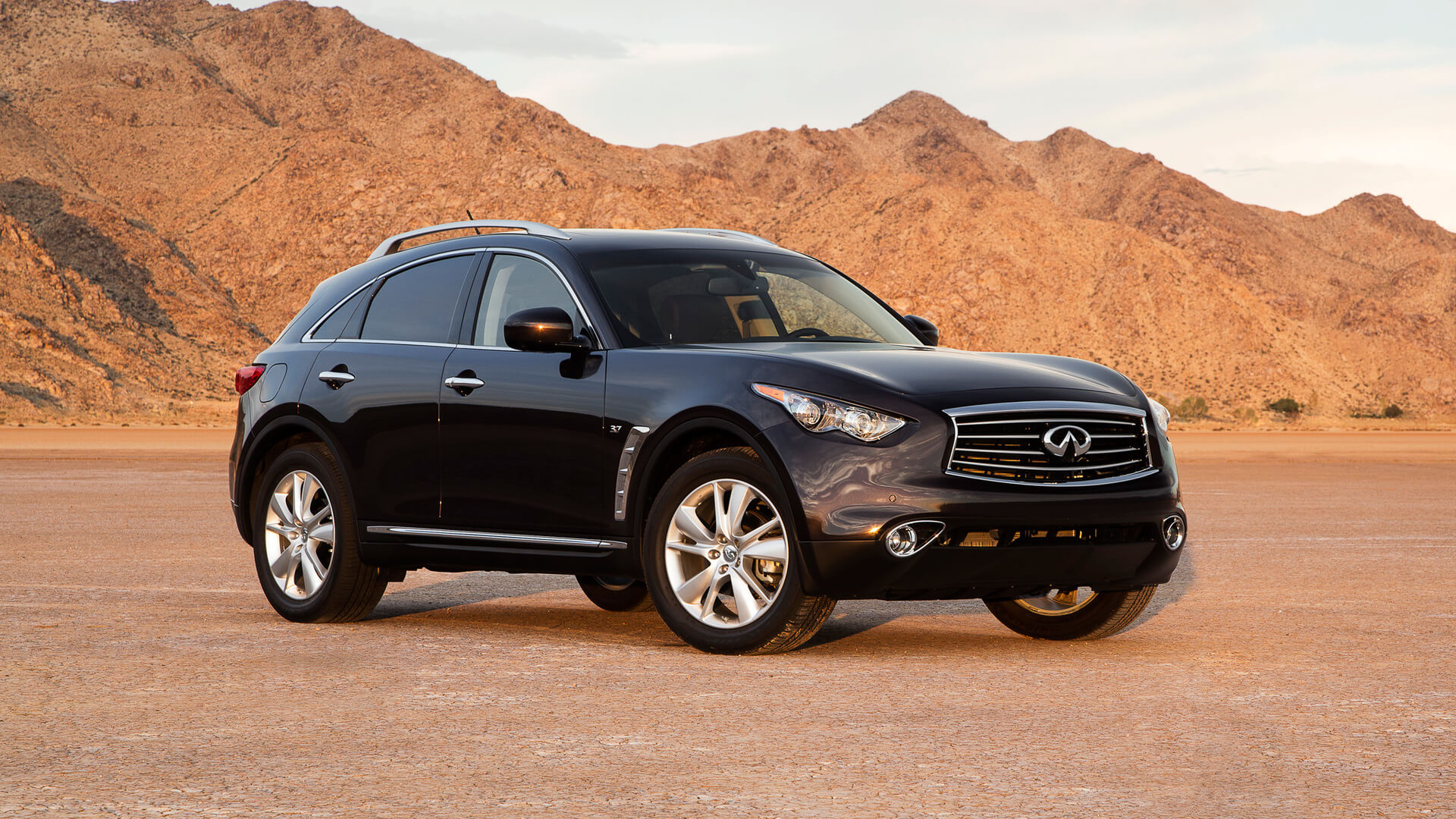
Styling is one of the QX70's main strengths. It keeps its large dimensions and gains many decorative elements: chrome inserts, bold surfacing, aggressive headlights and the large grille that identifies an Infiniti. The front is big and set high; visibility is not the best, but a slight forward slope helps, as does the bonnet, with a deep central channel and raised ridges at the sides. Below them are very aggressive, large bi-xenon headlights with automatic levelling. The near-rectangular grille has a wide chrome strip, a gloss-black recessed mesh and a large chrome Infiniti badge. The bumper has flowing surfaces, side recesses with cooling grilles, a slim intake, chrome inserts and a body-coloured diffuser.
The profile is stylish and modern, with a long, gently sloping roof and a slim window line that narrows towards the rear, framed by a thin chrome strip and divided by gloss-black pillars. Large mirrors, wave-like surfacing and a vent behind the front wheels stand out, and the arches are noticeably taller than on some rivals. Standard wheels are 20-inch alloys, with 21-inch wheels of a different design optional. Ground clearance is an average 184 mm. The rear is unusual too, much narrower at the top than at the bottom, with a small roof spoiler, aggressive triangular LED tail lights, plenty of sculpting and chrome badges on the stepped power tailgate, a large gloss-black diffuser and two big chrome exhaust tips.
Interior
The interior changed less than the exterior, as the previous version already scored well for comfort. It has a solid dashboard, ergonomic seats and a reasonably roomy cabin, although getting into the driver's seat takes some effort and there is no grab handle on the pillar. When the engine starts, the leather three-spoke steering wheel moves into position automatically; it has electric adjustment only. The instruments sweep their needles to the stops as a greeting, with soft white lighting and pale blue accents, round analogue dials and a small trip-computer display. Paddle shifters sit behind the wheel.
The leather cabin has real wood on the console and door panels. An air ioniser and a cabin filter impregnated with grape polyphenol remove up to 99.5% of known allergens. The interior is strict, with many buttons. The centre console has a 9-inch colour touchscreen with Bluetooth connectivity and an almost horizontal set of buttons, followed by the climate controls, an analogue clock, safety-system controls, USB ports and a covered 12 V socket; there is no wireless charging. The tunnel holds the gear selector, switches for front-seat heating and ventilation and two covered cupholders, ending in a compact armrest with a deep compartment — owners find it too small and it cannot slide. Its rear face has two air vents, an ashtray, a USB port and a 12 V socket.
The front seats are now softer and offer eight-way electric adjustment for both driver and passenger, with good side support, tall backrests and comfortable head restraints. The rear seats three, with plenty of legroom and headroom and a central armrest with two cupholders and a small storage box; upholstery is quality leather with perforated sections. The boot is modest at 376 litres; the rear seats fold 60/40, which helps a little, but families may find it small. Build quality is excellent, though some rivals have more modern interiors.
Engines and transmissions
| Engine | Fuel | Power (kW / PS) | Torque | 0–100 km/h | Top speed |
|---|---|---|---|---|---|
| 3.0 V6 turbodiesel, direct injection | Diesel | 175 kW / 238 PS | 550 Nm | 8.3 s | 212 km/h |
| 3.7 V6, multi-point injection, 24 valves (DOHC) | Petrol | 245 kW / 333 PS | 363 Nm | 6.8 s | 233 km/h |
| 5.0 V8 | Petrol | 294 kW / 400 PS | 500 Nm | 5.8 s | 250 km/h |
Owners value the engines for their robustness and long life. The diesel uses about 11 l/100 km in town and the 3.7 about 17 l/100 km of 95-octane petrol in town; the V8 uses noticeably more. The 3.7 V6 is the most popular choice. All engines are paired with a smooth seven-speed automatic with a manual mode, which becomes firmer in Sport mode.
Chassis
The QX70 is offered with rear- or all-wheel drive; the V8 comes with all-wheel drive only. The suspension is fully independent, with optional air suspension; comfort is good, though not class-leading. Sports ventilated disc brakes have aluminium calipers and four-channel ABS. Active rear steering is fitted, and the car handles very well, cornering with almost no body roll. A collapsible propshaft helps keep the passenger compartment intact in a severe crash.
Safety and equipment
The QX70 has front and side airbags, curtain airbags, a driver's knee airbag, a surround-view camera system, adaptive headlights, adaptive cruise control, EBD, brake assist, ABS, rain and light sensors, push-button start, back-up collision intervention, stability control, tyre-pressure monitoring, remote central locking, active rear steering, an immobiliser, ISOFIX anchorages, navigation, moving-object detection, parking-space detection and parking assistance. It was offered with the same trim levels as the FX — Premium, Sport, Sport Black and Hi-Tech. The base version has adaptive headlights, climate control, cruise control, an infotainment system, sports seats, chrome exterior trim, 20-inch wheels and a full set of airbags; the top Hi-Tech Black Quartz adds 21-inch alloys, automatic parking, the surround-view display, rear-seat entertainment, fog lamps, an interior motion sensor and navigation functions.
Key specifications
| Parameter | Value |
|---|---|
| Name | Infiniti FX until 2014, then QX70 |
| End of production | 2017 |
| Power (kW / PS) | 175–294 kW / 238–400 PS |
| Gearbox | 7-speed automatic |
| Drive | Rear or all-wheel drive |
| Ground clearance | 184 mm |
| Boot | 376 l |
| Wheels | 20–21 in |
Strengths and weaknesses
The QX70 has distinctive styling that turns heads and a high-quality, expensive-feeling and comfortable cabin, excellent performance, status and decent rough-road ability thanks to large wheels, ground clearance and all-wheel drive. Its drawbacks are an impractical boot, a somewhat dated interior, firm suspension, expensive servicing and high fuel consumption. Rivals include the BMW X6, Mercedes-Benz GLE Coupé, Porsche Cayenne, Range Rover Sport and Lexus RX.
FAQ
Is the Infiniti QX70 the same as the Infiniti FX?
Yes. The FX was renamed QX70 in 2014.
When was the Infiniti QX70 discontinued?
Production ended in 2017.
What engines does the Infiniti QX70 have?
A 3.0 V6 diesel with 175 kW (238 PS), a 3.7 V6 petrol with 245 kW (333 PS) and a 5.0 V8 with 294 kW (400 PS).
How big is the Infiniti QX70 boot?
376 litres, with a 60/40 folding rear seat.