Ford Fusion: Europe's High-Riding Fiesta
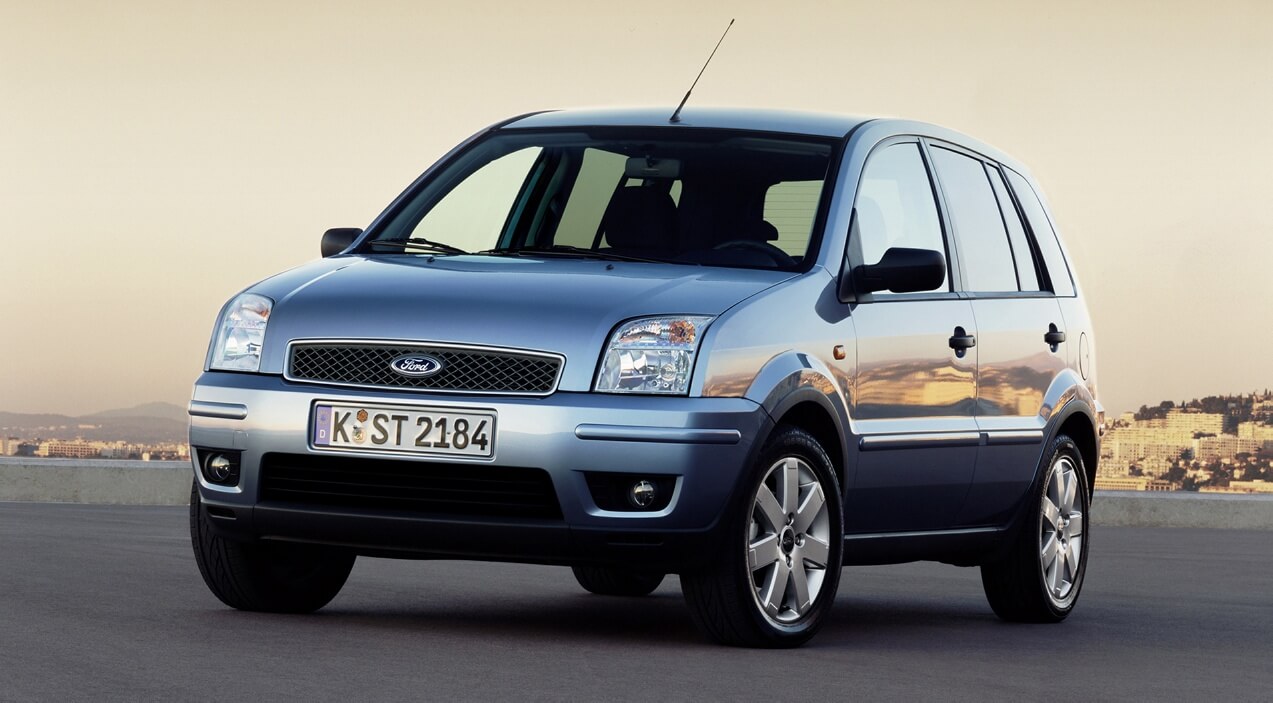
The European Ford Fusion is a small, high-riding hatchback - a subcompact MPV in today's terms - developed by Ford of Europe on the platform of the fifth-generation Fiesta. It was built in Cologne, Germany, from 2002 to 2012. In its day it stood out for a low price, a high level of safety, generous ground clearance and a roomy interior. This is a different car from the mid-size Fusion sedan sold in North America.
Key takeaways
- One generation, 2002–2012, facelifted in 2005; built in Cologne on the Fiesta platform.
- 1.4 and 1.6 Duratec petrol engines with 59 kW (80 PS) and 74 kW (100 PS), plus 1.4 and 1.6 TDCi diesels.
- 185 mm of ground clearance, a 337-litre boot (1,175 litres with seats folded) and a full-size spare.
- Owners praise reliability and low running costs; the firm ride and modest sound insulation are the main drawbacks.
Ford Fusion at a glance
Ford pitched the Fusion as a blend of a small hatchback and a soft-roader - the name itself means "synthesis". The company classed it as an Urban Activity Vehicle (UAV): a car for city streets with the look and seating position of a small SUV, but front-wheel drive only. The planned 2005 facelift changed the front and rear bumpers, mouldings and lights, and gave the dashboard a new design with soft-touch materials. Other Ford models are collected in our Ford catalogue, and the company's background is in Ford's history.
Design and body
The Fusion is not elegant, but its simple lines have aged reasonably well and appealed to a broad audience of men, women and younger drivers. The front has a rectangular grille, an air intake in the centre of the bumper and fog lamps at the corners. Large wheels and flared arch trims give the front and sides an off-road look. Even the base version came with 15-inch alloy wheels and 195/60 R15 tyres.
Ground clearance is 185 mm - one of the main reasons buyers chose the Fusion over a conventional hatchback. At the rear there is a large tailgate with a high-level brake light, vertical tail lamps and a bumper with two reflectors.
Interior and practicality
The cabin is largely shared with the fifth-generation Fiesta, which kept costs and prices down, although the three-tone trim makes it look pleasant. The high driving position, more typical of larger cars, gives good visibility. The three-spoke steering wheel adjusts for height. The instruments use two large dials for revs and speed with a small trip display between them, plus two smaller gauges for fuel and engine temperature; base cars have no full trip computer, but the display shows remaining fuel and the time.
Practical touches are a strong point. The front passenger seat backrest folds flat to form a table, there is storage under the driver's seat and on the centre console, and lifting the passenger seat cushion reveals a compartment designed for a spare pair of shoes. Three people can sit in the back and legroom is generous, but the backrest angle becomes tiring on long trips. The boot holds 337 litres, rising to 1,175 litres with the rear seats folded, although a step remains in the floor. A full-size spare wheel is stored underneath.
Engines and transmissions
The petrol engines came from the Fiesta: 16-valve Duratec units with aluminium crankcases.
| Engine | Power (kW / PS) | Gearboxes |
|---|---|---|
| 1.4 Duratec 16V | 59 kW / 80 PS | 5-speed manual or automated manual |
| 1.6 Duratec 16V | 74 kW / 100 PS | 5-speed manual or automatic |
The diesels were a 1.4 TDCi with 50 kW (68 PS) and, from the 2005 facelift, a 1.6 TDCi with 66 kW (90 PS). The engines were tuned to meet Euro 4 emissions limits. Ford quoted combined consumption of around 7 l/100 km; in town owners can expect about 9 l/100 km with the manual and 10.4 l/100 km with the automatic. Top speed is 180 km/h with the manual and 176 km/h with the automatic, and 0–100 km/h takes 10.9 and 13.1 seconds respectively. Drive goes to the front wheels only. The automated manual gearbox, available only with the 1.4, shifts smoothly without a clutch pedal and also offers manual selection.
Chassis and safety
The suspension is simple: MacPherson struts at the front and a semi-independent beam at the rear. Some owners find it too firm, but it is durable. The steering has hydraulic assistance, and the brakes are discs at the front and drums at the rear.
Ford paid attention to safety, since the Fusion was aimed at families. It scored four stars out of five in crash testing, with no concerns for driver and passenger protection; the weaker area was pedestrian protection. Front airbags and a reinforced body structure were standard.
Key specifications
| Parameter | Value |
|---|---|
| Production | 2002–2012, Cologne (Germany) |
| Platform | Ford Fiesta (fifth generation) |
| Body | 5-door hatchback / mini-MPV |
| Drive | Front-wheel drive |
| Petrol engines | 1.4 (59 kW / 80 PS), 1.6 (74 kW / 100 PS) |
| Top speed | 180 km/h (manual), 176 km/h (automatic) |
| 0–100 km/h | 10.9 s (manual), 13.1 s (automatic) |
| Ground clearance | 185 mm |
| Boot | 337 l / 1,175 l |
| Tyres (standard) | 195/60 R15 on alloy wheels |
Standard equipment
Base cars came with front and side airbags, ABS, an immobiliser, fog lamps, body-coloured bumpers, a rev counter, mirrors adjustable from inside, boot lighting, 15-inch alloy wheels, hydraulic power steering, central locking and the 1.4-litre engine with a five-speed manual.
Strengths and weaknesses
Owners praise the reliability of the gearbox, engine and body, together with easy manoeuvring, low maintenance costs, compact dimensions, high ground clearance, good visibility and safety, and a boot that is large for the car's size. Fuel consumption is modest, though performance suffers as a result.
On the downside, the suspension is firm, sound insulation is weak and the tall body is sensitive to crosswinds. Drivers who cover long distances often wish for more supportive seats. Direct rivals included the Nissan Note and the Skoda Roomster.
FAQ
Is the European Ford Fusion the same car as the American Ford Fusion?
No. The European Fusion (2002–2012) is a small, high-riding hatchback based on the Fiesta; the North American Fusion is a larger mid-size sedan.
What engines does the Ford Fusion have?
Petrol versions use 1.4-litre (59 kW / 80 PS) and 1.6-litre (74 kW / 100 PS) Duratec engines. The diesels were a 1.4 TDCi with 50 kW (68 PS) and a 1.6 TDCi with 66 kW (90 PS).
What is the ground clearance of the Ford Fusion?
185 mm, noticeably more than a regular Fiesta - one of the car's main selling points.
How big is the Ford Fusion's boot?
337 litres with the rear seats up and 1,175 litres with them folded. A full-size spare wheel sits under the floor.