
 Dacia 1300
All generations, specs and history
Published Sources (2) Report an error
By Oleksandr Hnatiuk, Automotive Editor & Used Car Specialist
- Built
- 1969–2004
- Generations
- 2
- Top power
- 40 kW (54 PS)
Timeline
1300 generations
Click a generation for its own page
Newest first · 2 generations since 1969
All generations by year: 1310 (1979–2004) · 1300 I (1969–1979)
Which one is mine?
Pick the year of first registration to see which generation it is.
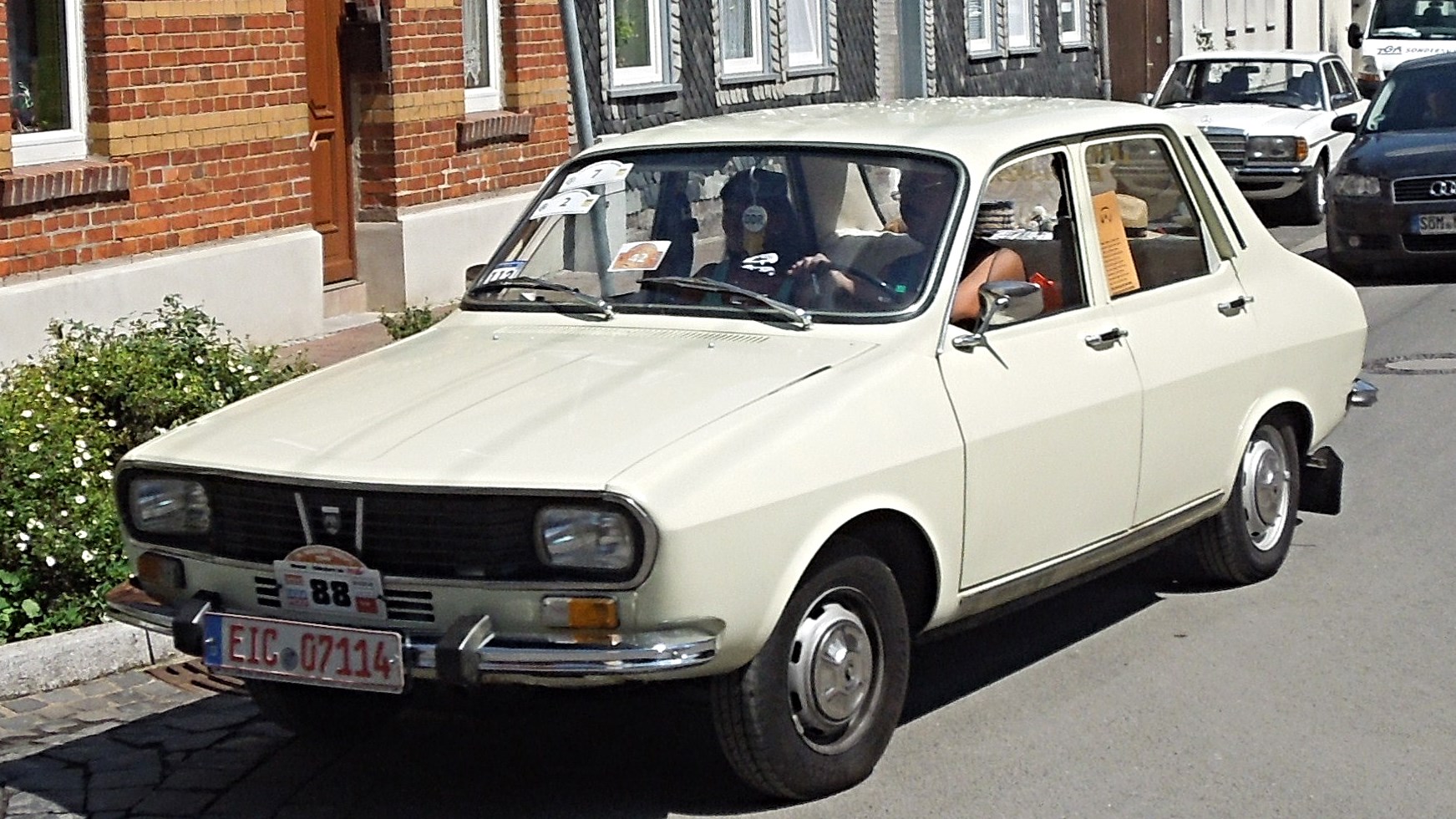
Check by VINThe Dacia 1300 is the Romanian-built version of the Renault 12, produced under licence at Colibași (today Mioveni) near Pitești from 1969 until the last 1310 saloon left the line on 21 July 2004. It came as a saloon, Break estate, two-door Sport coupé and pick-up, mostly with a 1,289 cc engine of 40 kW (54 PS), and became Romania's everyday car for three decades.
In short
- First cars built in August 1969, weeks before the Renault 12 was shown in Paris.
- Saloon and estate production ended in 2004; the pick-up continued until December 2006.
- The 1300 family, including the 1310, reached nearly 2.3 million vehicles, 319,000 of them utility versions (Dacia).
- Replaced by the Dacia Logan, launched in 2004.
Size at a glance
Dacia 1300 I
The Dacia 1310 is 8 mm longer and 80 mm lower than the Dacia 1300 I.
| Dimensions | Dacia 1310 | Dacia 1300 I | Difference |
|---|---|---|---|
| Length | 4,348 mm171.2 in | 4,340 mm170.9 in | +8 mm+0.3 in |
| Width | 1,636 mm64.4 in | 1,636 mm64.4 in | Same |
| Height | 1,355 mm53.3 in | 1,435 mm56.5 in | −80 mm−3.1 in |
| Wheelbase | 2,441 mm96.1 in | 2,441 mm96.1 in | Same |
Specs by version
Engines
| Version | Engine | Power | Drive | Production years |
|---|---|---|---|---|
| 1300 I · 1.3 saloon (54 PS) | 1.3 l · 4 cyl · Petrol 810 | 40 kW 54 PS54 hp | Front-wheel drive | 1969 |
| 1300 I · 1.3 Break (54 PS) | 1.3 l · 4 cyl · Petrol 810 | 40 kW 54 PS54 hp | Front-wheel drive | 1973 |
| 1310 · 1410 Sport coupé | Petrol | - | Front-wheel drive | 1983 |
| 1310 1.3 saloon (54 PS) | 1.3 l · 4 cyl · Petrol 1,289 cc | 40 kW 54 PS54 hp | Front-wheel drive | 1979–2004 |
Performance
Show all 1 versions
| Version | Top speed |
|---|---|
| 1300 I · 1.3 saloon (54 PS) | 140 km/h87 mph |
Dimensions and weight
Show all 4 versions
| Version | Length | Width | Height | Wheelbase | Kerb weight |
|---|---|---|---|---|---|
| 1300 I · 1.3 saloon (54 PS) | 4,340 mm170.9 in | 1,636 mm64.4 in | 1,435 mm56.5 in | 2,441 mm96.1 in | 930 kg2,050 lb |
| 1300 I · 1.3 Break (54 PS) | 4,404 mm173.4 in | 1,636 mm64.4 in | 1,455 mm57.3 in | 2,441 mm96.1 in | 980 kg2,161 lb |
| 1310 · 1410 Sport coupé | 4,148 mm163.3 in | 1,636 mm64.4 in | 1,250 mm49.2 in | 2,238 mm88.1 in | 900 kg1,984 lb |
| 1310 1.3 saloon (54 PS) | 4,348 mm171.2 in | 1,636 mm64.4 in | 1,355 mm53.3 in | 2,441 mm96.1 in | 960 kg2,116 lb |
Verified Manufacturer and type-approval data from our catalog · Sources and methodology
Dacia 1300 at a glance
| Item | Dacia 1300 |
|---|---|
| Years | 1969-2004 (saloon and estate); pick-up to 2006 |
| Production total | nearly 2.3 million for the 1300/1310 family (Dacia); last saloon numbered 1,959,730 |
| Plant | Uzina de Autoturisme Pitești, Colibași (now Mioveni), Romania |
| Origin | licence version of the Renault 12 |
| Body styles | 4-door saloon, 5-door Break estate, 2-door Sport coupé, pick-up, liftback |
| Layout | front longitudinal engine, front-wheel drive |
| Engine | 1,289 cc OHV four, engine 810 |
| Power | 40 kW (54 PS) at 5,250 rpm; 94 Nm at 3,300 rpm |
| Kerb weight | 930 kg (1300 saloon), 980 kg (estate), 900 kg (coupé) |
| Top speed | 140 km/h (Wikipedia EN); 144 km/h (Daily Driven) |
| Price new | EUR 4,100 (saloon) and EUR 4,250 (Break) in 2004 |
How Romania chose the Renault 12
The Pitești car plant was inaugurated on 20 August 1968 and started with the Dacia 1100, a licensed Renault 8; about 37,500 were built until 1971. For the main model, the Romanian state ran a tender that drew Peugeot, Fiat, Alfa Romeo and Austin as well as Renault, and the government set a limit of 1.3 litres on engine size. Renault's Project 117, the future 12, won.
Dacia moved fast. Production started in August 1969, and the new car appeared in the 23 August national parade before the Renault 12 had been unveiled at the Paris Motor Show that October. Output was tiny at first: 293 cars in 1969 and 4,128 in 1970, in Standard and L versions. Early cars relied on French parts. The 810-02 engine came from France until mid-1972, when Romania's own 810-99 took over, and Romanian gearboxes replaced French ones in 1974. Solex carburettors gave way to Carfil units built under Weber licence from 1973.
The licence contract expired in 1978, and Dacia's cooperation with Renault ended that year; the French partner's own path is traced in our history of Renault. From then on Romania developed the car alone. The wider story of the plant is in our history of Dacia.
Estate, Sport and pick-up versions
The range grew around the same 1,289 cc engine. The 1301 Lux Super, better equipped, was reserved for Communist Party officials. The Break estate arrived in 1973, three years after the Renault version, and a commercial version without rear seats or side glass followed. The 1302 pick-up of 1975 began a long line of utility vehicles: 318,969 pick-ups were built between 1975 and 2006.
| Year | Version or change |
|---|---|
| 1969 | 1300 saloon, 1,289 cc, 40 kW (54 PS) |
| 1973 | Break estate |
| 1975 | 1302 pick-up |
| 1979 | facelift: raised front bumper, shallower grille, larger tail lights |
| 1982 | name changed to 1310; 1304 pick-up replaces the 1302 |
| 1983 | 1410 Sport two-door coupé with lower roof |
| 1984 | black plastic grille, 1210 and 1410 versions, five-speed gearbox |
| 1987 | 1320 liftback |
| 1990 | 1325 Liberta liftback (to 1996) |
| 1992-1994 | 1307 and 1309 crew-cab pick-ups, 1304 King-Cab |
| 1998-1999 | final facelift, fuel injection, catalytic converter, Euro 2 |
The Sport used a wheelbase shortened to 2,238 mm, was 4,148 mm long and weighed 900 kg, against 4,340 mm and 2,441 mm for the 1300 saloon. Sources date the facelift that created the 1310 to 1979 and the new name to 1982, so the two numbers overlap in period documents.

A people's car with long waiting lists
Imports were restricted and Western cars almost impossible to buy, so Romanians ordered a Dacia and waited, often for a long time. Owners used the car for everything from long trips to moving furniture and firewood. Wikipedia EN quotes fuel consumption of 7.5-8.0 l/100 km at a steady 80-90 km/h.
Exports went to the Eastern Bloc, South America, China, North Korea, Canada, Denmark and the Netherlands. In Britain the 1310 was sold as the Dacia Denem from 1982 to 1984 with little success. The plant reached its first million vehicles in 1985 and two million in 1998, in three decades that Dacia itself describes as dominated by the Renault 12-based models.
Parts shortages led to many hybrid cars built with a mix of old and new components. The 1994 facelift brought plastic bumpers and slimmer headlamps, and the 1998 update added fuel injection and a catalytic converter to meet Euro 2.

The end in 2004 and the Logan
Renault bought Dacia from the Romanian state in September 1999. The last 1310 saloon, numbered 1,959,730, left Mioveni on 21 July 2004, still priced at EUR 4,100, or EUR 4,250 as an estate. Its successor was the Dacia Logan, launched the same year. The pick-up ran on until December 2006, which gave the basic design 37 years in production.

Dacia 1300 today: what to check when buying
Originality decides value. Playtech (November 2025) lists the details collectors check: original badges, correct upholstery and steering wheel, a dashboard clock matching the production year and the right wheels. Because parts shortages produced mixed-specification cars, a 1970s 1300 with later components is common, and documents should match the body and engine.
The body shell is closely related to the Renault 12, for which Classic Trader names the front wings, sills and rear axle mounts as the main rust areas; the same places deserve attention on a Dacia. The OHV engine and four- or five-speed gearbox are simple to work on. The owner scene is active: more than 70 historic Dacias met in Deva in June 2025, according to Agerpres.
Prices are rising from a low base. In March 2024 Adevărul reported a blue 1975 Dacia 1300 with 38,500 km offered on a German site for EUR 3,990, described by its seller as the oldest 1300 in use in Germany. Dacia's current range is in our Dacia catalogue, and other Eastern European cars of the period are in the classic cars section.
Dacia 1300: first vs latest generation
| Spec | 1300 I | 1310 | Change |
|---|---|---|---|
| Years | 1969–1979 | 1979–2004 | 10 years apart |
| Most powerful version | 40 kW (54 PS) | 40 kW (54 PS) | same (0%) |
| Length | 4,404 mm | 4,348 mm | −56 mm |
| Width | 1,636 mm | 1,636 mm | same |
| Wheelbase | 2,441 mm | 2,441 mm | same |
| Lightest kerb weight | 930 kg | 900 kg | −30 kg |
Oldest and newest generation in the 1cars catalog. Power is the strongest version of each; other rows are shown only when both generations have the figure.
Dacia 1300 in our rankings
- No. 5 of 23 · Smallest station wagons (4,404 mm)
- No. 6 of 98 · Lightest coupes (900 kg)
- No. 22 of 424 · Lightest cars (900 kg · top 6%)
- No. 12 of 110 · Smallest coupes (4,148 mm · top 11%)
- No. 11 of 79 · Lightest sedans (930 kg · top 14%)
- No. 102 of 565 · Smallest cars (4,148 mm · top 19%)
Lighter than 94% of ranked cars in the 1CARS catalog (No. 22 of 424).
FAQ
Is the Dacia 1300 a Renault 12?
Yes. Dacia built it under a Renault 12 licence from 1969, with a 1,289 cc engine of 40 kW (54 PS). After the licence ended in 1978, Dacia developed the 1310, Sport and pick-up versions on its own.
When did Dacia 1300 production end?
The last 1310 saloon, numbered 1,959,730, was built at Mioveni on 21 July 2004. Saloon and estate production ended then, while the pick-up continued until December 2006.
How many Dacia 1300s were built?
Dacia counts nearly 2.3 million vehicles for the 1300/1310 family, including 319,000 utility vehicles. The last saloon's serial number, 1,959,730, is often quoted as the passenger-car total.
What was the Dacia 1410 Sport?
It was a two-door coupé launched in 1983 with a lower roofline and a wheelbase shortened to 2,238 mm. It weighed 900 kg and was 4,148 mm long.
Data sources
Data checked by an editor against the sources below.
- Wikipedia - Dacia 1300
- Dacia


