Delahaye: From Tours Engineer to French Racing Champion
Delahaye was a French car and lorry maker founded by the engineer Émile Delahaye in Tours, who built his first car in 1894 and moved production to Paris by 1898. For decades the company lived mainly on lorries and fire engines. In the 1930s its Type 135 and its V12 racing cars made it one of the great French sporting brands, with a Le Mans win in 1938 and some of the most extravagant coachbuilt bodies of the period. Delahaye took over Delage in 1935. After the war its expensive cars sold poorly, and the company merged with Hotchkiss in 1954 and closed on 31 December that year.
Key takeaways
- Émile Delahaye showed his first car at the first Paris Motor Show in 1894 and raced in the Paris–Marseille–Paris of 1896; about 850 Delahayes had been built by 1904.
- The Type 135 "Coupe des Alpes" of 1935 used a 3.2-litre six of up to 82 kW (110 hp); about 2,000 were built until 1954.
- A Delahaye 135 driven by Chaboud and Trémoulet won the 1938 Le Mans 24 Hours, and René Dreyfus beat the Mercedes-Benz W154 at Pau in 1938 in a V12 Type 145.
- Delahaye shareholders approved the Hotchkiss takeover on 9 June 1954, and the company closed on 31 December 1954.
Delahaye at a glance
| Fact | Value |
|---|---|
| Founded | 1894, Tours; incorporated 1898 |
| Founder | Émile Delahaye (1843–1905) |
| Partners | Léon Desmarais, Georges Morane |
| Plant | Paris (Gobelins district) from 1898 |
| Products | Cars, lorries, fire engines, buses, military vehicles |
| Best-known models | Type 135, Type 145 V12, Type 165, Type 175, VLR |
| Racing | Le Mans winner 1938; Monte Carlo Rally 1937 |
| End | Merged with Hotchkiss 1954; closed 31 December 1954 |
Émile Delahaye and the Tours works
Émile Delahaye was born in Tours on 16 October 1843 and studied engineering at the Arts et Métiers school in Angers. His first job was at a locomotive works in Belgium. After the Franco-Prussian War Delahaye returned to Tours to join the Berthon foundry and engineering works, and in 1879 took control of it. The firm made brick kilns and ceramics equipment, and part of its work moved to stationary petrol engines for pumps.
His first car, belt-driven, was one of only two cars at the first Paris Motor Show in 1894. In 1896 Delahaye drove one in the Paris–Marseille–Paris road race to publicise it. Delahaye and his brothers-in-law Léon Desmarais and Georges Morane incorporated the company in 1898 and moved production to an industrial building in Paris. Ill health ended Émile Delahaye's career in 1901. The founder sold his shares to his partners and died on 1 June 1905.

Weiffenbach and the lorry business
Charles Weiffenbach ran the company from the early 1900s. By 1904 about 850 cars had been built. A production four-cylinder engine came in 1903 and shaft drive in 1907, and the chief engineer Amédée Varlet is credited with the V6 engine of the 1911 Type 44.
Commercial vehicles became the core business. Delahaye built heavy lorries, utility vehicles, buses and some of the first motor fire engines for the French government. By the end of the First World War lorries were its main source of income.
The Type 135 and the sporting turn
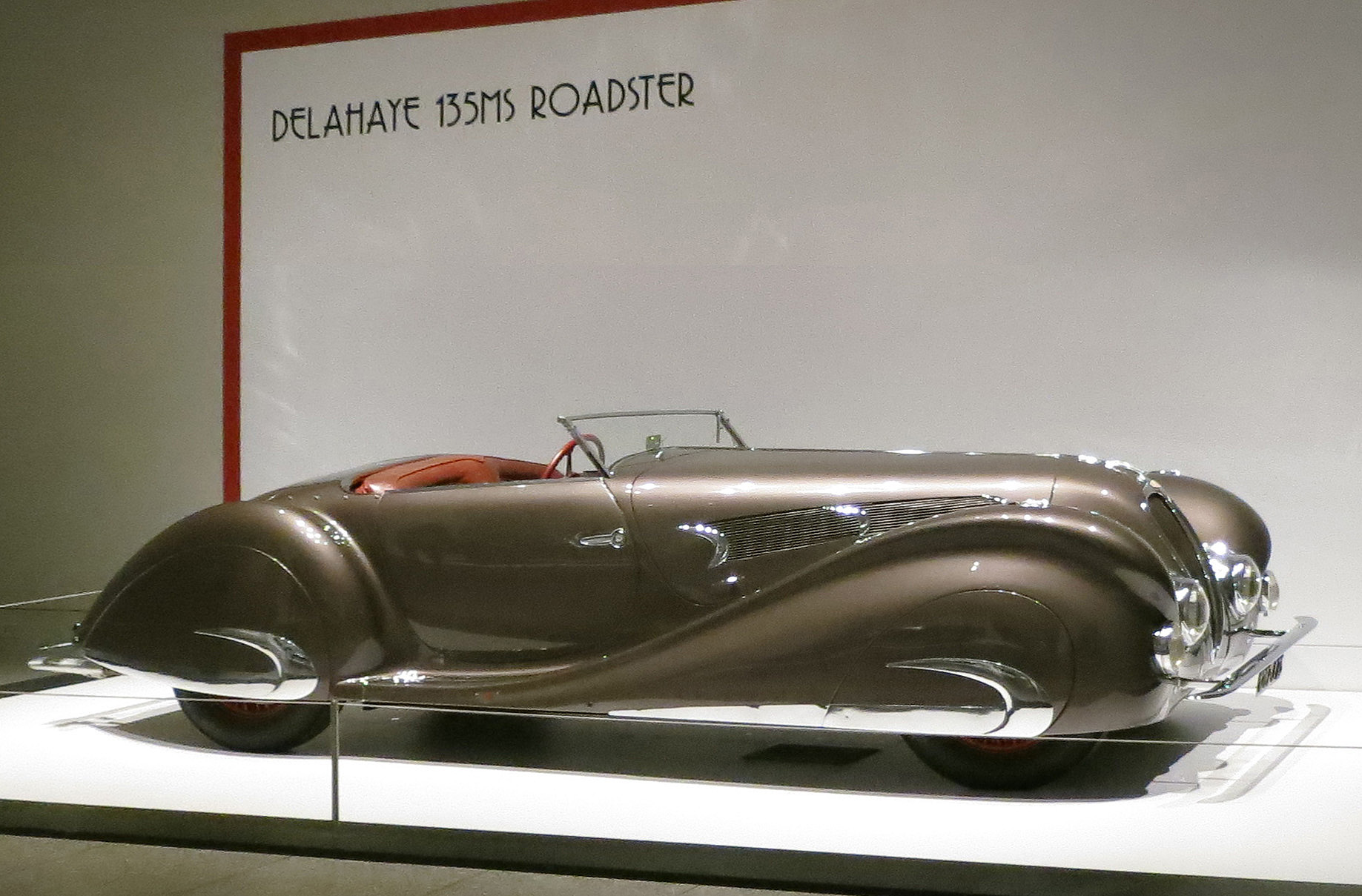
In the 1930s Delahaye turned to sporting cars. The 18 CV Type 138 had a 3.2-litre six, and success in the Alpine Trial gave the new Type 135 of 1935 its name, "Coupe des Alpes". Jean François designed it. The 3,227 cc straight-six gave 71 kW (95 hp) with two carburettors or 82 kW (110 hp) with three, for 148 km/h. The 3.6-litre 135M followed in 1936 with up to 86 kW (115 hp), and the 135MS had 89–108 kW (120–145 hp), more than 119 kW (160 hp) in competition form. A Cotal pre-selector gearbox was offered as well as the four-speed manual.
The bare chassis weighed 935 kg, and complete cars 1,250 to 1,640 kg. An 82 kW car of 1,250 kg had about 66 kW per tonne on these figures; the power-to-weight calculator gives the figure for any modern car. The Type 135 is covered in Delahaye 135 history, Le Mans and coachwork.
The results came quickly. By the end of 1935 Delahaye had won eighteen French sports car events and several hill climbs and finished fifth at Le Mans. In 1936 its cars were second and third in the Mille Miglia and second to fifth in the Belgian 24 Hours. A Delahaye won the Monte Carlo Rally in 1937, and in 1938 Chaboud and Trémoulet won the Le Mans 24 Hours, with other Delahayes second and fourth.
Lucy O'Reilly Schell and the V12
The racing programme had a private patron. Lucy O'Reilly Schell, an American heiress born in Paris in 1896, had driven in the Monte Carlo Rally since 1929; with Laury Schell as co-driver the couple finished second once and third twice. O'Reilly Schell paid for the short 2.70-metre "Competition Court" Type 135s, bought 12 of them and kept half for the amateur team Écurie Bleue. When Delahaye closed its works team at the end of 1936, Écurie Bleue became the factory racing effort, and an inheritance received in 1936 paid for the 4.5-litre V12 Type 145.
In 1937 a racing fund in France offered a prize of one million francs for covering 200 km at Montlhéry at more than 146.5 km/h before 1 September. Bugatti met an earlier target in April and received 400,000 francs. On 27 August 1937 René Dreyfus drove the "Million Franc Delahaye" at an average of 146.56 km/h and met the requirement. The Schell article says the winnings were shared between Delahaye and Écurie Bleue; the Delahaye article describes a 200,000-franc government prize in 1937.
The best result came on 10 April 1938 at Pau, where Dreyfus drove the V12 without a stop and beat the Mercedes-Benz W154 by more than two minutes. The W154 was estimated at about 349 kW (468 bhp) and the Delahaye at about 172 kW (230 bhp), 177 kW less. Écurie Bleue also took Maserati cars to the 1940 Indianapolis 500, where Dreyfus and René Le Bègue finished tenth. Laury Schell was killed in a road accident on 18 October 1939, and Lucy O'Reilly Schell died in Monte Carlo on 8 June 1952.
Delage, coachbuilders and the war
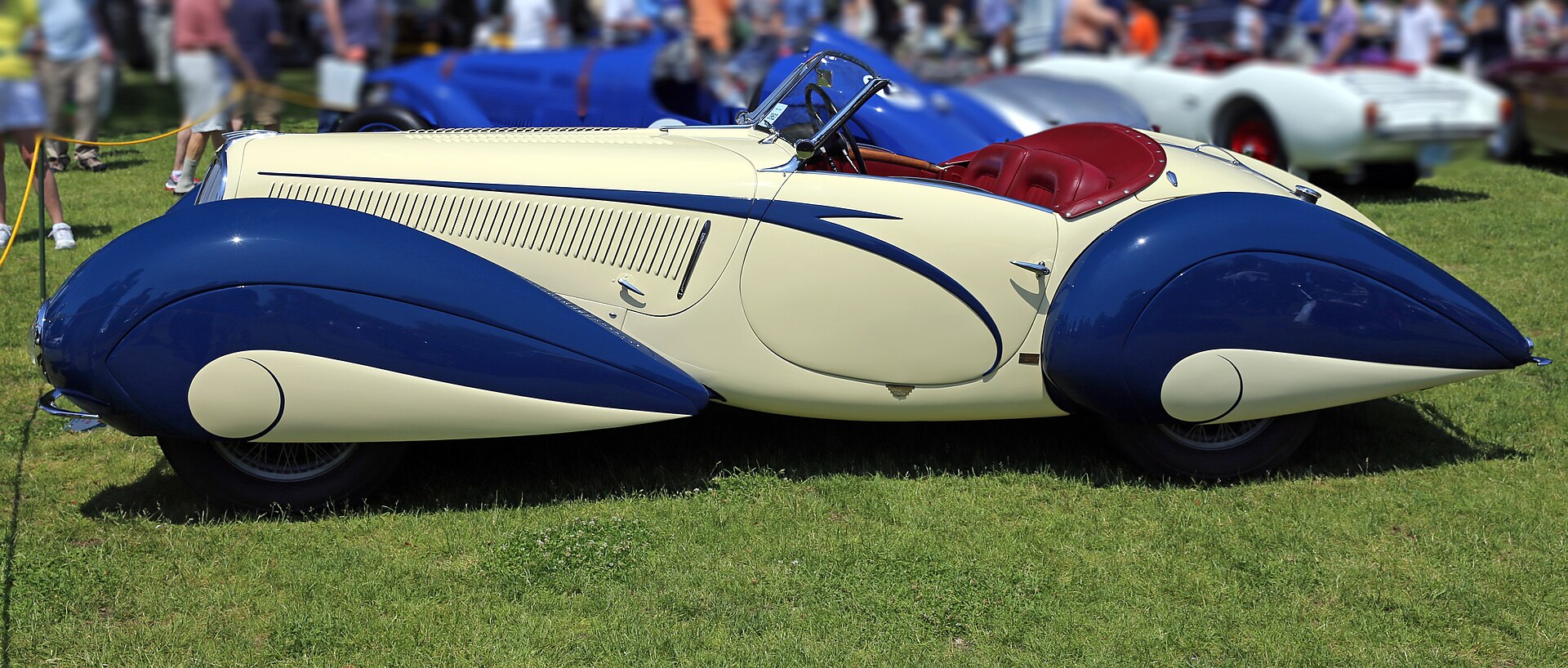
In 1935 Delahaye bought the name of the bankrupt Delage company, and by 1938 Delage was in practice a Delahaye subsidiary. Delahaye supplied chassis, and Paris coachbuilders built the bodies: Figoni et Falaschi, Chapron, Saoutchik, Letourneur et Marchand, Guilloré, Pourtout and Franay among them.
The French government stopped private car production in June 1939. In early 1940 Renault bodied 100 Type 134N and Type 168 chassis as staff cars for France's army, and small numbers of cars were built for the occupying forces until at least 1942.

Post-war decline and Hotchkiss
The Type 135 and the 148L returned in 1946, and 88% of 1947 production was exported. The Type 175, designed in 1938, reached production in 1948, but its suspension failed and Delahaye bought cars back to avoid lawsuits. The 175, 178 and 180 never covered their costs and were dropped in mid-1951. Output in 1948 was 573 cars, against 34,164 for the market leader Citroën. The last car model, the Type 235 of 1951–1954, was a rebodied 135MS with a 3.6-litre engine of 113 kW (152 hp), and only 84 were made.
Military orders briefly helped. The VLR, a 2-litre off-road reconnaissance vehicle, appeared in 1951, and in 1953 Delahaye built 1,847 VLRs and 537 other military vehicles. The French army then chose the cheaper Willys-based vehicle built by Hotchkiss and cancelled the VLR contract, and more than 200 workers were laid off in August 1953. The two firms' presidents signed a merger on 19 March 1954, shareholders approved it on 9 June, and Hotchkiss ended car production. The combined firm was absorbed by the Brandt group, and Delahaye closed for the last time on 31 December 1954.

Collecting a Delahaye today
The Type 135 is the core of any Delahaye collection, because it was built for nearly twenty years, raced at Le Mans and received bodies from almost every major French coachbuilder. The body maker largely defines a car's identity, so buyers check which coachbuilder made it and whether it is original. Other cars of the decade are in the 1930s classics section, and the models are listed in the Delahaye catalogue.
Delahaye timeline
| Year | Event |
|---|---|
| 1894 | First Delahaye car at the Paris Motor Show |
| 1898 | Company incorporated; production moves to Paris |
| 1901 | Émile Delahaye retires |
| 1935 | Type 135; Delage name acquired |
| 1937 | Monte Carlo Rally win; Million Franc run (27 August) |
| 1938 | Pau win against Mercedes-Benz (10 April); Le Mans win |
| 1939 | Private car production halted (June) |
| 1948 | Type 175 |
| 1951 | VLR military vehicle; Type 235 |
| 1954 | Merger with Hotchkiss; closure (31 December) |
Landmark Delahaye models
| Model | Years | Why it matters |
|---|---|---|
| Type 135 | 1935–1954 | 3.2- and 3.6-litre six; Le Mans winner in 1938 |
| Type 145 | from 1936 | 4.5-litre V12; Million Franc and Pau winner |
| Type 175 | 1948–1951 | Post-war luxury car with suspension problems |
| VLR | from 1951 | 2-litre military off-roader; 1,847 built in 1953 |
Photo gallery

FAQ
Who founded Delahaye?
Émile Delahaye, an engineer from Tours, who built his first car in 1894.
Did Delahaye win Le Mans?
Yes. Chaboud and Trémoulet won the 1938 Le Mans 24 Hours in a Delahaye 135.
What was the Million Franc Delahaye?
The V12 Type 145 that René Dreyfus drove at Montlhéry on 27 August 1937, averaging 146.56 km/h over 200 km to win a French racing prize.
Why did Delahaye close?
Its post-war luxury cars lost money, the army cancelled the VLR contract in 1953, and the company merged with Hotchkiss in 1954, which ended car production.
Sources
- Wikipedia - Delahaye (accessed 24 Oct 2026)
- Wikipedia - Émile Delahaye (accessed 24 Oct 2026)
- Wikipedia - Delahaye 135 (accessed 24 Oct 2026)
- Wikipedia - Lucy O'Reilly Schell (accessed 24 Oct 2026)
- Wikipedia - René Dreyfus (accessed 24 Oct 2026)
Found a mistake? Report an error