Delage — Louis Delâge's Racing and Luxury Cars From Courbevoie
Delage was a French maker of sporting and luxury cars, founded in 1905 by the engineer Louis Delâge in Levallois-Perret near Paris. Its racing cars won the 1914 Indianapolis 500 and, in 1927, four European Grands Prix that made Delage the world champion constructor. In the 1930s its D6 and D8 chassis carried some of the most elegant bodies of the period. The Depression forced the company into liquidation in 1935, after which Delahaye built Delage cars until 1953. The name was revived in 2019 for the D12 hybrid hypercar.
Key takeaways
- Louis Delâge borrowed 35,000 francs in 1905 and started with two lathes and three employees; by 1912, 350 workers built more than 1,000 cars a year.
- René Thomas won the Indianapolis 500 on 30 May 1914 in a Delage; Delage won the 1924 European Grand Prix, and its 1.5-litre 15 S 8 won four European Grands Prix in 1927.
- The D8 of 1929–1940 had a 4,061 cc straight-eight of 76 kW (102 hp), and 89 kW (120 hp) in the D8 S.
- The Courbevoie factory entered voluntary liquidation on 20 April 1935; Delahaye built about 2,000 Delages up to 1940 and about 330 from 1946 to 1953.
Delage at a glance
| Fact | Value |
|---|---|
| Founded | 1905, Levallois-Perret, near Paris |
| Founder | Louis Delâge (1874–1947) |
| Plants | Levallois (Rue Baudin, 1907), Courbevoie (from 1910) |
| Racing | Indianapolis 500 1914; European Grand Prix 1924; world constructors' title 1927 |
| Best-known models | Type A, CO, GL, DM, D6, D8 |
| Output | about 40,000 cars to 1935, plus about 2,330 built by Delahaye |
| Liquidation | 20 April 1935 |
| Revival | Delage D12 (announced 7 November 2019) |
Louis Delâge and the first cars
Pierre Louis Delâge was born in Cognac on 22 March 1874 into a family of modest means, and lost the sight of one eye as a baby. At 16 Delâge began engineering studies at the Arts et Métiers school in Angers and graduated in 1893. After military service in Algeria and a job with a railway company, the young engineer moved to Paris in 1900 and worked in the design office of a car maker. In 1903 the young Renault company offered him a place.
In 1905 Delâge set out alone. With 35,000 francs of borrowed money, and without his salary of 600 francs a month, he started in Levallois-Perret with two lathes and three employees, one of them a former chief designer from Peugeot. At first the firm made parts for Helbé, which assembled chassis with De Dion-Bouton engines. Delage's own first car, the Type A voiturette of 1906, used a single-cylinder De Dion-Bouton engine of about 3.4 or 6.7 kW (4.5 or 9 hp).
Growth was fast. The works moved to Rue Baudin in Levallois in 1907, to a building of about 4,000 m². In 1908 Delage sold more than 300 cars and won the Grand Prix des Voiturettes at Dieppe on 6 July. Four-cylinder engines arrived in 1909, the company moved to Courbevoie in 1910, and by 1912 it had 350 workers building more than 1,000 cars a year.

Racing: from Boulogne to Indianapolis
Competition was central to the brand. Paul Bablot won the 1911 Coupe de l'Auto at Boulogne, and in 1912 Delage entered Grand Prix racing with a 6.2-litre car. The Type Y set the fastest lap of the 1913 French Grand Prix.
The best-known pre-war win came in America. On 30 May 1914 René Thomas, with his riding mechanic Robert Laly, won the Indianapolis 500 in a Delage entered by Louis Delâge. Thomas led 102 of the 200 laps, averaged 132.73 km/h and finished more than six minutes ahead of Arthur Duray's Peugeot. Albert Guyot finished third in another Delage.

Passenger cars of the 1920s
After the First World War Delage concentrated on larger cars. The six-cylinder CO of 1918 had a 4,524 cc engine and front brakes. The GL, or 40/50, of the early 1920s had a 5,344 cc overhead-cam six. The DR six became the brand's best-selling model, and the DM of 1926, with a 3,182 cc six, is seen as typical of the decade.

The Grand Prix years and the 1927 title
Louis Delâge returned to racing in 1923 with a 2-litre twelve-cylinder car, which won the 1924 European Grand Prix at Lyon. In 1924 René Thomas also set a land speed record of 230.52 km/h at Arpajon. The peak came in 1927. The 15 S 8, a 1,500 cc eight-cylinder, won four European Grands Prix, and Delage was named "World Champion of Car Builders". The D6 later won the 1938 Tourist Trophy at Donington Park.
D6 and D8: the classic Delages
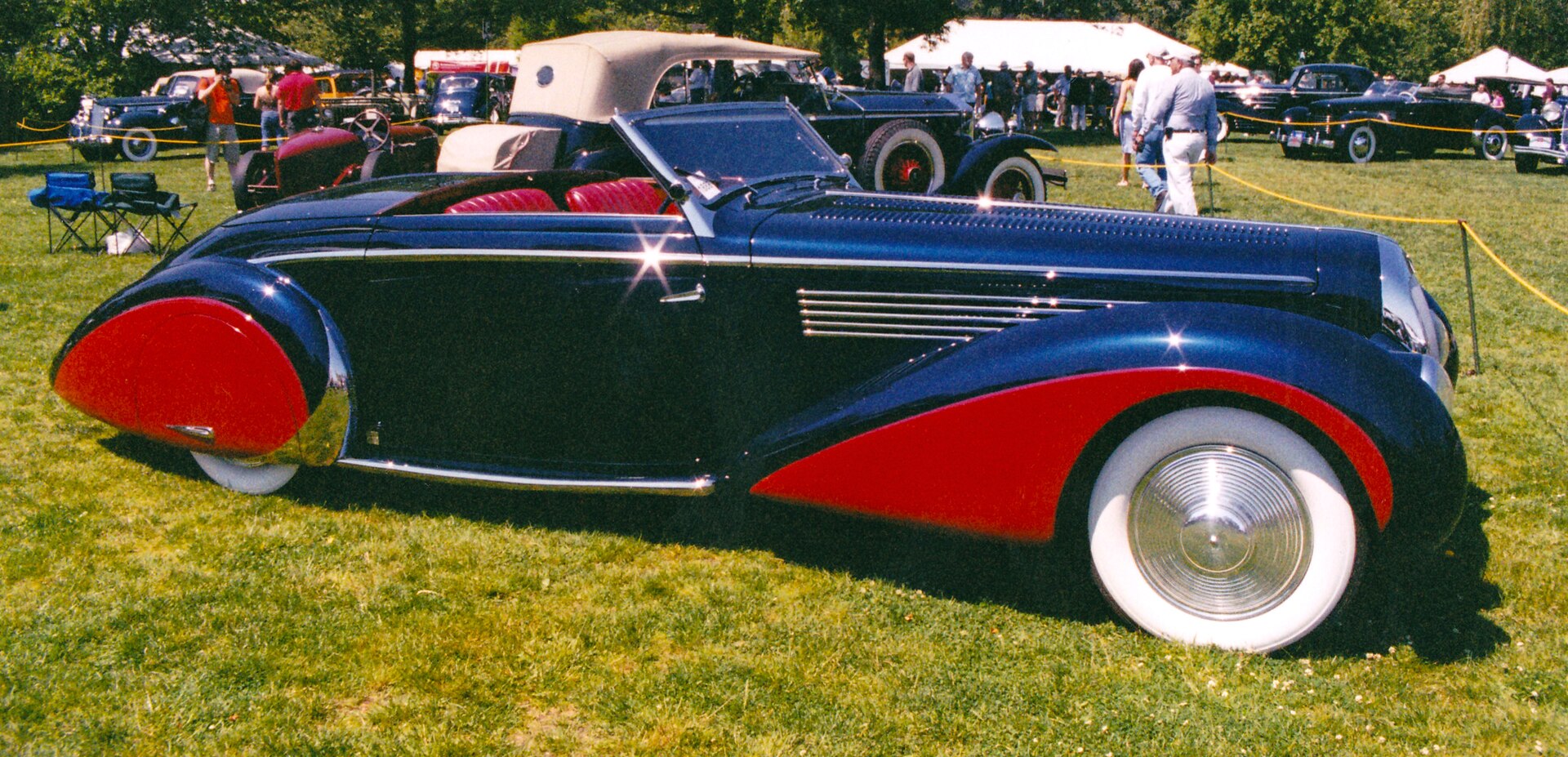
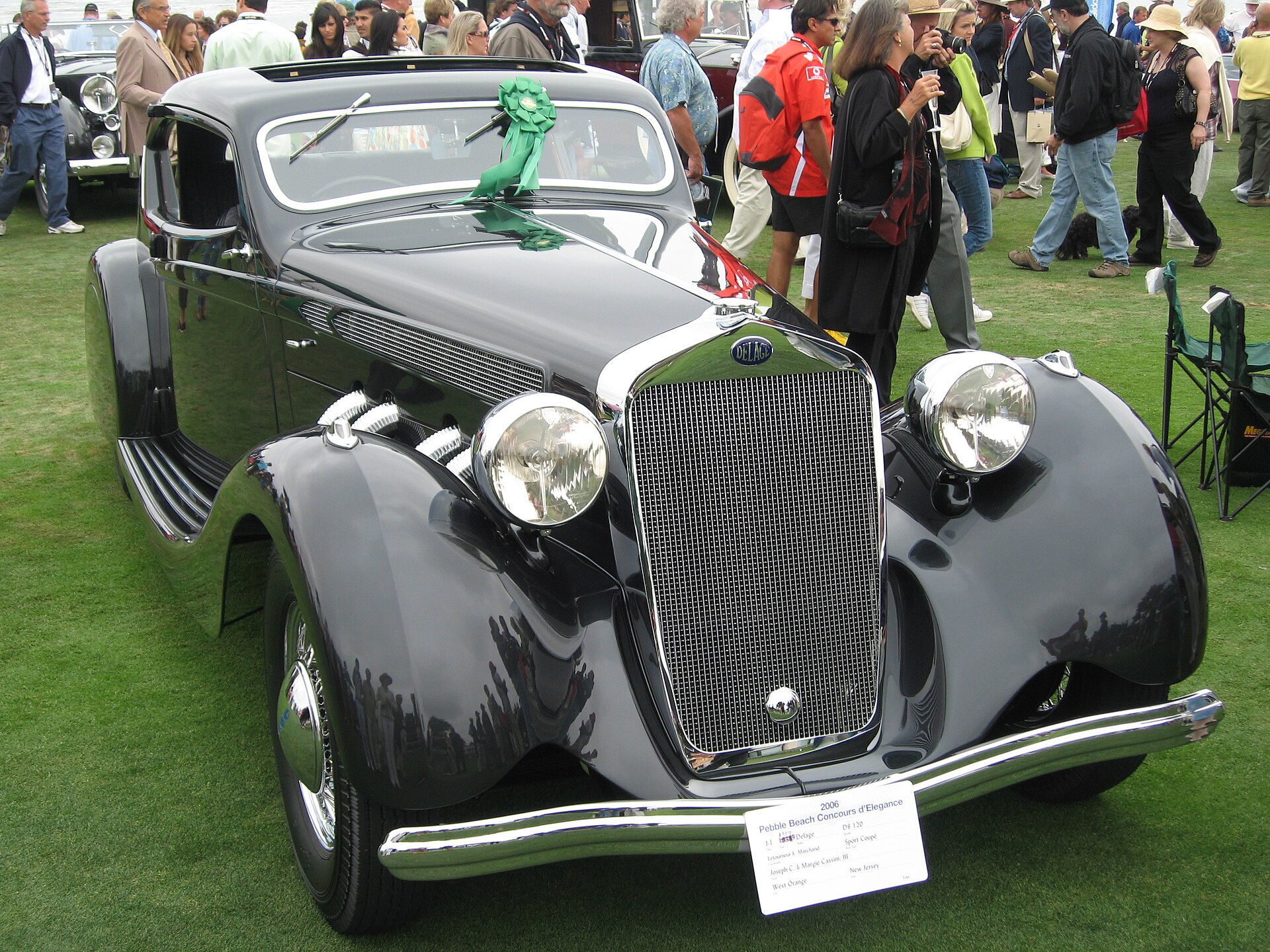
The D8, introduced late in 1929, was the brand's flagship. Its 4,061 cc overhead-cam straight-eight gave 76 kW (102 hp) at 3,500 rpm in the D8 Normale and 89 kW (120 hp) in the short-wheelbase D8 S, for top speeds of 120 and 130 km/h. Delage supplied rolling chassis, and Paris coachbuilders such as Letourneur et Marchand, Chapron, Figoni et Falaschi and Saoutchik built the bodies. The later D8-120 of 1937 had 89 kW (120 hp) at 4,500 rpm. The D8 is covered in Delage D8 history and specifications.
The six-cylinder D6 of 1930 became the mainstay of the range until 1954. The first D6 had a 3,045 cc engine of 56 kW (75 hp), and about 1,160 were built up to 1933; compared with it, the D8 had 20 kW more. Many smaller versions followed, from the 2.0-litre D6-11 to the 2.8-litre D6-75, with names that generally reflected their fiscal or actual horsepower.

Depression, liquidation and Delahaye
The crisis of 1929 hit luxury makers hard, and Delage's sales fell. In spring 1932 Louis Delâge borrowed 25 million francs to tool up for the D6. Talks with Peugeot and other partners failed, and the Courbevoie factory went into voluntary liquidation on 20 April 1935. The Delage name was auctioned to Delahaye, and its new owners dismissed Louis Delâge with a small pension.
With Walter Watney, Delâge set up SAFAD in 1935 to sell cars assembled by Delahaye, and in December 1940 Delahaye took over SAFAD's presidency. By 1938 Delage was effectively a Delahaye subsidiary, and about 2,000 Delages were built from 1935 to 1940. Car production stopped when German forces occupied the Delahaye plant in 1940.
Louis Delâge himself became poor. Nearly 60, and with his marriage over, Delâge turned to the Catholic faith and made pilgrimages on foot or by bicycle to Lisieux and Lourdes. Louis Delâge died on 14 December 1947 and is buried at Le Pecq. In 1990 a vocational school in Cognac was named after him.
After the war and the D12
Six-cylinder D6 models returned in 1946, among them the D6 3-litre of 66 kW (90 hp) and the D6 Olympic of 1948–1949, with 74 kW (100 hp) and triple carburettors. The D8 did not come back. Joint Delage and Delahaye output fell to 41 cars in 1952, Delage production ended in 1953, and both brands passed to Hotchkiss in 1954, which ended car making.
The name returned on 7 November 2019, when Les Amis de Delage and Laurent Tapie announced a relaunch. The resulting D12 is a hybrid hypercar with a naturally aspirated V12 of about 738 kW (990 hp) and an electric motor, for a combined output of about 820 kW (1,100 hp). Jacques Villeneuve is its development driver, and only 30 are planned, at more than €2 million each in 2026. By mid-2026 three had been delivered.

Collecting a Delage today
The D8 is the flagship among classic Delages, with its straight-eight engine and coachbuilt bodies; the six-cylinder D6 was built for longer and in more versions. Buyers should check which coachbuilder made the body and whether a car was built at Courbevoie before 1935 or by Delahaye afterwards. The power converter turns the period hp figures into kW, other cars of the decade are in the 1930s classics section, and the models are listed in the Delage catalogue.
Delage timeline
| Year | Event |
|---|---|
| 1905 | Louis Delâge founds the company in Levallois-Perret |
| 1906 | Type A voiturette |
| 1908 | Grand Prix des Voiturettes win (6 July) |
| 1910 | Move to Courbevoie |
| 1914 | René Thomas wins the Indianapolis 500 (30 May) |
| 1924 | European Grand Prix win; 230.52 km/h land speed record |
| 1927 | Four Grand Prix wins; constructors' world title |
| 1929 | D8 introduced |
| 1935 | Liquidation (20 April); Delahaye takes over |
| 1947 | Louis Delâge dies (14 December) |
| 1953 | Last Delage cars |
| 2019 | Revival announced (7 November) |
Landmark Delage models
| Model | Years | Why it matters |
|---|---|---|
| Type A | 1906 | First Delage, De Dion-Bouton engine |
| Type Y | 1913–1914 | Indianapolis 500 winner |
| 15 S 8 | 1927 | 1.5-litre eight; four Grand Prix wins |
| D8 | 1929–1940 | 4,061 cc straight-eight, up to 89 kW (120 hp) |
| D6 | 1930–1954 | Six-cylinder mainstay; 1938 Tourist Trophy winner |
| D12 | from 2020s | V12 hybrid, about 820 kW (1,100 hp) |
FAQ
Who founded Delage?
Louis Delâge, an engineer from Cognac, in Levallois-Perret near Paris in 1905.
Did Delage win the Indianapolis 500?
Yes. René Thomas won the 1914 race in a Delage, averaging 132.73 km/h.
Why did Delage close?
The Depression cut sales of its luxury cars. The factory went into voluntary liquidation in April 1935, and Delahaye took over the name.
Is Delage still making cars?
The brand was revived in 2019 for the D12 hybrid hypercar, of which 30 are planned.
Sources
- Wikipedia — Delage (accessed 24 Oct 2026)
- Wikipedia — Louis Delâge (accessed 24 Oct 2026)
- Wikipedia — Delage D8 (accessed 24 Oct 2026)
- Wikipedia — Delage D6 (accessed 24 Oct 2026)
- Wikipedia — 1914 Indianapolis 500 (accessed 24 Oct 2026)
Found a mistake? Report an error