How to Check a Car's History: VIN, Mileage, Accidents and Finance
To check a car's history in Europe, start with the 17-character VIN, confirm it matches the car and its registration document, then build a mileage timeline from every dated record you can get: national registers where they exist, inspection reports, service invoices and a commercial history report. Add checks for accident damage, theft and outstanding finance before you pay anything. No single database covers the whole EU, so the timeline you assemble is the real history check.
Key takeaways
- The VIN is the key to everything: it must match on the car, the registration document and every invoice.
- Mileage fraud is common; studies cited by the European Parliament put it at 30–50% of cross-border used car sales.
- Some countries publish free mileage records (the UK MOT history, Belgium's Car-Pass); elsewhere you rely on paperwork and paid reports.
- Ask for both parts of the registration certificate: in many countries a lender keeps the ownership part until the loan is repaid.
What a history check can and cannot tell you
| Question | Where the answer comes from | How reliable |
|---|---|---|
| Is this the car on the papers? | VIN on the body and on the registration document | High, if you check both yourself |
| Is the mileage genuine? | Inspection reports, service invoices, national registers, history reports | Good when records are frequent and continuous |
| Has it been in an accident? | Insurance and repair data in paid reports, seller's written declaration, inspection | Partial: unreported repairs leave no record |
| Is it stolen or financed? | Police and registry data, original ownership documents | Varies by country |
| Is it affected by a recall? | Manufacturer recall lookup by VIN, dealer | High for the brand's own data |
A clean report is not proof of a clean car. It only means nothing was recorded, which is why the physical inspection still matters.
Step 1: Read and match the VIN
Modern cars carry a 17-character VIN. The first three characters identify the manufacturer, the next six describe the vehicle, and the last eight identify the individual car, including the plant and serial number. You will find it at the base of the windscreen, on a plate in the door pillar, stamped into the body (often under the passenger seat or on the bulkhead) and in field E of the EU registration certificate.
Check that:
- all locations show the same number, with no scratched, re-riveted or glued plates;
- the number on the registration document and service invoices is identical;
- a VIN decoder returns the same make, model, engine and year as the advert. The US safety agency's vPIC decoder, for example, returns data reported by manufacturers, including the build plant. Small differences can be legitimate, but a different engine or body is a stop sign.
Then use the decoded version to look up the car's real specification and engine on our specs pages and engine pages.
Step 2: Build a mileage timeline
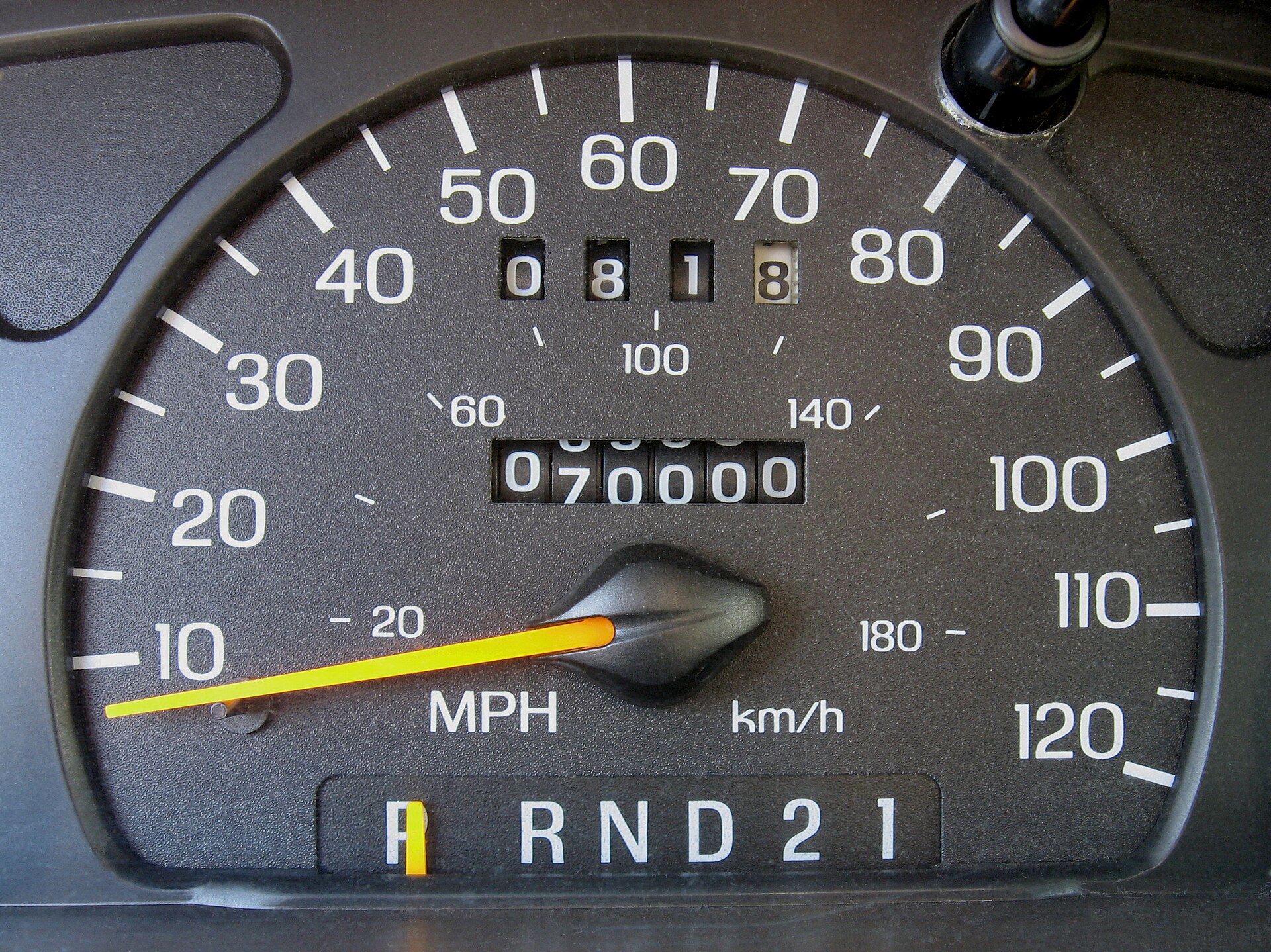
Write down every date and mileage you can find, oldest first. The figures must rise steadily, never fall, and fit the car's age.
The scale of the problem is why this matters. A European Parliament resolution adopted on 31 May 2018 cited studies estimating that between 5% and 12% of used cars in national sales and between 30% and 50% in cross-border sales have a manipulated odometer. Parliament called for interconnected national mileage databases and mandatory recording of mileage at periodic inspections, so buyers could check a car before purchase. carVertical, which sells history reports, found the highest shares of clocked cars in its own checks in Latvia (11.2%), Ukraine (9.1%) and Lithuania (7.8%), against 2.1% in the UK.
Where to find mileage records:
- Inspection reports: most EU countries record the mileage at each roadworthiness test, usually four years after first registration and every one or two years after that.
- Service invoices: better than stamps alone, because they carry a date, the mileage and the VIN.
- Oil-change stickers and the car's own memory: some control units store mileage; a dealer can read it.
- National registers: see the table below.
Country registers worth knowing
| Country | What you can check | Notes |
|---|---|---|
| United Kingdom | MOT history: pass or fail, mileage at each test since 2005, failure and minor-defect details | Free GOV.UK service using the registration number |
| Belgium | Car-Pass mileage record, handed over with every used car sale | Not used in neighbouring countries |
| Netherlands | NAP odometer verdict, shown with the registration lookup | Covers cars registered in the Netherlands |
| Germany | No public mileage register | Rely on HU (TÜV) reports, invoices and paid reports |
| Cross-border purchase | Records from the export country only | Ask for that country's inspection reports and invoices |
When you import a car, its home-country history does not travel with it automatically. Get copies of the inspection reports and invoices before you pay, while the seller still has an incentive to provide them.
Step 3: Look for accident and damage history
Commercial history reports combine registry, insurance, auction and workshop data. Their coverage differs by country, so check what a provider actually holds for the export country before buying a report.
In Germany, ADAC points out that a dealer must disclose accident damage without being asked, while a private seller must disclose damage they know about. Ask directly and get the answer in the contract: "accident-free" in writing has legal weight, a verbal assurance rarely does. Confirm what you are told with a paint-thickness gauge and an inspection of the chassis legs and boot floor.
Step 4: Check for theft and outstanding finance
- Ask for the original registration documents. In countries with a two-part certificate, the second part often proves ownership; if a bank or leasing company still holds it, the seller cannot transfer the car freely.
- Make sure the seller's ID matches the registered keeper, and meet at their address, not in a car park.
- In the UK, finance and theft markers are included in commercial history checks; in most EU countries, ask the lender or your national registry how to confirm there is no outstanding loan.
- Be wary of cars that have changed hands several times in a short period, and of "export only" sales at prices well below the market.
Step 5: Check recalls and known problems
Enter the VIN on the manufacturer's recall page or ask a franchised dealer to confirm that all recall work is done; recall repairs are free. Then read up on the engine and gearbox of that version. Known weaknesses, such as timing chain stretch or wet timing belts, are easier to price into a deal than to discover after it.
Finally, value the car as it really is. Use our cost of ownership calculator to see what the car will cost per year once any overdue work is added, and compare alternatives with the car finder.
Red flags in a car's history
- Mileage that falls between two records or a long period with no records at all.
- A service book full of stamps but no invoices, or stamps from garages that do not exist.
- Wear on pedals, seats and steering wheel that does not fit the mileage.
- A recent re-registration in another country with no older paperwork.
- A seller who will not give the VIN before a viewing.
Try our calculator
Cost of ownership calculatorFAQ
Can I check a car's history with just the VIN?
Partly. The VIN gives you the factory specification and lets you buy a commercial report and check recalls. Mileage, ownership and inspection data are often linked to the registration number instead, and in many countries only the owner can request them, so ask the seller for copies.
Is there a free EU-wide car history check?
No. Each country keeps its own registers, and there is no public EU database of mileage or accident history. The UK MOT history and Belgium's Car-Pass are among the most useful free sources, but they only cover cars that lived in those countries.
How do I know if the mileage has been rolled back?
Build a timeline from inspection reports and invoices and look for any reading that falls. Then compare the wear on the pedals, steering wheel, seat bolster and door hinges with the claimed mileage, and check that the stored mileage in control units matches the dashboard.
Are paid car history reports worth it?
For imported cars and anything with a gap in the paperwork, yes, because they pull in records from other countries that you cannot reach yourself. Check which countries and data types a provider covers before you pay, and never treat a clean report as a replacement for an inspection.
Sources
- European Parliament Legislative Observatory: Odometer manipulation in motor vehicles, resolution summary (2018) (accessed 21 Oct 2026)
- GOV.UK: Check the MOT history of a vehicle (accessed 21 Oct 2026)
- Car-Pass: Importing a vehicle from abroad, useful tips when purchasing (accessed 21 Oct 2026)
- Your Europe (European Union): Car registration documents and formalities (accessed 21 Oct 2026)
- carVertical: How to detect an odometer rollback (accessed 21 Oct 2026)
- NHTSA vPIC: VIN decoder (accessed 21 Oct 2026)
- ADAC: Auto gebraucht kaufen, worauf Sie achten sollten (accessed 21 Oct 2026)
Found a mistake? Report an error