Ford Galaxy — Generations, Specs and the Third-Generation MPV
The Ford Galaxy is a large MPV originally developed together with Volkswagen. Three generations were built: the first appeared in 1995, the second in 2006 and the third was revealed at the Paris motor show in 2014 and went on sale in 2015. The third generation was facelifted in 2019 with a fresher exterior and updated cabin. Ford ended Galaxy production in April 2023. This article focuses on the third generation and its facelift.
Key takeaways
- Three generations: Mk I (1995, facelifted as Mk II in 2000), Mk III (2006) and Mk IV (2015, facelift 2019, built until April 2023).
- Mk IV petrol engines: 1.5 EcoBoost and 2.0 EcoBoost with 118–176 kW (160–240 PS); diesels from 88 to 154 kW (120–210 PS), later EcoBlue units and a 2.5 hybrid.
- Front-wheel drive, with all-wheel drive available on selected diesel versions.
- Seven seats in three rows and up to 2,339 litres of luggage space.
Ford Galaxy at a glance
The Galaxy was the largest MPV in Ford's European range, sitting above the S-Max, with which the Mk IV shares much of its engineering. More Ford models are listed in our Ford catalogue.
| Generation | Years | Notes |
|---|---|---|
| Mk I | 1995–2000 | Developed with Volkswagen, built at the AutoEuropa plant in Portugal alongside the VW Sharan and SEAT Alhambra |
| Mk II | 2000–2006 | Facelift of the first generation, updated again in 2004 |
| Mk III | 2006–2015 | Introduced at the Geneva motor show 2006, built in Genk, Belgium, without Volkswagen content |
| Mk IV | 2015–2023 | Revealed in Paris in 2014; facelift 2019; production ended in April 2023 |
Exterior of the Mk IV
The third-generation Galaxy looks more modern and appealing than before, with a slightly more assertive character that helps it stand out from rivals. At the front there is a gently sculpted bonnet, narrow LED headlights and a hexagonal chrome grille, while the bumper carries large fog lamps and compact air intakes.
The side also changed compared with the previous Galaxy. It has strongly pronounced wheel arches — unusual in this class but an undeniable advantage — an attractive crease low down and a decorative line higher up, and roof rails. Unlike many rivals, the Galaxy has conventional hinged rear doors rather than sliding ones. The large glass area gives excellent visibility, and keyless entry is available. Ground clearance is a modest 124 mm. The redesigned wheels look attractive, even slightly sporty; 17-inch wheels are standard and 19-inch wheels optional.
The rear also improved, with narrow tail lights, a massive tailgate topped by a decorative spoiler with an integrated brake light and reflectors in the rear bumper.
Interior
The Galaxy's cabin is just as well executed. Only high-quality materials are used — soft plastics, metal inserts and genuine leather — there are no unnecessary details and no uneven gaps. The ride is very soft and smooth without wallowing, the car holds the road well, and sound insulation is excellent, blocking both outside noise and the sound of the engine.
The driver has a familiar Ford three-spoke steering wheel with many buttons for the climate, audio and cruise control, and a 10-inch display that serves as the instrument panel and can be configured to each driver's taste. The centre console has a futuristic look with far fewer mechanical buttons than before. In the middle is a compact but bright, high-quality touchscreen, flanked by vertical air vents, through which many vehicle functions can be controlled, not just music and navigation. Near the gear selector are a covered storage compartment, two cupholders, switches for chassis systems and the parking-brake button.
The Galaxy has three rows of seats, all comfortable and well made: soft but supportive, with heating and electric adjustment available on many seats, so almost every passenger can find a comfortable position. There is plenty of legroom, shoulder room and headroom, and the second row has trays with cupholders. With seven seats in use, the boot holds 300 litres; folding the rear rows increases this to 2,339 litres, and a hidden 20-litre compartment sits under the floor.
Engines and transmissions at launch
| Engine | Fuel | Power (kW / PS) | Torque | Notes |
|---|---|---|---|---|
| 1.5 EcoBoost | Petrol | 118 kW / 160 PS | 240 Nm | 6-speed manual or automatic |
| 2.0 EcoBoost | Petrol | 176 kW / 240 PS | 345 Nm | PowerShift automatic only |
| 2.0 TDCi | Diesel | 88 kW / 120 PS | 310 Nm | 6-speed manual |
| 2.0 TDCi | Diesel | 110 kW / 150 PS | 350 Nm | Manual or PowerShift |
| 2.0 TDCi | Diesel | 132 kW / 180 PS | 400 Nm | Manual or PowerShift; AWD available |
| 2.0 TDCi bi-turbo | Diesel | 154 kW / 210 PS | 450 Nm | PowerShift |
The turbocharged EcoBoost petrol engines have direct injection and use 6.5–7.9 l/100 km on the combined cycle. They take the Galaxy to 100 km/h in 8.6–10 seconds, with top speeds of 195–222 km/h. The 2.0 TDCi diesels, with direct injection, use 5.0–5.8 l/100 km; they reach 100 km/h in 8.9–13.6 seconds and top out at 180–214 km/h. Diesel versions use a six-speed manual or the six-speed PowerShift dual-clutch gearbox, and the intelligent all-wheel-drive system uses a multi-plate clutch to engage the rear wheels.
Chassis
The Mk IV Galaxy is built on Ford's front-wheel-drive CD4 platform, which underpins many of the brand's larger cars of the period. It has MacPherson struts at the front and an Integral Link multi-link rear suspension, with three damping settings — Comfort, Normal and Sport — on versions with adaptive dampers. Rack-and-pinion steering with electric assistance and a variable ratio makes the car easy to drive, and it stops well thanks to disc brakes on all wheels (ventilated at the front), with ABS, EBD, brake assist and ESP.
Equipment
Ford offered several trim levels with different engines and equipment. Even well-equipped entry versions had air conditioning, a panoramic roof, a rear camera, fog lamps, ABS, ESP and EBD and seven airbags. Higher trims added navigation, the most powerful engine, three-zone climate control, an 8-inch infotainment screen, leather upholstery and electric, ventilated seats.
The 2019 facelift
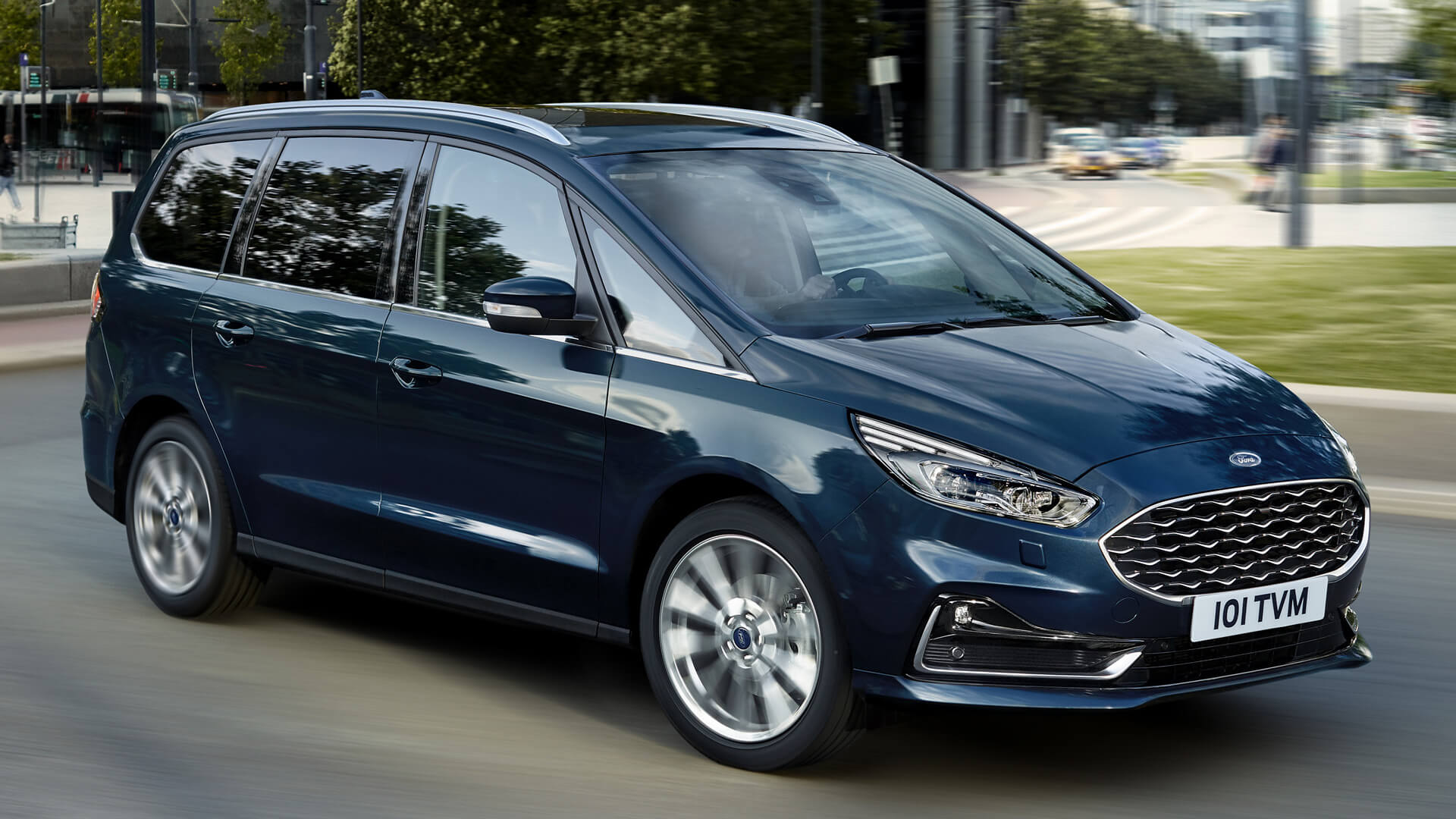
In 2019 Ford presented updated Galaxy and S-Max models for the 2020 model year in Europe, with a refreshed exterior, revised equipment, a new automatic gearbox and a top Vignale version.
Despite its size, the facelifted Galaxy looks dynamic. The front has large headlights with LED elements, an imposing grille and a neatly shaped bumper with a compact intake and round fog lamps. The side has large doors, round wheel arches, steeply raked windscreen pillars, sculpted flanks and roof rails, and ground clearance remains 124 mm. The Titanium version rides on two-tone 20-spoke 17-inch wheels. The rear keeps large tail lights, an imposing tailgate and a tidy bumper. Seven paint colours and several wheel designs were offered.
The interior follows Ford's design language, with well-thought-out ergonomics, a stylish dashboard and quality materials. The multifunction steering wheel has chrome inserts, the 10-inch instrument display remains, and a large SYNC 3 touchscreen with Apple CarPlay and Android Auto sits in the centre. Storage is plentiful, including a large glovebox and a compartment on top of the dashboard. The wide centre console has the automatic gear selector, a few buttons, two cupholders and a broad armrest. A Wi-Fi hotspot and FordPass Connect let the owner check the car and lock or unlock it from a smartphone, and Local Hazard Information warns of dangers on the route using data from other vehicles and emergency services.
The front seats offer heating, ventilation, good side support and a wide range of adjustment; higher trims have quality leather and an optional massage function. Three adults fit in the second row, which has its own climate controls and fold-out tables, while the third row suits children or teenagers. Folding it creates a perfectly flat floor and more than 2,000 litres of space.
According to published figures, the facelifted range comprised a 1.5 EcoBoost petrol engine with 121 kW (165 PS) and a 2.0 EcoBlue diesel in three versions with 110, 140 and 176 kW (150, 190 and 240 PS). Petrol models and the entry diesel use a six-speed manual, the stronger engines an eight-speed automatic, and the 140 kW (190 PS) diesel with the automatic can be ordered with all-wheel drive. From late 2021 the only engine left was a 2.5-litre hybrid with 140 kW (190 PS) and a CVT.
Safety
The Galaxy has advanced safety systems. Pre-Collision Assist detects vehicles and pedestrians ahead or about to cross the car's path and warns the driver. The Intelligent Protection System coordinates the safety systems for maximum protection, perimeter alarm protection triggers if doors or the bonnet are forced, and an advanced airbag system protects the occupants.
Rivals
The Galaxy competed with the Volkswagen Sharan, SEAT Alhambra, Citroën Grand C4 SpaceTourer and Kia Carnival.
Verdict
The facelifted Galaxy looks elegant, modern and stylish, with a more advanced cabin and better equipment. It suits families well, offering strong engines, a roomy and comfortable seven-seat cabin, a high level of safety and good build quality. Low ground clearance and the lack of a spare wheel are minor points that do not spoil the overall impression.
FAQ
When was the Ford Galaxy built?
From 1995 until April 2023, in three generations.
Was the Ford Galaxy developed with Volkswagen?
The first generation was, and it was built alongside the VW Sharan and SEAT Alhambra in Portugal. Later generations were developed by Ford alone.
How many seats does the Ford Galaxy have?
Seven, in three rows.
How big is the Ford Galaxy boot?
300 litres with all seven seats in use and up to 2,339 litres with the rear rows folded.