 Polestar 3
Specs, engines and history
Published Sources (2) Report an error
By Felix Hartmann, Automotive Technology & EV Contributor
- Built
- 2024–present
- Top power
- 500 kW (680 PS)
- Euro NCAP
- 5 stars · 2025
Which Polestar 3 to buy
Our verdict · Felix Hartmann
- Best range: the 2026 Dual Motor, with 647 km WLTP and 400 kW.
- Lowest price and efficiency: the 2026 Rear Motor at EUR 78,900 and 17.7 kWh/100 km.
- Fastest: the 2026 Performance, 0-100 km/h in 3.9 seconds.
- Used: a 2024-2025 Long Range Dual Motor with the 111 kWh battery, but note its slower 250 kW charging and 400 V system.
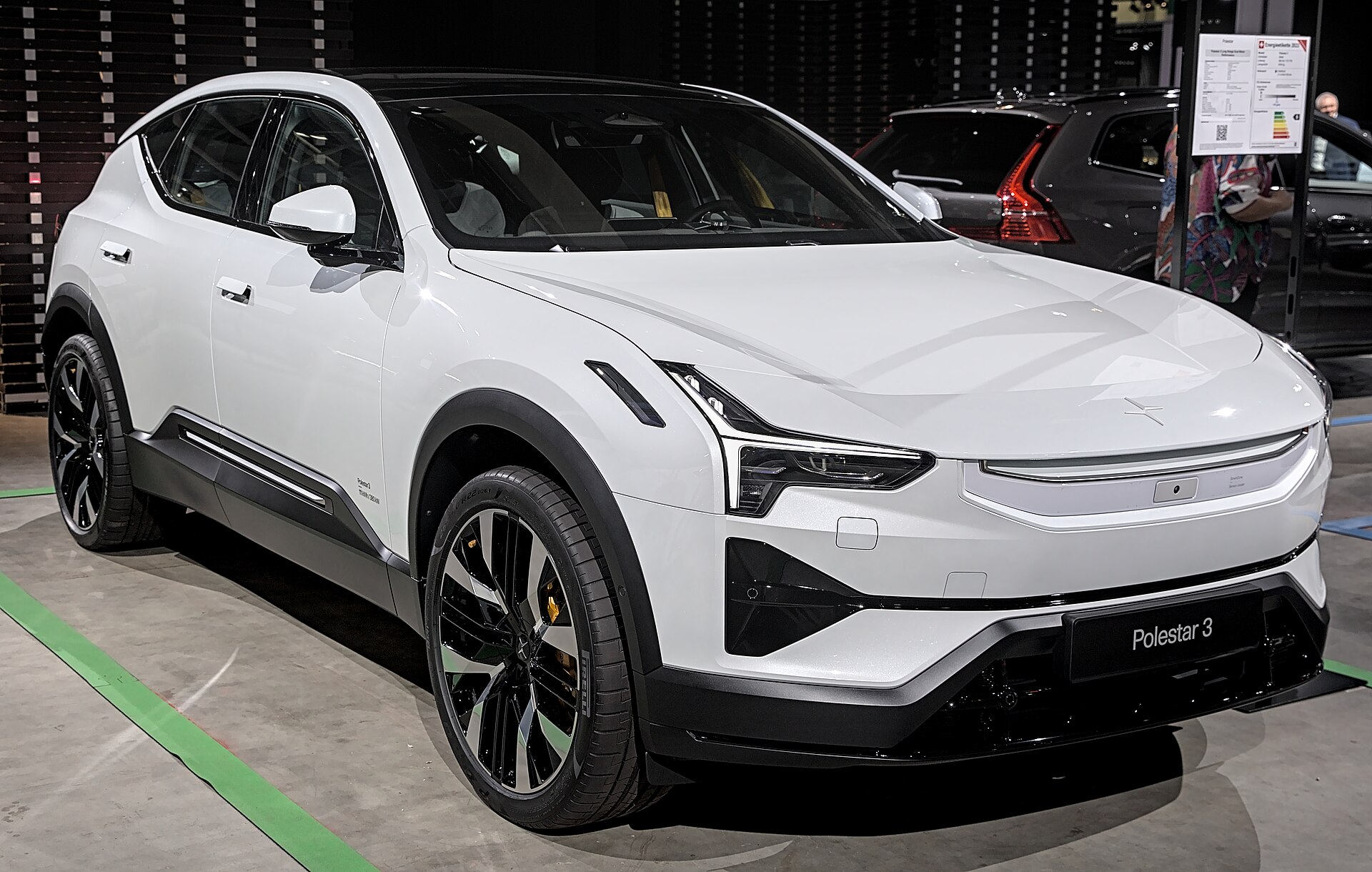
The Polestar 3 is a five-seat electric SUV, about 4.9 m long, that Polestar has built since February 2024, first in Chengdu, China, and in Ridgeville, South Carolina, and since March 2026 only in the US. It was the first car on Volvo's SPA2 platform, which it shares with the Volvo EX90. A heavily updated version with an 800-volt system, new batteries and up to 500 kW (680 PS) arrived in Germany in May 2026.
In short
- Large electric SUV, five doors and five seats, on the SPA2 platform shared with the Volvo EX90.
- 2024-2026: 111 kWh battery, 400 V, dual-motor versions with 360 or 380 kW, later a 220 kW rear-motor version.
- From 2026: 800 V, 92 or 106 kWh, 245 kW to 500 kW, up to 647 km WLTP and up to 350 kW DC charging (ADAC).
- Five stars in the Euro NCAP test of 2025, with 93% for child occupant protection.
Size at a glance
| Dimensions | Polestar 3 P519 |
|---|---|
| Length | 4,900 mm192.9 in |
| Width | 1,935 mm76.2 in |
| Height | 1,614 mm63.5 in |
| Wheelbase | 2,985 mm117.5 in |
Specs by version
Engines
| Version | Engine | Power | Torque | Gearbox | Drive | Production years |
|---|---|---|---|---|---|---|
| Rear Motor (92 kWh) | Electric | 245 kW 333 PS329 hp | 480 Nm354 lb-ft | 1-sp Automatic | Rear-wheel drive | 2026 |
| Dual Motor (106 kWh) | Electric | 400 kW 544 PS536 hp | 740 Nm546 lb-ft | 1-sp Automatic | All-wheel drive | 2026 |
Performance
Show all 2 versions
| Version | 0–100 km/h | Top speed |
|---|---|---|
| Rear Motor (92 kWh) | 6.5 s 0–62 mph | 210 km/h130 mph |
| Dual Motor (106 kWh) | 4.7 s 0–62 mph | 230 km/h143 mph |
Dimensions and weight
Show all 2 versions
| Version | Length | Width | Height | Wheelbase |
|---|---|---|---|---|
| Rear Motor (92 kWh) | 4,900 mm192.9 in | 1,935 mm76.2 in | 1,618 mm63.7 in | 2,985 mm117.5 in |
| Dual Motor (106 kWh) | 4,900 mm192.9 in | 1,935 mm76.2 in | 1,614 mm63.5 in | 2,985 mm117.5 in |
Verified Manufacturer and type-approval data from our catalog · Sources and methodology
Safety
-
Euro NCAP 2025
Stars from different years and organisations are not directly comparable: test protocols change every few years.
Polestar 3 at a glance
| Specification | Polestar 3 |
|---|---|
| Segment | Large electric SUV (five seats) |
| Internal code | P519 |
| Revealed | 12 October 2022; public debut at Auto Shanghai, April 2023 |
| Production | February 2024 to date |
| Plants | Chengdu, China (2024-2026); Ridgeville, South Carolina, US (sole plant from March 2026) |
| Platform | SPA2 (Volvo), dedicated to battery-electric cars |
| Related | Volvo EX90, Volvo ES90 |
| Drive | rear-wheel drive or all-wheel drive with two motors |
| Power range | 220-500 kW (299-680 PS) |
The Polestar 3 sits above the Polestar 2 and next to the coupe-styled Polestar 4 in our Polestar catalogue. For other battery-electric models see the electric cars section.
Generations and versions
There is one generation so far. Polestar updated it thoroughly for 2026, so the market now has two quite different technical versions.
| Generation | Code | Years | Body styles | Engines | Power (kW / hp) |
|---|---|---|---|---|---|
| Polestar 3 (400 V) | P519 | 2024-2026 | 5-door SUV | 1 or 2 electric motors, 111 kWh | 220-380 kW (299-517 PS) |
| Polestar 3 (800 V update) | P519 | 2026- | 5-door SUV | 1 or 2 electric motors, 92 or 106 kWh | 245-500 kW (333-680 PS) |
The original car launched as a Long Range Dual Motor, with an optional Performance Pack. ADAC lists a rear-motor version with 220 kW (299 PS) before the update. In the 2026 update, ADAC reports that the 400-volt system was replaced by an 800-volt architecture, the battery capacities changed to 92 kWh (rear motor) and 106 kWh (dual motor), and every version gained power. The main computer is said to be about eight times more powerful, and voice control uses Google Gemini.

Motors, batteries and performance
2024-2026 (400 V, 111 kWh)
| Version | Power | Torque | 0-100 km/h | Top speed | WLTP range |
|---|---|---|---|---|---|
| Long Range Dual Motor | 360 kW (489 PS) | 840 Nm | 5.0 s | 210 km/h | 610 km |
| Dual Motor, Performance Pack | 380 kW (517 PS) | 910 Nm | 4.7 s | 210 km/h | 560 km |
The battery is a 111 kWh nickel manganese cobalt pack. Both motors are permanent-magnet synchronous units, one on each axle, and the rear axle has true torque vectoring with a clutch that can disconnect the rear motor to save energy. Wikipedia's infobox and text convert the outputs to horsepower slightly differently, but the kW values are consistent.
From 2026 (800 V)
| Version | Power | Torque | 0-100 km/h | Battery (gross) | WLTP range | Consumption |
|---|---|---|---|---|---|---|
| Rear Motor | 245 kW (333 PS) | 480 Nm | 6.5 s | 92 kWh | 602 km | 17.7 kWh/100 km |
| Dual Motor | 400 kW (544 PS) | 740 Nm | 4.7 s | 106 kWh | 647 km | 19.0 kWh/100 km |
| Performance | 500 kW (680 PS) | 870 Nm | 3.9 s | 106 kWh | 601 km | 20.5 kWh/100 km |
Top speed is 210 km/h for the rear-motor car and 230 km/h for both all-wheel-drive versions. The batteries come from CATL. Maximum DC charging rose from 250 kW to 350 kW (310 kW for the rear-motor car), and Polestar quotes 10-80% in 22 minutes under ideal conditions. AC charging is 11 kW. On ADAC's first drive, the Dual Motor used 18.2 kWh/100 km on country roads at a gentle pace.

Dimensions, space and boot
| Parameter | Metric | Imperial |
|---|---|---|
| Length | 4,900 mm | 192.9 in |
| Width (body, ADAC) | 1,935 mm | 76.2 in |
| Height | 1,614-1,618 mm | 63.5-63.7 in |
| Wheelbase | 2,985 mm | 117.5 in |
| Kerb weight (2024, Wikipedia) | 2,584 kg | 5,697 lb |
| Kerb weight (2026, EU) | 2,315-2,525 kg | 5,104-5,567 lb |
| Boot, seats up / folded | 484 / 1,411 l | 17.1 / 49.8 cu ft |
| Braked towing (2026) | 1,500-2,200 kg | 3,307-4,850 lb |
| Payload (2026) | 605-645 kg | 1,334-1,422 lb |
The Polestar 3 has two rows and five seats; unlike the Volvo EX90 it does not offer a third row. Wheels range from 20 to 22 inches. You can check its footprint against other cars with the size comparison tool.

Running costs
With WLTP consumption of 17.7 to 20.5 kWh/100 km for the 2026 versions, the Polestar 3 is in line with other large electric SUVs of similar weight. ADAC gives a two-year vehicle warranty for Germany. Electricity costs depend heavily on how much you charge at home; ADAC still plans to test the charging curve and battery management of the updated car in detail.
Trims and equipment
Every Polestar 3 has a 14.5-inch central touchscreen running Android Automotive, an Nvidia central computer, three-zone climate control with an air-cleaning system, a heated steering wheel and USB-C sockets front and rear. The 2026 German price list starts at EUR 78,900 for the Rear Motor, EUR 87,900 for the Dual Motor and EUR 106,900 for the Performance (ADAC, June 2026).
Safety
Euro NCAP awarded the Polestar 3 five stars in 2025. It scored 90% for adult occupant protection, 93% for child occupant protection, 79% for vulnerable road users and 83% for safety assist; Euro NCAP's press release headline said it "sets the standard for child safety". ANCAP's 2025 result is almost identical (90%, 94%, 79% and 79%).
Reliability and known issues
The car is too new for long-term breakdown statistics, and ADAC has no reliability data for it. The start of production was delayed, which Wikipedia's sources link to the timing of Volvo's platform. Production volume in China was modest: 9,763 cars in 2024 and 1,425 in 2025, before all production moved to South Carolina.
Rivals
| Model | Engines | Power (hp) | Boot (l) | Price from (EUR) |
|---|---|---|---|---|
| Polestar 3 (2026) | 1 or 2 electric motors, 92-106 kWh | 333-680 | 484 | 78,900 (Germany, 2026) |
| Volvo EX90 | 2 electric motors | - | - | - |
| BMW iX | 2 electric motors | - | - | - |
| Mercedes-Benz EQE SUV | 1 or 2 electric motors | - | - | - |
| Porsche Macan Electric | 1 or 2 electric motors | - | - | - |
The closest relative is the Volvo EX90, which shares the SPA2 platform but offers seven seats. The Polestar is the sportier, five-seat car of the pair. Use the comparison tool to check current figures for each.

Polestar 3 in our rankings
- No. 8 of 253 · Most powerful SUVs and crossovers (500 kW)
- No. 9 of 80 · Fastest electric cars (230 km/h)
- No. 97 of 1011 · Most powerful cars (500 kW · top 10%)
- No. 13 of 132 · Most powerful electric cars (500 kW · top 13%)
- No. 19 of 126 · Quickest SUVs and crossovers, 0–100 (4.7 s · top 16%)
- No. 29 of 171 · Most torque: SUVs and crossovers (740 Nm · top 17%)
More powerful than 96% of ranked SUVs and crossovers in the 1CARS catalog (No. 8 of 253).
FAQ
How far can the Polestar 3 go on a charge?
The 2024 Long Range Dual Motor is rated at 610 km WLTP. After the 2026 update, ADAC quotes 602 km for the Rear Motor, 647 km for the Dual Motor and 601 km for the Performance.
How fast does the Polestar 3 charge?
The 400 V car charged at up to 250 kW DC. The 800 V update charges at up to 350 kW (310 kW for the Rear Motor), 10-80% in about 22 minutes according to Polestar. AC charging is 11 kW.
Where is the Polestar 3 built?
It was built in Chengdu, China, and in Ridgeville, South Carolina. Since March 2026 the US plant builds it alone.
Is the Polestar 3 the same as the Volvo EX90?
They share the SPA2 platform, but the Polestar is a five-seat SUV with its own body, interior and tuning, while the EX90 has seven seats.
Data sources
Data checked by an editor against the sources below.
- Wikipedia - Polestar 3
- ADAC - Polestar 3