 Cadillac de Ville
Specs, engines and history
Published Sources (1) Report an error
By Felix Hartmann, Automotive Technology & EV Contributor
- Built
- 1959–2005
- Top power
- 242 kW (329 PS)
Which de Ville to choose
Our verdict · Felix Hartmann
For a classic, the obvious choices are the 1959 Coupe de Ville with its tailfins and the convertibles, which were built only from 1964 to 1970. Buyers who want the full 1970s experience look at the 500 cu in cars of 1971–1976, whose sheer size is part of the appeal. The rear-drive 1977–1979 cars with the 425 V8 are the simplest of the downsized generation. For a usable modern car, the 2000–2005 de Ville gives the most equipment, but only with a documented Northstar history. The Cadillac Eldorado Biarritz is the convertible alternative from the same era of tailfins.
The Cadillac de Ville was Cadillac's mainstream full-size car for almost half a century. The name began in 1949 as the Coupe de Ville, a pillarless hardtop version of the Series 62, became a separate series for the 1959 model year and was built in eight generations until June 2005, when the DTS replaced it. In its best years it accounted for three out of four Cadillacs sold.
In short
- Separate series from the 1959 to the 2005 model year; eight generations, rear-wheel drive until 1984 and front-wheel drive from 1985.
- Engines ranged from the 500 cu in (8.2-litre) V8 of the 1970s to the 4.6-litre Northstar V8 with 224 kW (300 hp).
- Record sales of 216,243 cars in 1973; 181,719 in 1970 were 76% of all Cadillacs.
- Firsts include the 1964 Comfort Control climate system and the Night Vision infrared system of 2000.
Cadillac de Ville at a glance
| Item | Details |
|---|---|
| Maker | Cadillac (General Motors), United States |
| Production | 1959–2005 model years as a series; Coupe de Ville trim from 1949 |
| Class | full-size luxury car |
| Bodies | two-door hardtop and coupe (to 1993), four-door hardtop and sedan, convertible (1964–1970) |
| Layout | front engine, rear-wheel drive 1959–1984; transverse engine, front-wheel drive 1985–2005 |
| Plants (from 1977) | Detroit, Linden, South Gate, Orion Township; Hamtramck from 1994 |
| Power range | 78–280 kW (105–375 hp; gross figures to 1971) |
| Predecessor / successor | Cadillac Series 62 / Cadillac DTS (2006) |
The Cadillac catalogue on 1cars lists the de Ville with the other big Cadillacs, and the history of Cadillac explains where it sat in the brand's long story.
From Coupe de Ville trim to a series of its own
The name comes from the French "de ville", "of the town". A coupé de ville was a short town carriage in which the owner sat inside and the driver outside. Cadillac first used it on a show car at the 1949 GM Motorama, built on a Sixty Special chassis with power windows and a one-piece windscreen.
The production Series 62 Coupe de Ville went on sale late in the 1949 model year at US$3,496 and was one of the first pillarless hardtop coupes. Sales rose quickly: 2,150 in 1949, 4,507 in 1950 and 10,241 in 1951. In 1956 the Sedan de Ville followed as Cadillac's first standard four-door hardtop and found 41,732 buyers in its first year.
For 1959 the de Ville became its own Series 6300, with the Series 62 renumbered 6200. More than 53,000 de Villes were sold that year, about 37% of Cadillac's output.
De Ville generations from 1959 to 2005
| Generation | Code | Years | Body styles | Engines | Power (kW / hp) |
|---|---|---|---|---|---|
| 1st | Series 6300 | 1959–1960 | 2-door hardtop, 4- and 6-window hardtop sedans | 390 cu in V8 | 242 / 325 (gross) |
| 2nd | - | 1961–1964 | hardtops, convertible from 1964 | 390 and 429 V8 | up to 254 / 340 (gross) |
| 3rd | - | 1965–1970 | hardtops, pillared sedans, convertible | 429 and 472 V8 | up to 280 / 375 (gross) |
| 4th | - | 1971–1976 | coupe, hardtop and pillared sedan | 472 and 500 V8 | 257 / 345 (1971, gross) |
| 5th | - | 1977–1984 | Coupe and Sedan de Ville | 425, 368, 4.1 V8; 350 diesel; 4.1 V6 | 78–145 / 105–195 |
| 6th | C-body, FWD | 1985–1993 | coupe, sedan | 4.1, 4.5 and 4.9 V8 | 101–149 / 135–200 |
| 7th | K-body | 1994–1999 | sedan | 4.9 V8, 4.6 Northstar V8 | 149–224 / 200–300 |
| 8th | G-body | 2000–2005 | sedan | 4.6 Northstar V8 | 205–224 / 275–300 |
Wikipedia calls the 2006 DTS a de facto ninth generation; it kept the platform and engine but dropped the de Ville name.
Tailfins to land yachts: 1959–1976
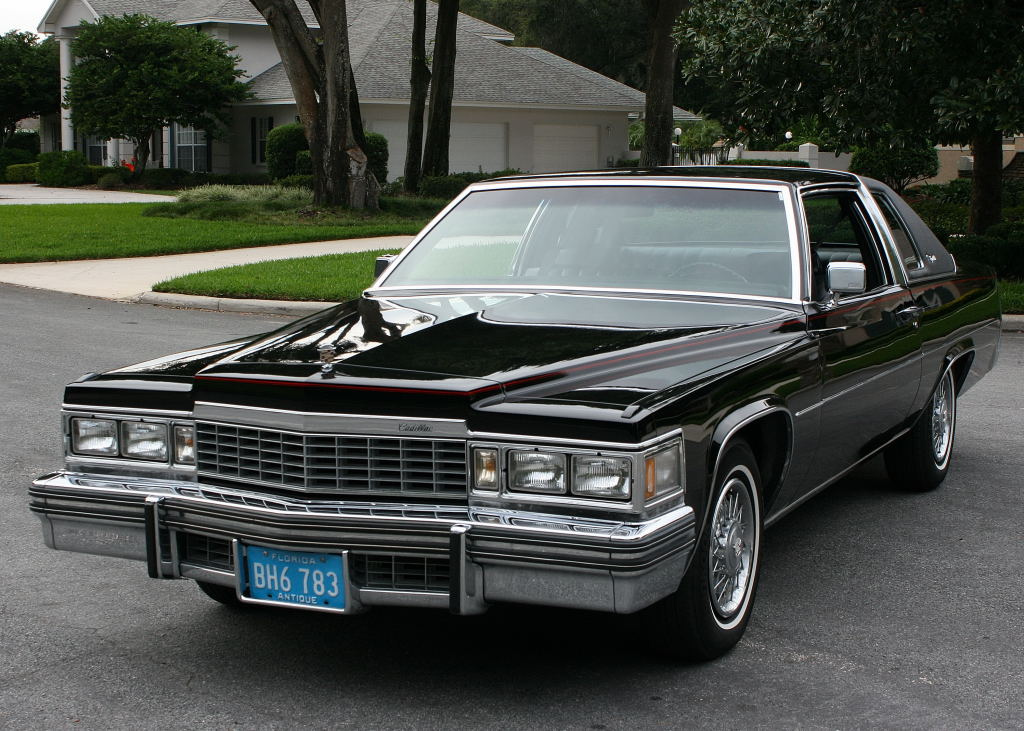
The 1959 de Ville wore tall tailfins with twin bullet tail lamps on a 3,302 mm (130 in) wheelbase. Power steering and brakes, an automatic gearbox, power windows and two-way power seats were standard. The 1960 car was calmer in style, and the redesigned 1961 car swapped air suspension for coil springs. The 429 cu in V8 with 254 kW (340 hp) arrived in 1964, together with the Turbo-Hydramatic gearbox, the first de Ville convertible and Comfort Control, which Wikipedia describes as an industry-first automatic climate system.
For 1965 a new perimeter frame replaced the X-frame and pillared sedans joined the hardtops. The 472 cu in V8 of 1968 gave 280 kW (375 hp, gross), front disc brakes became available and the bonnet grew by 216 mm (8.5 in). In 1970, the last year of the convertible, Cadillac sold 181,719 de Villes.
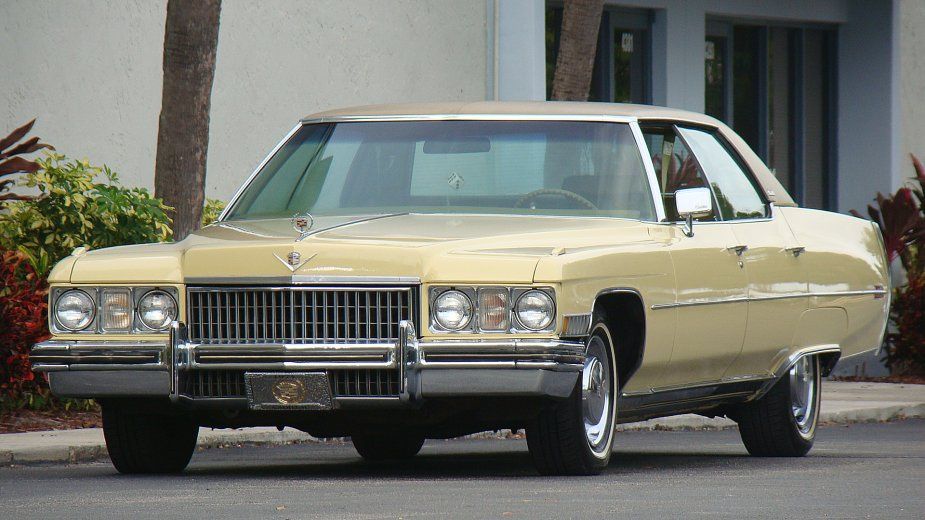
The fourth generation of 1971 was the biggest. The 500 cu in (8.2-litre) V8 produced 257 kW (345 hp, gross) and 678 Nm (500 lb-ft), and the 1974–1976 sedan was 5,860 mm (230.7 in) long. Sales reached 194,811 in 1972 and a record 216,243 in 1973. In 1971 a showroom-stock Coupe de Ville finished third in the Cannonball Run at an average of 136 km/h (84.6 mph). From 1974 an airbag (Air Cushion Restraint System) was offered, one of the first in any car; it was dropped after 1976. Emissions rules cut the 500 to 157 kW (210 hp, net) in 1975, the year optional electronic fuel injection appeared.

Downsizing and front-wheel drive: 1977–1993
The 1977 de Ville was more than 9 in (229 mm) shorter, 4 in (102 mm) narrower and about half a ton lighter than the 1976 car. The new 425 cu in V8 produced 134 kW (180 hp) and 434 Nm. For 1980 a Rolls-Royce-style grille arrived, and fuel prices led to unusual engines: the 368 cu in V8-6-4 that switched off cylinders (108 kW / 145 hp), an Oldsmobile-built 5.7-litre diesel V8 with 78 kW (105 hp), a Buick V6 and, from 1982, the aluminium-block HT-4100 V8 with 101 kW (135 hp).
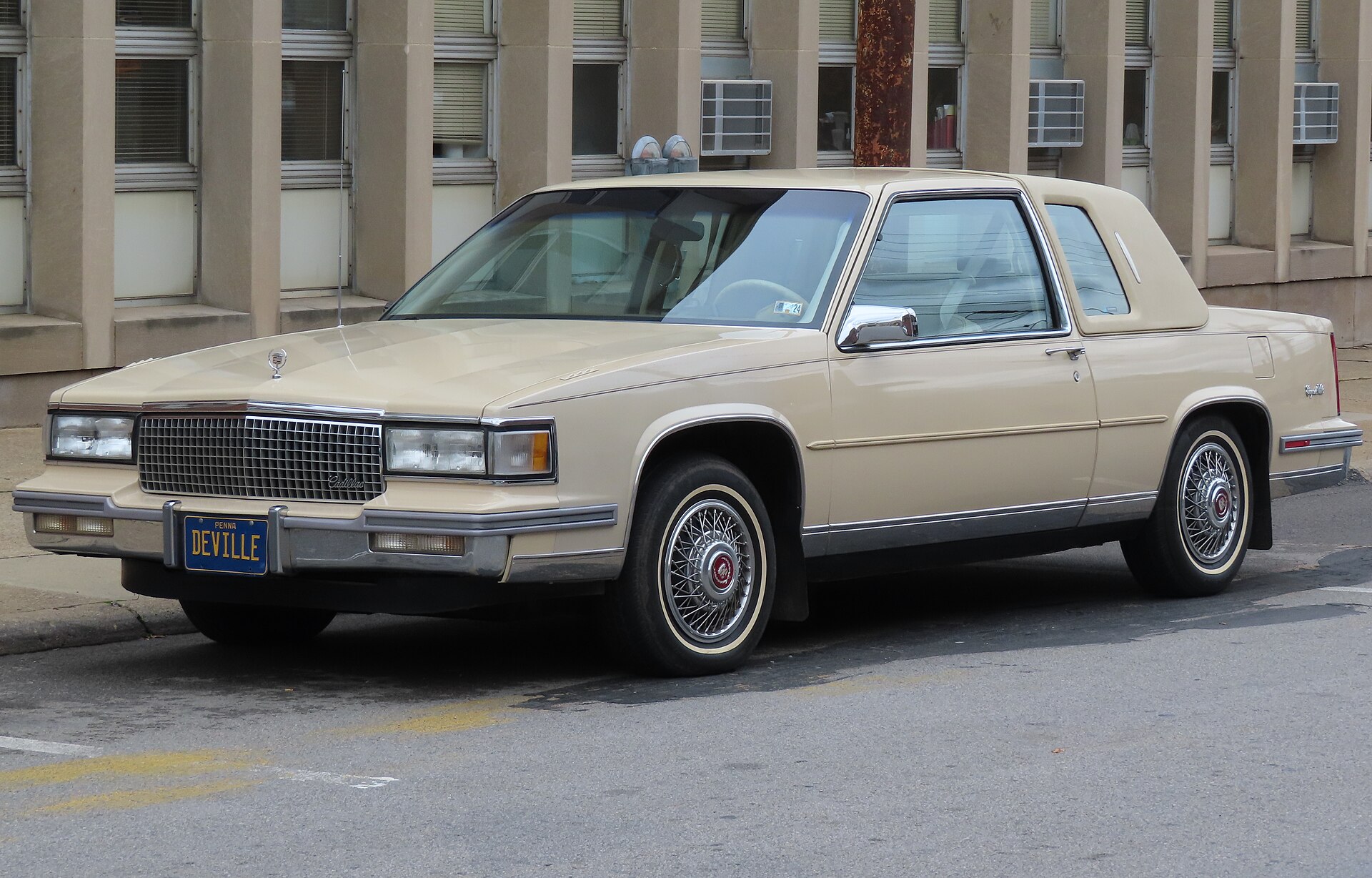
The sixth generation brought the biggest technical change. Production of the new front-wheel-drive C-body started at Orion Township in December 1983, and the car was introduced in April 1984 as a 1985 model, so rear-drive and front-drive de Villes were on sale at the same time. Wikipedia names it the first series-production car with a transversely mounted V8. The engine grew to 4.5 litres (116 kW / 155 hp) in 1988 and to 4.9 litres with 149 kW (200 hp) in 1991. ABS arrived as an option in 1986 and became standard in 1991. The two-door Coupe de Ville was built until July 1993.

Northstar years: 1994–2005
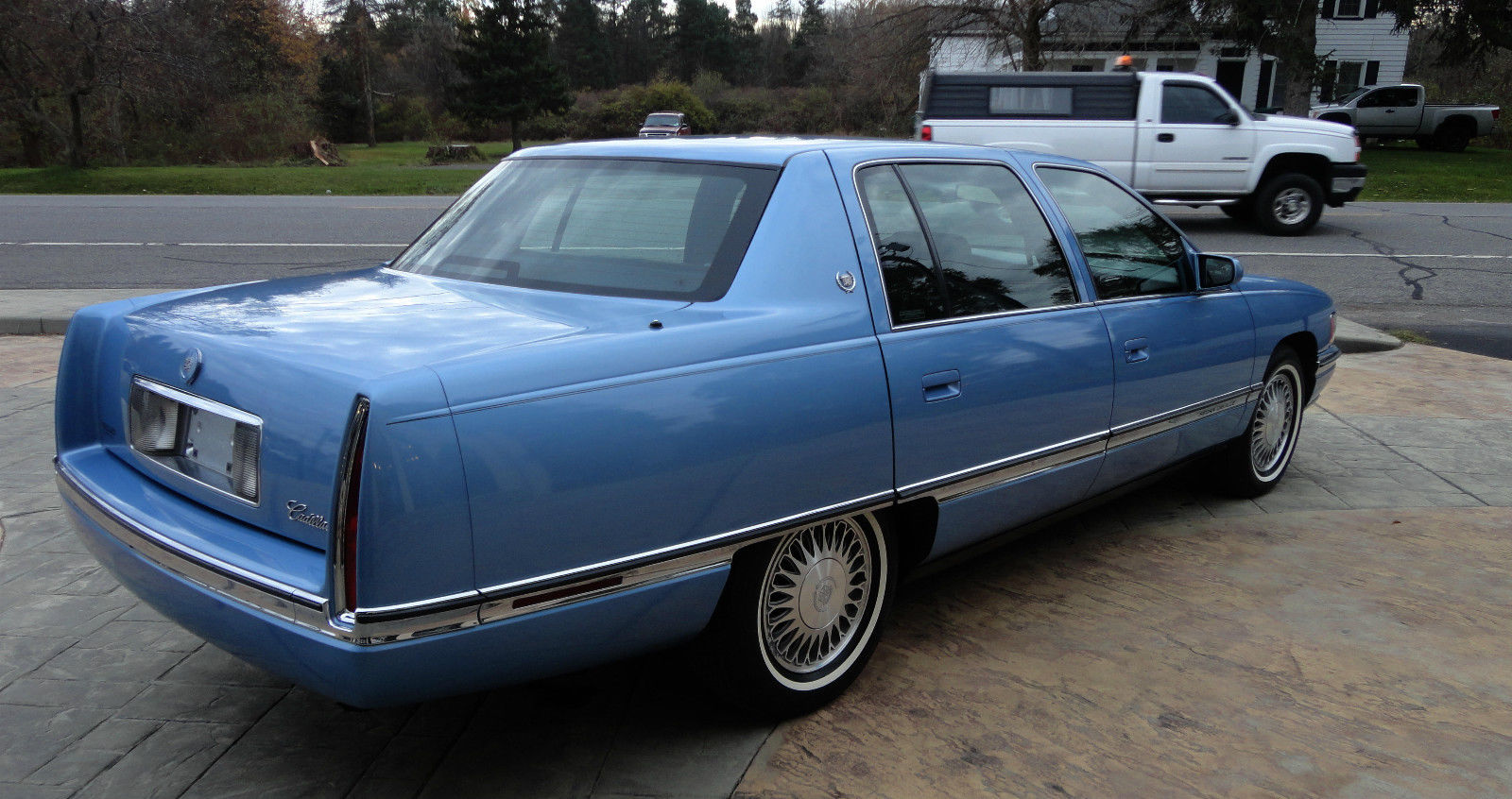
The seventh-generation de Ville of 1994 used a lengthened version of the Seville's K-platform, was built only as a four-door at Hamtramck, Michigan, and had a 2,890 mm (113.8 in) wheelbase. The base car kept the 4.9 V8 at first; the Concours model brought the 4.6-litre Northstar V8 and the adaptive road-sensing suspension later known as MagneRide. From 1996 every de Ville had a Northstar: the LD8 with 205 kW (275 hp) and 407 Nm or, in the Concours, the L37 with 224 kW (300 hp). The d'Elegance trim returned in 1997, and the Concours received standard stability control.
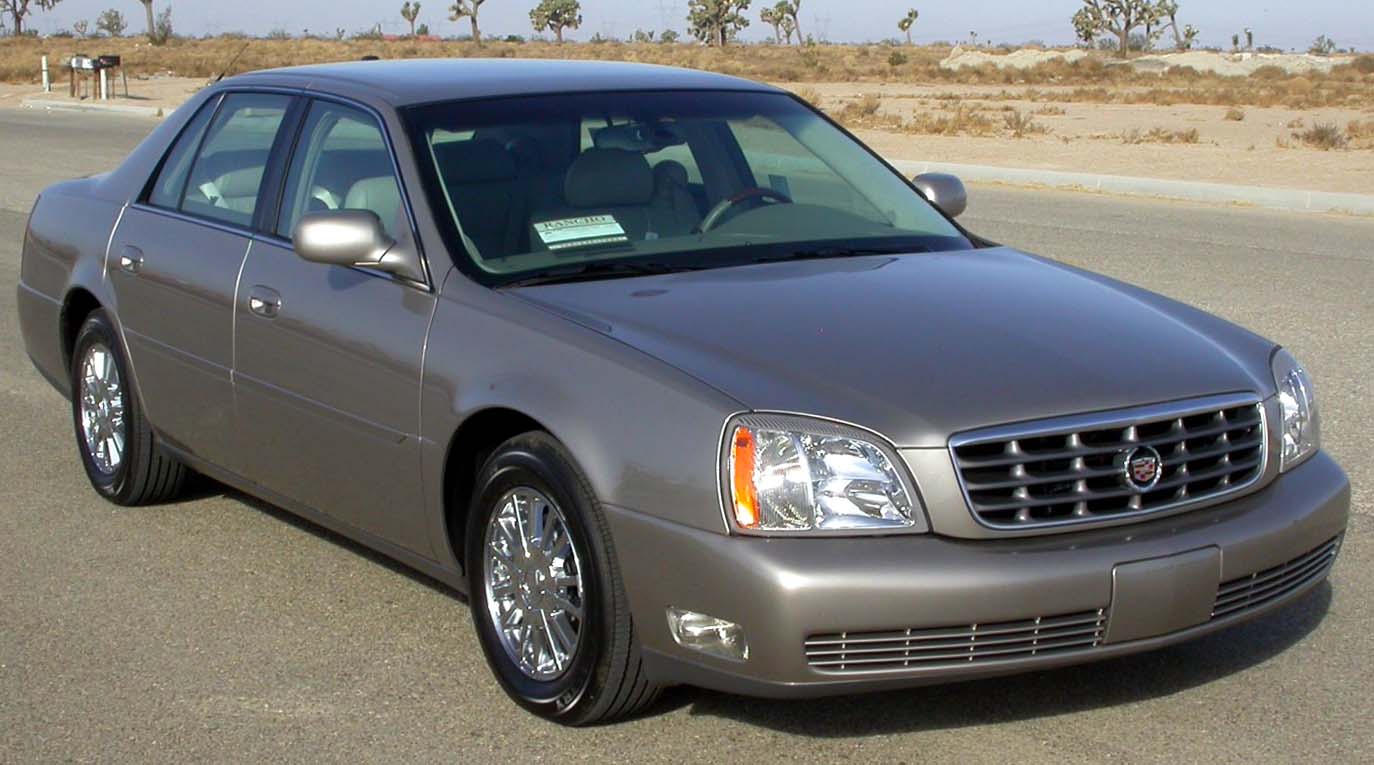
The final generation went into production in August 1999 with a drag coefficient of 0.30 and three versions: base, DHS (luxury) and DTS (touring sedan, formerly Concours). Its Night Vision option, developed with Raytheon, was the first infrared night-vision system in a series-production car; it was dropped after 2004. A mild facelift came for 2003, and the last de Ville was built at Detroit-Hamtramck in June 2005.

Engines and power
| Engine | Years | Power | Torque |
|---|---|---|---|
| 390 cu in (6.4 l) V8 | 1959–1963 | 242 kW (325 hp, gross, 1959) | - |
| 429 cu in (7.0 l) V8 | 1964–1967 | 254 kW (340 hp, gross) | - |
| 472 cu in (7.7 l) V8 | 1968–1970 | 280 kW (375 hp, gross) | - |
| 500 cu in (8.2 l) V8 | 1971–1976 | 257 kW (345 hp, gross, 1971); 157 kW (210 hp, net, 1975) | 678 Nm (1971) |
| 425 cu in (7.0 l) V8 | 1977–1979 | 134 kW (180 hp) | 434 Nm |
| 368 cu in (6.0 l) V8-6-4 | 1980–1981 | 108 kW (145 hp) | 366 Nm |
| 5.7 l diesel V8 (Oldsmobile) | 1980–1984 | 78 kW (105 hp) | 278 Nm |
| 4.1 l HT-4100 V8 | 1982–1987 | 101 kW (135 hp) | 271 Nm (1986) |
| 4.9 l V8 | 1991–1995 | 149 kW (200 hp) | 373 Nm |
| 4.6 l Northstar LD8 | 1994–2005 | 205 kW (275 hp) | 407 Nm |
| 4.6 l Northstar L37 | 1996–2005 | 224 kW (300 hp); 216 kW (290 hp) in 2005 | 400 Nm |
Gross ratings (to 1971) are not comparable with the net figures used from 1972.
Prices and production
Cadillac's US list prices rose steeply over the years. A 1977 Coupe de Ville cost US$9,654 and a Sedan de Ville US$9,864. By 1987 the coupe listed at US$21,316, and in 1993 the de Ville started at US$33,915. Wikipedia's production tables give 1,037,226 sixth-generation de Villes from 1985 to 1993 (931,577 of them sedans), and between 99,601 and 120,352 cars a year from 1994 to 1998. The extended-wheelbase Fleetwood Limited of 1998–1999, converted by Superior Coachbuilders, reached only 781 cars.
To set a de Ville against a Lincoln Town Car or a Chrysler of the same years, the 1cars comparison tool shows the catalogue data side by side.
Known weak points
The best-documented weak point is the 4.6-litre Northstar V8 of 1995–2005. Wikipedia describes it as notorious for head-gasket failures and traces them to torque-to-yield head bolts that can loosen in their threads under high load. When buying a Northstar car, ask for proof of a head-bolt repair and check for coolant loss and overheating.
The early 1980s cars carry unusual technology that is harder to keep running today: the V8-6-4 with cylinder deactivation (1980–1981), the Oldsmobile diesel and the aluminium-block HT-4100. Original, documented engines matter more on these cars than on the simpler 1960s and 1970s V8s. The 1985 diesel V6 option is a curiosity: only 1,088 de Villes and Fleetwoods were ordered with it.
Photo gallery


Cadillac de Ville in our rankings
- No. 428 of 1011 · Most powerful cars (242 kW · top 43%)
- No. 98 of 168 · Most powerful American cars (242 kW · top 59%)
- No. 1041 of 1082 · Longest-running car nameplates (1 year)
More powerful than 57% of ranked cars in the 1CARS catalog (No. 428 of 1011).
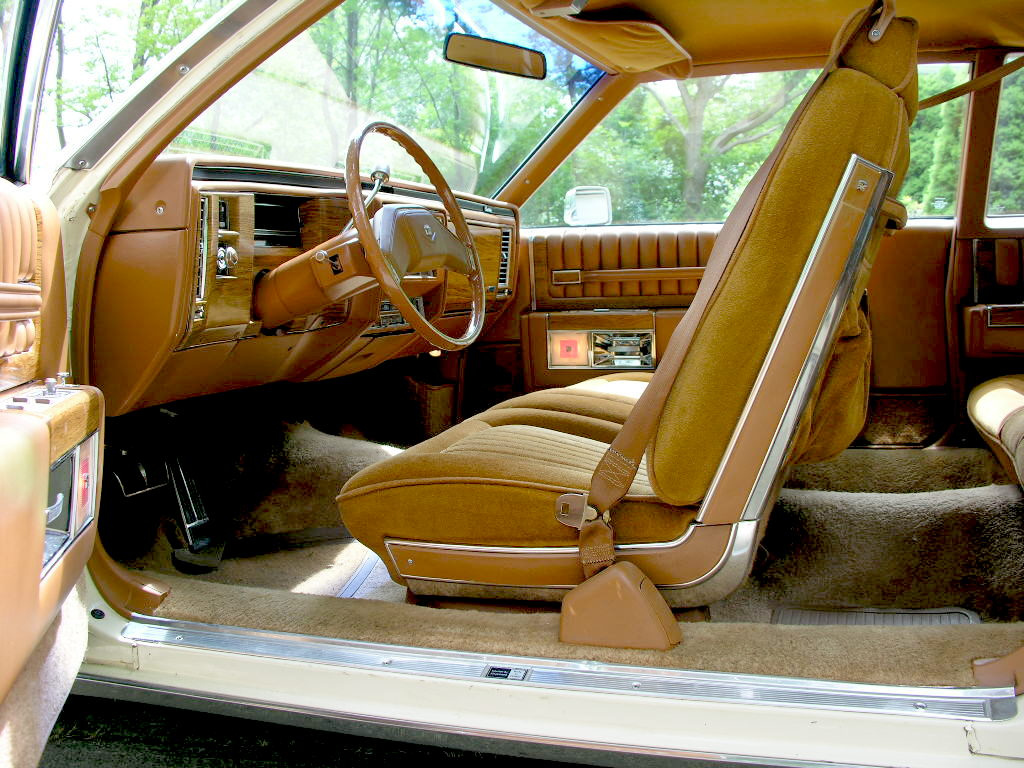
Cadillac de Ville photos 6
FAQ
How many generations of the Cadillac de Ville are there?
Eight, from 1959 to 2005: 1959–1960, 1961–1964, 1965–1970, 1971–1976, 1977–1984, 1985–1993, 1994–1999 and 2000–2005.
When did the de Ville switch to front-wheel drive?
With the 1985 model, introduced in April 1984. Both rear-drive and front-drive versions were on sale for a while.
What replaced the Cadillac de Ville?
The Cadillac DTS took over for the 2006 model year; the last de Ville was built in June 2005.
What engine problems does the de Ville have?
The 4.6-litre Northstar V8 of 1995–2005 is known for head-gasket failures caused by its head bolts; ask for proof of a repair.
What does "de Ville" mean?
It is French for "of the town", after the coupé de ville town carriage.
Data sources
Data checked by an editor against the sources below.