EU Tyre Label Explained: Fuel Efficiency, Wet Grip, Noise and Snow
The EU tyre label rates every new car tyre sold in the EU on three things: fuel efficiency (rolling resistance, classes A to E), wet grip (braking on wet roads, classes A to E) and external rolling noise (a decibel value plus classes A to C). Extra pictograms show whether the tyre is approved for severe snow or designed for ice, and a QR code links to the tyre's entry in the EU product database. The current label has applied since 1 May 2021 under Regulation (EU) 2020/740. The two classes that matter most are wet grip for safety and fuel efficiency for cost.
Key takeaways
- Wet grip: class A tyres can stop up to 18 metres shorter than class E from 80 km/h, according to DEKRA.
- Fuel efficiency: class A tyres can use up to 7.5 % less fuel than class E, about 0.5 l/100 km for a car using 6.6 l/100 km.
- Noise: class A is more than 3 dB below the EU limit; a 10 dB rise sounds about twice as loud.
- The label says nothing about dry grip, handling, aquaplaning or wear, so read independent tyre tests too.
What the EU tyre label shows
| Label element | What it tells you |
|---|---|
| QR code | Opens the tyre's entry in EPREL, the EU product database, with the label and product information sheet |
| Supplier and tyre type | Brand or trade name and the type designation |
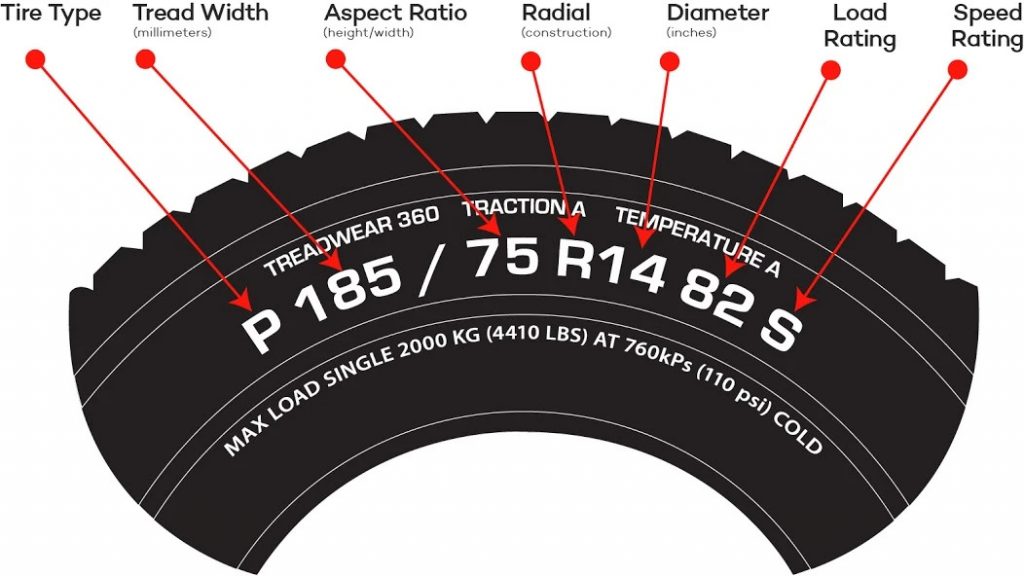
| Size, load index and speed rating | The tyre size with its load index and speed symbol |
| Fuel efficiency class | A (lowest rolling resistance) to E (highest) |
| Wet grip class | A (shortest wet braking) to E (longest) |
| External rolling noise | Value in dB(A) and a class from A to C |
| Snow grip pictogram | Shown if the tyre meets the severe snow requirements (3PMSF, three-peak mountain snowflake) |
| Ice grip pictogram | Shown if the tyre is designed for ice and compacted snow |
The regulation covers C1 tyres for cars, C2 tyres for light commercial vehicles and C3 tyres for trucks and buses. For tyre size, load index and speed rating, our tyre size calculator compares two sizes side by side.
The classes behind the letters
The letters are bands of measured values set in Annex I of the regulation. For car tyres (C1):
| Class | Fuel efficiency: rolling resistance coefficient (N/kN) | Wet grip index (G) |
|---|---|---|
| A | 6.5 or less | 1.55 or more |
| B | 6.6 to 7.7 | 1.40 to 1.54 |
| C | 7.8 to 9.0 | 1.25 to 1.39 |
| D | 9.1 to 10.5 | 1.10 to 1.24 |
| E | 10.6 or more | 1.09 or less |
A rolling resistance coefficient of 6.5 N/kN means the tyre needs 6.5 newtons of force to keep rolling for every kilonewton of load. The wet grip index compares the tyre's wet braking with a reference tyre: the higher the index, the better. Pirelli notes that rolling resistance is tested at 80 km/h and wet grip at 65 km/h.
What the classes mean on the road
Fuel efficiency and wet grip are where class differences turn into litres and metres:
| Comparison | Difference | Source |
|---|---|---|
| Fuel, class A vs class E | Up to 7.5 % less fuel; about 0.5 l/100 km for a car using 6.6 l/100 km | DEKRA, 2023 |
| Fuel, class A vs class E | About 6 litres less per 1,000 km | Pirelli |
| Share of fuel used to overcome rolling resistance | About 20 % | Pirelli |
| Wet braking from 80 km/h, class A vs class E | Up to 18 metres shorter | DEKRA, 2023 |
| Wet braking, class A vs class E | When the class A car has stopped, the class E car is still doing 50 km/h | DEKRA, 2023 |
The two fuel figures differ because they rest on different assumptions; treat them as a range rather than a promise.
A worked example. Take DEKRA's 0.5 l/100 km saving and a car driven 15,000 km a year: 15,000 ÷ 100 × 0.5 = 75 litres a year. If the tyres last four years, that is about 300 litres. Multiply by the fuel price where you live, or enter both consumption figures in the fuel cost calculator to get the difference in euros. A set of class E tyres that is cheap to buy can cost more over its life.
The wet grip difference matters even more. Eighteen metres is roughly four car lengths. On a wet road, that can decide whether you stop in time.
Noise classes and decibels
The noise class is set against the EU noise limit for that tyre size. DEKRA explains the bands:
- Class A: more than 3 dB below the limit.
- Class B: at the limit or up to 3 dB below it.
- Class C: meets the limit.
The dB(A) figure itself is more useful than the letter when comparing two tyres. Pirelli points out that just 3 dB separates the quietest class A tyres from class B, and DEKRA notes that an increase of 10 dB is perceived as about twice as loud. The value measures noise outside the car, which affects people near the road.
Snow and ice pictograms
The snow pictogram, a three-peak mountain with a snowflake (3PMSF), shows that the tyre meets minimum snow grip values set in UN Regulation No 117.
The ice grip pictogram is different. The regulation requires sellers to state that ice grip tyres are designed for ice and compacted snow and should be used only in very severe conditions. In milder weather they can perform sub-optimally on wet roads, in handling and in wear. For most drivers in central and western Europe, a 3PMSF tyre is the right winter choice, not an ice grip tyre. Our guide on how to choose winter tyres covers the selection in more detail.
What changed with the 2021 label
The EU tyre label was first introduced in 2012. The revised version, which took effect on 1 May 2021, changed several things:
| Specification | Label until April 2021 | Label from May 2021 |
|---|---|---|
| Fuel and wet grip scale | Classes A to G, with D unused | Classes A to E |
| Noise | dB value with a three-bar sound-wave symbol | dB value with classes A to C |
| Snow and ice | Not shown | Snow (3PMSF) and ice grip pictograms |
| Product data | Paper label only | QR code linking to the EPREL database |
When comparing old reviews with new tyres, do not read an old "C" as equal to a new "C": the bands were redrawn.
What the label does not tell you
DEKRA lists what the label leaves out: behaviour on dry roads, driving stability, steering precision and durability. German Wikipedia's summary adds aquaplaning and wear.
That is why it should be one input, not the whole decision:
- Start with wet grip. Choose class A or B for the tyres you drive on most in wet weather.
- Check fuel efficiency. Class A or B pays back over a long life, especially at high annual mileage.
- Compare the dB figure if road noise matters to you.
- Read independent tests from automobile clubs and tyre magazines for dry handling, aquaplaning and wear.
- Check pressures after fitting. DEKRA reminds drivers that low pressure raises rolling resistance and, if much too low, can shorten tyre life and destroy the tyre.
Dealers must show the label clearly where tyres are sold. The QR code or the EPREL database lets you check the data for any tyre type.
Try our calculator
Fuel cost calculatorTyre size calculatorFAQ
What is the most important class on the EU tyre label?
Wet grip, because it affects braking distance. DEKRA says class A tyres can stop up to 18 metres shorter than class E from 80 km/h on a wet road. Fuel efficiency comes second, as it affects running costs over the tyre's life.
How much fuel do class A tyres save?
Up to 7.5 % compared with class E, according to DEKRA, or about 0.5 l/100 km for a car using 6.6 l/100 km. At 15,000 km a year, that is about 75 litres a year.
What does 3PMSF mean on a tyre label?
It is the three-peak mountain snowflake symbol. It shows that the tyre meets minimum snow grip values under UN Regulation No 117 and is approved for severe snow conditions.
Is the tyre noise class important?
It matters if you care about road noise. Compare the decibel figure rather than the letter; DEKRA says a 10 dB rise is perceived as about twice as loud.
Which tyres do not need an EU label?
German Wikipedia lists retreaded tyres among the exemptions, along with racing tyres, spare-use tyres, studded tyres and tyres for vintage cars. For any new tyre type, check the label or the EPREL database.
Sources
- Regulation (EU) 2020/740 on the labelling of tyres, Annex I (classes) and Annex IV (promotional material) (accessed 23 Oct 2026)
- EUR-Lex: Regulation (EU) 2020/740 (dates of adoption and application) (accessed 23 Oct 2026)
- European Commission (DG Energy): What is the tyre label? (accessed 23 Oct 2026)
- DEKRA: EU tire label provides important information (March 2023) (accessed 23 Oct 2026)
- Pirelli: New European labelling for tyres, how the values are changing (accessed 23 Oct 2026)
- Pirelli UK: European tyre label (accessed 23 Oct 2026)
- Wikipedia (DE): Reifenlabel (accessed 23 Oct 2026)
Found a mistake? Report an error