Kia Picanto — Generations, Specs and History
The Kia Picanto is a small city car from Kia Motors — an A-segment model in European terms — built as a three- or five-door hatchback. It replaced the Pride in Kia's range, and three generations have appeared: the first in 2003 and the third, revealed in Europe on 16 February 2017. The first generation alone sold more than 1.1 million units in seven years.
Key takeaways
- Three generations: 2003, 2011 (TA, Geneva) and 2017 (JA).
- 1.0- and 1.2-litre petrol engines with 46–63 kW (62–85 PS); the first generation also offered a 1.1 diesel.
- Boot: 157 litres in the first generation, 200 litres in the second and 255 litres in the third (1,010 litres with the seats folded).
- The third generation is five-door only, with a sporty GT-Line version.
Kia Picanto at a glance
The Picanto is Kia's smallest model: easy to park, economical and well equipped for its class. Front-wheel drive, MacPherson front suspension and a torsion-beam rear axle are common to all generations. Other Kia models are in our Kia catalogue.
Kia Picanto generations
First generation (2003–2011)
The original Picanto was 3.49 m long, 1.59 m wide and 1.48 m tall — an upright, boxy shape with large headlights, a trapezoidal grille and tall vertical tail lights on either side of a big rear window. A 2007 update brought new lights, bumpers and grille, and in 2009 it received new bumpers, Kia's "tiger nose" grille and new wheels. Ground clearance is 145 mm.
The cabin is plain but cosy, practical and well assembled. The rear bench has three headrests but suits two, and the boot holds 157 litres. The updates brought a new steering wheel, an improved dashboard, new seats and new trim materials. Engines were a 1.0 and a 1.1 petrol with 46 and 47 kW (62 and 64 PS), plus a 1.1 diesel. 0–100 km/h took 16–17 seconds, top speed was 140–160 km/h and consumption 4–6 l/100 km, the diesel with a manual gearbox being the most economical.
Second generation: TA (2011–2017)
The TA was unveiled at the Geneva motor show in 2011 and updated in 2015. It grew slightly, with a small chrome upper grille, projector headlights with LED elements, round fog lamps, flared wheel arches and LED tail lights. Ground clearance is 152 mm, and base cars ride on 14-inch steel wheels.
The five-seat cabin does not feel cheap, unlike many A-segment cars. Heated fabric front seats were standard in many versions, the steering wheel carries audio controls and adjusts for height, and AUX and USB sockets are provided. The rear is best for two. The boot holds 200 litres, or 918 litres with the rear seats folded, with a space-saver spare under the floor.
Two petrol engines were offered: a 1.0 three-cylinder with 49 kW (66 PS) and 95 Nm (five-speed manual, 0–100 km/h in 14.6 seconds, 158 km/h, about 4.5 l/100 km) and a 1.2 Kappa four-cylinder with 63 kW (85 PS) and 121 Nm (four-speed automatic, 13.7 seconds, 163 km/h, up to 5.6 l/100 km). The TA uses the Hyundai i10 platform with high-strength steel in the body, electric power steering, ventilated front discs and rear drums. Higher trims had climate control, rear parking sensors, cruise control, side airbags, hill-start assist, alloy wheels, keyless entry and push-button start.
Third generation: JA (2017 onwards)
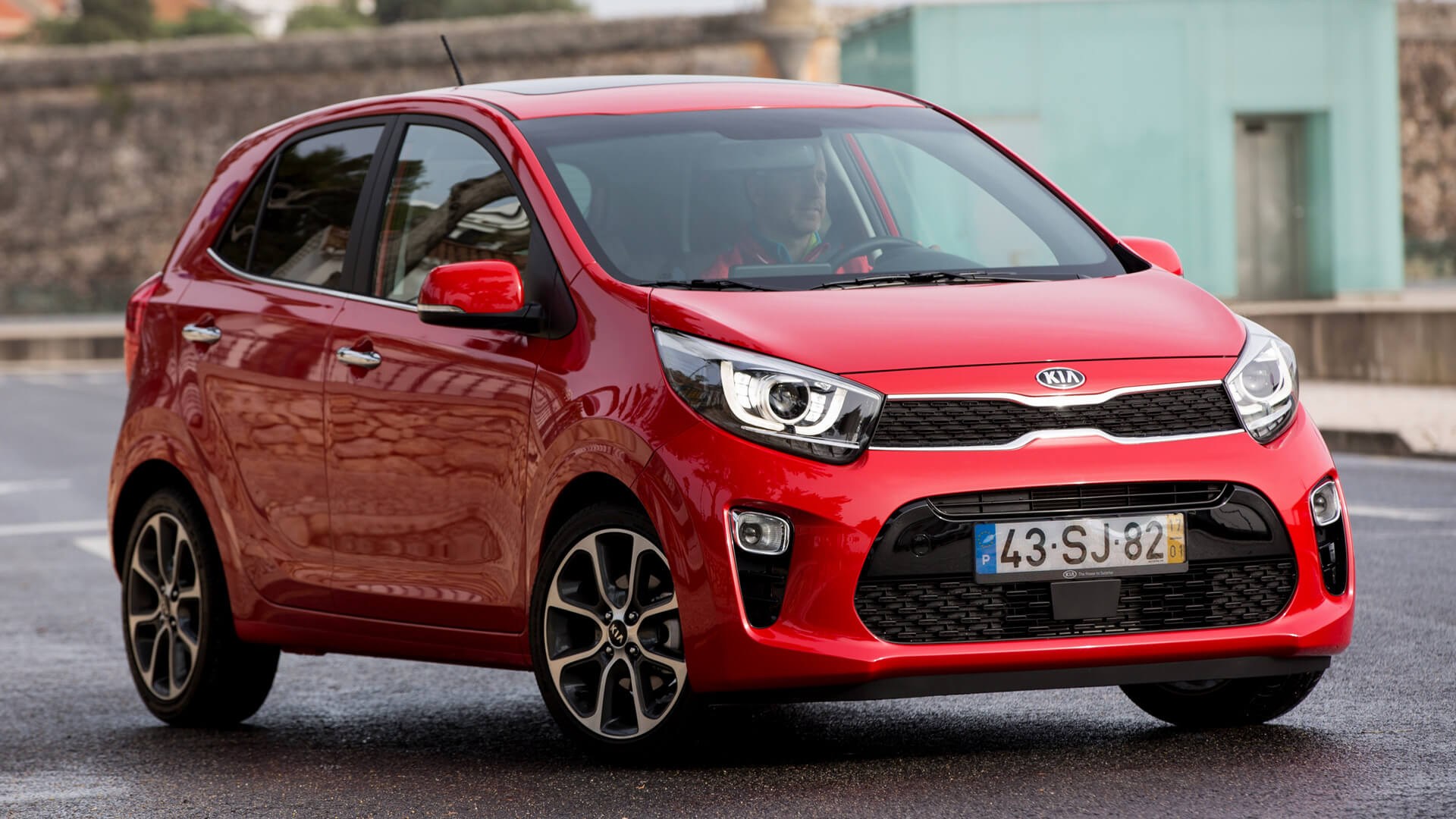
The third Picanto was fully presented in Europe on 16 February 2017. The three-door was dropped, and a sporty GT-Line joined the range. A large oval lower intake dominates the front, with a slim upper grille flowing into the headlights; the fog lamps sit in side intakes that also feed air to the brakes. Wheels range from 14-inch steel to 16- or 17-inch alloys, and ground clearance is 160 mm.
Materials are budget-grade, but the cabin looks attractive, centred on a 7-inch touchscreen. There is no centre armrest, and the steering wheel buttons are limited to phone and audio. The fabric seats are firm and lack side support. Two people sit comfortably in the back. The boot holds 255 litres, rising to 1,010 litres with the 60:40 rear seat folded, and a space-saver spare is fitted.
Engines and transmissions (third generation)
| Engine | Power (kW / PS) | Torque | Gearbox | 0–100 km/h | Top speed | Consumption |
|---|---|---|---|---|---|---|
| 1.0 MPI, three-cylinder, aluminium block | 49 kW / 67 PS | 96 Nm | 5-speed manual | 14.3 s | 161 km/h | 4.4 l/100 km |
| 1.2 MPI, four-cylinder | 62 kW / 84 PS | 122 Nm | 4-speed automatic | 13.7 s | 161 km/h | 5.4 l/100 km |
In Europe the range also included a 1.0 T-GDi turbocharged three-cylinder with 74 kW (100 PS). The new front-wheel-drive platform uses MacPherson struts at the front and a lightweight twist beam at the rear. High-strength steel makes up 44% of the body, with hot-stamped parts in key areas for crash strength and torsional stiffness. The steering has adaptive electric assistance; brakes are ventilated front discs and rear drums, with rear discs on more expensive versions.
Safety and equipment
The third Picanto offers front and side airbags, ABS, EBD, stability control (ESC), hill-start assist (HAC), rear parking assistance and tyre-pressure monitoring. Depending on version, equipment includes keyless entry, heated steering wheel and front seats, navigation and a multimedia touchscreen.
Key specifications by generation
| Parameter | 1st | 2nd (TA) | 3rd (JA) |
|---|---|---|---|
| Years | 2003–2011 | 2011–2017 | 2017 onwards |
| Bodies | 3- and 5-door | 3- and 5-door | 5-door |
| Power (kW / PS) | 46–47 kW / 62–64 PS (petrol) | 49–63 kW / 66–85 PS | 49–62 kW / 67–84 PS |
| Ground clearance | 145 mm | 152 mm | 160 mm |
| Boot | 157 l | 200 / 918 l | 255 / 1,010 l |
Strengths and weaknesses
Owners say the Picanto is at home in town: compact, good-looking and economical, with tidy handling, all the necessary electronic aids and a comfortable driving position with good visibility. The drawbacks are mediocre sound insulation, hard interior plastics, engines that are fine in town but short of power on the motorway, limited rear space and a firm ride. Rivals include the Hyundai i10, Toyota Aygo, Fiat Panda, Volkswagen up!, Renault Twingo and Suzuki Celerio.
FAQ
How many generations of the Kia Picanto are there?
Three: 2003, 2011 and 2017.
What engines does the Kia Picanto have?
The third generation has a 1.0 three-cylinder with 49 kW (67 PS) and a 1.2 four-cylinder with 62 kW (84 PS).
How big is the Kia Picanto boot?
255 litres in the third generation, or 1,010 litres with the rear seats folded.
What did the Kia Picanto replace?
It replaced the Kia Pride as the brand's smallest car.