Mazda 6: Generations, Specs and History
The Mazda 6 is Mazda's large family car - a D-segment model - and one of the most important cars in the Japanese company's range, serving for years as its flagship. It was also the first car to carry Mazda's "Zoom-Zoom" design philosophy. A direct descendant of the 626 (known in Japan as the Capella), it arrived in 2002, and by 2006 more than a million had been sold. Three generations followed: GG, GH and GJ, the last unveiled in August 2012, updated several times and built until 2024.
Key takeaways
- Three generations: GG (2002), GH (2007) and GJ (2012), offered as sedan, hatchback/liftback and wagon.
- The GG shared its platform with the Ford Mondeo; the GH used Mazda's own platform; the GJ rides on the SKYACTIV platform.
- Engines range from an 88 kW (120 PS) 1.8 to a turbocharged 2.5 with 170 kW (231 PS).
- The GJ earned five stars from Euro NCAP; owners mostly criticise noise insulation and thin paint.
Mazda 6 at a glance
All three generations are front-wheel drive with transverse four-cylinder engines (plus a V6 in some first-generation markets), and all have independent suspension at both ends. More models from the brand are listed in our Mazda catalogue, and the company's background is in the history of Mazda.
Mazda 6 generations
First generation: GG (2002–2007)
The GG was revealed in 2002 and shared its platform with the Ford Mondeo. It was updated two years later. The front has a raised bonnet whose lines frame a small grille with a thick chrome bar, and narrow headlights made up of round lamps; headlight washers were optional. Flared wheel arches house 15-inch wheels, and ground clearance is 150 mm. The rear lights are divided into four round sections. A known weak point is thin paint, so the body condition is the first thing to check on a used car.
The interior aged better than the exterior. It has thick front seats (leather on higher trims, fabric otherwise), a three-spoke steering wheel with audio and cruise-control buttons and an unusual instrument cluster of five overlapping round dials, with a trip computer in the speedometer. Higher trims have a pop-up navigation screen. The rear bench has a fold-down armrest. The sedan's boot holds 500 litres; the wagon's is only 5 litres larger with the seats up but grows to 1,710 litres with them folded.
Petrol engines are 16-valve DOHC four-cylinders with multi-point injection:
- 1.8: 88 kW (120 PS), 165 Nm - 0–100 km/h in 10.7 seconds (sedan and hatchback; 11.2 seconds for the wagon), 192–196 km/h, 7.7–8.3 l/100 km.
- 2.0: 104 kW (141 PS), 181 Nm - 9.7 seconds (sedan), 203–208 km/h, 8.0–8.2 l/100 km.
- 2.3: 122 kW (166 PS), 207 Nm - 8.9 seconds, 209–214 km/h, 8.9–9.1 l/100 km.
North American cars could have a 3.0-litre V6 with 162 kW (220 PS) and 260 Nm, sedan only. A 2.0-litre diesel was offered with 88 kW (120 PS) and 100 kW (136 PS) and up to 310 Nm. Gearboxes were a five-speed manual and a four-speed automatic before the update, and a six-speed manual and five-speed automatic afterwards. The suspension uses MacPherson struts at the front and an E-type multi-link rear axle; brakes are discs all round, and the steering has hydraulic assistance.
Second generation: GH (2007–2013)
The GH was unveiled at the Frankfurt motor show in September 2007 and, unlike its predecessor, was built on Mazda's own platform. It was offered as a sedan, a five-door hatchback and a wagon, received a light update around 2009–2010 and was replaced in 2013.
Its sporty shape still looks current. Narrow petal-shaped halogen headlights, strongly flared wheel arches, a sharp shoulder line and 16-inch alloys give it presence; ground clearance rose to 165 mm. The update brought a new bumper with a three-part lower section, round fog lamps in chrome surrounds and a small boot spoiler.
Inside, materials are good, the cabin is roomy and the front seats have light side support, although sound insulation trails some rivals. The leather steering wheel adjusts for height and reach, the instruments sit in four deep cowls, and a Bose audio system was available. The rear seat has adjustable headrests and a fold-down armrest. The sedan's boot holds 519 litres and the liftback's 510 litres, rising to 1,702 litres with the rear seats folded; a space-saver spare is fitted.
| Engine (GH) | Power (kW / PS) | Torque | Gearboxes | 0–100 km/h | Top speed |
|---|---|---|---|---|---|
| 1.8 | 88 kW / 120 PS | 165 Nm | 5-speed manual | 11.3–11.7 s | 194–200 km/h |
| 2.0 | 108 kW / 147 PS | 184 Nm | 6-speed manual, 5-speed automatic | 9.9–11.1 s | 198–214 km/h |
| 2.5 | 125 kW / 170 PS | 226 Nm | 6-speed manual | 8.0–8.3 s | 220 km/h |
The 1.8 uses about 6.8–7.0 l/100 km and the 2.5 about 8.1 l/100 km. The chassis has double wishbones at the front and a multi-link rear axle, electric power steering, disc brakes all round and ABS. Base cars came with front and side airbags, electric windows, ABS, ESP, air conditioning and 16-inch wheels.
Third generation: GJ (2012–2024)
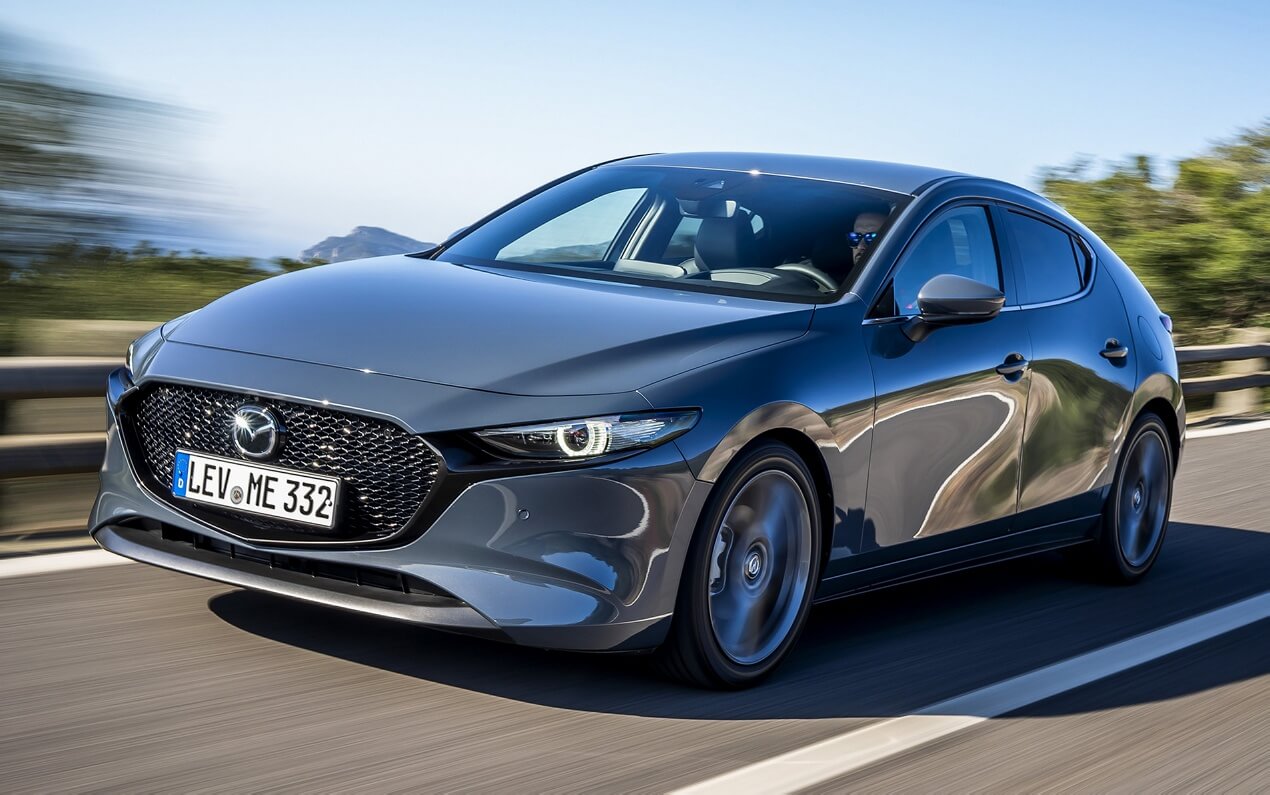
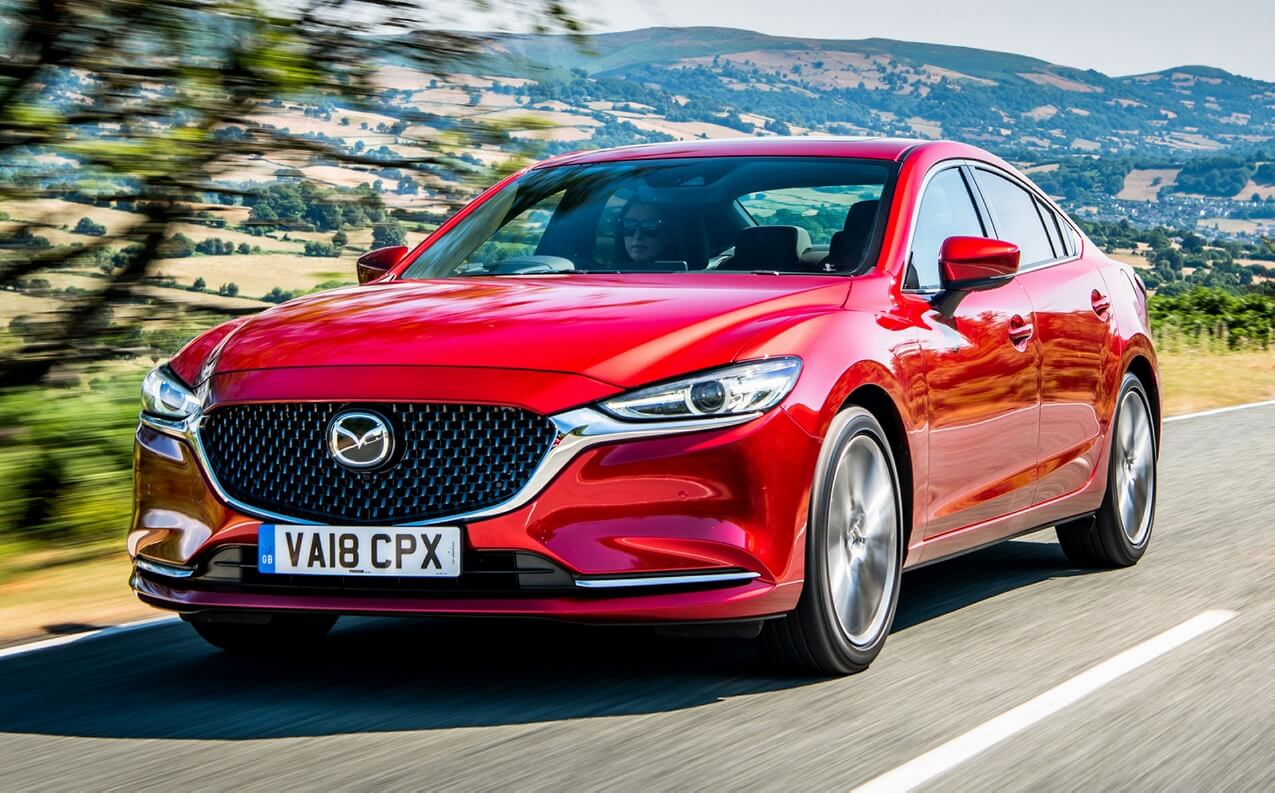
The GJ was unveiled in the second half of 2012, was updated roughly every two years and stayed in production until 2024. It is offered as a sedan and a wagon. Its "Kodo – Soul of Motion" design proved so successful that later updates changed it only in detail: narrow headlights with projector lenses and LEDs, a large grille underlined in chrome, LED fog lamps and pronounced wheel arches. Ground clearance is 165 mm. Ten paint colours, including Soul Red, Titanium Flash and Jet Black, and wheels of 17 to 19 inches are available.
The facelifted cabin, inspired by the Vision Coupe concept, looks and feels more upmarket. Higher trims have a 7-inch digital instrument display, genuine suede and Japanese ash trim, while all cars have an 8-inch infotainment screen. The front seats - electrically adjustable, heated and ventilated on higher trims - now use shock-absorbing mats instead of S-springs. Five adults fit comfortably, though the sloping roof limits rear headroom; rear passengers get their own vents, seat heating and an armrest. The sedan's boot holds 429 litres, the rear seat folds flat, and a full-size spare sits under the floor. Thicker metal in the wheel arches and better insulation materials reduce noise and vibration.
Engines and transmissions (GJ)
| Engine | Fuel | Power (kW / PS) | Torque |
|---|---|---|---|
| 2.0 SKYACTIV-G | Petrol, direct injection | 110 kW / 150 PS | 213 Nm |
| 2.5 SKYACTIV-G | Petrol, direct injection, variable valve timing | 143 kW / 194 PS | 258 Nm |
| 2.5 SKYACTIV-G turbo | Petrol | 170 kW / 231 PS | 400 Nm |
| 2.2 SKYACTIV-D | Diesel (Europe) | 110 kW / 150 PS or 129 kW / 175 PS | - |
The petrol engines are paired with a six-speed automatic and front-wheel drive; 0–100 km/h takes 7–10.5 seconds, top speed is 207–239 km/h and combined consumption 6.5–7.7 l/100 km. In Europe, a new-generation all-wheel-drive system became available after the update.
The SKYACTIV platform uses about 60% high-strength steel, MacPherson struts at the front, a four-link rear axle, electric power steering and disc brakes all round. G-Vectoring Control is standard: it adjusts engine output in response to steering input to keep the load on the tyres even when accelerating, braking and cornering.
Safety
The GJ received the maximum five stars in Euro NCAP tests. Depending on version it offers lane-departure warning, adaptive headlights, Smart City Brake Support, blind-spot monitoring, driver-fatigue detection, rear cross-traffic alert, autonomous emergency braking with pedestrian detection, a head-up display, a surround-view camera, front and rear parking sensors, adaptive cruise control, a full set of airbags, ISOFIX mounts and ABS, ESP and EBD. Higher trims add an 11-speaker Bose system, leather trim, 19-inch wheels and keyless entry.
Key specifications by generation
| Parameter | GG | GH | GJ |
|---|---|---|---|
| Years | 2002–2007 | 2007–2013 | 2012–2024 |
| Bodies | Sedan, hatchback, wagon | Sedan, hatchback, wagon | Sedan, wagon |
| Petrol power (kW / PS) | 88–162 kW / 120–220 PS | 88–125 kW / 120–170 PS | 110–170 kW / 150–231 PS |
| Ground clearance | 150 mm | 165 mm | 165 mm |
| Sedan boot | 500 l | 519 l | 429 l |
Strengths and weaknesses
Owners of the GJ praise its distinctive styling, Japanese build quality, excellent handling, a modern, high-quality cabin, a reasonably large boot and a high level of safety. The complaints are modest sound insulation, thin paint and, at times, limited ground clearance. Rivals include the Ford Mondeo, Honda Accord, Subaru Legacy, Toyota Camry, Hyundai Sonata, Kia Optima, Skoda Superb and Volkswagen Passat.
FAQ
How many generations of the Mazda 6 are there?
Three: GG (2002–2007), GH (2007–2013) and GJ (2012–2024).
What car did the Mazda 6 replace?
The Mazda 626, known in Japan as the Capella.
Is the Mazda 6 related to the Ford Mondeo?
The first generation (GG) shared its platform with the Ford Mondeo. Later generations use Mazda's own platforms.
What engines does the Mazda 6 GJ have?
SKYACTIV-G petrol engines of 2.0 litres (110 kW / 150 PS), 2.5 litres (143 kW / 194 PS) and 2.5 turbo (170 kW / 231 PS), plus a 2.2 SKYACTIV-D diesel with 110 or 129 kW (150 or 175 PS) in Europe.
How safe is the Mazda 6?
The third generation achieved the maximum five-star Euro NCAP rating.