
Subaru Levorg VM vs Subaru Crosstrek GU: specs side by side
Quick comparison from catalog data - no editorial review of this pair yet.

Subaru · 2014–2020
Levorg VM
Price from €29,990 (2015)
- Power
- 125 kW170 PS
- 0–100 km/h
- 8.9 s
- Top speed
- 210 km/h
- Kerb mass
- 1,537 kg

Subaru · 2022–present
Crosstrek GU
- Power
- 100 kW136 PS
- 0–100 km/h
- 10.8 s
- Top speed
- 198 km/h
- Kerb mass
- 1,612 kg
At a glance
Who suits what, worked out from the catalog figures of the versions above.
Categories won: Levorg VM 1 Crosstrek GU 2
- City Crosstrek GU Length: 4,495 mm vs 4,690 mm
- Performance Levorg VM Power per tonne: 81 kW/t vs 62 kW/t; 0–100 km/h: 8.9 s vs 10.8 s
- Off-road Crosstrek GU Drive and body: All-wheel drive · Crossover vs All-wheel drive · Station wagon
In plain words
Subaru Levorg VM is quicker: 0–100 km/h in 8.9 s against 10.8 s for Subaru Crosstrek GU. Subaru Levorg VM is 195 mm longer than Subaru Crosstrek GU (4,690 mm vs 4,495 mm). Subaru Levorg VM is lighter by 75 kg (1,537 kg vs 1,612 kg). Subaru Levorg VM is the older design (from 2014); Subaru Crosstrek GU arrived in 2022. Subaru Crosstrek GU is still in production; Subaru Levorg VM is not. On the catalog figures, the Subaru Crosstrek GU is the pick for city and off-road; the Subaru Levorg VM is the pick for performance.
Race Stats side by side
Each figure is a 0–100 score from the catalog numbers, the same as on the 1CARS Race cards. PI is the overall performance index (100–999) and its class D–S.
| Stat | Levorg VM | Crosstrek GU |
|---|---|---|
| PI | B · 534 | C · 471 |
| Power | 44 | 35 |
| Grip | 54 | 53 |
| Handling | 66 | 56 |
| Top speed | 42 | 38 |
| Launch | 37 | 28 |
Grip and handling are estimates from drive type, weight, height and body (hover a figure to see where it comes from). 1CARS Race
Who wins a race?
Quarter-mile (402 m) drag from a standing start, dry road, no reaction time - the 1CARS Race physics on the catalog figures of these versions.
- 1 Levorg VM1.6 DIT Lineartronic · petrol · 125 kW (170 PS) 16.29 sat 131 km/h
- 2 Crosstrek GU2.0ie e-Boxer · hybrid · 100 kW (136 PS) 17.30 sat 123 km/h · +1.01 s
Size and weight
Side view to scale, all cars from the front bumper.
| Levorg VM | Crosstrek GU | |
|---|---|---|
| Length | 4,690 mm184.6 in | 4,495 mm177.0 in −195 mm −7.7 in −4.2% |
| Width | 1,780 mm70.1 in | 1,800 mm70.9 in +20 mm +0.8 in +1.1% |
| Height | 1,485 mm58.5 in | 1,600 mm63.0 in +115 mm +4.5 in +7.7% |
| Wheelbase | 2,650 mm104.3 in | 2,670 mm105.1 in +20 mm +0.8 in +0.8% |
| Kerb weight | 1,537 kg3,389 lb | 1,612 kg3,554 lb +75 kg +165 lb +4.9% |
| Fits a standard garage? | Yes | Yes |
Difference vs Levorg VM (±). Garage check: a standard single garage takes a car up to about 5.0 m (16 ft 5 in) long and 1.9 m (6 ft 3 in) wide (width as listed in the catalog; some makers include the mirrors). Leave about 0.6 m (2 ft) to open the doors.
Full specifications
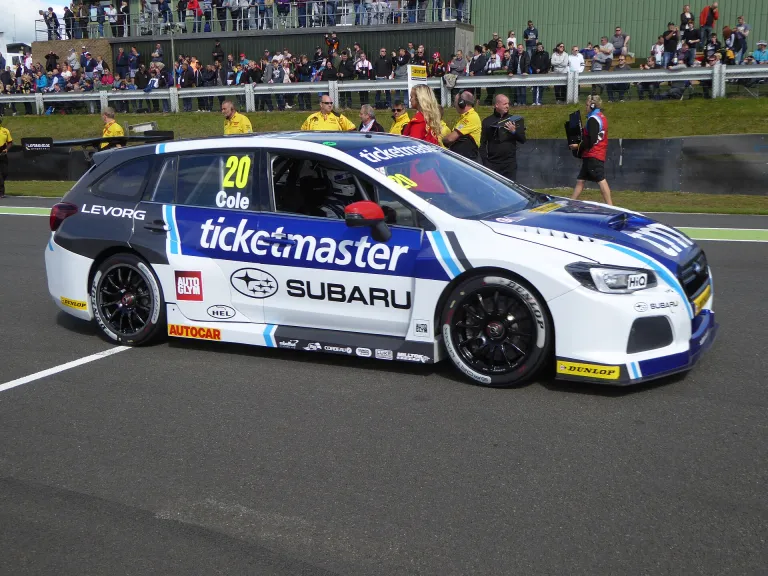
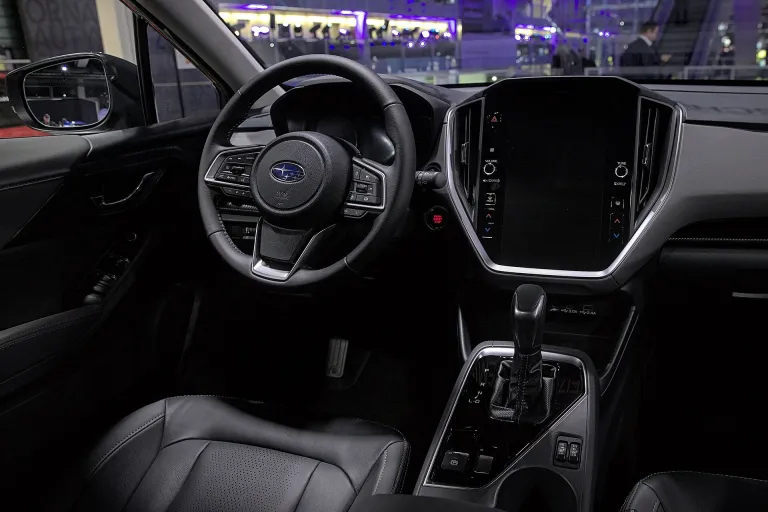
| Subaru Levorg VM | Subaru Crosstrek GU | |
|---|---|---|
| General | ||
| Version | 1.6 DIT Lineartronic · petrol · 125 kW (170 PS) | 2.0ie e-Boxer · hybrid · 100 kW (136 PS) |
| Production years | 2014–2020 | 2022–present |
| Body | Station wagon | Crossover |
| Class | D-segment (mid-size) | SUV / crossover |
| Country | Japan | Japan |
| Performance | ||
| Power Why it matters: More power means stronger acceleration and easier overtaking, especially with a full load. | 125 kW (170 PS) 168 hp Better | 100 kW (136 PS) 134 hp |
| Power, all versions | 110–221 kW (150–300 PS) 148–296 hp | 100–145 kW (136–197 PS) 134–194 hp |
| Torque Why it matters: Torque is the pulling force you feel when accelerating from low revs, towing or climbing hills. | 250 Nm 184 lb-ft Better | 182 Nm 134 lb-ft |
| 0–100 km/h Why it matters: A shorter 0–100 km/h time means quicker getaways and safer merging onto fast roads. | 8.9 s Better | 10.8 s |
| Top speed Why it matters: Top speed hints at how relaxed the car is at motorway speeds, even if you never reach it. | 210 km/h 130 mph Better | 198 km/h 123 mph |
| Power per tonne | 81 kW/t 99 hp/ton calculated Better | 62 kW/t 75 hp/ton calculated |
| Engine and transmission | ||
| Fuel | Petrol | Hybrid |
| Engine | 1,600 cc · 4 cyl 1.6 l | 4 cyl |
| Engine code | FB16 | No data |
| Gearbox | CVT | CVT |
| Drive | All-wheel drive | All-wheel drive |
| Dimensions and weight | ||
| Length | 4,690 mm 184.6 in | 4,495 mm 177.0 in |
| Width | 1,780 mm 70.1 in | 1,800 mm 70.9 in |
| Height | 1,485 mm 58.5 in | 1,600 mm 63.0 in |
| Wheelbase | 2,650 mm 104.3 in | 2,670 mm 105.1 in |
| Kerb weight Why it matters: A lighter car is usually more agile and uses less energy. | 1,537 kg 3,389 lb Better | 1,612 kg 3,554 lb |
| Boot Why it matters: A bigger boot fits more luggage, shopping or a pram. | No data | 315 l 11.1 cu ft |
| Fuel tank Why it matters: A larger tank means more distance between fuel stops. | No data | 48 l 12.7 gal US |
| Economy and running costs | ||
| Fuel consumption Why it matters: Lower consumption cuts running costs and CO₂ emissions on every trip. | No data | 7.7 l/100 km 30.5 mpg US |
| CO₂ | No data | 174 g/km |
| Fuel cost per year | No data | €2,020/year estimated |
| Range on a full tank | No data | 623 km 387 mi estimated |
| Safety | ||
| Euro NCAP | No data | ★★★★★ (2024) |
| Price | ||
| Price | from €29,990 (2015) | No data |
These cars do not differ in the data we have.
Equal rows hidden (3): Country, Gearbox, Drive.
Better marks the stronger figure - only for measurable specs (power, torque, 0–100 km/h, consumption, boot, weight).
Estimated at 15,000 km a year with fuel at €1.75/l petrol.