
Kia Rio UB vs Hyundai Solaris RB: specs side by side
Quick comparison from catalog data - no editorial review of this pair yet.

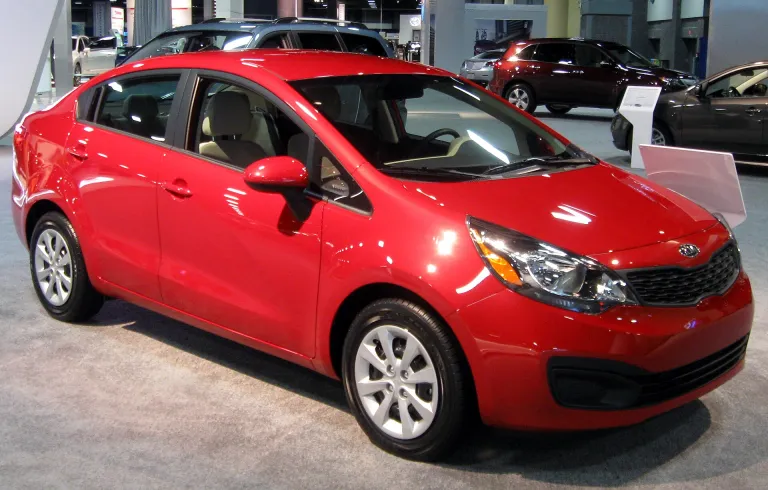
Kia · 2011–2017
Rio UB
- Power
- 79 kW107 PS
- Kerb mass
- 1,151 kg
Photo: IFCAR / Wikimedia Commons, Public domain

Hyundai · 2011–2017
Solaris RB
- Power
- 90 kW122 PS
- Kerb mass
- -
Photo: Retired electrician / Wikimedia Commons, CC0
At a glance
Who suits what, worked out from the catalog figures of the versions above.
- City Too close to call Length: 4,366 mm vs 4,370 mm
In plain words
Hyundai Solaris RB has more power: 90 kW (122 PS) against 79 kW (107 PS) for Kia Rio UB. Hyundai Solaris RB is 4 mm longer than Kia Rio UB (4,370 mm vs 4,366 mm). Our catalog has no kerb mass for the Hyundai Solaris RB yet, so some checks above leave it out.
Size and weight
Side view to scale, all cars from the front bumper.
| Rio UB | Solaris RB | |
|---|---|---|
| Length | 4,366 mm171.9 in | 4,370 mm172.0 in +4 mm +0.2 in +0.1% |
| Height | 1,455 mm57.3 in | 1,700 mm66.9 in +245 mm +9.6 in +16.8% |
| Wheelbase | 2,570 mm101.2 in | 2,570 mm101.2 in |
| Fits a standard garage? | Yes | No data |
Difference vs Rio UB (±). Garage check: a standard single garage takes a car up to about 5.0 m (16 ft 5 in) long and 1.9 m (6 ft 3 in) wide (width as listed in the catalog; some makers include the mirrors). Leave about 0.6 m (2 ft) to open the doors.
Full specifications

| Kia Rio UB | Hyundai Solaris RB | |
|---|---|---|
| General | ||
| Version | 79 kW (107 PS) | 1.6 · 90 kW (122 PS) |
| Production years | 2011–2017 | 2011–2017 |
| Body | Sedan | Sedan, Hatchback |
| Country | South Korea | South Korea |
| Performance | ||
| Power Why it matters: More power means stronger acceleration and easier overtaking, especially with a full load. | 79 kW (107 PS) 106 hp | 90 kW (122 PS) 121 hp Better |
| Power, all versions | 55–90 kW (75–122 PS) 74–121 hp | 79–90 kW (107–122 PS) 106–121 hp |
| Power per tonne | 69 kW/t 83 hp/ton calculated | No data |
| Engine and transmission | ||
| Fuel | Petrol | Petrol |
| Engine | No data | 1,600 cc · 4 cyl 1.6 l |
| Gearbox | 5-speed manual | No data |
| Drive | Front-wheel drive | No data |
| Dimensions and weight | ||
| Length | 4,366 mm 171.9 in | 4,370 mm 172.0 in |
| Width | 1,720 mm 67.7 in | No data |
| Height | 1,455 mm 57.3 in | 1,700 mm 66.9 in |
| Wheelbase | 2,570 mm 101.2 in | 2,570 mm 101.2 in |
| Kerb weight Why it matters: A lighter car is usually more agile and uses less energy. | 1,151 kg 2,538 lb | No data |
| Boot Why it matters: A bigger boot fits more luggage, shopping or a pram. | 500 l 17.7 cu ft | No data |
| Economy and running costs | ||
| Fuel consumption Why it matters: Lower consumption cuts running costs and CO₂ emissions on every trip. | No data | 5.0 l/100 km 47.0 mpg US |
| Fuel cost per year | No data | €1,310/year estimated |
| Safety | ||
| Euro NCAP | ★★★★★ (2011) | No data |
These cars do not differ in the data we have.
Equal rows hidden (4): Production years, Country, Fuel, Wheelbase.
Better marks the stronger figure - only for measurable specs (power, torque, 0–100 km/h, consumption, boot, weight).
Estimated at 15,000 km a year with fuel at €1.75/l petrol.