
SsangYong Rexton W vs Mitsubishi Pajero V80/V90: specs side by side
Quick comparison from catalog data - no editorial review of this pair yet.

SsangYong · 2012–2017
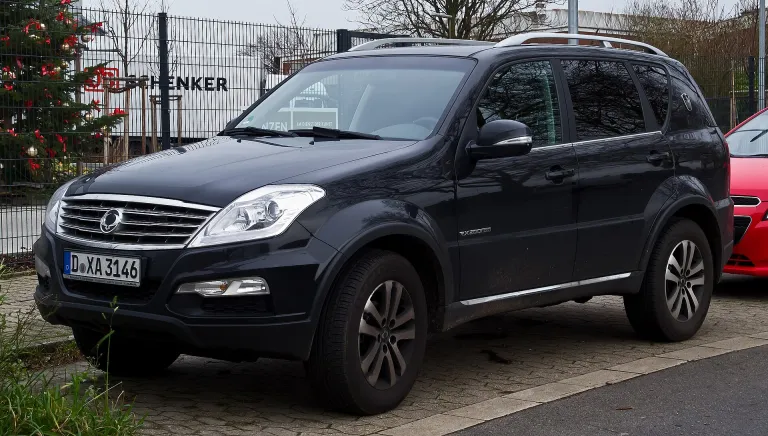
Rexton W
- Power
- 137 kW186 PS
- 0–100 km/h
- 11.3 s
- Kerb mass
- -
Photo: M 93 / Wikimedia Commons, CC BY-SA 3.0 de

Mitsubishi · 2006–2021
Pajero V80/V90
- Power
- 118 kW160 PS
- 0–100 km/h
- -
- Kerb mass
- 2,355 kg
Version spec sheet All generations
Photo: Dinkun Chen / Wikimedia Commons, CC BY-SA 4.0At a glance
Who suits what, worked out from the catalog figures of the versions above.
- City Rexton W Length: 4,755 mm vs 4,900 mm
In plain words
SsangYong Rexton W has more power: 137 kW (186 PS) against 118 kW (160 PS) for Mitsubishi Pajero V80/V90. Mitsubishi Pajero V80/V90 is 145 mm longer than SsangYong Rexton W (4,900 mm vs 4,755 mm). Mitsubishi Pajero V80/V90 is the older design (from 2006); SsangYong Rexton W arrived in 2012. On the catalog figures, the SsangYong Rexton W is the pick for city. Our catalog has no 0–100 km/h for the Mitsubishi Pajero V80/V90 yet, so some checks above leave it out.
Race Stats side by side
Each figure is a 0–100 score from the catalog numbers, the same as on the 1CARS Race cards. PI is the overall performance index (100–999) and its class D–S.
| Stat | Rexton W | Pajero V80/V90 |
|---|---|---|
| PI | C · 403 | D · 342 |
| Power | 31 | 29 |
| Grip | 35 | 21 |
| Handling | 52 | 29 |
| Top speed | 24 | 32 |
| Launch | 26 | 23 |
Grip and handling are estimates from drive type, weight, height and body (hover a figure to see where it comes from). 1CARS Race
Who wins a race?
Quarter-mile (402 m) drag from a standing start, dry road, no reaction time - the 1CARS Race physics on the catalog figures of these versions.
- 1 Rexton W137 kW (186 PS) 17.69 sat 121 km/h
- 2 Pajero V80/V903.2 DI-D diesel · 118 kW (160 PS) 18.06 sat 121 km/h · +0.37 s
Size and weight
Side view to scale, all cars from the front bumper.
| Rexton W | Pajero V80/V90 | |
|---|---|---|
| Length | 4,755 mm187.2 in | 4,900 mm192.9 in +145 mm +5.7 in +3.0% |
| Width | 1,900 mm74.8 in | 1,875 mm73.8 in −25 mm −1.0 in −1.3% |
| Height | 1,840 mm72.4 in | 1,890 mm74.4 in +50 mm +2.0 in +2.7% |
| Wheelbase | 2,835 mm111.6 in | 2,780 mm109.4 in −55 mm −2.2 in −1.9% |
| Fits a standard garage? | Tight | Tight |
Difference vs Rexton W (±). Garage check: a standard single garage takes a car up to about 5.0 m (16 ft 5 in) long and 1.9 m (6 ft 3 in) wide (width as listed in the catalog; some makers include the mirrors). Leave about 0.6 m (2 ft) to open the doors.
Full specifications

| SsangYong Rexton W | Mitsubishi Pajero V80/V90 | |
|---|---|---|
| General | ||
| Version | 137 kW (186 PS) | 3.2 DI-D diesel · 118 kW (160 PS) |
| Production years | 2012–2017 | 2006–2021 |
| Body | SUV | SUV |
| Class | SUV / crossover | SUV / crossover |
| Country | South Korea | Japan |
| Performance | ||
| Power Why it matters: More power means stronger acceleration and easier overtaking, especially with a full load. | 137 kW (186 PS) 184 hp Better | 118 kW (160 PS) 158 hp |
| Power, all versions | 137 kW (186 PS) 184 hp | 118–184 kW (160–250 PS) 158–247 hp |
| Torque Why it matters: Torque is the pulling force you feel when accelerating from low revs, towing or climbing hills. | No data | 381 Nm 281 lb-ft |
| 0–100 km/h Why it matters: A shorter 0–100 km/h time means quicker getaways and safer merging onto fast roads. | 11.3 s | No data |
| Power per tonne | No data | 50 kW/t 61 hp/ton calculated |
| Engine and transmission | ||
| Fuel | Diesel | Diesel |
| Engine | No data | 4 cyl |
| Gearbox | No data | 5-speed manual |
| Drive | No data | All-wheel drive |
| Dimensions and weight | ||
| Length | 4,755 mm 187.2 in | 4,900 mm 192.9 in |
| Width | 1,900 mm 74.8 in | 1,875 mm 73.8 in |
| Height | 1,840 mm 72.4 in | 1,890 mm 74.4 in |
| Wheelbase | 2,835 mm 111.6 in | 2,780 mm 109.4 in |
| Kerb weight Why it matters: A lighter car is usually more agile and uses less energy. | No data | 2,355 kg 5,192 lb |
| Boot Why it matters: A bigger boot fits more luggage, shopping or a pram. | No data | 663 l 23.4 cu ft |
| Economy and running costs | ||
| Fuel consumption Why it matters: Lower consumption cuts running costs and CO₂ emissions on every trip. | 7.6 l/100 km 30.9 mpg US | No data |
| Fuel cost per year | €1,880/year estimated | No data |
These cars do not differ in the data we have.
Equal rows hidden (3): Body, Class, Fuel.
Better marks the stronger figure - only for measurable specs (power, torque, 0–100 km/h, consumption, boot, weight).
Estimated at 15,000 km a year with fuel at €1.65/l diesel.