
Volkswagen Passat B8 vs Kia Optima: specs side by side
Quick comparison from catalog data - no editorial review of this pair yet.

Volkswagen · 2014–2023
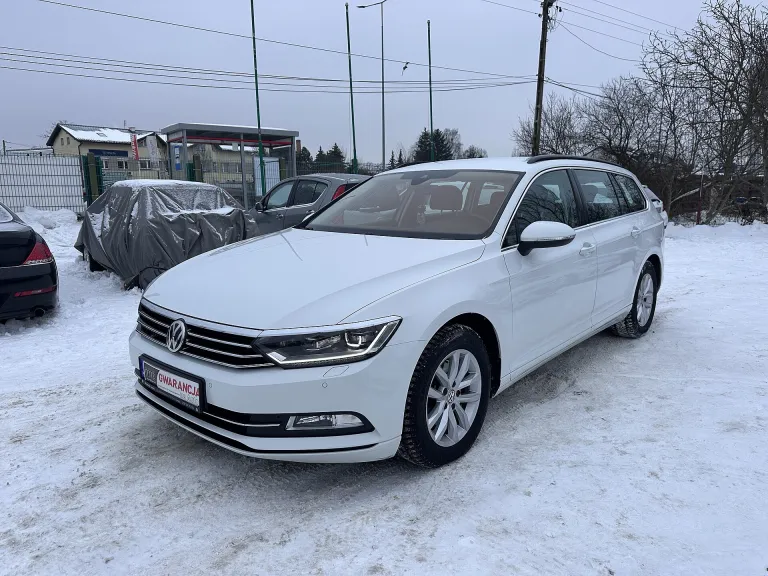
Passat B8
- Power
- 115 kW156 PS
Photo: Acgskup / Wikimedia Commons, CC BY 4.0

Kia · 2015–2020
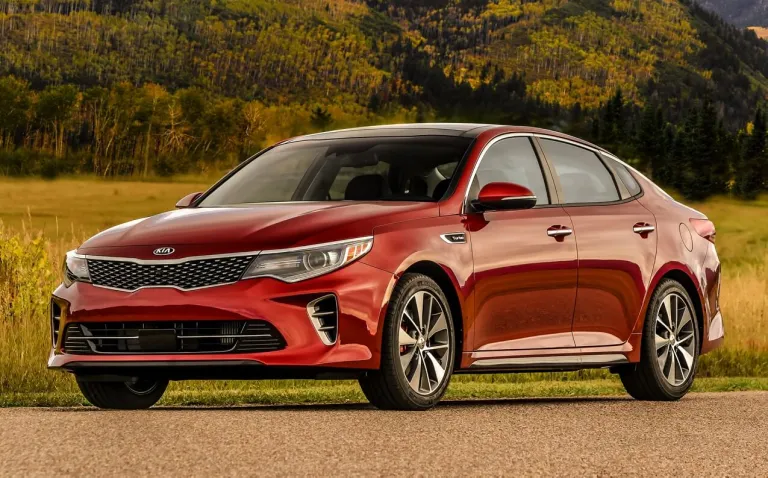
Optima
- Power
- 110 kW150 PS
At a glance
Who suits what, worked out from the catalog figures of the versions above.
Categories won: Passat B8 2 Optima 0
- Family Passat B8 Boot: 586 l vs 505 l
- City Passat B8 Width: 1,832 mm vs 1,860 mm
In plain words
Volkswagen Passat B8 has more power: 115 kW (156 PS) against 110 kW (150 PS) for Kia Optima. Kia Optima is 45 mm longer than Volkswagen Passat B8 (4,845 mm vs 4,800 mm). Volkswagen Passat B8 has the bigger boot: 586 l against 505 l. Volkswagen Passat B8 is the older design (from 2014); Kia Optima arrived in 2015. On the catalog figures, the Volkswagen Passat B8 is the pick for family and city.
Size and weight
Side view to scale, all cars from the front bumper.
| Passat B8 | Optima | |
|---|---|---|
| Length | 4,800 mm189.0 in | 4,845 mm190.7 in +45 mm +1.8 in +0.9% |
| Width | 1,832 mm72.1 in † | 1,860 mm73.2 in +28 mm +1.1 in +1.5% |
| Height | 1,456 mm57.3 in † | 1,455 mm57.3 in −1 mm −0.04 in −0.1% |
| Boot | 586 l20.7 cu ft † | 505 l17.8 cu ft −81 l −2.9 cu ft −13.8% |
| Fits a standard garage? | Yes | Tight |
Difference vs Passat B8 (±). Garage check: a standard single garage takes a car up to about 5.0 m (16 ft 5 in) long and 1.9 m (6 ft 3 in) wide (width as listed in the catalog; some makers include the mirrors). Leave about 0.6 m (2 ft) to open the doors. † from another version of this generation.
Full specifications
| Volkswagen Passat B8 | Kia Optima | |
|---|---|---|
| General | ||
| Version | 1.4 · plug-in hybrid · 115 kW (156 PS) | 2.0 · 110 kW (150 PS) |
| Production years | 2014–2023 | 2015–2020 |
| Body | Sedan, Station wagon | Sedan |
| Country | Germany | South Korea |
| Performance | ||
| Power Why it matters: More power means stronger acceleration and easier overtaking, especially with a full load. | 115 kW (156 PS) 154 hp Better | 110 kW (150 PS) 148 hp |
| Power, all versions | 81–206 kW (110–280 PS) 109–276 hp | 100–180 kW (136–245 PS) 134–241 hp |
| Engine and transmission | ||
| Fuel | Plug-in hybrid | No data |
| Engine | 1,400 cc 1.4 l | 2,000 cc · 4 cyl 2.0 l |
| Gearbox | No data | manual |
| Drive | Front-wheel drive | Front-wheel drive |
| Dimensions and weight | ||
| Length | 4,800 mm 189.0 in | 4,845 mm 190.7 in |
| Width | 1,832 mm 72.1 in † | 1,860 mm 73.2 in |
| Height | 1,456 mm 57.3 in † | 1,455 mm 57.3 in |
| Wheelbase | No data | 2,805 mm 110.4 in |
| Boot Why it matters: A bigger boot fits more luggage, shopping or a pram. | 586 l 20.7 cu ft † Better | 505 l 17.8 cu ft |
| Fuel tank Why it matters: A larger tank means more distance between fuel stops. | 66 l 17.4 gal US † | No data |
| Safety | ||
| Euro NCAP | ★★★★★ (2014) | ★★★★★ (2015) |
These cars do not differ in the data we have.
Equal rows hidden (1): Drive.
Better marks the stronger figure - only for measurable specs (power, torque, 0–100 km/h, consumption, boot, weight).
† from another version of this generation.