
Kia Ceed vs Peugeot 308 II: specs side by side
Quick comparison from catalog data - no editorial review of this pair yet.

Kia · 2012–2018
Ceed JD
- Power
- 74 kW101 PS
- Kerb mass
- 1,254 kg

Peugeot · 2013–2021
308 II
- Power
- 60 kW82 PS
- Kerb mass
- -
At a glance
Who suits what, worked out from the catalog figures of the versions above.
Categories won: Ceed JD 0 308 II 1
- Family 308 II Boot: 470 l vs 380 l
- City Too close to call Length: 4,310 mm vs 4,253 mm
In plain words
Kia Ceed has more power: 74 kW (101 PS) against 60 kW (82 PS) for Peugeot 308 II. Kia Ceed is 57 mm longer than Peugeot 308 II (4,310 mm vs 4,253 mm). Peugeot 308 II has the bigger boot: 470 l against 380 l. Kia Ceed is the older design (from 2006); Peugeot 308 II arrived in 2013. On the catalog figures, the Peugeot 308 II is the pick for family. Our catalog has no kerb mass for the Peugeot 308 II yet, so some checks above leave it out.
Size and weight
Side view to scale, all cars from the front bumper.
| Ceed JD | 308 II | |
|---|---|---|
| Length | 4,310 mm169.7 in | 4,253 mm167.4 in −57 mm −2.2 in −1.3% |
| Width | 1,780 mm70.1 in | 1,804 mm71.0 in +24 mm +0.9 in +1.3% |
| Height | 1,470 mm57.9 in | 1,457 mm57.4 in −13 mm −0.5 in −0.9% |
| Wheelbase | 2,650 mm104.3 in | 2,620 mm103.1 in −30 mm −1.2 in −1.1% |
| Boot | 380 l13.4 cu ft | 470 l16.6 cu ft +90 l +3.2 cu ft +23.7% |
| Fits a standard garage? | Yes | Yes |
Difference vs Ceed JD (±). Garage check: a standard single garage takes a car up to about 5.0 m (16 ft 5 in) long and 1.9 m (6 ft 3 in) wide (width as listed in the catalog; some makers include the mirrors). Leave about 0.6 m (2 ft) to open the doors.
Full specifications
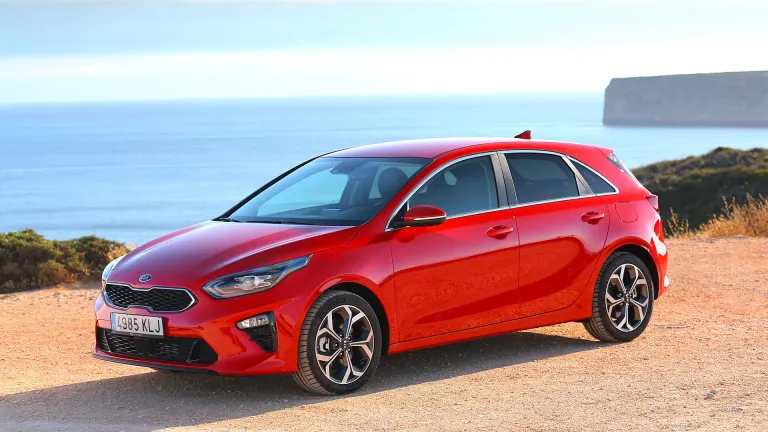
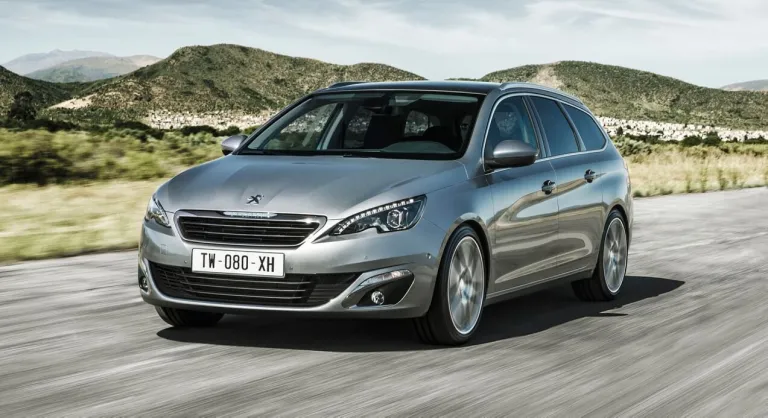
| Kia Ceed | Peugeot 308 II | |
|---|---|---|
| General | ||
| Version | Ceed JD · 74 kW (101 PS) | 1.2 · petrol · 60 kW (82 PS) |
| Production years | 2012–2018 | 2013–2021 |
| Body | Hatchback, Station wagon | Hatchback |
| Country | South Korea | France |
| Performance | ||
| Power Why it matters: More power means stronger acceleration and easier overtaking, especially with a full load. | 74 kW (101 PS) 99 hp Better | 60 kW (82 PS) 80 hp |
| Power, all versions | 66–150 kW (90–204 PS) 89–201 hp | 60–199 kW (82–271 PS) 80–267 hp |
| Torque Why it matters: Torque is the pulling force you feel when accelerating from low revs, towing or climbing hills. | 134 Nm 99 lb-ft | No data |
| Power per tonne | 59 kW/t 72 hp/ton calculated | No data |
| Engine and transmission | ||
| Fuel | Petrol | Petrol |
| Engine | No data | 1,200 cc · 3 cyl 1.2 l |
| Drive | Front-wheel drive | No data |
| Dimensions and weight | ||
| Length | 4,310 mm 169.7 in | 4,253 mm 167.4 in |
| Width | 1,780 mm 70.1 in | 1,804 mm 71.0 in |
| Height | 1,470 mm 57.9 in | 1,457 mm 57.4 in |
| Wheelbase | 2,650 mm 104.3 in | 2,620 mm 103.1 in |
| Kerb weight Why it matters: A lighter car is usually more agile and uses less energy. | 1,254 kg 2,765 lb | No data |
| Boot Why it matters: A bigger boot fits more luggage, shopping or a pram. | 380 l 13.4 cu ft | 470 l 16.6 cu ft Better |
| Safety | ||
| Euro NCAP | ★★★★★ (2012) | ★★★★★ (2013) |
These cars do not differ in the data we have.
Equal rows hidden (1): Fuel.
Better marks the stronger figure - only for measurable specs (power, torque, 0–100 km/h, consumption, boot, weight).