
GAZ-Ataman
Specs, engines and history
Updated Published Sources (2) Report an error
By Oleksandr Hnatiuk, Automotive Editor & Used Car Specialist Reviewed by Felix Hartmann

- Built
- 1996–2001
- Top power
- 110 kW (150 PS)
Who the Ataman suits: verdict
Our verdict · Oleksandr Hnatiuk
Today the Ataman is a curiosity for collectors of GAZ vehicles and off-road enthusiasts. Its strengths are a strong frame, permanent all-wheel drive with a locking centre differential, high ground clearance and a payload of about 800 kg. Its weaknesses are high fuel consumption, a basic cab, a heavy clutch and, above all, the rarity of its unique body parts. Many mechanical parts are shared with Volga saloons and GAZ light commercials such as the GAZ Sobol, which helps keep surviving cars running. Other models of the brand are in the GAZ catalogue.
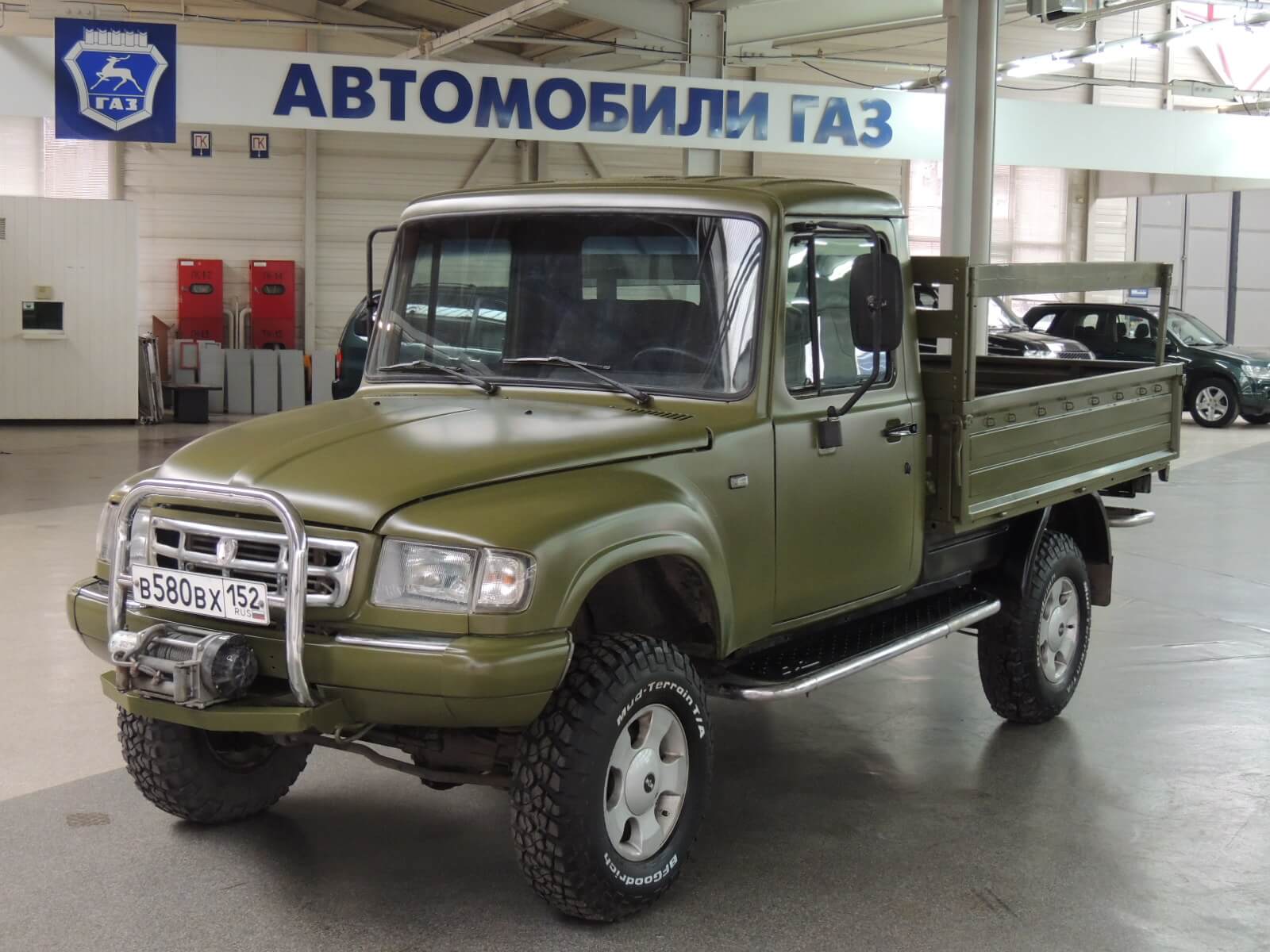
The GAZ-2308 Ataman is a four-wheel-drive pickup developed by GAZ in the mid-1990s on components of the Volga saloon and the plant's light trucks. Shown in 1996 and built in small numbers until about 2001, it had a separate frame, a 3,100 mm wheelbase and permanent all-wheel drive. Series production was approved for 2000 but cancelled, so only around 100 cars were made.
In short
- Development from 1995, public debut in 1996; small-series and prototype production from about 1995 to 2001.
- Versions: GAZ-2308 Ataman with permanent 4x4, GAZ-2309 with rear-wheel drive, and the GAZ-3106 Ataman-2 SUV.
- 3,100 mm wheelbase (300 mm more than the Volga saloon), 215 mm ground clearance, 16-inch wheels, payload about 800 kg.
- Petrol and diesel engines of about 74–110 kW (100–150 hp) were planned or fitted; a change of management in 2000 ended the project.

Specs by version
Engines
Dimensions and weight
Show all 3 versions
| Version | Wheelbase |
|---|---|
| Diesel · 1 version | |
| 81 kW (110 PS) | 3,100 mm122.0 in |
| Petrol · 1 version | |
| 2.5 110 kW (150 PS) | 3,100 mm122.0 in |
| Other · 1 version | |
| 2.9 74 kW (101 PS) | 3,100 mm122.0 in |
Verified Manufacturer and type-approval data from our catalog · Sources and methodology
GAZ Ataman at a glance
In the mid-1990s GAZ was looking for new uses for the production capacity of its Volga passenger-car line. Its engineers had already developed a light truck, the Burlak, on Volga components, and a pickup called the GAZ-2307 followed. The Ataman grew out of this work. It was a more robust pickup with its own frame, all-wheel drive and a higher stance, intended for buyers who needed an off-road work vehicle. Its unusual looks earned it many nicknames when it appeared. The wider story of the plant is in the history of GAZ.

| Fact | Value |
|---|---|
| Maker | GAZ (Gorkovsky Avtomobilny Zavod) |
| Model codes | GAZ-2308 (4x4), GAZ-2309 (4x2), GAZ-3106 Ataman-2 |
| Debut | 1996 (development from 1995) |
| Production | Prototypes and small series, about 1995–2001 |
| Units built | About 100 |
| Body | Pickup with three-seat cab; SUV for the Ataman-2 |
| Wheelbase | 3,100 mm |
| Ground clearance | 215 mm |
| Payload | About 800 kg |
How the Ataman was developed
The starting point was the Volga saloon of the time (the Volga generations comparison shows the family), the GAZ-3110 and its predecessors. To make a pickup, engineers lengthened the wheelbase by 300 mm, which required a longer propeller shaft and handbrake cables. They also reinforced the suspension and added a rear frame joined to the body's side members. This produced the GAZ-2307 pickup, a hybrid of the Volga's body base and a truck-style load area.

The Ataman went further. It received a full separate frame, its own cab and front end, all-wheel drive and a range of engines from the plant's cars and light trucks. The four-wheel-drive GAZ-2308 was the main version, and a rear-wheel-drive GAZ-2309 was built alongside it for buyers who did not need off-road ability. According to the old 1cars text, the Ataman-2, coded GAZ-3106, was developed in cooperation with an American engineering company and had a more modern, enclosed SUV body.
GAZ Ataman engines: a V8, petrol fours and a turbodiesel
The engine line-up changed during development, and the old 1cars text describes several combinations. The figures below are those it gives.

| Engine | Type | Power | Notes |
|---|---|---|---|
| V8 petrol | 4.25 l, from GAZ light trucks | about 74 kW (100 hp) | Early 4x4 Ataman |
| Four-cylinder petrol | 2.89 l | about 74 kW (100 hp) | Rear-wheel-drive version |
| Four-cylinder petrol | 2.5 l | up to about 110 kW (150 hp) | Later option |
| Four-cylinder turbodiesel | With intercooler | about 81 kW (110 hp) | Later option |
| GAZ-560 (Steyr licence) | Diesel | – | Planned for later versions |
With these engines the Ataman reached 120–140 km/h, depending on version. Fuel consumption was high, with about 15.8 l/100 km in town quoted for the petrol versions (the fuel cost calculator converts that into a cost per trip), a result of the vehicle's weight, size and the technology of the time. The clutch pedal was notably heavy.
Drivetrain, chassis and brakes
| Area | Design |
|---|---|
| Gearbox | 5-speed manual |
| Four-wheel drive (GAZ-2308) | Permanent, with a two-speed transfer case and lockable centre differential |
| Front suspension | Independent, wishbones with coil springs and anti-roll bar |
| Rear suspension | Rigid axle on leaf springs with anti-roll bar |
| Steering | Hydraulic power steering on all versions |
| Brakes | Discs at the front, drums at the rear; ABS on later GAZ-3106 cars |
| Wheels | 16-inch |
The all-wheel-drive version has two extra levers next to the gear lever: one for the low range and one for the centre differential lock. The old 1cars text describes a comparison on loose sand in which the rear-wheel-drive GAZ-2309 began to dig in, while the GAZ-2308 crossed without trouble and was even able to pull the 4x2 version out. Long-travel front springs and rear leaf springs gave a reasonably smooth ride while carrying about 800 kg.

Cab and interior
The three-seat cab of the pickups was spacious, with a large glass area and good visibility. Inside, the Ataman was a working vehicle: a separate driver's seat, a dashboard with much in common with GAZ's trucks, a large speedometer and a two-spoke steering wheel. Plastics were basic and the overall finish was spartan, closer to a light truck than to the Volga saloon whose parts it shared.

Ataman versions compared

| Version | Drive | Body | Status |
|---|---|---|---|
| GAZ-2307 | Rear-wheel drive | Pickup on the Volga body base | Predecessor, small batch |
| GAZ-2308 Ataman | Permanent 4x4 | Pickup with three-seat cab | Approved for series production for 2000, cancelled |
| GAZ-2309 | Rear-wheel drive | Pickup | Built alongside the 2308 |
| GAZ-3106 Ataman-2 | 4x4 | Enclosed SUV | Later development, ABS |
Why the Ataman never reached series production
The GAZ-2308 was the version cleared for series production, which was planned to start in 2000. In that year, however, GAZ came under new ownership and management, and the restructuring that followed cut many projects, the Ataman among them. Only about 100 experimental and pre-series cars had been built. Some were sold to private owners and are still in use, while others have disappeared. GAZ's later attempt at a modern passenger car, the Volga Siber, came from a very different direction: a licensed Chrysler design.

GAZ-Ataman photos 18


GAZ-Ataman videos 3

GAZ-Ataman video 1

Test drive

Video overview
FAQ
What is the GAZ Ataman?
The GAZ-2308 Ataman is a four-wheel-drive pickup developed by GAZ in the mid-1990s from Volga and light-truck components. It was shown in 1996, but only about 100 cars were built before the project was stopped.
Was the GAZ Ataman ever mass-produced?
No. Series production of the GAZ-2308 was approved for 2000, but a change of ownership and management at GAZ that year led to the project's cancellation. Only around 100 prototypes and pre-series cars were made.
What engines did the GAZ Ataman have?
Several were used or planned. The old 1cars text lists a 4.25-litre V8 and a 2.89-litre four, both of about 74 kW (100 hp), a 2.5-litre petrol engine of up to about 110 kW (150 hp) and a turbodiesel of about 81 kW (110 hp).
What is the difference between the GAZ-2308 and GAZ-2309?
The GAZ-2308 Ataman has permanent four-wheel drive with a two-speed transfer case and a lockable centre differential. The GAZ-2309 is the rear-wheel-drive version, intended for good roads and lighter use.
What is the GAZ-3106 Ataman-2?
The GAZ-3106 Ataman-2 is a later development of the Ataman with an enclosed SUV body instead of a pickup bed. It was developed with an American engineering partner, according to the old 1cars text, and later cars received ABS.
Data sources
Data checked by an editor against the sources below.
- The text of this article (1cars archive)
- Wikipedia - GAZ 2308


