
MAZ-541
Specs, engines and history
Updated Published Sources (2) Report an error
By Oleksandr Hnatiuk, Automotive Editor & Used Car Specialist Reviewed by Felix Hartmann

- Built
- 1956
- Top power
- 221 kW (300 PS)
Verdict: strengths, weaknesses and legacy
Our verdict · Oleksandr Hnatiuk
The MAZ-541 solved a real problem with simple means: weight for grip, a low body for a short tow bar and a second driving position for manoeuvring. It also showed why the solution did not last. As airliners grew, airports needed tugs that were even lower, more manoeuvrable and easier to drive. Modern aircraft tugs keep the same basic ideas of mass, low height and control in both directions, but in a much flatter form. Other vehicles of that decade appear among the 1950s classics. More heavy vehicles from the region are collected in the best Soviet trucks, and the rest of the range is in the MAZ catalogue.
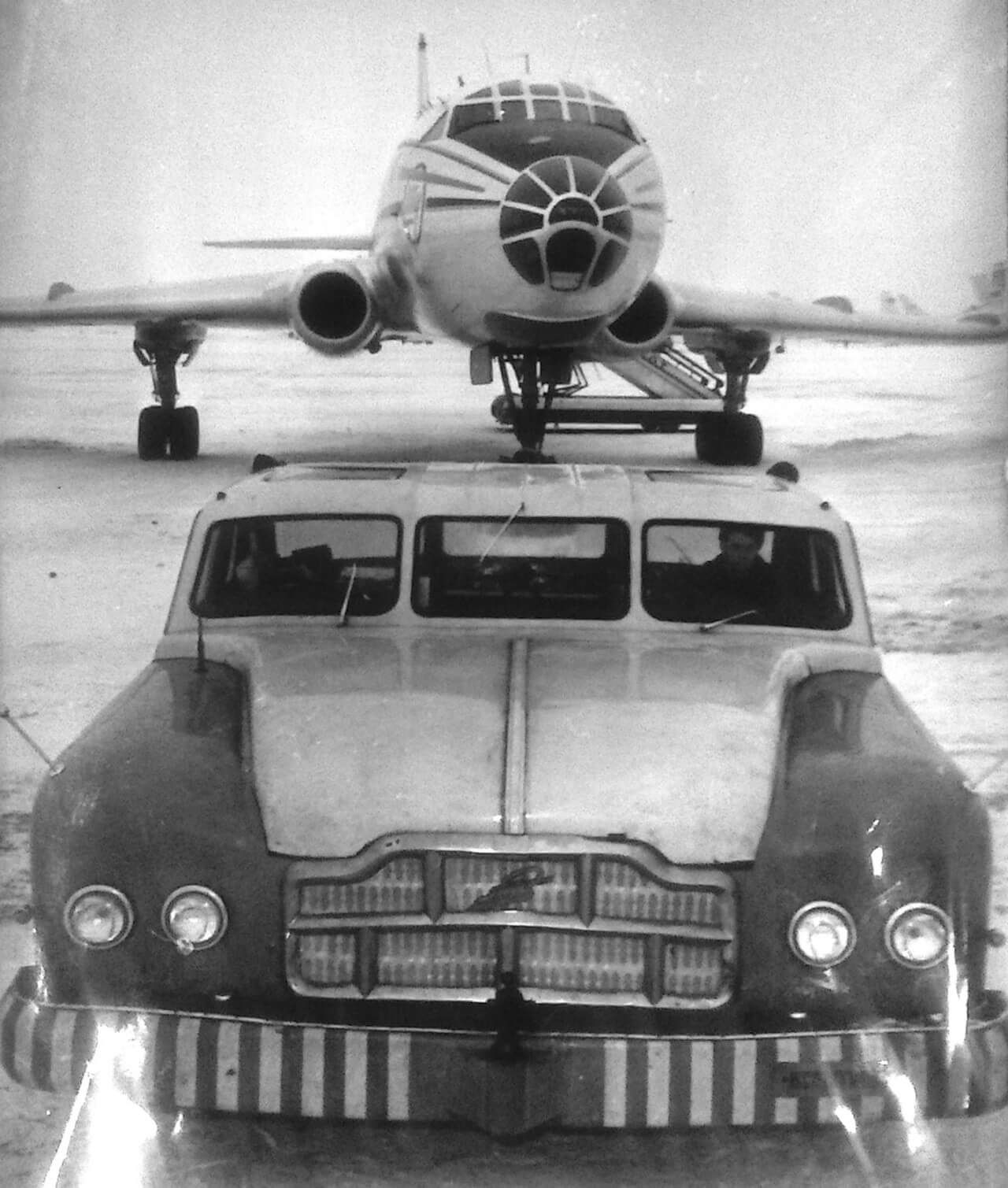
The MAZ-541 is an airfield tractor for towing large airliners, built by the Minsk Automobile Plant (MAZ) in 1956. Only three were made. It looks like an oversized four-door sedan, weighs about 28 tonnes and uses a 38.8-litre D-12A V12 diesel. Two steering positions let the driver tow an aircraft in either direction without turning round.
In short
- Built in 1956 by MAZ to tow airliners such as the Tu-104 and Tu-114; three units were completed.
- Engine: D-12A V12 diesel, 38.8 litres, derived from the V-2 tank engine; sources give 221 to 373 kW (300 to 500 hp).
- Kerb weight 28,230 kg, length 7,797 mm, width 3,400 mm, height 2,802 mm.
- Low body, two driving positions and a towing load of up to 85 tonnes; in service until about 1970.

Size at a glance
| Dimensions | MAZ-541 |
|---|---|
| Length | 7,797 mm307.0 in |
| Width | 3,400 mm133.9 in |
| Height | 2,802 mm110.3 in |
| Wheelbase | 3,403 mm134.0 in |
Specs by version
Engines
| Version | Engine | Power | Gearbox | Drive |
|---|---|---|---|---|
| 38.8 D12-A/B-2 221 kW (300 PS) Tractor unit | 38.8 l · 12 cyl · Diesel D12-A/B-2 | 221 kW 300 PS296 hp | 3-sp | All-wheel drive |
Performance
Show all 1 versions
| Version | Top speed |
|---|---|
| 38.8 D12-A/B-2 221 kW (300 PS) Tractor unit | 30 km/h19 mph |
Dimensions and weight
Show all 1 versions
| Version | Length | Width | Height | Wheelbase | Kerb weight |
|---|---|---|---|---|---|
| 38.8 D12-A/B-2 221 kW (300 PS) Tractor unit | 7,797 mm307.0 in | 3,400 mm133.9 in | 2,802 mm110.3 in | 3,403 mm134.0 in | 28,000 kg61,729 lb |
Verified Manufacturer and type-approval data from our catalog · Sources and methodology
MAZ-541 at a glance
| Fact | Value |
|---|---|
| Maker | Minsk Automobile Plant (MAZ), Belarus |
| Purpose | Airfield tractor (aircraft tug) |
| Built | 1956; three units |
| Body | Four-door, sedan-style steel body |
| Base | MAZ-525 dump truck components |
| Engine | D-12A V12 diesel, 38.8 l |
| Kerb weight | 28,230 kg |
| Towing load | Up to 85 t (rated) |
| Service | Until about 1970 |
The MAZ-541 is one of the most unusual vehicles in the history of the Minsk plant, better known for its trucks from the MAZ-200 to the MAZ-500. The plant's own story is told in the history of MAZ.
Why airports needed a new tractor
In the early 1950s Soviet airports moved aircraft with ordinary heavy trucks from MAZ and YaAZ. The arrival of jet and turboprop airliners such as the Tu-104 and the Tu-114 changed that, because these aircraft were far heavier than the piston types before them. The old 1cars text adds the Il-18 and Il-62 to the list of aircraft that pushed the limits of the existing tractors.

The airports first used the MAZ-535, a heavy tractor originally designed for military equipment. It had the power but sat too high. A tall tractor needs a long tow bar to reach the aircraft's nose gear, and a long tow bar makes manoeuvring slow and difficult. Drivers often had to stop, unhitch and reconnect to change direction, which delayed flights and raised the risk of damage on the apron. MAZ was asked to build a dedicated tug that was low, heavy and easy to steer in both directions.
Development and production in 1956
Work on the new tractor began in 1956, and the plant completed three units that year. The design reused parts from existing trucks to save time: the rear wheels and much of the running gear came from the MAZ-525 dump truck, the front wheels from the YaAZ-214, and the steering gear from the MAZ-535.

Reports on the production run differ. Most sources agree on three cars. Some mention 13, and the old 1cars text says that in 1976 the aviation ministry ordered another ten tractors for civil airports, which were not built. By then airliners had grown heavier again, and the needs of the airports had changed.
Design: a sedan-shaped tractor
The most striking feature of the MAZ-541 is its body. Instead of a truck cab, it has a closed, four-door steel body with a bonnet and a roof, so it looks like a giant sedan. Its colour scheme was orange with a white bonnet and roof, and bumpers in the same colours carried towing hitches at both ends. The MAZ badge sat on the front grille, with two pairs of headlights at the corners.

Inside there are two rows of bench seats. Only the front doors were used to get in; the rear doors served for technical access. The front and rear windows were split into three sections, and two hatches in the roof helped to ventilate the cabin. With its kerb weight of more than 28 tonnes, the MAZ-541 is often described as the heaviest sedan-style vehicle ever built.
Two driving positions
The MAZ-541 was built as low as possible so that a short tow bar could reach the aircraft. To make it easier to steer precisely in both directions, it has two driving positions, one facing forward and one facing the rear. The rear post was used to couple the tractor to the aircraft's nose gear with great accuracy. To reverse the direction of the tow, the driver simply moved to the other seat and drove away, without turning the tractor round.

D-12A V12 diesel engine
The engine is the D-12A, a 38.8-litre V12 diesel taken from the MAZ-525 dump truck. It belongs to the family of the V-2 tank diesel developed at the Kharkiv Locomotive Plant in the 1930s, the engine also used in the T-34 tank. According to the old 1cars text, the design began as an aircraft engine before it was adapted for tanks.

Sources disagree on its power output. The old 1cars text gives 221 kW (300 hp), while English-language sources report around 373 kW (500 hp). Without a factory document, the table lists both figures.
| Parameter | Value |
|---|---|
| Engine | D-12A, V12 diesel, 60° bank angle |
| Displacement | 38.8 l |
| Power | 221 kW (300 hp) in the old 1cars text; about 373 kW (500 hp) in other sources |
| Gearbox | Three forward speeds with an auxiliary two-speed box; several reverse speeds |
| Drive | 4x4, front axle could be disconnected |
| Top speed | About 30 km/h |
| Fuel consumption | About 130 l/100 km; about 45 l per hour of apron work |
The gearbox had a friction clutch built for frequent engagement under load. The old 1cars text lists three forward and three reverse gears, while other sources give two reverse speeds or a three-speed box with a two-speed auxiliary unit.
Chassis, wheels and specifications
The MAZ-541 uses wheels of two sizes: 15.00-20 tyres from the YaAZ-214 at the front and larger 17.00-32 tyres from the MAZ-525 at the rear. The bigger rear wheels gave more grip for pulling heavy aircraft. Both axles sat on leaf springs borrowed from the MAZ-525. The ride was hard, but softer springs would not have carried the tractor's own weight. The steering gear came from the MAZ-535 and had no hydraulic assistance, so steering a 28-tonne vehicle was hard physical work.

| Dimension | Value |
|---|---|
| Length | 7,797 mm |
| Width | 3,400 mm |
| Height | 2,802 mm |
| Wheelbase | 3,403 mm |
| Wheel formula | 4x4 |
| Front tyres | 15.00-20 (YaAZ-214) |
| Rear tyres | 17.00-32 (MAZ-525) |
| Kerb weight | 28,230 kg |
| Rated towing load | 85 t |
By our calculation, the tractor alone had about 7.8 kW per tonne on the lower power figure. Coupled to an 85-tonne airliner, the whole train of about 113 tonnes had less than 2 kW per tonne, which explains the walking-pace towing speeds. The power-to-weight calculator shows how this compares with ordinary trucks.
In service at the airport
The three tractors worked at Sheremetyevo airport and towed the airliners of the period to and from their stands. Their appearance made them famous well beyond aviation circles, and one appeared in promotional film of the Tu-144 supersonic airliner. They remained in use until about 1970, according to most sources; the old 1cars text puts the end of their service in the late 1970s. None of the three is known to survive.

| Year | Event |
|---|---|
| Before 1956 | Airports tow aircraft with ordinary trucks, then with tall heavy tractors |
| 1956 | Development starts; three MAZ-541 tractors built |
| About 1970 | Tractors leave service, according to most sources |
| 1976 | Ten more ordered for civil airports, not built (old 1cars text) |
| Strengths | Weaknesses |
|---|---|
| Low body allowed a short tow bar | Huge size and poor visibility |
| Two driving positions for precise coupling | No power steering |
| High weight gave strong traction | Very high fuel consumption |
| Rated for aircraft of up to 85 t | Hard ride on leaf springs |

MAZ-541 in our rankings
More powerful than 60% of ranked trucks in the 1CARS catalog (No. 21 of 56).
MAZ-541 photos 10

FAQ
What was the MAZ-541 used for?
It was an airfield tractor that towed large airliners such as the Tu-104 and Tu-114 between runways and stands. Its low body let it use a short tow bar, and two driving positions made coupling and towing in both directions easier.
How many MAZ-541 tractors were built?
Most sources say three, all built in 1956. Some mention 13, and a 1976 order for ten more tractors for civil airports was not carried out. None of the original tractors is known to survive.
How heavy was the MAZ-541?
The kerb weight was 28,230 kg, and some sources round it up to more than 30 tonnes. The weight gave the tractor enough traction to move aircraft of up to 85 tonnes, its rated towing load.
What engine did the MAZ-541 have?
It used the D-12A, a 38.8-litre V12 diesel from the MAZ-525 dump truck, related to the V-2 tank engine. Sources disagree on the output, giving figures between 221 kW (300 hp) and about 373 kW (500 hp).
Why does the MAZ-541 look like a sedan?
Instead of a truck cab, MAZ gave it a closed four-door body with a bonnet and roof, two rows of bench seats and roof hatches. The low, enclosed body kept the tractor as flat as possible for short tow bars.
Data sources
Data checked by an editor against the sources below.
- The text of this article (1cars archive)
- Wikipedia - MAZ 541


