Moskvich and AZLK: History, Landmark Models and Revival
Moskvich is a car brand founded in the Soviet Union, built by a plant that started around 1930 as KIM, became MZMA in 1945 and AZLK in 1968. Its first car, the 400 of 1946, was based on the pre-war Opel Kadett. The 407, 408 and 412 were exported across Europe, original production stopped in the early 2000s, and the name returned in 2022.

Key takeaways
- The plant changed names three times: KIM (around 1930), MZMA (August 1945) and AZLK (October 1968).
- The Moskvich 400 went into production in December 1946 and was based on the Opel Kadett K38.
- The 407 (1958) and 408 (1964) made Moskvich a Soviet export brand, and the 412 introduced an aluminium overhead-camshaft engine.
- Original production stopped around 2001–02; the brand was revived in 2022 with the Moskvich 3, a rebadged JAC Sehol X4.
Moskvich at a glance
Moskvich is a car brand from the Soviet Union (USSR) whose plant traded as KIM, MZMA, AZLK and finally OAO Moskvitch before bankruptcy, and which was relaunched in 2022 on the former site. Key facts as of October 2026:
| Fact | Value |
|---|---|
| Origins | Assembly plant begun around 1930, named KIM after the Young Communist International |
| Later names | MZMA (from August 1945), AZLK (from October 1968), OAO Moskvitch (from the early 1990s) |
| Country of origin | Soviet Union (USSR) |
| First Moskvich car | Moskvich 400, first built on 9 December 1946 |
| Best-known models | 400, 402, 407, 408, 412, 2140, 2141 Aleko |
| Total production | Over 5 million cars by the early 2000s |
| End of original production | Around 2001–02; bankruptcy declared in 2006 |
| Revival | Brand relaunched in 2022 with the Moskvich 3, based on the JAC Sehol X4 |
| Owner today | A municipal owner, after Renault sold its stake in May 2022 |

Origins: from KIM to MZMA
Moskvich grew out of the KIM assembly plant, built around 1930 and named after the Young Communist International. Its first work was assembling Ford Model A cars and Model AA trucks from Ford-licensed kits, the same licence that shaped the early vehicles of GAZ. In 1933 KIM became a branch of GAZ, whose GAZ-AA truck was itself a licensed Ford AA.
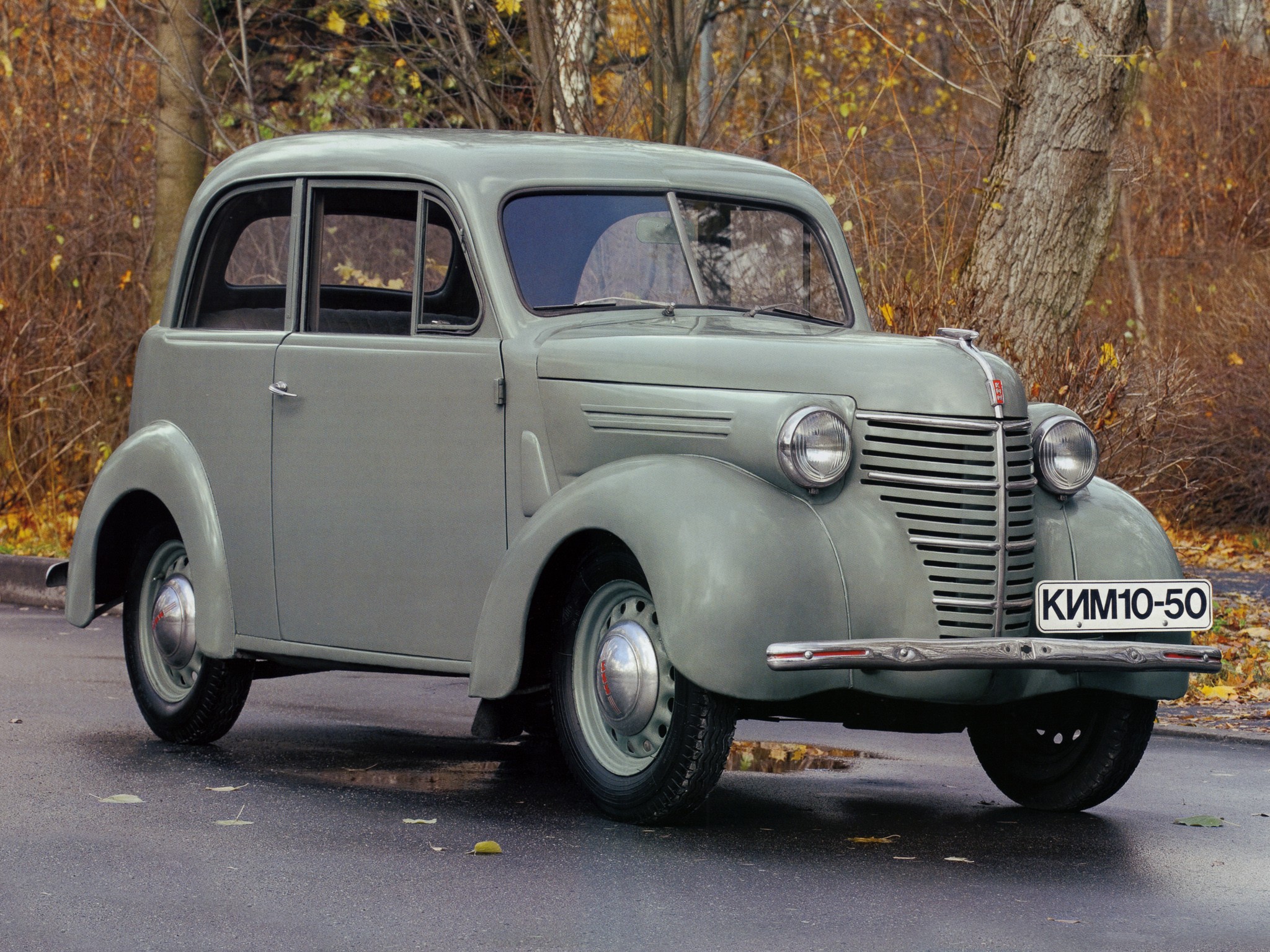
The plant's first small car was the KIM-10. Only 338 were built between November 1940 and April 1941, so it is a footnote rather than a production model. In August 1945 the plant was renamed MZMA, a factory for small cars, and given a new task: building a compact saloon for private owners.
1946–1963: the Kadett-based 400 and the first exports
The first car to carry the Moskvich name was the Moskvich 400, first built on 9 December 1946 and based on the pre-war Opel Kadett K38. Its tooling is reportedly reconstructed from Opel's, and an independent University of Illinois history page calls the car a replica of the Kadett. Mass production was approved on 28 April 1947.

The improved 401 followed in 1954, with its output usually quoted as 19 kW (26 PS) against the 400's 17 kW (23 PS). The two models together reached 247,439 cars before the saloon ended on 20 April 1956.
The 402 and 407: Moskvich's own designs
The 402 of 1956 was the first Moskvich not based on a foreign model. It brought independent front suspension with double wishbones and 12-volt electrics, and 94,080 were built, 18,019 of them for export. A four-wheel-drive version, the 410, was made in 1957–58.
The Moskvich 407 of 1958 brought a 1.36-litre (83 cu in) overhead-valve engine. It was built until October 1963, and 359,980 were made, 120,903 of them for export. English-language references call it the first truly successful Soviet export in the West. In Western Europe it was sold as the Elite, and from 1962–64 it was assembled in Belgium by Scaldia. The Moskvich 403, which followed it, ran until July 1965 and reached 133,523 cars.
1964–1975: the 408, the 412 and the export push
The Moskvich 408, launched in 1964, was a new saloon with a 1,357 cc (82.8 cu in) engine of 37 kW (50 PS). The 100,000th car was built on 20 August 1966, and 55% of the plant's 1968 output went abroad. From 1969 the car gained safety equipment that English-language references describe as a first for a Soviet car.

Exports reached the Eastern Bloc and Western countries such as Norway, Finland, France, Britain and Belgium. Two foreign partners assembled cars from kits: Scaldia in Belgium took the 408 from 1965, and Balkancar in Bulgaria built Rila-badged versions of the 408, 412, 2140 and 2141 between 1966 and 1990. On 18 May 1967 the plant built its one-millionth car, and in October 1968 MZMA was renamed AZLK, the Lenin Komsomol Automobile Plant.
The UZAM-412 engine
The Moskvich 412 of 1967 put a new engine into the 408 body. The UZAM-412, designed by Igor Okunev, is a 1,478 cc (90.2 cu in) inline four with an aluminium block, a single overhead camshaft and an output of 55 kW (75 PS). The first production engine was made on 15 March 1966 by UZAM, the engine plant that gave it its name.
AZLK built the 412 saloon until 1975, while IzhAvto built its own Izh-412 version from 1967 to 1982. In Britain the importer SATRA Motors sold the car, badged Moskvitch 1500 from 1974. By August 1974 the plant had reached two million cars.
Motorsport and engineering firsts
Long-distance rallies gave Moskvich its best documented international results. In the 1968 London–Sydney Marathon a 412 finished 20th, and in the 1970 London–Mexico World Cup Rally the best factory 412 finished 12th overall. The 412 is also credited with a 1-2-3 in the 1973 Avon Round Britain Rally and a class win in the 1973 Safari Rally, results recorded in one source family only.

The engineering firsts are the aluminium overhead-camshaft UZAM-412 and the 1969 safety upgrade of the 408 and 412. Claims of wins on the Monte Carlo or overall Safari results do not appear in the sources checked and are left out here.
1976–2002: the 2140, the Aleko and the end of AZLK
The Moskvich 2140 replaced the 412 in January 1976 and stayed in production until July 1988. It was a development of the 412 and kept its 1.5-litre engine of 55 kW (75 PS). A 1.36-litre version, the 2138, ran until 1982, and the better-equipped 2140 SL arrived in 1981. Export cars were badged 1500 and 1500 SL.

The 2141 Aleko changed the layout completely. Announced in 1985 and sold from 1986, it was a front-wheel-drive five-door hatchback, powered at first by the 1.5-litre UZAM-331.10 among other engines. Its shape is often compared with the Simca 1307; according to its designers, only the roof area was carried over. Later developments, the Svyatogor and the 2142 saloon family, were built between 1997 and 2002.
None of these later models reached the volume of the 408, 412 or 2140. After privatisation as OAO Moskvitch in the early 1990s, production stopped around 2001–02. The company filed for bankruptcy in 2002, was declared bankrupt in 2006 and was liquidated in 2007.
Ownership changes, plants and Renault
Moskvich passed from state plant to private company to bankruptcy, while part of its site was used by Renault from 1999 to 2022. Renault's link with the plant goes back to an agreement signed in 1966. In 1998 Renault and the city government set up the Avtoframos joint venture, which began assembling Renault cars in April 1999 on part of the former AZLK site. Renault became the sole owner at the end of 2012.

Renault sold its stake in the plant to the city administration in May 2022. The plant was then restarted under the Moskvich name. Throughout its history the brand also relied on foreign assembly, through Scaldia in Belgium and Balkancar in Bulgaria.
The revival since 2022
Moskvich has existed again as a brand since 2022, using Chinese-designed vehicles assembled on the former site. The new range was presented on 6 July 2022. Assembly of the Moskvich 3 from imported kits began on 23 November 2022, and the car went on sale on 26 December 2022.

The Moskvich 3 is a rebadged JAC Sehol X4, a compact crossover made by JAC in China. It has a 1.5-litre turbocharged petrol engine of about 110 kW (150 PS); the electric Moskvich 3e has 142 kW (193 PS), a 65.7 kWh battery and a claimed range of 410 km (255 mi). Further models are listed in reference sources, but their status could not be confirmed with manufacturer data as of October 2026.
Landmark models
Eight models trace the arc of Moskvich, from the Kadett-based 400 to the Chinese-based 3. The catalogue of all Moskvich models has specifications for each.
| Model | Years | Why it matters |
|---|---|---|
| 400 / 401 | 1946–1956 | First Moskvich, based on the Opel Kadett K38; 247,439 built |
| 402 | 1956–1958 | First own design; independent front suspension, 12-volt electrics |
| 407 | 1958–1963 | First major Western export; 359,980 built, 120,903 exported |
| 408 | 1964–1975 | New body, 55% of 1968 output exported, safety upgrade in 1969 |
| 412 | 1967–1975 (Izh-412 to 1982) | Aluminium UZAM-412 overhead-camshaft engine, rally results |
| 2140 | 1976–1988 | Main saloon for 12 years; exported as 1500 and 1500 SL |
| 2141 Aleko | From 1986 | First front-wheel-drive Moskvich, five-door hatchback |
| Moskvich 3 | 2022– | Revival model, rebadged JAC Sehol X4 |
Moskvich timeline
These are the dated milestones of the plant and the brand, from Ford kit assembly to the 2022 relaunch.
| Year | Event |
|---|---|
| c.1930 | KIM assembly plant begins work on Ford Model A and AA kits |
| 1933 | KIM becomes a branch of GAZ |
| 1940 | KIM-10 small car; 338 built to April 1941 |
| 1945 | Plant renamed MZMA in August |
| 1946 | First Moskvich 400 built on 9 December |
| 1956 | Moskvich 402, the first own design |
| 1958 | Moskvich 407 launched; exports to Western Europe grow |
| 1964 | Moskvich 408 launched |
| 1967 | Moskvich 412 enters production; one-millionth car on 18 May |
| 1968 | MZMA renamed AZLK in October |
| 1974 | Two-millionth car in August |
| 1976 | Moskvich 2140 replaces the 412 in January |
| 1986 | 2141 Aleko front-wheel-drive hatchback goes on sale |
| c.2001–02 | Original production stops; bankruptcy declared in 2006 |
| 2022 | Renault sells its stake in May; Moskvich 3 on sale in December |
Model line-up
The table lists the main production models of the original company and the revived brand; the post-2022 entries are as listed in October 2026.
| Model | Segment | Body | Years |
|---|---|---|---|
| 400 / 401 | Small family car | Saloon and derivatives | 1946–1956 |
| 402 / 403 / 407 | Small family car | Saloon, estate | 1956–1965 |
| 408 / 412 | Small family car | Saloon, estate, van | 1964–1975 |
| 2140 / 2138 | Small family car | Saloon, estate | 1976–1988 |
| 2141 Aleko | Small family car | Five-door hatchback | From 1986 |
| Svyatogor / 2142 | Small family car | Hatchback, saloon | 1997–2002 |
| Moskvich 3 / 3e | Compact crossover | SUV, petrol or electric | 2022– |
Moskvich in numbers
Moskvich production passed five million cars over about 55 years of original production. The key figures are below:
- One-millionth car: 18 May 1967.
- Two-millionth car: August 1974.
- Moskvich 400 and 401 together: 247,439 cars.
- Moskvich 402: 94,080 cars, 18,019 exported.
- Moskvich 407: 359,980 cars, 120,903 exported.
- Moskvich 403: 133,523 cars.
- Share of 1968 output exported: 55%.
- Total of the original company: over 5 million cars.
FAQ
When was Moskvich founded?
The plant behind Moskvich began around 1930 as the KIM assembly works, assembling Ford kits. It became MZMA in August 1945, and the first car bearing the Moskvich name, the 400, was built on 9 December 1946.
What does AZLK stand for?
AZLK is the abbreviation of the Lenin Komsomol Automobile Plant, the name the Moskvich factory took in October 1968. Before that it was called MZMA, and its first name, KIM, referred to the Young Communist International.
Was the Moskvich 400 a copy of the Opel Kadett?
Yes, the Moskvich 400 was based on the pre-war Opel Kadett K38. Its tooling is reportedly reconstructed from Opel equipment, and independent histories describe the car as a replica of the Kadett. The 402 of 1956 was the first Moskvich of its own design.
Did Renault own Moskvich?
Renault was linked to the plant rather than the original cars. From 1999 its Avtoframos joint venture used part of the former AZLK site, and Renault became its sole owner at the end of 2012. It sold its stake in the plant to the city administration in May 2022.
Is Moskvich still made?
Yes, under a revived brand. Original production stopped around 2001–02, and the old company was declared bankrupt in 2006. Since December 2022 the Moskvich 3, a rebadged JAC Sehol X4 assembled from kits, has been sold under the name.
What was the best-known Moskvich model?
The 407 is usually seen as the first Soviet car to sell successfully in the West, with 120,903 of 359,980 exported. The 412 is the best remembered for its aluminium UZAM-412 engine and its long-distance rally results.
Videos 2

Video 1

Video 2