Spyker History: From the Golden Coach to the C8 and the Saab Takeover
Spyker is a Dutch car brand with two lives. The original company, started by the Spijker brothers as coachbuilders in 1880, built cars from 1899 to 1926 and aircraft during the First World War. The modern Spyker Cars, founded in 1999 by Victor Muller and Maarten de Bruijn, revived the name for hand-built C8 and C12 supercars, bought Saab in 2010 and has since gone through several bankruptcies.
Key takeaways
- The original Spyker built the royal Golden Coach of the Netherlands (1898) and the 1903 Spyker 60 HP, an early four-wheel-drive racing car.
- Its motto "Nulla tenaci invia est via" and its wheel-and-propeller logo date from 1914–1915.
- The modern company sold about 290 cars from 2000 to 2010, with a peak of 94 in 2006.
- It took over Saab from GM early in 2010; Saab went bankrupt in December 2011.

Spyker at a glance
| Item | Original Spyker | Modern Spyker Cars |
|---|---|---|
| Years | 1880 (coachworks), cars 1899–1926 | founded 1999 |
| Founders | Jacobus and Hendrik-Jan Spijker | Victor Muller, Maarten de Bruijn |
| Base | Hilversum, then Trompenburg, Amsterdam | Zeewolde, Netherlands; briefly Coventry, England |
| Known for | Golden Coach, 60 HP four-wheel drive, C4 | C8 Spyder, C8 Laviolette, C12, C8 Preliator |
| Output | no more than about 2,000 vehicles | about 290 cars sold 2000–2010 |
The two companies have no direct link apart from the name, the motto and the logo, which the founders of Spyker Cars acquired.

The Spijker brothers: coachbuilders in Hilversum and Amsterdam
In 1880 the blacksmiths Jacobus and Hendrik-Jan Spijker opened a carriage-building and repair business in Hilversum, in the Netherlands. In 1898 they moved to Trompenburg in Amsterdam, and the same year they built the Golden Coach, which is still one of the two main ceremonial state coaches of the Netherlands' royal house.

The brothers began building cars in 1899. Their first models, shown in 1900, had two-cylinder engines of 3 and 5 hp and looked much like contemporary Benz cars. Four-cylinder models followed in 1903, and from 1905 most Spykers had a distinctive round radiator.
1903: the Spyker 60 HP and four-wheel drive
The most remarkable early Spyker was the 60 HP racing car of 1903. It had a six-cylinder engine and is credited as the first four-wheel-drive car powered by a single engine, the first with the engine at the front and drive to all four wheels, and the first with brakes on all four wheels. The six-cylinder engine was also an early example of that layout in a car.

In 1907 an 18 hp Spyker finished second in the 15,000 km Peking to Paris race, one of the longest car events of its time. That year also brought disaster: Hendrik-Jan Spijker died when the SS Berlin sank on his way back from England. His death led to the bankruptcy of the first company, and investors restarted production without Jacobus.
Aircraft, a new motto and the C4 (1914–1926)
After new financial problems in 1913, the company merged in 1914 with Dutch Aircraft Factory N.V. and adopted the Latin motto "Nulla tenaci invia est via", "for the tenacious, no road is impassable". In 1915 the new owners renamed the firm Trompenburg, and the logo combining a spoked wheel and an aircraft propeller dates from this period. Although the Netherlands stayed neutral in the First World War, the factory built about 100 fighter aircraft and 200 aircraft engines.

Car production resumed after the war. The C1 "Aerocoque" of 1919 was mainly a show car. On 27 November 1920 the first 30/40 HP C4 was completed, with a 5,742 cc six-cylinder Maybach engine; it was nicknamed "Tenax". In 1921–1922 a C4 covered 30,360 km in just over a month, improving the long-distance record by about 6,000 km, and in 1922 Selwyn Edge drove a streamlined C4 at Brooklands for a "Double 12" record of 2,868 km (1,782 miles).
The company went bankrupt again in 1922. Its British distributor bought it and renamed it Spyker Automobielfabriek, but sales kept falling. In 1926 the money ran out, and production of the C4 car and C2 truck ended. In total, the original Spyker built no more than about 2,000 vehicles.
Spyker Cars: the 1999 revival and the C8
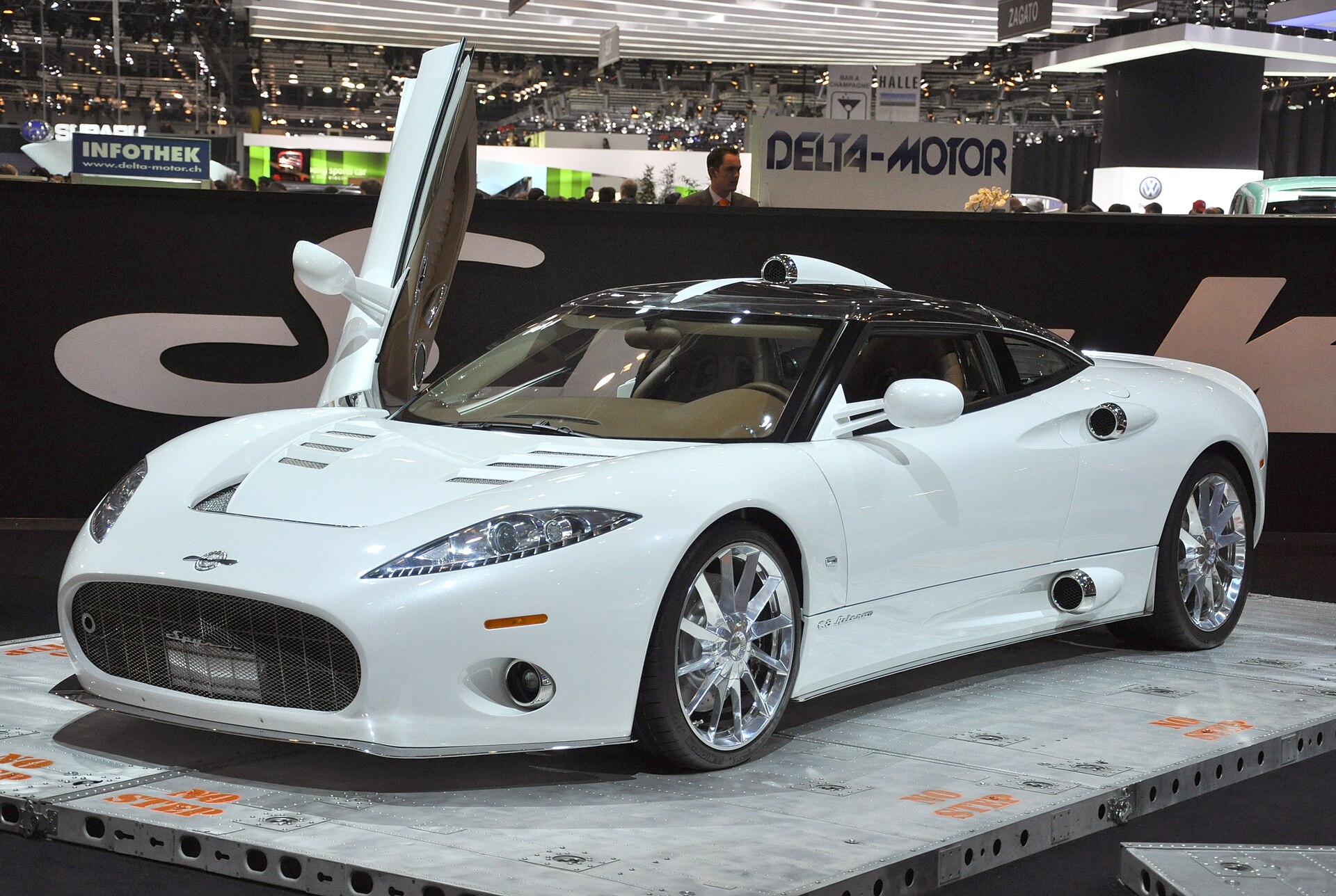
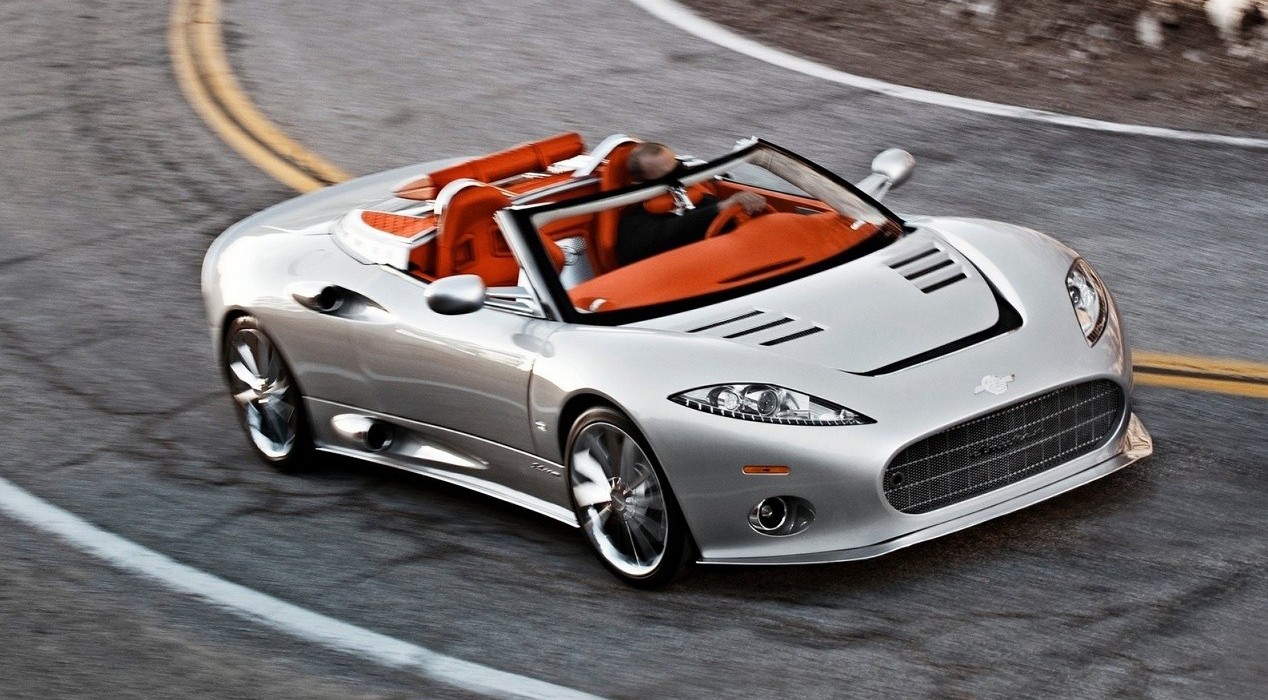
Spyker Cars was founded in 1999 by the entrepreneur Victor Muller and the designer Maarten de Bruijn. The old 1cars text dates the founding to the 19th century, mixing up the two companies. Production started in 2000 with the C8 Spyder and the closed C8 Laviolette, both powered by an Audi 4.2-litre V8 of about 298 kW (400 bhp). The cars used aluminium space frames and aircraft-inspired details such as propeller-style steering wheels and turned-aluminium dashboards.

| Model | Years | Engine | Power |
|---|---|---|---|
| C8 Spyder / Laviolette | from 2000 | Audi 4.2 V8 | about 298 kW (400 bhp) |
| C8 Double 12 S | 2002–2006 | Audi 4.2 V8, five stages | 298–462 kW (400–620 hp) |
| C8 Spyder T | 2003–2007 | 4.2 V8 twin-turbo, Cosworth | 391 kW (525 hp) |
| C12 La Turbie | 2006 | W12 | 373 kW (500 hp) |
| C12 Zagato | 2007 | W12 | about 373 kW (500 hp) |
| C8 Preliator | 2016 | Audi 4.2 V8 supercharged | 391 kW (525 hp) |
Compared with the C8 Spyder's 298 kW, the twin-turbo Spyder T had 93 kW more. It was developed with Cosworth in Britain and, according to the old text, reached 100 km/h in about 4 seconds. The C8 range is described in detail on our Spyker C8 and C8 Aileron pages.
Stock market, Formula 1 and the C12 (2004–2008)
Spyker listed on Euronext Amsterdam in 2004 at 15.50 euros per share. In 2005 de Bruijn left, and the Abu Dhabi investor Mubadala took a 17 % stake. The C12 La Turbie with a 373 kW (500 hp) W12 followed in 2006, and in 2007 Spyker and the Italian coachbuilder Zagato presented the C12 Zagato, the brand's most exclusive car of the period.

In September 2006 Spyker bought the Midland Formula 1 team for 106.6 million US dollars (about €84 million at the time). It raced as Spyker MF1 for the last three Grands Prix of 2006 and as Spyker F1, with Ferrari engines, in 2007. In September 2007 the team was sold to Vijay Mallya and Michiel Mol and became Force India from 2008. In October 2007 the C12 programme was cancelled, and the company's best sales year, 2006, remained at 94 cars.
The Saab takeover and its collapse (2009–2012)
In 2009 Spyker announced plans to move production to Whitley, Coventry, in England, but disagreements stopped the move. That year it also bid for Saab, after a deal between General Motors and Koenigsegg collapsed. On 26 January 2010 Spyker agreed to buy Saab for 74 million US dollars in cash plus 320 million dollars in Spyker shares, and the deal closed on 23 February 2010.
Saab never recovered its volume, and in June 2011 the parent company was renamed Swedish Automobile N.V. On 19 December 2011 Saab Automobile filed for bankruptcy; its assets later went to the Swedish company National Electric Vehicle Sweden (NEVS). In 2012 Spyker sued General Motors for 3 billion US dollars, claiming GM had blocked a rescue, but the claim was dismissed in 2013 and the appeal failed in October 2014. The Swedish side of the story is in our Saab history.
Bankruptcies and revivals since 2013
The company, named Spyker N.V. again, showed the B6 Venator concept at the Geneva Motor Show in March 2013, its first new model in four years. It could not finance production, and on 18 December 2014 a Dutch court declared Spyker bankrupt. The ruling was reversed on appeal on 29 January 2015, and the restructuring was completed on 29 July 2015. The old 1cars text adds that a merger with the American electric-aircraft start-up Volta Volare was planned at that time.

In March 2016 Spyker presented the C8 Preliator at Geneva, with a supercharged Audi 4.2 V8 of 391 kW (525 hp). Production remained very small, and in January 2021 the company filed for bankruptcy once more. In January 2022 Spyker announced a return to car building with new investors, but no series production followed. In August 2025 the bankruptcy trustee sold the trademark rights, and in October 2025 Muller and the trustee reached a final settlement.
Spyker timeline
| Year | Event |
|---|---|
| 1880 | Spijker brothers open a coachworks in Hilversum |
| 1898 | Move to Amsterdam; Golden Coach built |
| 1903 | Spyker 60 HP four-wheel-drive racer |
| 1907 | Second in the Peking to Paris race; Hendrik-Jan dies |
| 1914 | Merger with an aircraft maker; Latin motto adopted |
| 1926 | End of original car production |
| 1999 | Spyker Cars founded by Muller and de Bruijn |
| 2000 | C8 Spyder and Laviolette enter production |
| 2006 | Peak year, 94 cars; Midland F1 team bought |
| 2010 | Saab purchased from General Motors |
| 2011 | Saab bankruptcy |
| 2014–2015 | Spyker bankruptcy, reversed on appeal |
| 2021 | New bankruptcy |
| 2025 | Trademark rights sold by the trustee |
Collecting a Spyker: legacy of a small brand
Spyker's importance is out of proportion to its size. The 1903 60 HP was a technical milestone for four-wheel drive and four-wheel braking, and the modern C8 showed that a tiny Dutch company could build supercars with a strong design identity. The Saab episode, however, showed the risk of a niche maker taking on a mass-market manufacturer.
For collectors, early C8 Spyders and Laviolettes are rare: by the company's own figures, only about 290 cars were sold in the first decade, and by our calculation the 2006 peak of 94 cars alone made up about a third of that total. Buy one only with a full service history and a specialist inspection, since parts come from a company that no longer builds cars. Compare their outputs with other supercars in the 1cars supercars section or with the comparison tool, check power-to-weight with the 1cars calculator, and see every model in the Spyker brand catalogue.

FAQ
Is Spyker still in business?
Not as an active car maker, as of late 2025. After bankruptcies in 2014 and 2021, plans to restart production in 2022 did not lead to series cars. The trustee then sold the brand's trademark rights in August 2025.
Who founded Spyker?
The original Spyker was founded by the brothers Jacobus and Hendrik-Jan Spijker, coachbuilders who started in Hilversum in 1880. The modern company, Spyker Cars, was created in 1999 by Muller and de Bruijn, an entrepreneur and a car designer.
Did Spyker own Saab?
Yes. Spyker bought Saab from General Motors in February 2010 for 74 million US dollars in cash and 320 million dollars in shares. Saab went bankrupt in December 2011, and its assets passed to NEVS.
What does the Spyker logo mean?
The logo combines a spoked wheel with an aircraft propeller. It dates from around 1915, when the original company built both cars and aeroplanes, and was revived by Spyker Cars in 1999 with the old motto.
What engine does the Spyker C8 use?
Most C8 models use an Audi 4.2-litre V8. The C8 Spyder and Laviolette produced about 298 kW (400 bhp), the Cosworth twin-turbo C8 Spyder T 391 kW (525 hp), and the supercharged C8 Preliator of 2016 also 391 kW.