
GAZ-52
Specs, engines and history
Updated Published Sources (3) Report an error
By Oleksandr Hnatiuk, Automotive Editor & Used Car Specialist Reviewed by Felix Hartmann
- Built
- 1966–1989
- Top power
- 55 kW (75 PS)
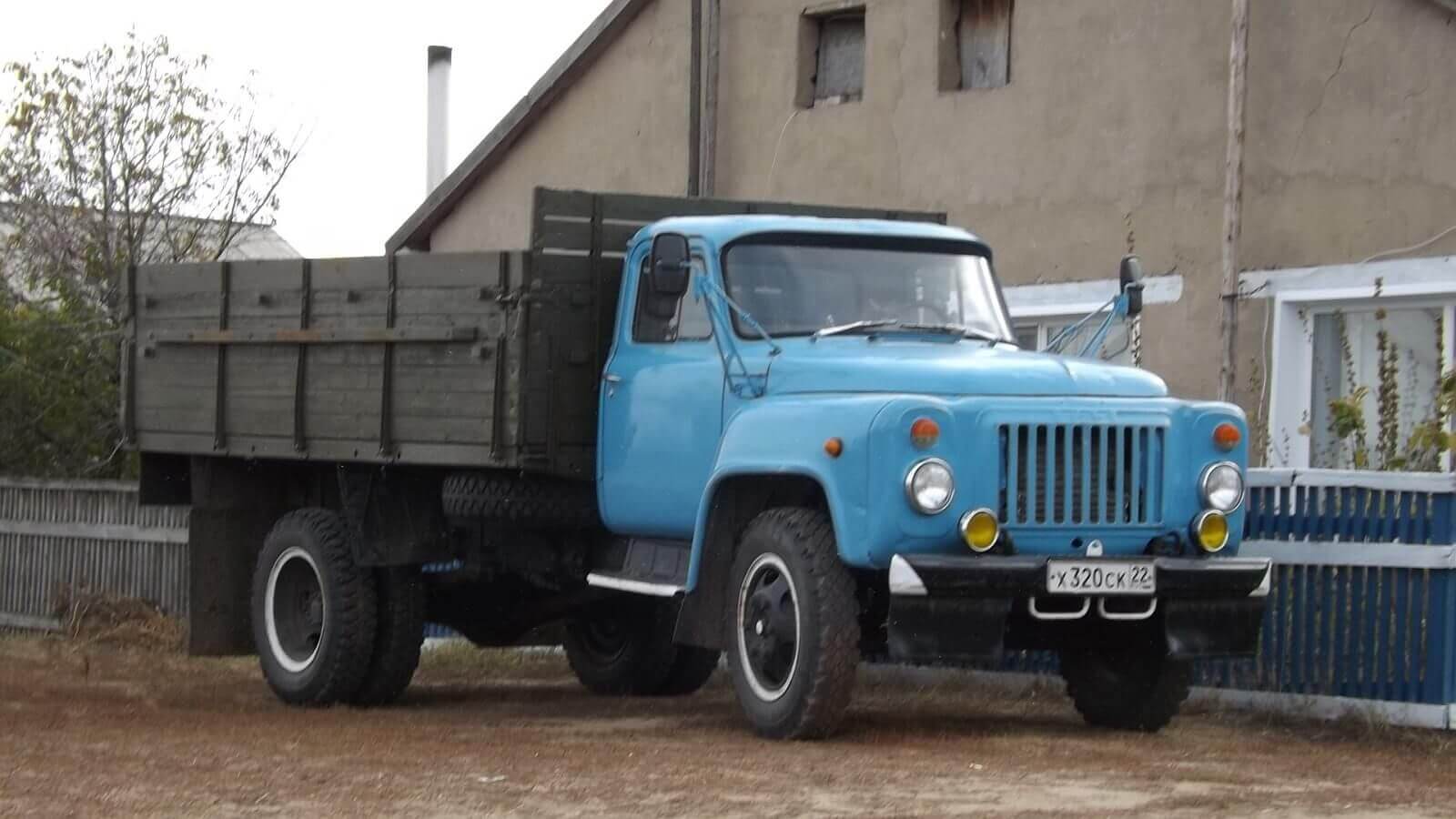
The GAZ-52 is a medium-duty 4×2 truck with a 2.5-tonne payload, built by the Gorky Automobile Plant (GAZ) in series from 1966 to 1989. More than one million were made. It shares its cab and most of its body with the V8 GAZ-53, but it has a 3.48-litre inline-six petrol engine with 55 kW (75 PS), which made it cheaper to run on light rural work.
In short
- Series production 1966–1989; prototypes date back to 1956 and a 300-truck pilot batch was built in 1958–1959.
- Engine: GAZ-52 inline-six petrol, 3.48 litres, 55 kW (75 PS), 206 Nm, with a four-speed manual gearbox.
- Payload 2,500 kg, gross weight 5,465 kg, top speed 70 km/h.
- Main versions: long-wheelbase 52-03 (1966–1973) and short-wheelbase 52-04 (1975–1989), plus LPG and natural-gas trucks.

Specs by version
Performance
Show all 1 versions
| Version | Fuel consumption |
|---|---|
| 3.4 55 kW (75 PS) Flatbed truck | 24.0 l/100 km9.8 mpg US · 11.8 mpg UK |
Verified Manufacturer and type-approval data from our catalog · Sources and methodology
GAZ-52 at a glance: the lighter half of a truck family
At the end of the 1950s GAZ planned a new family of bonneted trucks with one shared cab. The V8 GAZ-53 became the heavier model, rated first at 3.5 and later at 4 tonnes. The GAZ-52 was the lighter one, rated at 2.5 tonnes, the same as the GAZ-51 it eventually replaced. Its six-cylinder engine is the most reliable way to tell the two apart, because the bodies differ by only a few millimetres.

| Fact | Value |
|---|---|
| Maker | Gorky Automobile Plant (GAZ) |
| Series production | 1966–1989 |
| Total built | more than 1 million |
| Layout | Front engine, rear-wheel drive, 4×2 |
| Engine | 3.48 L inline-six petrol |
| Power | 55 kW (75 PS) |
| Payload | 2,500 kg |
| Successor | GAZ-3307 |
The GAZ-52 was built to carry goods in towns and on farms, where good roads were rare. That brief explains its high ground clearance of 265 mm, its simple leaf-spring suspension and its modest engine. The whole range of the maker is in the GAZ catalogue, and its background is in the history of GAZ.
From the 1956 prototype to series production
Development took ten years. The first truck called GAZ-52 appeared in 1956: a GAZ-51 chassis with a new cab and an experimental six-cylinder engine of 59 kW (80 PS). Only one was built. In 1958 the new cab arrived, styled after American trucks of the 1950s, and in 1958–1959 GAZ built a small series of 300 GAZ-52F trucks with the 3,300 mm wheelbase of the GAZ-51.

Several more prototypes followed between 1959 and 1964, including a tractor unit and a flatbed with a different engine. None of them went into production. The GAZ-53 was given priority and went into production in 1961, built alongside the old GAZ-51. Mass production of the GAZ-52 finally began in 1966 with the GAZ-52-03, which had the longer 3,700 mm wheelbase of the GAZ-53.
| Year | Event |
|---|---|
| 1956 | First GAZ-52 prototype on a GAZ-51 chassis |
| 1958 | New family cab; pilot series of 300 GAZ-52F trucks begins |
| 1959–1964 | Further prototypes, none produced |
| 1966 | Series production of the long-wheelbase GAZ-52-03 |
| 1973 | GAZ-52-03 ends |
| 1975 | GAZ-52-04 on a short chassis replaces the GAZ-51 |
| 1976–1977 | LPG versions 52-07, 52-08 and 52-09 |
| 1984 | Natural-gas GAZ-52-27 |
| 1989 | End of production; the GAZ-3307 takes over |
The shared GAZ cab and the flatbed
The all-metal, two-seat cab sits behind a long bonnet. Its curved one-piece windscreen gave a far wider view than the split, V-shaped glass of the GAZ-51. According to the old 1cars text, both door windows wind down and have swivelling quarter-lights, warm air from the heater can be blown onto the windscreen, and the dashboard carries a speedometer, fuel gauge, coolant temperature and oil pressure gauges and an ammeter. Instead of separate seats there is a bench, with storage for tools under the cushion.

The same source describes small changes over the years. Early trucks had one round mirror on a single bracket, which vibrated; it was replaced by a larger oval mirror on a triple bracket, and a right-hand mirror was added. Cabs were painted sand or khaki at first, then also in turquoise and light brown shades, and from 1978 in blue. In 1984 the grille slots were lengthened and the indicators moved to the sides.
The standard body is a wooden drop-side flatbed. A double-cab version was made by a conversion plant, and tipper bodies came from the SAZ tipper factory.
Engine and gearbox
| Parameter | Value |
|---|---|
| Engine | GAZ-52, four-stroke inline-six petrol |
| Displacement | 3,480 cc (212 cu in) |
| Bore × stroke | 82 × 110 mm |
| Compression ratio | 6.2:1 |
| Power | 55 kW (75 PS) |
| Torque | 206 Nm (152 lb-ft) |
| Fuel | Petrol, at least 72 octane |
| Gearbox | 4-speed manual, synchromesh on 3rd and 4th |
| Clutch | Single dry plate |
| Electrics | 12 V |
The engine is a development of the GAZ-51 six, with the same bore, stroke and 3.48-litre displacement. Its low compression ratio of 6.2:1 let it run on 72-octane petrol. The GAZ-52-04 of 1975 used a lightly revised version of the GAZ-51 engine. The old 1cars text links the first trucks of 1958–1959 to an experimental prechamber-torch ignition meant to save up to 20% of fuel; in tests it was hard to start and ran unevenly, and it did not last.

LPG versions could still run on petrol of 76 octane or more. In the 1990s some owners fitted diesel engines to their trucks to cut fuel costs, according to the old 1cars text.
GAZ-52-03 specifications in metric and imperial units
| Parameter | Metric | Imperial |
|---|---|---|
| Length | 6,395 mm | 251.8 in |
| Width | 2,380 mm | 93.7 in |
| Height | 2,190 mm | 86.2 in |
| Wheelbase | 3,700 mm (52-04: 3,300 mm) | 145.7 in (129.9 in) |
| Ground clearance | 265 mm | 10.4 in |
| Turning circle | 18.8 m | 61.7 ft |
| Kerb weight | 2,815 kg | 6,206 lb |
| Payload | 2,500 kg | 5,512 lb |
| Gross vehicle weight | 5,465 kg | 12,048 lb |
| Trailer load | 2,500 kg | 5,512 lb |
| Top speed | 70 km/h | 43 mph |
| Fuel use at 40 km/h | 21 l/100 km | 11.2 mpg US |
| Fuel tank | 90 l | 23.8 US gal |
| Braking distance from 50 km/h | 27 m | 88.6 ft |
Chassis: suspension, brakes and steering
Both axles are rigid and hang on longitudinal semi-elliptic leaf springs. The front has telescopic hydraulic dampers; the rear has main springs plus helper springs that start working under load. Later trucks mounted the spring ends in rubber cushions, which cut stress on the main leaves, according to the old 1cars text. The same source notes a rear axle with a cam-type limited-slip differential to help on muddy tracks.

The brakes are drums on all four wheels, with hydraulic operation and a hydro-vacuum servo. The steering uses a globoid worm with a double roller and has no power assistance, so the truck is heavy to turn at low speed.
GAZ-52 versions: from the 52-03 to gas-powered trucks
| Variant | Years | Body / purpose | Engine | Notes |
|---|---|---|---|---|
| GAZ-52F | 1958–1959 | Flatbed | Six-cylinder petrol | Pilot series of 300, 3,300 mm wheelbase |
| GAZ-52-03 | 1966–1973 | Long-wheelbase flatbed | GAZ-52 I6 | First series version |
| GAZ-52-04 | 1975–1989 | Short-wheelbase flatbed | Revised GAZ-51-type I6 | Replaced the GAZ-51 |
| GAZ-52-05 | – | Goods taxi | GAZ-52 I6 | On the 52-04 |
| GAZ-52-06 | – | Tractor unit | GAZ-52 I6 | For light semi-trailers |
| GAZ-52-07 | 1976–1984 | Flatbed | I6 on LPG | Short wheelbase |
| GAZ-52-08 | 1977–1989 | Long-wheelbase flatbed | I6 on LPG or petrol | – |
| GAZ-52-09 | 1977–1989 | Goods taxi | I6 on LPG | – |
| GAZ-52-27 / 52-28 | from 1984 | Flatbed | I6 on natural gas | 3.3 m and 3.7 m wheelbases |
| GAZ-52-54 / 52-74 | – | Flatbed | GAZ-52 I6 | Export: tropical / temperate climates |
| GAZ-SAZ-3503 / 3504 | 1975–1983 | Tipper | GAZ-52 I6 | Tipper bodies by SAZ |
| MRS-1-52 | 1978–1992 | Double-cab conversion | GAZ-52 I6 | Just over 1,000 built |
Special bodies included workshop vans, buses for staff transport and fire engines.

GAZ-52 vs GAZ-53: how to tell them apart
| Detail | GAZ-52 | GAZ-53 |
|---|---|---|
| Engine | Inline-six petrol, 3.48 L | ZMZ-53 V8 petrol, 4.25 L |
| Payload | 2,500 kg | 3,500 kg, then 4,000 kg (53A) |
| Gearbox | 4-speed manual | 4-speed manual |
| Wheels | Six large ventilation holes | Three holes at 120° |
| Top speed | 70 km/h | 90 km/h |
| Built | over 1 million | over 4 million |
The GAZ-53 carries 1,500 kg more and is 20 km/h faster, thanks to its V8 derived from the GAZ-13 Chaika engine. The two trucks' wheels share the same bolt pattern and rim size, so they can be swapped. Other trucks of the time, including the ZIL-130, are compared in our guide to eight Soviet trucks that mattered.

In service and legacy
The GAZ-52 was a farm and municipal truck for three decades. Drivers valued its simple, repairable mechanics, good ground clearance, small size and a quiet gearbox. Its weak points were a cramped cab, no power steering, a long bonnet that hid the road ahead at close range, and low power when loaded. The old 1cars text puts real-world fuel use at about 24 litres per 100 km, higher than the official figure.

Its replacement, the GAZ-3307, arrived in October 1989 on the GAZ-53 chassis with a new cab. Many GAZ-52s outlived that change and kept working in villages and on farms.
Buying and preserving a GAZ-52 today
Our verdict: the GAZ-52 suits collectors who want a simple, cheap-to-run Soviet truck and enthusiasts restoring farm vehicles; the GAZ-53 is the better pick if you need more payload or speed. Most survivors are short-wheelbase 52-04 trucks. The early long-wheelbase 52-03 is rarer.

When you inspect one, check:
- the frame and the cab floor and sills for rust;
- the engine for smoke and oil leaks, and the cooling system;
- the gearbox synchromesh on third and fourth gear;
- spring hangers, kingpins and the hydraulic brakes with their vacuum servo;
- whether an LPG or diesel conversion is fitted and documented.
Parts are still common because many components are shared with the GAZ-53 and GAZ-51. Other Soviet commercial vehicles can be browsed in our trucks section.
Rivals
Compare with…
Compare GAZ-52 with
- ZIL-130 quick spec comparison
-
Classic
- Years
- 1962–1994
- Body
- Truck
- Fuel
- Petrol, Diesel
- Power
- 81–110 kW (110–150 PS)

GAZ-52 in our rankings
More powerful than 3% of ranked trucks in the 1CARS catalog (No. 54 of 56).
GAZ-52 photos 17


GAZ-52 videos 3

GAZ-52 video 1

GAZ-52 video 2

Video overview
FAQ
When was the GAZ-52 produced?
Series production ran from 1966 to 1989. A first prototype appeared in 1956 and a pilot batch of 300 GAZ-52F trucks was built in 1958–1959, but the GAZ-53 was given priority, so mass production of the GAZ-52 started only in 1966.
What engine does the GAZ-52 have?
The GAZ-52 has a 3.48-litre inline-six petrol engine with overhead valves, giving 55 kW (75 PS) and 206 Nm. It runs on petrol of at least 72 octane and drives the rear wheels through a four-speed manual gearbox.
What is the payload of the GAZ-52?
The GAZ-52 carries 2,500 kg, with a gross vehicle weight of 5,465 kg. It can also tow a trailer of up to 2,500 kg. The heavier GAZ-53 with the same cab carries 3,500 to 4,000 kg.
What is the difference between the GAZ-52 and the GAZ-53?
The GAZ-52 has a six-cylinder engine and a 2.5-tonne payload; the GAZ-53 has a V8 and carries 3.5–4 tonnes. Their cabs are almost identical. The easiest outside clue is the wheels: six large holes on the GAZ-52, three on the GAZ-53.
How many GAZ-52 trucks were built?
More than one million GAZ-52 trucks were built in all versions between 1966 and 1989. The V8 GAZ-53, produced from 1961 to 1993, reached more than four million and became the most-produced truck in the Soviet Union.
What replaced the GAZ-52?
The GAZ-3307 replaced both the GAZ-52 and the GAZ-53 from 1989. It used the GAZ-53 chassis with a new cab and V8 or diesel engines, and stayed in production until 2020.
Data sources
Data checked by an editor against the sources below.
- The text of this article (1cars archive)
- Wikipedia - GAZ 53
- Wikipedia - GAZ 52


