
 FAW V2
Specs, engines and history
Updated Published Sources (2) Report an error
By Oleksandr Hnatiuk, Automotive Editor & Used Car Specialist Reviewed by Felix Hartmann

- Built
- 2010–2013
- Top power
- 67 kW (91 PS)
Which FAW V2 to buy: verdict
Our verdict · Oleksandr Hnatiuk
The V2 suits a buyer who needs a cheap, light and economical city car and accepts basic materials and limited safety equipment. If you are choosing between versions, take the manual gearbox for its simpler design and smoother driving, and look for a higher trim with front airbags. The V2 Cross adds style but not real off-road ability. Buyers who carry passengers often or drive long distances on motorways will be better served by a larger, safer small car. More FAW models are in the FAW catalogue, and the group's story is in the history of FAW.
The FAW V2, sold in China as the Weizhi V2 or Vizi V2, is a five-door supermini built by FAW's Tianjin division from 2010 to 2013. It has a 1.3-litre CA4GA1 petrol engine with 67 kW (91 PS) and 120 Nm, a five-speed manual or automated gearbox, front-wheel drive and a combined consumption of about 4.7 l/100 km.
In short
- Production version shown at the Chengdu Auto Show on 17 September 2010, based on a 2008 concept; built in Tianjin and assembled in Karachi, Pakistan.
- Size: 3,760 mm long on a 2,450 mm wheelbase, 981–985 kg, 320-litre boot.
- Performance: 0–100 km/h in about 14 seconds and a top speed of 166 km/h (103 mph).
- A raised V2 Cross with plastic cladding and roof rails followed in late 2011.
Running cost
Fuel · V2 1.3 67 kW (91 PS) Hatchback
about 1,250 EUR fuel a year at 15,000 km
4.7 l/100 km · petrol at 1.75 EUR/l · change mileage, fuel price or version
Specs by version
Engines
Performance
Show all 1 versions
| Version | Fuel consumption |
|---|---|
| 1.3 67 kW (91 PS) Hatchback | 4.7 l/100 km50.0 mpg US · 60.1 mpg UK |
Verified Manufacturer and type-approval data from our catalog · Sources and methodology
FAW V2 at a glance
The V2 came from Tianjin FAW, the part of the FAW Group that grew out of the Xiali car business in the city of Tianjin. It was the successor to the FAW Vita in the brand's small-car range and sat below the FAW V5 saloon. The design was first previewed as a concept at the 2008 Beijing Auto Show, and the production car went on sale in China in autumn 2010.

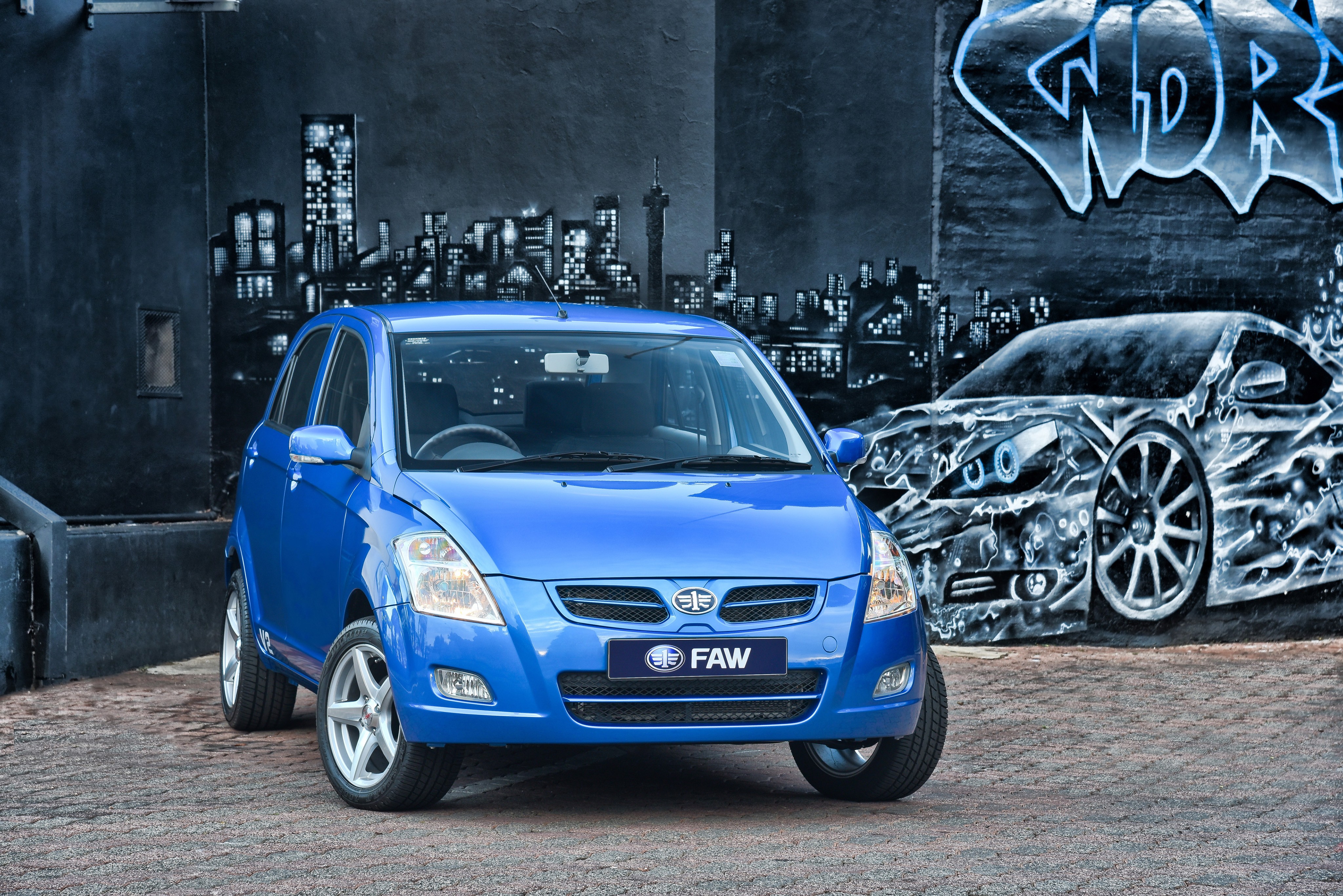
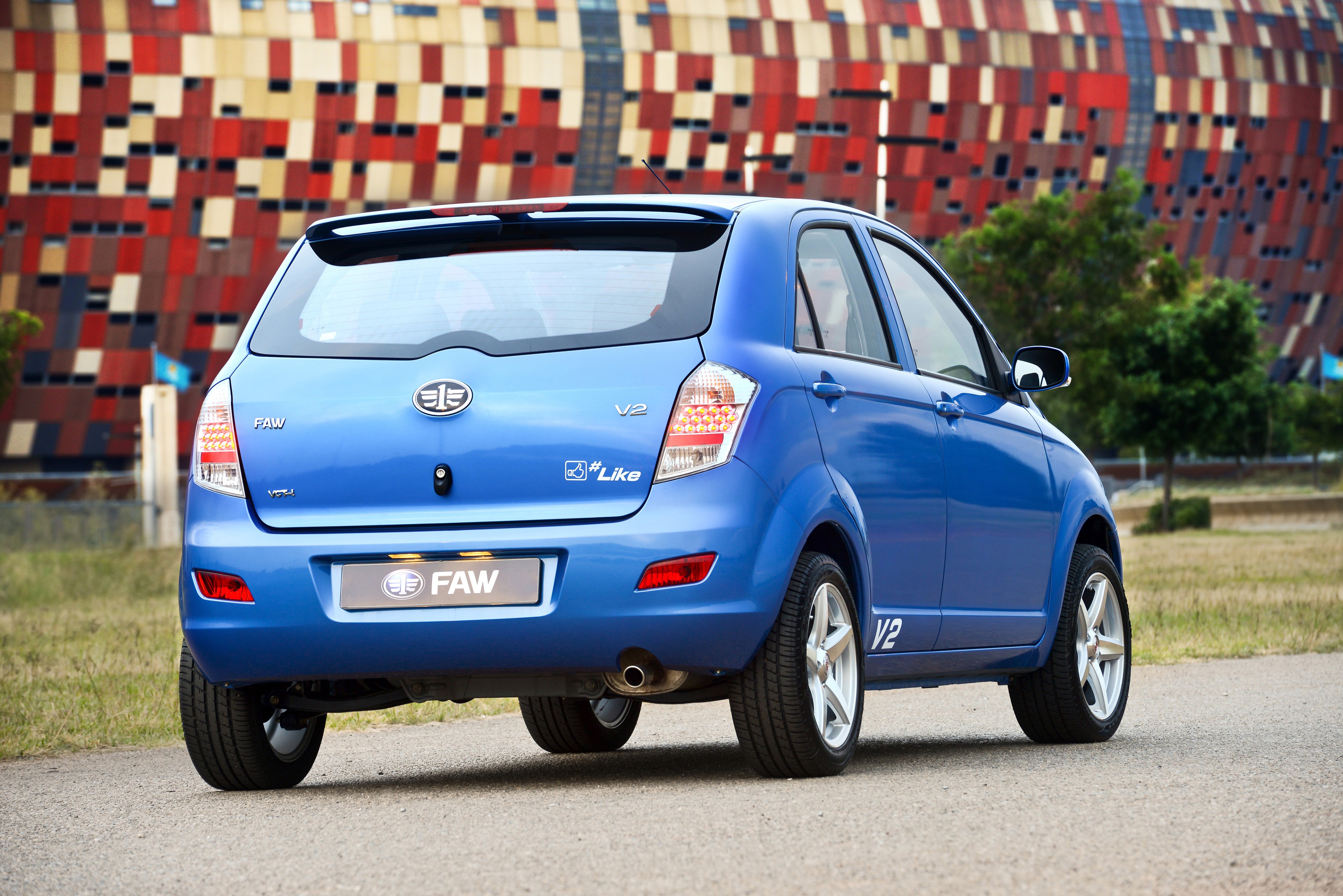
From the front, the V2 has a sloping bonnet with raised ribs, large swept-back headlamps and a bumper with an extra air intake and fog lamps. Its nose is often compared with that of the 2005 Suzuki Swift. At the back, it has a simple hatch, a roof spoiler and LED elements in the tail lamps. A saloon version and a facelift were planned but never built.
| Parameter | Metric | Imperial |
|---|---|---|
| Body | 5-door hatchback, front-wheel drive | – |
| Length / width / height | 3,760 / 1,680 / 1,530 mm | 148.0 / 66.1 / 60.2 in |
| Wheelbase | 2,450 mm | 96.5 in |
| Ground clearance | 143 mm | 5.6 in |
| Kerb weight | 981–985 kg | 2,163–2,172 lb |
| Boot | 320 l | 11.3 cu ft |
| Fuel tank | 37 l | 9.8 US gal |
| Tyres | 175/65 R14 | – |
1.3 CA4GA1 engine, gearboxes and performance
Every V2 uses the same engine: a 1,339 cc four-cylinder with double overhead camshafts and 16 valves, developed in-house by the FAW technical centre and shared with the Xiali N5. It produces 67 kW (91 PS) at 6,000 rpm and 120 Nm (89 lb-ft) at 4,400 rpm. Reviewers found it slightly unrefined but praised its pulling power at low revs, which suits city driving.
| Version | Power | Torque | Gearbox | 0–100 km/h | Top speed |
|---|---|---|---|---|---|
| 1.3 manual | 67 kW (91 PS) | 120 Nm | 5-speed manual | 14.0 s | 166 km/h (103 mph) |
| 1.3 automated | 67 kW (91 PS) | 120 Nm | 5-speed automated manual | – | 166 km/h (103 mph) |
The automated version uses a five-speed robotised manual gearbox rather than a conventional torque-converter automatic. The FAW automated box saves the driver from using a clutch, but its gear changes are slower and less smooth than those of a traditional automatic, so a test drive is worthwhile.
Chassis, cabin and practicality
The V2 has MacPherson struts at the front and an independent rear suspension, with disc brakes at the front and drums at the rear. FAW fitted power-assisted steering as standard. The FAW's ride is tuned for city streets, and the 143 mm ground clearance is normal for a small hatchback.
Inside, the cabin is simple and made of hard two-tone plastics with metal-effect trim. The driver faces three round dials under deep hoods, and the centre console has a basic radio and the air-conditioning controls. The three-spoke steering wheel has no buttons. The front seats are firm and narrow, better suited to slim adults, and the rear bench is shaped for two passengers rather than three, with limited knee room. The FAW's 320-litre boot is competitive for a car of this length.
Fuel economy and running costs
Official figures give about 60 mpg (UK), or 4.7 l/100 km, in the combined cycle for both gearboxes. The 37-litre tank therefore gives a theoretical range of close to 800 km. That figure makes the V2 the third most economical car in the 1cars most economical cars ranking, behind only the Mini Cooper and the Smart ForTwo. Real-world use of the FAW in town is higher, but the light weight of under 1,000 kg keeps consumption low. Parts supply depends on the country: the car was sold mainly in China, and export markets such as Pakistan had their own local assembly. To compare running costs with other small cars, use the fuel cost calculator.

V2 trims and the raised V2 Cross
The V2 was offered in several trim levels with a personalisation programme of options. Even the base car had anti-lock brakes with brake-force distribution, power steering, electric windows, air conditioning, a radio and remote central locking. Higher trims added front airbags, a CD player and alloy wheels.
The V2 Cross, launched in late 2011, added plastic wheel-arch cladding, roof rails and a little more ground clearance for a crossover look, with the same 1.3-litre engine and 120 Nm. It followed the fashion for raised small cars, in the same spirit as the Renault Sandero Stepway.
Crash safety and body structure
The V2 was not tested by Euro NCAP. FAW stated at launch that the car scored more than 86% in a C-NCAP-style frontal offset test with 40% overlap, but no full C-NCAP star rating is widely published, so this figure should be read as a manufacturer claim. The body uses high-strength steel with front and rear crumple zones and steel beams in all four doors. Front airbags were standard only on higher trims.

Rivals: how the V2 compares
| Model | Type | How it compares with the V2 |
|---|---|---|
| FAW V2 | 1.3 petrol supermini | Light and economical, basic cabin |
| ZAZ Chance | Budget saloon and hatchback | Older design, similar price class |
| Renault Sandero | Budget supermini | Larger cabin and wider dealer network |
| Volkswagen Polo | Mainstream supermini | Better safety and refinement, higher price |
Against its Chinese rivals of the time, the V2 offered a modern engine and low weight. Against European small cars, the FAW lacked their safety equipment, refinement and resale value.

FAW V2 in our rankings
- No. 42 of 307 · Most economical cars (4.7 l/100 km · top 15%)
- No. 25 of 56 · Most economical hatchbacks (4.7 l/100 km · top 47%)
- No. 77 of 95 · Biggest engines: hatchbacks (1,300 cc · top 84%)
- No. 121 of 144 · Most powerful hatchbacks (67 kW · top 85%)
- No. 958 of 1127 · Longest-running car nameplates (3 years · top 89%)
- No. 992 of 1058 · Most powerful cars (67 kW · top 95%)
More economical than 85% of ranked cars in the 1CARS catalog (No. 42 of 307).
FAW V2 photos 15


FAW V2 videos 2

Crash test

Test drive
FAQ
What engine does the FAW V2 have?
A 1.3-litre CA4GA1 four-cylinder petrol engine of 1,339 cc, developed by FAW. It produces 67 kW (91 PS) at 6,000 rpm and 120 Nm at 4,400 rpm and drives the front wheels.
What is the fuel consumption of the FAW V2?
The official combined figure is about 4.7 l/100 km (around 60 mpg UK) for both the manual and the automated gearbox. In town, real-world consumption is higher, but the low kerb weight of about 980 kg helps.
Is the FAW V2 available with an automatic or four-wheel drive?
There is a five-speed automated manual gearbox as an alternative to the five-speed manual. All versions are front-wheel drive; even the V2 Cross is a styling version without four-wheel drive.
How big is the FAW V2?
It is 3,760 mm long, 1,680 mm wide and 1,530 mm high, with a 2,450 mm wheelbase. The boot holds 320 litres, and the rear bench is best suited to two adults.
What are the main rivals of the FAW V2?
In China it competed with other small domestic hatchbacks. Compared with European cars such as the Renault Sandero or Volkswagen Polo, it was lighter and cheaper but had less safety equipment and a simpler cabin.
Data sources
Data checked by an editor against the sources below.
- The text of this article (1cars archive)
- Wikipedia - FAW Weizhi V2


