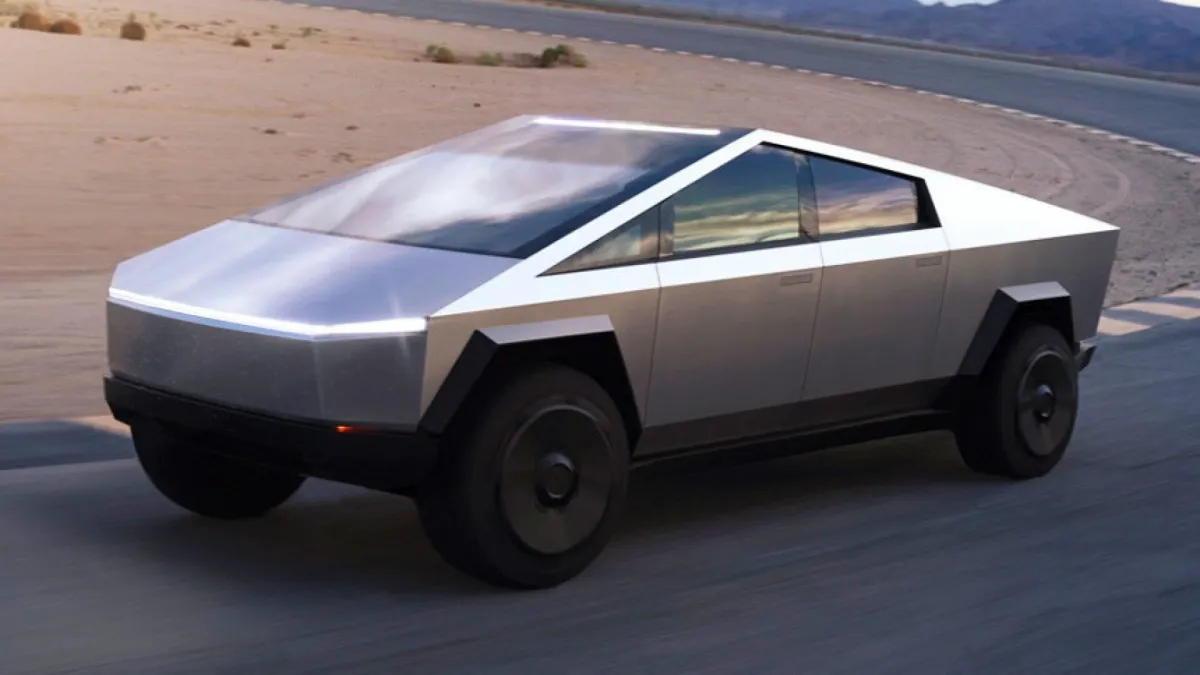
 Tesla Semi
Specs, engines and history
Updated Published Sources (2) Report an error
By Felix Hartmann, Automotive Technology & EV Contributor Reviewed by Oleksandr Hnatiuk

- Built
- 2017–present
- Top power
- 800 kW (1,088 PS)
Verdict: who the Tesla Semi suits
Our verdict · Felix Hartmann
The Semi makes most sense for fleets running regular regional and long-haul routes in North America with access to megawatt charging, such as drinks, food and parcel distribution. For irregular routes without depot charging, or in Europe, diesel and European electric trucks remain the practical choice. More Tesla models are in the Tesla catalogue, and passenger EVs in the electric cars section.
The Tesla Semi is a battery-electric Class 8 tractor unit for long-distance haulage. Shown as a prototype on 16 November 2017, it reached its first customer, PepsiCo, on 1 December 2022 after years of delays. In April 2026 Tesla announced volume production next to Giga Nevada, with three motors of up to 800 kW and batteries of 548 or 822 kWh for about 520 or 800 km.
In short
- First announced in Tesla's 2016 Master Plan; the 2017 prototype promised about 800 km (500 miles) with a full 36-tonne load.
- Fleet tests showed real energy use of about 1.64–1.72 kWh per mile, roughly 102–107 kWh per 100 km.
- The 2026 version is about 450 kg lighter, charges at up to 1.2 MW (about 60% in 30 minutes) and has a 48-volt system.
- Volume production was announced on 29 April 2026 at a plant designed for 50,000 trucks a year; deliveries so far have gone to North American fleets.

Tesla Semi at a glance
The Semi follows the idea of Tesla's passenger cars, such as the Tesla Model S, applied to the heaviest road vehicles. The diesel engine and gearbox give way to electric motors, a large battery and software. The cab is unusual for a truck, with a central driving position between two large touchscreens. Its low, rounded nose gives a drag coefficient of 0.36, against more than 0.4 for typical tractors, according to the 2017 presentation.

| Fact | Value |
|---|---|
| Maker | Tesla, USA |
| Type | Class 8 battery-electric tractor unit |
| Prototype | 16 November 2017 |
| First deliveries | 1 December 2022 (PepsiCo) |
| Volume production | Announced 29 April 2026, plant next to Giga Nevada |
| Motors | Three independent motors, up to 800 kW (1,088 PS) |
| Batteries | 548 kWh or 822 kWh |
| Charging | Up to 1.2 MW (Megawatt Charging System) |
The 2017 promise and the long delay
Tesla first described an electric truck in its 2016 Master Plan, and the prototype was revealed in November 2017 near Los Angeles. The company quoted versions with 300 and 500 miles of range, about 480 and 800 km, at a gross combination weight of about 36 tonnes (80,000 lb). A "Megacharger" was to add about 640 km of range in 30 minutes. According to the old 1cars report of the launch, Tesla also claimed 0–100 km/h in about 5 seconds without a trailer and promised a powertrain warranty of 1.6 million km (1 million miles).

Production was planned for 2019, then moved to the end of 2021 and then to 2023. Tesla finally started building the truck in October 2022, after a Semi completed a 500-mile (805 km) drive at a weight of 81,000 lb (about 36.7 tonnes).
From pilot fleet to volume production
| Year | Event |
|---|---|
| 2016 | Electric truck announced in Tesla's Master Plan |
| 2017 | Prototype shown on 16 November |
| 2022 | 500-mile loaded test drive; first deliveries to PepsiCo on 1 December |
| 2024 | Pilot customers include Walmart, Costco, Sysco and US Foods; volume production targeted for 2026 |
| 2025 | Plans for a public network of 46 Megacharger stations |
| 2026 | Redesigned Semi shown on 23 March; volume production announced on 29 April |
PepsiCo used its first trucks on Frito-Lay snack routes of about 680 km (425 miles) and on heavier drinks routes of about 160 km (100 miles). Independent fleet data is encouraging. The NFI group measured 1.64 kWh per mile in August 2024. DHL reported 1.72 kWh per mile in October 2024 at 75,000 lb (34 tonnes) gross, covering 624 km (388 miles) on one charge. Tesla says the prototype fleet has covered more than 21.7 million km (13.5 million miles) with 95% uptime.

2026 specifications
| Parameter | Long Range | Standard Range |
|---|---|---|
| Battery | 822 kWh | 548 kWh |
| Range (Tesla) | about 805 km (500 mi) | about 523 km (325 mi) |
| Motors | 3, up to 800 kW (1,088 PS) | 3, up to 800 kW |
| Energy use | about 1.7 kWh/mi (106 kWh/100 km) | about 1.7 kWh/mi |
| Kerb weight (tractor) | about 10,430 kg (23,000 lb) | under 9,070 kg (20,000 lb) |
| Charging | 1.2 MW MCS, about 60% in 30 min | 1.2 MW MCS |
| Cells | 4680, NMCA chemistry | 4680, NMCA chemistry |
The redesigned truck has a sleeker front and weighs about 450 kg (1,000 lb) less than before. A 48-volt low-voltage system and an electric power take-off of about 25 kW can drive refrigeration units and other equipment. Regenerative braking returns energy to the battery on descents and reduces brake wear.

Running costs and price
Electric trucks cost more to buy and less to run. US press reports in March 2026 put the price of the Semi at about twice that of a diesel tractor. Tesla claims operating costs 20% below diesel across the USA and 50% below in California. Tesla has not announced a European price or launch. At about 106 kWh per 100 km, the Semi uses roughly as much energy as five or six electric cars. A typical diesel tractor burns about 35 litres per 100 km, according to the old 1cars report.

Safety and incidents
In August 2024 a Semi caught fire after a crash in California and closed a motorway for 16 hours. Firefighters used about 190,000 litres (50,000 US gallons) of water to put it out, which shows how hard large lithium-ion battery fires are to fight. Tesla says 75–80% of breakdowns in its fleet are fixed within 24 hours.

Rivals: electric heavy trucks
| Model | Market | Battery | Range (maker) |
|---|---|---|---|
| Tesla Semi (2026) | North America | 548–822 kWh | 523–805 km |
| Mercedes-Benz eActros 600 | Europe | 621 kWh | about 500 km |
| Volvo FH Electric | Europe | up to 540 kWh | up to about 300 km (2022 data) |
| Freightliner eCascadia | North America | up to 438 kWh | up to about 370 km |
The Tesla offers the largest battery and the longest claimed range in this group: about 305 km more than the eActros 600 in its long-range form. Compare trucks in the 1cars comparison tool or see the most powerful trucks ranking.

Rivals
Compare with…
Compare Tesla Semi with
- Mercedes-Benz Actros quick spec comparison
-
Ended 2018
- Years
- 1996–2018
- Body
- Truck
- Fuel
- Diesel
- Power
- 228–480 kW (310–653 PS)
4 generations
- MP1
- MP2
- MP3
- MP4

Tesla Semi in our rankings
More powerful than 98% of ranked trucks in the 1CARS catalog (No. 1 of 56).
Tesla Semi photos 17


Tesla Semi videos 2

Tesla Semi video 1

Video overview
FAQ
What is the range of the Tesla Semi?
Tesla quotes about 805 km (500 miles) for the 822 kWh Long Range version and about 523 km (325 miles) for the 548 kWh Standard Range version. DHL recorded 624 km (388 miles) on one charge at 34 tonnes gross.
When did the Tesla Semi go into production?
Tesla began limited production in October 2022 and delivered the first trucks to PepsiCo on 1 December 2022. Volume production at a new plant next to Giga Nevada, designed for 50,000 trucks a year, was announced in April 2026.
How powerful is the Tesla Semi?
The 2026 Semi has three independent electric motors with a combined output of up to 800 kW, equal to about 1,088 PS. It can haul a gross combination weight of about 36 tonnes (80,000 lb).
How fast does the Tesla Semi charge?
The 2026 version uses the Megawatt Charging System at up to 1.2 MW and can recover about 60% of its range in 30 minutes. Tesla is building a public network of Megacharger stations in the USA.
Is the Tesla Semi sold in Europe?
Tesla has not announced a European launch or price, and deliveries so far have gone to North American fleets. In Europe, electric tractors such as the Mercedes-Benz eActros 600 and Volvo FH Electric serve the same role.
Data sources
Data checked by an editor against the sources below.
- The text of this article (1cars archive)
- Wikipedia - Tesla Semi