
Ural-Next
Specs, engines and history
Updated Published Sources (3) Report an error
By Oleksandr Hnatiuk, Automotive Editor & Used Car Specialist Reviewed by Felix Hartmann

- Built
- 2015–present
- Top power
- 230 kW (313 PS)
The Ural Next is a family of bonneted all-wheel-drive trucks built by the Ural Automotive Plant, part of GAZ Group, since 2015. It modernised the classic Ural-4320 chassis with a new cab developed with GAZ, a composite bonnet, a Euro 5 YaMZ-536 diesel with up to 230 kW (312 PS), an optional nine-speed ZF gearbox and payloads of up to 13 tonnes in the 6×6 version.
In short
- Introduced in 2015 at the CTT construction equipment exhibition; 6×6 and 4×4 chassis.
- Engine: YaMZ-536 6.65-litre turbo-diesel six with common-rail injection, 177–230 kW (240–312 PS); a gas-diesel version was also offered.
- Drivetrain: full-time all-wheel drive, two-speed transfer case, inter-axle and cross-axle locks, central tyre inflation.
- Payload up to 13 t, gross weight 22.5 t, road-train weight up to 38 t; ground clearance about 400 mm.

Size at a glance
| Dimensions | Ural-Next |
|---|---|
| Length | 9,000 mm354.3 in |
| Width | 2,259 mm88.9 in |
| Height | 2,952 mm116.2 in |
| Wheelbase | 4,755 mm187.2 in |
Specs by version
Engines
| Version | Engine | Power | Torque |
|---|---|---|---|
| 177 kW (241 PS) Truck | - | 177 kW 241 PS237 hp | 900 Nm664 lb-ft |
| 6.7 YaMZ-536 229 kW (311 PS) Truck | 6.7 l · Diesel YaMZ-536 | 229 kW 311 PS307 hp | - |
Dimensions and weight
Verified Manufacturer and type-approval data from our catalog · Sources and methodology
Ural Next at a glance
Ural trucks have been known since the Ural-375 and Ural-4320 for their cross-country ability. GAZ Group took over the Ural plant around 2001, and the Next was its first major update of the classic bonneted 6×6. The plant's story is told in the history of Ural, and the range is in the Ural catalogue.

The truck was designed for work where there are no proper roads: oil and gas fields, geological exploration, power-line construction, forestry and remote building sites. Because the mounting points for bodies and equipment were kept from the 4320, body builders could fit existing superstructures without redesign.
| Fact | Value |
|---|---|
| Maker | Ural Automotive Plant (GAZ Group), Russia |
| Introduced | 2015 |
| Drive formulas | 6×6, 4×4 |
| Engine | YaMZ-536 6.65 L inline-six diesel, Euro 4/5 |
| Power | 177–230 kW (240–312 PS) |
| Payload | up to 13,000 kg (first 6×6: 10,000 kg) |
| Gross weight | 22,500 kg; road train up to 38,000 kg |
Design and cab
The Next keeps a bonnet, but the new front end is made of a strong composite, which does not corrode; in a demonstration a log was dropped on it without leaving dents. The bumper is steel. Headlights are arranged on two levels: dipped and main beams and fog lights sit in the bumper behind a protective grille, and the lamps in the wings serve as daytime running lights and indicators.

The cab was developed together with GAZ and shares elements with the GAZelle Next van, including the dashboard and a small, steeply raked steering wheel. Equipment includes electric windows, air conditioning, steering-wheel audio controls and an air-suspended driver's seat with many adjustments. The front axle and low range are engaged with buttons rather than levers. The cab is high: the door handles are above head height, and the driver climbs in using three steps, the lowest of which hangs on a flexible steel cable to survive rough terrain. Despite the steep windscreen, visibility is good.
Engines and transmission
| Version | Engine | Power | Gearbox |
|---|---|---|---|
| 6×6 | YaMZ-536 diesel | 230 kW (312 PS) at 2,300 rpm | 9-speed ZF manual or 5-speed YaMZ manual |
| 6×6 | YaMZ-536 diesel | 210 kW (285 PS) | – |
| 4×4 | YaMZ-536 diesel | 177 kW (240 PS) | 5-speed YaMZ manual |
| Gas-diesel | YaMZ-536 dual-fuel | 177 kW (240 PS) | – |
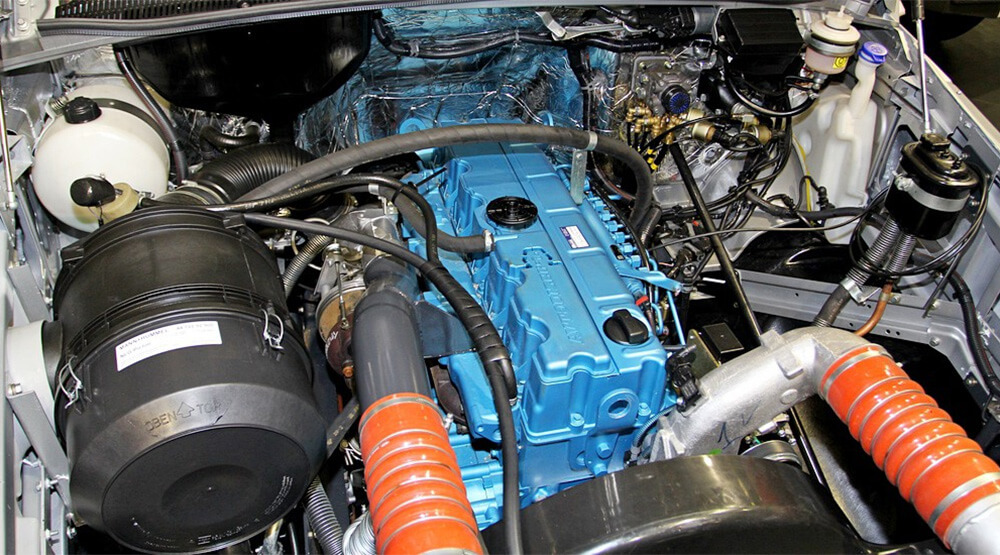
The YaMZ-536 is a 6.65-litre inline six with turbocharging and common-rail injection. The dual-fuel version runs on a mix of natural gas and diesel, which can cut fuel costs significantly, and switches to diesel alone if gas runs out. GAZ quoted fuel consumption about 8% lower than before. The engine is limited to about 2,300 rpm and the truck to about 85 km/h. Testers preferred the ZF gearbox to the 5-speed YaMZ unit, which has long lever travel and is noisier.

All-wheel drive is permanent. The two-speed transfer case has a lockable centre differential, and cross-axle locks are standard; the locks are controlled pneumatically. The transfer case and propeller shafts were strengthened: the transfer case handles 1.4 times more torque, the new shafts double the transmitted torque, and service life rose by about 50%. The front axle load capacity grew from 5.3 to 6.5 tonnes. Brakes are full air brakes from Wabco instead of the old air-hydraulic system.
Off-road ability and dimensions
| Parameter | Metric | Imperial |
|---|---|---|
| Length (chassis) | 9,000 mm | 354.3 in |
| Width | 2,259 mm | 88.9 in |
| Height | 2,952 mm | 116.2 in |
| Wheelbase (6×6) | 4,755 + 1,400 mm | 187.2 + 55.1 in |
| Ground clearance | 400 mm | 15.7 in |
| Wading depth | 700 mm; up to 1,200 mm when prepared | 27.6 / 47.2 in |
| Approach / departure angle | 38° / 26° | – |
| Fuel capacity | 300 + 210 L (510 L total) | 79 + 55 US gal |
Central tyre inflation lets the driver lower tyre pressure on soft ground and raise it on the move. The frame was strengthened and given better corrosion protection. With a flatbed body, the truck is about 600 mm longer and 197 mm wider.
Versions

| Version | Purpose |
|---|---|
| Chassis cab 6×6 | Base for special bodies |
| Flatbed 6×6 | General cargo, crew transport |
| Dump truck | Construction and quarries |
| Crew bus (shift bus) | Transport of work crews to remote sites |
| Fuel tanker | Field refuelling |
| Crane-manipulator truck | Loading and lifting work |
| Tractor unit | Semi-trailers |
| 4×4 | Lighter all-wheel-drive version |
From Ural-4320 to Ural Next: what changed

| Area | Ural-4320 | Ural Next |
|---|---|---|
| Cab | Steel cab of the earlier design | New cab developed with GAZ, air-suspended seat, air conditioning |
| Bonnet | Steel | Composite, corrosion-free |
| Engine | Older diesels | YaMZ-536 common-rail, Euro 4/5, up to 230 kW |
| Gearbox | 5-speed | 9-speed ZF or 5-speed YaMZ |
| Brakes | Air-hydraulic | Full air system (Wabco) |
| Front axle load | 5.3 t | 6.5 t |
| Payload (6×6) | lower | up to 13 t |
Driving impressions
Testers who drove the Ural Next with about five tonnes of soil in a dump body were surprised by how briskly it accelerated and by the car-like feel of its brakes and steering.

The suspension absorbs large holes without harsh blows, and the air-suspended seat filters out small bumps. The instruments look familiar from GAZ vans, but the rev counter reads to 4,000 rpm and the speedometer to 160 km/h although the engine is limited to about 2,300 rpm and the truck to 85 km/h. Shifting through the nine ZF gears takes some practice; the five-speed YaMZ gearbox was criticised for long lever travel, poorly chosen ratios and noise. Buttons on the dashboard replace the old levers for the front axle and low range, which leaves the cab floor clear.
Built for extreme conditions
Ural trucks are designed for harsh climates and terrain. The manufacturer states that its off-road vehicles can operate at altitudes of up to 4,500 m and in temperatures from -50 °C to +50 °C, push through snow banks about one metre deep and, with preparation, ford rivers up to 1.75 m deep. For the Next, the stated wading depth is 700 mm as standard and 1,200 mm with special preparation. Cold-climate details include the flexible lowest cab step, which does not crack in frost like rubber loops, and recessed headlights that are hard to damage. These features explain why the Next is mainly bought by operators in remote regions rather than for normal road haulage.

Strengths and weaknesses
Strengths: a modern cab with good comfort and visibility, high ground clearance, permanent all-wheel drive with locks and tyre inflation, a strong engine, the dual-fuel option, a composite bonnet that resists corrosion and parts commonality with earlier Urals. Weaknesses: interior quality below the level of Western trucks, the lower output of the dual-fuel engine and the shortcomings of the YaMZ gearbox compared with the ZF.

Rivals: how the Ural Next compares
The Ural Next competes with other heavy all-wheel-drive trucks such as the KamAZ Arctic and KamAZ 6×6 models, the Tatra 815, and off-road versions of European trucks. It offers more ground clearance and a lower price than most European rivals, while European trucks lead on cab refinement and electronics. Other heavy-duty models can be found in the trucks section.

Rivals
Compare with…
Compare Ural-Next with
- KamAZ-4326 quick spec comparison
- Tatra 815 quick spec comparison
- KamAZ Arctic quick spec comparison
-
In production
- Years
- 1995–present
- Body
- Truck
- Fuel
- Diesel
- Power
- 177 kW (241 PS)
-
Ended 2025
- Years
- 1983–2025
- Body
- Truck
- Fuel
- Diesel
- Power
- 170–440 kW (231–598 PS)
-
In production
- Years
- 1994–present
- Body
- Truck
- Fuel
- Diesel
- Power
- 243–265 kW (330–360 PS)


Ural-Next in our rankings
- No. 4 of 17 · Longest trucks (9,000 mm)
- No. 9 of 16 · Most torque: trucks (900 Nm)
- No. 17 of 56 · Most powerful trucks (230 kW · top 31%)
Longer than 76% of ranked trucks in the 1CARS catalog (No. 4 of 17).
Ural-Next photos 16


Ural-Next videos 4

Ural-Next video 1

Ural-Next video 2

Ural-Next video 3

Ural-Next video 4
FAQ
When was the Ural Next introduced?
The Ural Next was introduced in 2015 at the CTT construction equipment exhibition. It is built by the Ural Automotive Plant, which has been part of GAZ Group since around 2001.
What engine does the Ural Next have?
It uses the YaMZ-536, a 6.65-litre inline-six turbo-diesel with common-rail injection, rated at 177–230 kW (240–312 PS) depending on version. A dual-fuel gas-diesel version was also offered.
What is the payload of the Ural Next?
The heaviest 6×6 versions carry up to 13 tonnes, the first 6×6 model 10 tonnes. Gross weight is 22.5 tonnes, and with a trailer the truck can move up to 38 tonnes.
Is the Ural Next all-wheel drive?
Yes. Both the 6×6 and the 4×4 have permanent all-wheel drive with a two-speed transfer case, differential locks and central tyre inflation for soft ground and snow.
What gearbox does the Ural Next use?
The most powerful versions use a nine-speed ZF manual gearbox. A five-speed YaMZ manual was also offered, mainly with the 240 PS engine and in the 4×4 version.
Data sources
Data checked by an editor against the sources below.
- The text of this article (1cars archive)
- Jalopnik - Fuck You Nature 1712755577
- Co


