
 SsangYong Stavic
Specs, engines and history
Updated Published Sources (2) Report an error
By Sarah Whitmore, Senior Automotive Writer Reviewed by Oleksandr Hnatiuk

- Built
- 2013–2019
- Top power
- 131 kW (178 PS)
- Used price today
- about €5,500–14,000 (AutoScout24, Nov 2026)
Which Stavic to buy
Our verdict · Sarah Whitmore
For most buyers, a 2016–2019 car with the 2.2 diesel and seven-speed automatic is the best choice: it is cleaner, quicker and smoother than the 2.0. Pick 4WD only if you tow or use unmade roads; it adds weight and fuel use. The Stavic suits large families, shuttle operators and anyone who needs 9 or 11 seats on a car licence and a low purchase price. Buyers who carry children every day and value crash protection should look at the Carnival first.
The SsangYong Stavic is a large rear-wheel-drive MPV with up to 11 seats and optional four-wheel drive, built in Pyeongtaek, South Korea, from 2004 to 2019. Stavic is the export name of the SsangYong Rodius. The second generation, shown at Geneva in March 2013, was also sold as the Korando Turismo and, in the UK, simply as the Turismo.
In short
- Two generations: the Rodius/Stavic of 2004 and the reworked Stavic/Turismo of 2013, both on the same Mercedes-derived mechanicals.
- Seating for 7, 9 or 11 in three or four rows; up to 3,240 litres of load space.
- 2013 engine: 2.0 e-XDi diesel with 114 kW (155 PS) and 360 Nm; a 2.2 with 131 kW (178 PS) followed in 2016.
- Strengths are space, towing (up to 2,000 kg) and price; weaknesses are refinement, crash protection and fuel use.

Size at a glance
| Dimensions | SsangYong Stavic |
|---|---|
| Length | 5,130 mm202.0 in |
| Width | 1,915 mm75.4 in |
| Height | 1,815 mm71.5 in |
| Wheelbase | 3,000 mm118.1 in |
| Boot | 400 L14.1 cu ft |
Specs by version
Engines
Dimensions and weight
Verified Manufacturer and type-approval data from our catalog · Sources and methodology
SsangYong Stavic at a glance
SsangYong launched the Rodius in late 2004 as the successor to its Istana van. The name was meant to combine "road" and "Zeus". The first generation was styled by Ken Greenley, a former head of automotive design at the Royal College of Art in London. He said he wanted to capture the feeling of a luxury yacht. The result was one of the most debated shapes of its decade: readers of the Daily Telegraph voted it the ugliest car on the road.

The second generation was revealed on 5 February 2013 and shown at the Geneva Motor Show that March. It kept the chassis, the long 3,000 mm wheelbase and the high roof, but received a new nose, bi-xenon headlamps and a tidier tail. Names varied by country: Korando Turismo in Korea, Turismo in the UK, Stavic in Southeast Asia and Australia, Stavic Rodius in Algeria.
| Generation | Years | Names | Engines | Power (hp / kW) |
|---|---|---|---|---|
| First | 2004–2013 (Europe to 2011) | Rodius, Stavic | 2.7 diesel I5, 3.2 petrol I6 | 162–217 hp / 121–162 kW |
| First, Rodius Euro | 2012–2013 | Rodius | 2.0 e-XDi diesel | 155 PS / 114 kW |
| Second | 2013–2016 | Stavic, Korando Turismo, Turismo | 2.0 e-XDi diesel | 155 PS / 114 kW |
| Second, Euro 6 | 2016–2019 | Stavic, Turismo | 2.2 e-XDi diesel | 178 PS / 131 kW |
Other SsangYong models of the period are the Rexton, the Kyron and the Actyon; the company story is in the history of SsangYong.
Diesel engines, gearboxes and four-wheel drive
The 2013 Stavic uses SsangYong's own 2.0-litre e-XDi turbodiesel with 114 kW (155 PS) at 3,400 rpm and 360 Nm (266 lb-ft) from 1,800 rpm. It came with a six-speed manual or a five-speed automatic made by Mercedes-Benz. From 2016 the 2.2-litre e-XDi220 met the Euro 6 standard with 131 kW (178 PS) and was paired with a seven-speed Mercedes automatic, while the six-speed manual stayed available.

The first generation offered a Mercedes-licensed 3.2-litre six-cylinder petrol engine with 162 kW (217 hp) and 309 Nm, and a 2.7-litre five-cylinder common-rail diesel with 121 kW (162 hp) and 342 Nm.
Rear-wheel drive is standard. The 4WD versions use a selectable system, so the Stavic can tow and cope with wet fields and gravel tracks, but its long body and overhangs limit it off-road.
| Version (UK data, 2013) | Power | Torque | 0–100 km/h | Top speed | Combined fuel use | CO2 |
|---|---|---|---|---|---|---|
| 2.0 e-XDi 4WD automatic | 114 kW (155 PS) | 360 Nm | 14.0 s | 180 km/h (112 mph) | 8.1 l/100 km (34.9 mpg UK) | 212 g/km |
With 2,179 kg of kerb weight and 114 kW, the car carries about 19 kg per kW, a figure you can check against any other car in the power-to-weight calculator. That explains the leisurely acceleration: a typical family estate of the time had about 13–15 kg per kW. The 80-litre tank gives a range of nearly 1,000 km at the official consumption.
Size, seats and load space
| Parameter | Metric | Imperial |
|---|---|---|
| Length | 5,130 mm | 202.0 in |
| Width | 1,915 mm | 75.4 in |
| Height | 1,815 mm | 71.5 in |
| Wheelbase | 3,000 mm | 118.1 in |
| Ground clearance | 185 mm front, 200 mm rear | 7.3 / 7.9 in |
| Kerb weight (2.0 4WD auto) | 2,179 kg | 4,804 lb |
| Gross weight | 2,850 kg | 6,283 lb |
| Towing (braked) | up to 2,000 kg | 4,409 lb |
| Turning circle | 11.4 m | 37.4 ft |
At 5.13 metres, the Stavic is longer than most large MPVs and close to a long-wheelbase van. Seating plans include 7, 9 and 11 seats in three or four rows; Hong Kong even had a five-seater. The seats slide on rails, and the rear rows fold or can be removed. In a UK seven-seater the load space ranges from 875 to 1,975 litres, and the maximum figure with the rear seating out of the way is 3,240 litres.

The cabin is plain rather than plush. The driver's seat has more adjustment than the others, and the steering wheel adjusts for height only. Two-zone air conditioning, many cup holders and storage trays were standard on mid trims; the second row is comfortable for two adults, the third row less so.
Chassis and safety ratings
The second generation kept the Mercedes-derived running gear of the first, with double wishbones at the front, a multi-link rear axle and coil springs. The 2013 car has ventilated disc brakes at all four wheels. Stability control with rollover mitigation, ABS with brake-force distribution and brake assist were standard in most markets, as were front airbags and ISOFIX mounts.

ANCAP tested the 2013 Stavic. It scored 9.06 out of 16 in the frontal offset test and 15.49 out of 16 in the side impact. It received 0 of 3 points for seat-belt reminders and a Poor rating for pedestrian protection. Euro NCAP did not test the second generation.
Trims and equipment
Equipment depended on the market. The entry versions had air conditioning, heated front seats, front airbags, electric windows and mirrors, ABS and an audio system. Mid trims added stability control, roof rails and 16- or 17-inch alloy wheels. Higher versions, called Elegance or ELX in some countries, brought climate control, parking sensors, a rain sensor, a leather steering wheel with audio buttons and the automatic gearbox. The top trims had four-wheel drive, leather upholstery, an electric driver's seat and a sunroof.

Reliability and what to check
Reviewers praised the space, value and long warranty but criticised build quality, handling, ride and safety. Many Rodius and Stavic vans worked as airport taxis and minibuses, so high mileages are common. When buying, check:
- The service history of the diesel, including the injectors and the turbocharger.
- The automatic: the Mercedes five- and seven-speed units are durable but need fluid changes.
- The 4WD transfer case and front axle engagement on 4WD cars.
- All seat rails and fixings, especially on taxis.
- Rust on the underbody and the tailgate.

Rivals: how the Stavic compares
| Model | Seats | Drive | Notes |
|---|---|---|---|
| SsangYong Stavic | 7–11 | RWD or 4WD | selectable 4WD, 2,000 kg towing |
| Kia Carnival | 7–11 | FWD | more car-like, better crash results |
| Mercedes-Benz Vito | up to 9 | RWD or 4x4 | van-based, stronger resale |
| Hyundai H-1 / Starex | up to 12 | RWD | van-based, simpler cabin |
Compare the dimensions with any rival in the 1cars comparison tool.

SsangYong Stavic in our rankings
- No. 31 of 586 · Longest cars (5,130 mm · top 6%)
- No. 136 of 558 · Widest cars (1,915 mm · top 25%)
- No. 13 of 26 · Most powerful minivans and MPVs (131 kW · top 50%)
- No. 102 of 194 · Most powerful diesel cars (114 kW · top 53%)
- No. 208 of 332 · Biggest boot: cars (400 l · top 63%)
- No. 240 of 367 · Most powerful cars of the 2010s (131 kW · top 66%)
Longer than 94% of ranked cars in the 1CARS catalog (No. 31 of 586).
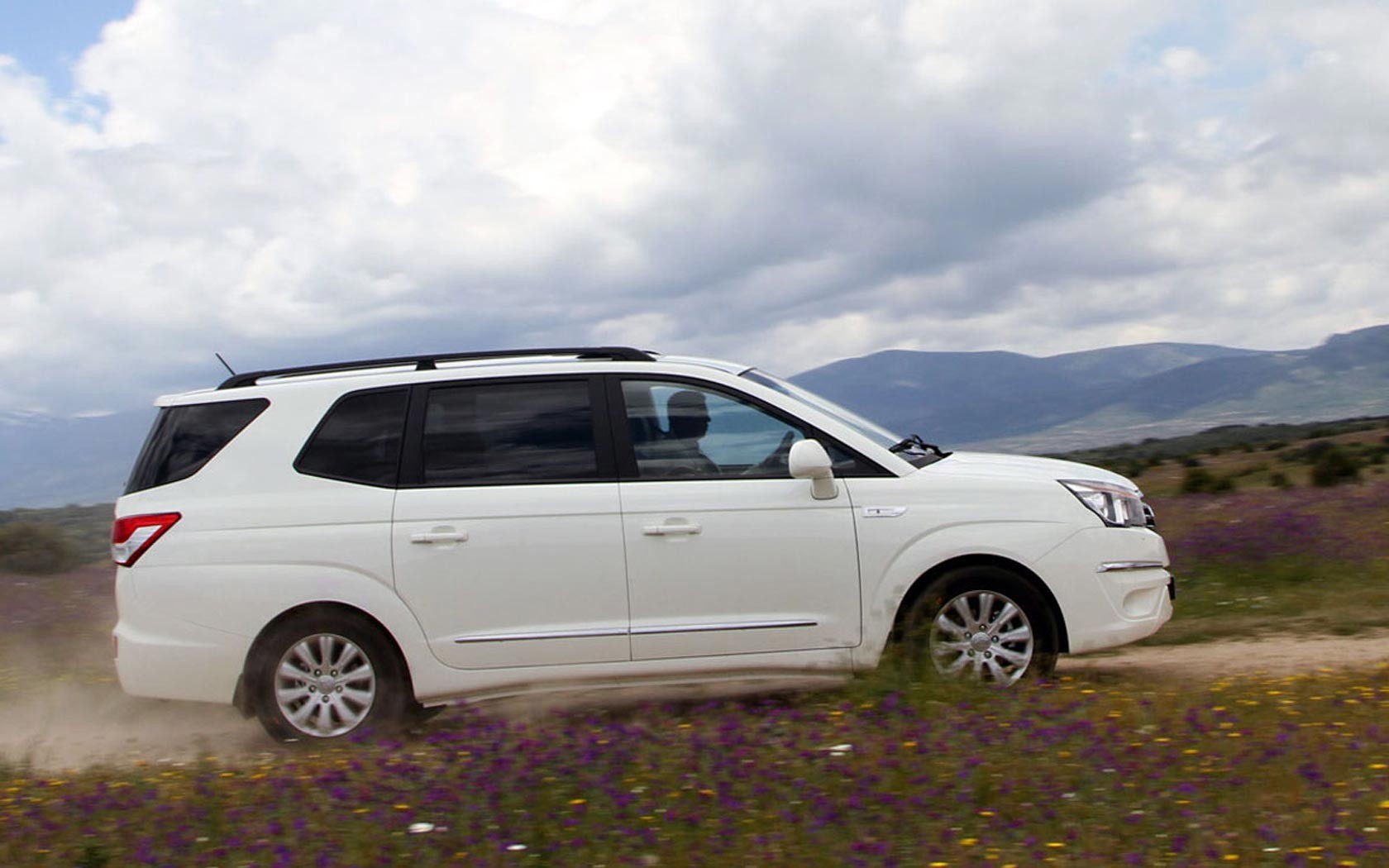
SsangYong Stavic photos 15


SsangYong Stavic videos 4

SsangYong Stavic video 1

SsangYong Stavic video 2

Video overview
Test drive
FAQ
Is the SsangYong Stavic the same as the Rodius?
Yes. Stavic is the export name of the SsangYong Rodius. The second generation of 2013 was also sold as the Korando Turismo in Korea and as the Turismo in the UK. All versions were built in Pyeongtaek, South Korea.
How many seats does the SsangYong Stavic have?
Depending on the market and version, it has 7, 9 or 11 seats in three or four rows; Hong Kong also had a five-seater. The rear seats slide on rails and fold, giving up to 3,240 litres of load space.
What engine does the SsangYong Stavic have?
The 2013 car has a 2.0 e-XDi turbodiesel with 114 kW (155 PS) and 360 Nm. From 2016 a 2.2 diesel with 131 kW (178 PS) replaced it. The first generation offered a 2.7 diesel and a 3.2 petrol six.
Does the SsangYong Stavic have four-wheel drive?
Rear-wheel drive is standard, and higher trims offer selectable four-wheel drive. The 4WD car can tow up to 2,000 kg, but the long body limits its ability on rough ground.
When was the SsangYong Stavic discontinued?
Production ended in 2019. SsangYong cited weak sales and the cost of making its diesel engines meet the next European emissions stage, and it moved its focus to SUVs and pickups. No direct successor was offered.
Data sources
Data checked by an editor against the sources below.
- The text of this article (1cars archive)
- Wikipedia - SsangYong Rodius


